Math Test 1St Grade
- Grades
- Grade 1, Elementary
- Pages
- 69
- File type
- Answer key
- Included


- Subject
- Math, Addition and Subtraction
- Topic
- Test, 1st Grade
- Resource types
- Worksheets & Printables, Word Problems, Worksheets, Tests
- Answer key
- Included
About this resource
What's inside this resource
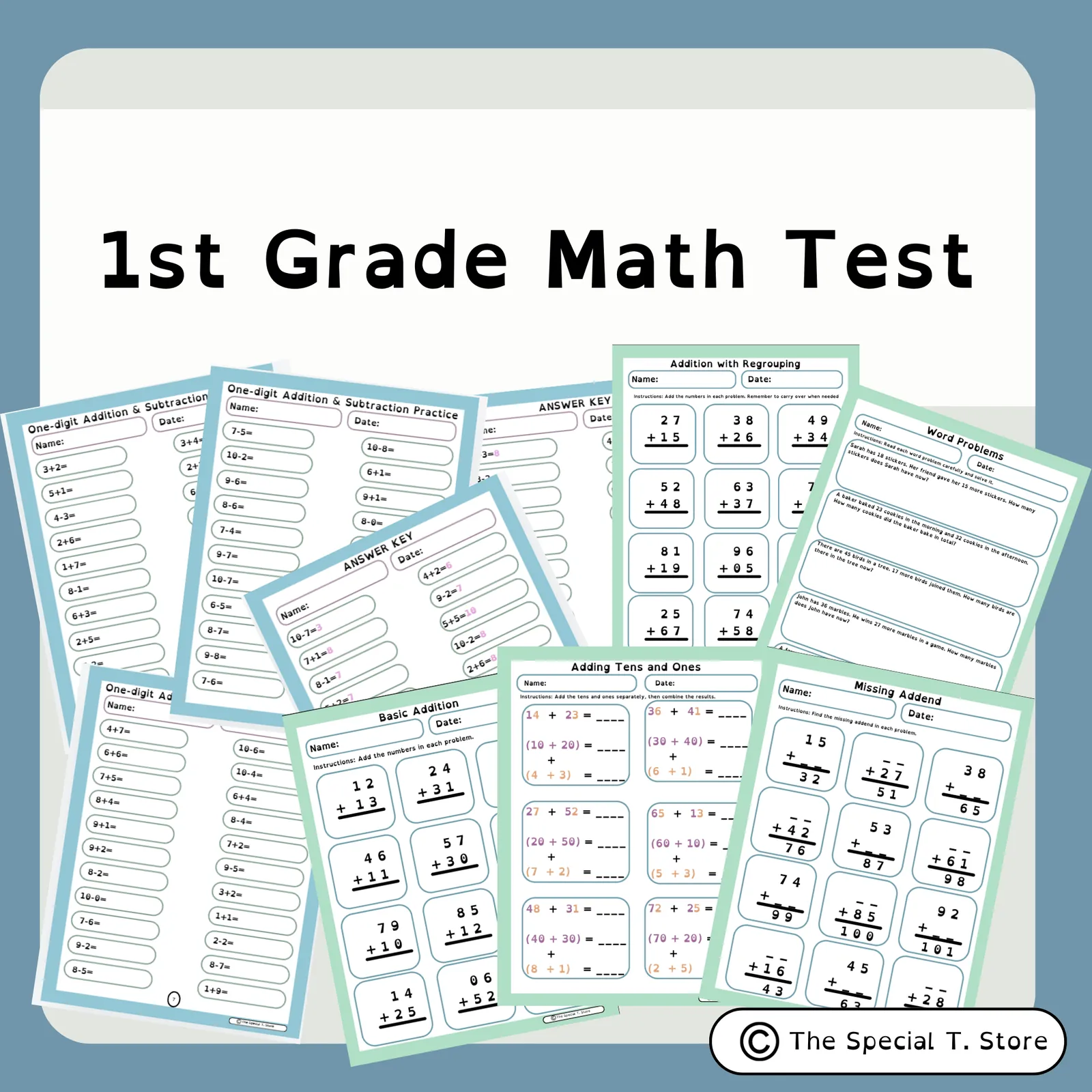
First Grade Math Test
This Math test is designed for kids with Autism and Dyslexia in mind. It uses the OpenDyslexic typeface by Abigail Gonzalez. This resource is a great tool for differentiated instruction.
Key Features of this resource include:
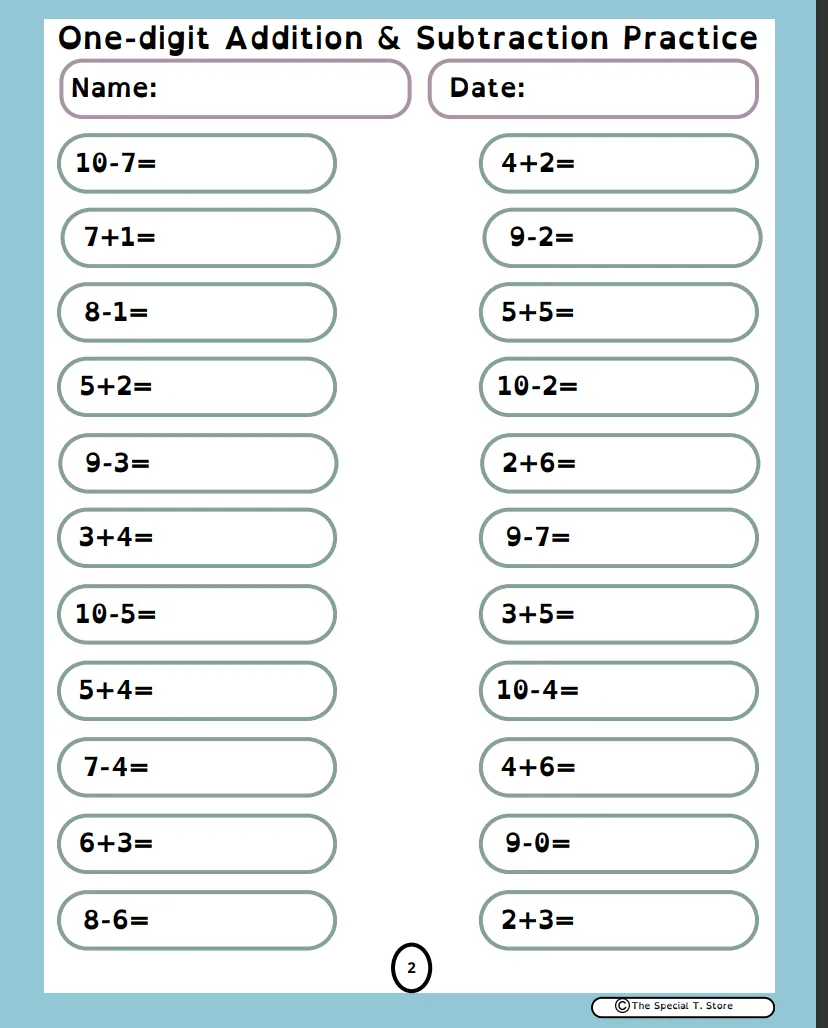
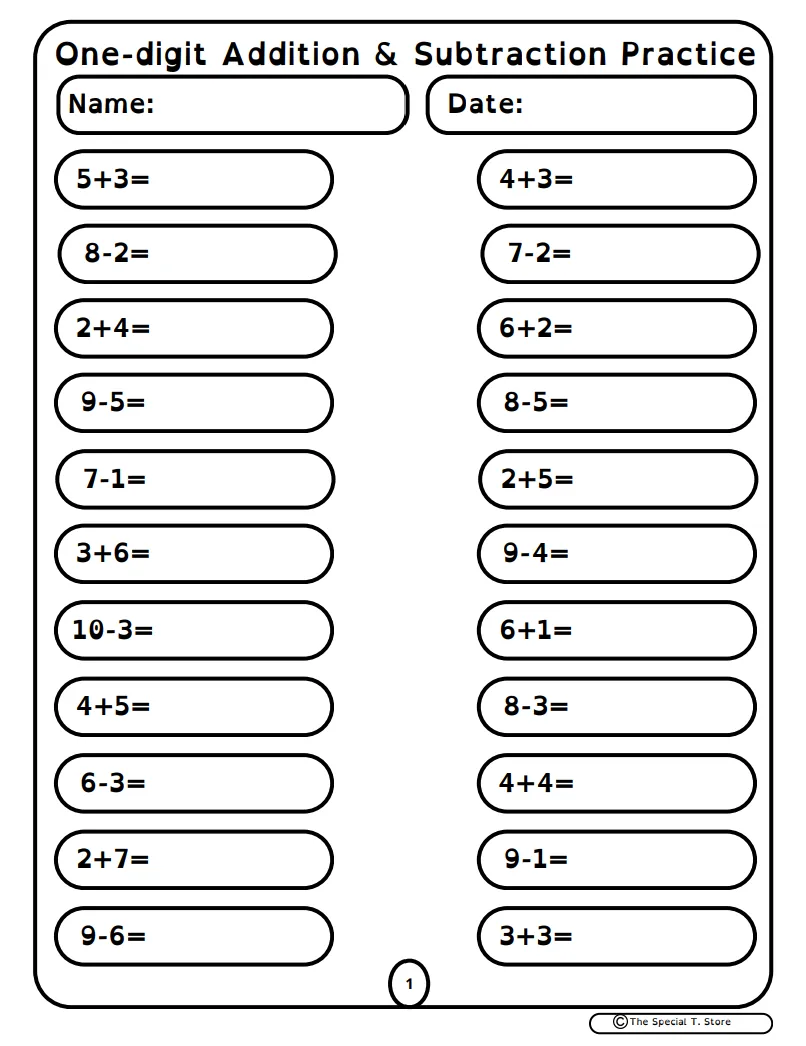
Worksheets focusing on one-digit addition;
Worksheets on one-digit subtraction;
Worksheets on addition without regrouping;
Worksheets on addition with regrouping;
Worksheets on addition word problems;
Worksheets on adding tens and ones;
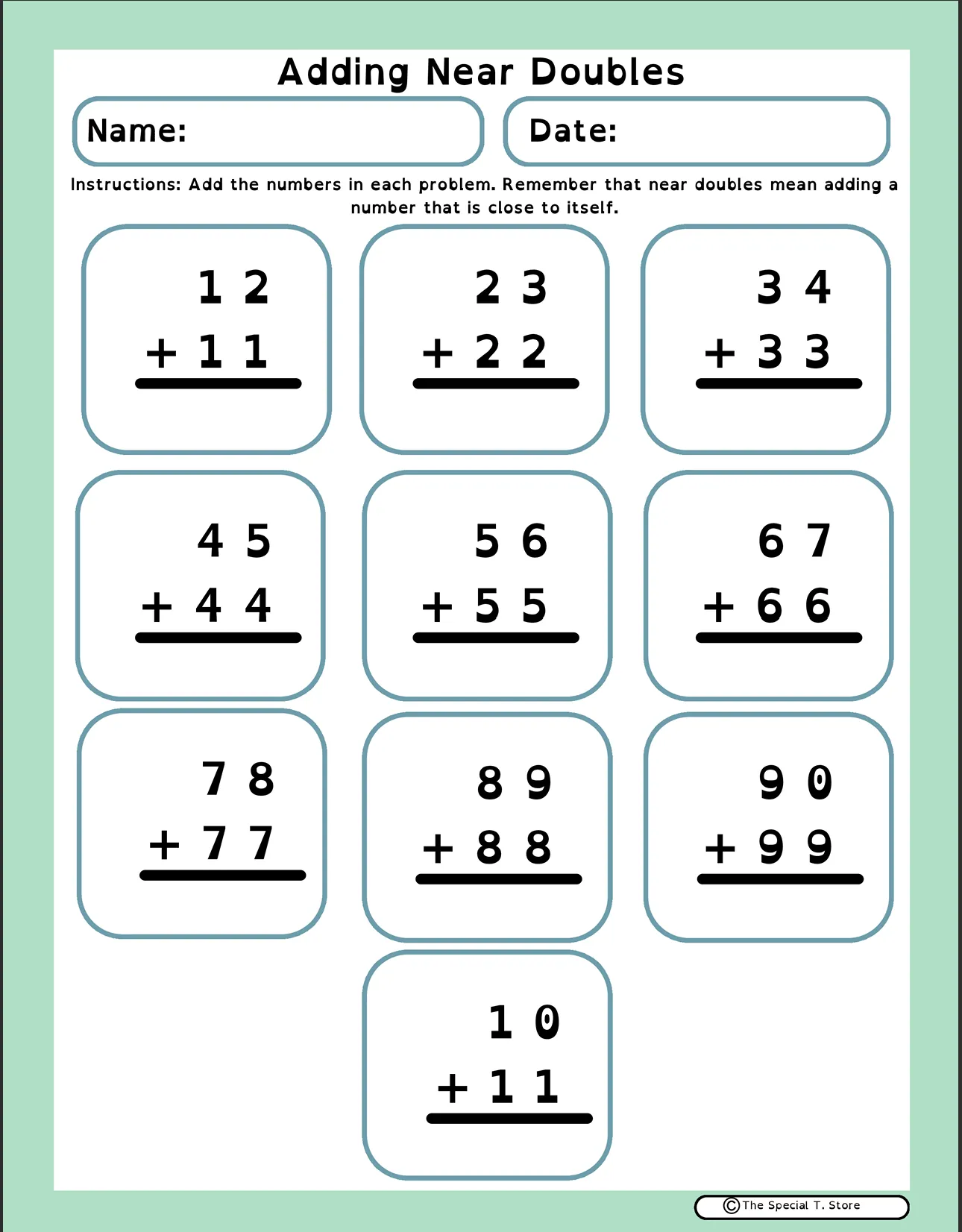
Worksheets on adding near doubles;
Worksheets on missing addend;
Answer keys for convenient checking and grading;
Uncluttered layout to avoid overstimulation.
This is designed to support different learning styles for every child.
This resource is made for First Grade students within the special education classrooms or in an inclusive setting and even homeschool. This worksheet is available in PDF format and has 69 pages in total and is available in colored and black and white.
If you are looking for more resources similar to this, please visit my Teach Simple storefront!
If you have any questions or suggestions please feel free to email us at thespecialtstore.customercare@gmail.com. Thank you!
Related resources
More resources teachers may find useful
24 related resources were found using this product's title, contributor, categories and tags.



In the classroom
Teaching tips & learning objectives

Learning objectives
Recall basic addition facts efficiently
Recall basic subtraction facts within an early-number range
Switch accurately between addition and subtraction symbols

Teaching tips
Use a short selected page range rather than assigning the full packet in one sitting.
Review errors by operation type to distinguish fact recall from symbol confusion.

Skills covered
Addition fluency — learners solve repeated basic facts.
Subtraction fluency — early differences are practiced alongside sums.
Operation discrimination — mixed symbols require flexible selection.

No reviews yet
Downloaded this resource? Tell other teachers how it went.
Curriculum
Standards, concepts & topics
Standards
 Standards
- K.OA — Understand Addition as putting together and adding to, and understand subtraction as taking apart and taking from
- K.OA.A.2 — Solve addition and subtraction word problems, and add and subtract within 10, e.g., by using objects or drawings to represent the problem.
- K.OA.A.3 — Decompose numbers less than or equal to 10 into pairs in more than one way, e.g., by using objects or drawings, and record each decomposition by a drawing or equation (e.g., 5 = 2 + 3 and 5 = 4 + 1).
- K.OA.A.4 — For any number from 1 to 9, find the number that makes 10 when added to the given number, e.g., by using objects or drawings, and record the answer with a drawing or equation.
- K.OA.A.5 — Fluently add and subtract within 5
- 1.OA.A.1 — Use addition and subtraction within 20 to solve word problems involving situations of adding to, taking from, putting together, taking apart, and comparing, with unknowns in all positions, e.g., by using objects, drawings, an
- 2.OA.A.1 — Use addition and subtraction within 100 to solve one- and two-step word problems involving situations of adding to, taking from, putting together, taking apart, and comparing, with unknowns in all positions, e.g., by using drawings and equations with a symbol for the unknown number to represent the problem. 1
- 1.OA.C.5 — Relate counting to addition and subtraction (e.g., by counting on 2 to add 2).
- 1.OA.C.6 — Add and subtract within 20, demonstrating fluency for addition and subtraction within 10. Use strategies such as counting on; making ten (e.g., 8 + 6 = 8 + 2 + 4 = 10 + 4 = 14); decomposing a number leading to a ten (e.g., 13 – 4 = 13 – 3 – 1 = 10 – 1 = 9); using the relationship between addition and subtraction (e.g., knowing that 8 + 4 = 12, one knows 12 – 8 = 4); and creating equivalent but easier or known sums (e.g., adding 6 + 7 by creating the known equivalent 6 + 6 + 1 = 12 + 1 = 13).
- 1.NBT.B.2 — Understand that the two digits of a two-digit number represent amounts of tens and ones. Understand the following as special cases: a. 10 can be thought of as a bundle of ten ones — called a “ten.” b. The numbers from 11 to 19 are composed of a ten and one, two, three, four, five, six, seven, eight, or nine ones. c. The numbers 10, 20, 30, 40, 50, 60, 70, 80, 90 refer to one, two, three, four, five, six, seven, eight, or nine tens (and 0 ones).
- 1.NBT.C.4 — Add within 100, including adding a two-digit number and a one-digit number, and adding a two-digit number and a multiple of 10, using concrete models or drawings and strategies based on place value, properties of operations, and/or the relationship between addition and subtraction; relate the strategy to a written method and explain the reasoning used. Understand that in adding two-digit numbers, one adds tens and tens, ones and ones; and sometimes it is necessary to compose a ten.
Core concepts
 Core concepts
Grade 1 operations
Addition facts
Subtraction facts
 Topics
Explore more
Categories this resource belongs to
Explore related searches
More to explore
You may also like