


5 CVC worksheets: Short A FREEBIE!


- Grades
- Preschool–1, Elementary, Not Grade Specific
- Pages
- 5
- File type
- Preparation
- Print ready


- Subject
- Special Resources, ELA, Special Education Needs (SEN), Language Development, Pre-Reading, Phonics, Spelling
- Topic
- short a, cvc worksheets
- Resource types
- Worksheets & Printables, Worksheets
- Preparation
- Print ready
- Standards
- CCSS.RF.1 CCSS.RF.K.1a +11
About this resource
What's inside this resource
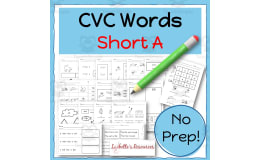
This set of 5 FREE Short A CVC Worksheets will support every student in your class as they advance in their phonics journey, regardless of ability level. We have the worksheets and activities you need, whether you need them for word families or mixed families.
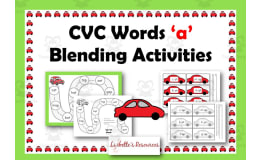
This is a sample of our bumper CVC short A worksheets.
The following details, while relevant to this small sample, are of the whole pack.
Compatible with all phonic programs, including RWI Set 1. There are no non-decodable words used.
Objectives:
These CVC short A worksheets aim to help children to:
Read and spell Short A CVC words through blending and segmenting sounds
Hear initial and final consonant sounds
Hear the medial vowel
Develop reading comprehension
As children learn to read the phrases and sentences they will learn that:
Words have spaces between them
To read from left to right
What can these worksheets be used for?
Use them for:
Classwork
Independent work.
Literacy centers,
Homework assignments
They offer enough similarities among the activities to allow children to work independently while providing variety. Even the slower learners will have plenty to work with here; as their confidence increases, they can work from the simpler worksheets to the more difficult ones.
Who are the Short A CVC Worksheets for?
The young child just starting to learn to read and spell
Those with a special need
EFL/ESL - these worksheets are not babyish.
These worksheets' straightforward layout ensures that people with dyslexia, ESL/EFL, or other learning disabilities will not feel overwhelmed.
Each child can have the ideal activity thanks to the fully differentiated worksheets.
These multisensory worksheets use the power of the hand to teach phonics, asking students to write and trace as much as possible.
By blending and segmenting words and identifying the beginning, middle, and end sounds, students will gain phonemic awareness.
What is included?
One PDF with 54 worksheets with a variety of fun activities:
Trace, cut and stick, join, colour....plenty to keep all the class engaged!
Related resources
More resources teachers may find useful
24 related resources were found using this product's title, contributor, categories and tags.


In the classroom
Teaching tips & learning objectives

Learning objectives
- Read short a CVC words and match them to pictures
- Spell CVC words by supplying missing letters
- Read a simple sentence and show its meaning in a drawing

Skills covered
- Decoding — reading words like mat, hat and tap to match pictures
- Encoding — writing missing letters to complete short a words
- Sentence comprehension — drawing what a short sentence describes

No reviews yet
Downloaded this resource? Tell other teachers how it went.
Curriculum
Standards, concepts & topics
Standards
 Standards
- CCSS.RF.1 — Demonstrate understanding of the organization and basic features of print.
- CCSS.RF.K.1a — Follow words from left to right, top to bottom, and page by page.
- CCSS.RF.K.1b — Recognize that spoken words are represented in written language by specific sequences of letters.
- CCSS.RF.K.1c — Understand that words are separated by spaces in print.
- CCSS.RF.1 — Demonstrate understanding of the organization and basic features of print.
- CCSS.RF.2 — Demonstrate understanding of spoken words, syllables, and sounds (phonemes).
- CCSS.RF.K.2.a — Recognize and produce rhyming words.
- CCSS.RF.K.2.d — Isolate and pronounce the initial, medial vowel, and final sounds (phonemes) in three-phoneme (consonant-vowel-consonant, or CVC) words.* (This does not include CVCs ending with /l/, /r/, or /x/.)
- CCSS.RF.1.2.c — Isolate and pronounce initial, medial vowel, and final sounds (phonemes) in spoken single-syllable words.
- CCSS.RF.1.2.d — Segment spoken single-syllable words into their complete sequence of individual sounds (phonemes).
- CCSS.RF.3 — Know and apply grade-level phonics and word analysis skills in decoding words.
- CCSS.RF.K.3.b — Associate the long and short sounds with common spellings (graphemes) for the five major vowels.
- CCSS.RF.1.3.b — Decode regularly spelled one-syllable words.
Core concepts
 Core concepts
- CVC words
- Short a
- Word families
 Topics
Explore more
Categories this resource belongs to
Explore related searches
More to explore
You may also like


