Adding Details to Sentences

- Grades
- Grades 1–2, Elementary
- Pages
- 17
- File type
- Preparation
- Print ready


- Subject
- ELA, Writing, Language Development, Grammar
- Topic
- Sentence Expansion, Adjectives
- Resource types
- Worksheets & Printables, Writing Prompts
- Preparation
- Print ready
- Standards
- CCSS.L.1.1
Product description
From the author
One important skill for students to learn is to write sentences. Sometimes students have difficulty adding details to sentences. This activity gets students to practice adding extra details to sentences by working with adjectives, adverbs, and prepositional phrases. By adding details to their sentences, students will write more interesting and engaging stories
What is Included:
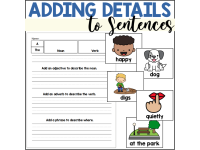
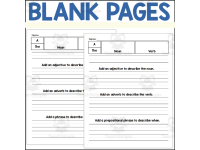
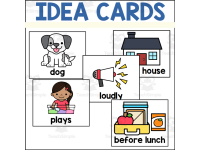
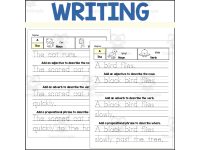
This activity includes two practice pages where the additional details are already given to the student. Students will practice handwriting by tracing the sentences that show students how to add the details to the sentences. Also included are word cards (for nouns, verbs, adjectives, adverbs, and prepositional phrases) to help students come up with ideas to create their own sentences. Blank writing pages are also provided for students to write their own sentences by writing the details in each step.
When to Use:
Literacy or Writing Center - The worksheets and word cards can be placed in a literacy center for students to write interesting sentences.
Morning Work - The teacher can give the students a simple sentence to start with and use the blank pages to add details to that sentence while their classmates arrive at class.
Homework - The blank pages can be sent home for students to practice adding details with their parents.
Skills Assessed:
Students will practice adding more details to their sentences by adding descriptive language.
The worksheets included in this resource are no-prep. They just need to be printed out and given to students to complete. The teacher may choose to give students a simple sentence to start with or the students can use the word cards to build a sentence. The word cards are low prep, needing to be printed and cut apart. The blank pages can be laminated to become a reusable write and wipe activity. The cards will store nicely in a task box.
Related resources
More resources teachers may find useful
24 related resources were found using this product's title, contributor, categories and tags.


In the classroom
Teaching tips & learning objectives

Learning objectives
Expand a bare noun-verb sentence by adding an adjective to describe the noun.
Expand a sentence further by adding an adverb to describe the verb.
Add a prepositional phrase to a sentence to describe where or when an action happens.

Teaching tips
Model the two worked examples (the cat runs, a bird flies) as a class before assigning the blank templates independently.
Cut apart the category cards (nouns, verbs, adjectives, adverbs, phrases) and let students draw one from each pile to build a randomized sentence for extra practice.
Use the where- and when-phrase template variants on different days to keep the final expansion step varied.

Skills covered
Sentence expansion — students add an adjective, an adverb, and a prepositional phrase in sequence to grow a bare sentence.
Adjective use — students select or supply an adjective that describes the sentence's noun.
Prepositional phrase use — students add a phrase telling where or when an action happens, choosing from cards such as across the street or before school.

No reviews yet
Downloaded this resource? Tell other teachers how it went.
Curriculum
Standards, concepts & topics
Standards
 Standards
- CCSS.L.1.1 — Demonstrate command of the conventions of standard English grammar and usage when writing or speaking. a. Print all upper- and lowercase letters. b. Use common, proper, and possessive nouns. c. Use singular and plural nouns with matching verbs in basic sentences (e.g., He hops; We hop). d. Use personal, possessive, and indefinite pronouns (e.g., I, me, my; they, them, their; anyone, everything). e. Use verbs to convey a sense of past, present, and future (e.g., Yesterday I walked home; Today I walk home; Tomorrow I will walk home). f. Use frequently occurring adjectives. g. Use frequently occurring conjunctions (e.g., and, but, or, so, because). h. Use determiners (e.g., articles, demonstratives). i. Use frequently occurring prepositions (e.g., during, beyond, toward). j. Produce and expand complete simple and compound declarative, interrogative, imperative, and exclamatory sentences in response to prompts
Core concepts
 Core concepts
Sentence expansion
Adjectives
Adverbs
Prepositional phrases
 Topics
Explore more
Categories this resource belongs to
Explore related searches
More to explore
You may also like