Adjectives Booklet


- Grades
- Grades 1–2
- Pages
- 12
- File type
- Preparation
- Print ready


- Subject
- ELA, Language Development
- Topic
- Adjectives, Grammar booklet
- Resource types
- Worksheets
- Preparation
- Print ready
- Standards
- CCSS.L.1.1
Product description
From the author
If you want a fun and motivating activity to use at home or school, you will love this adjective booklet.
Children will write adjectives about their family members and more. There is even a blank page to add any noun to describe. It can even get a little silly when describing nouns…I mean there are lots of fun adjectives like: grumpy, silly, adorable, precious and even supercalifragilisticexpialidocious!
Here’s What’s Included:
A cover for the Booklet. Although the pages can be used separately.
8 specific Frames to write about Family.
1 generic frame to add any NOUN.
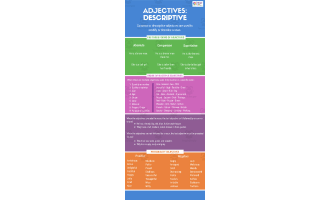
One small 8 ½ X 11-inch Anchor Chart to explain adjectives.
Some Ideas for Use:
Follow-up after learning about adjectives.
Family gift
Literacy Center
Distance Learning Activity
Homework
Writing Center
Choice activity
Morning Work
Bulletin Board Display
I hope this makes your day a little brighter!
Related resources
More resources teachers may find useful
24 related resources were found using this product's title, contributor, categories and tags.


In the classroom
Teaching tips & learning objectives

Learning objectives
Students can generate multiple adjectives to describe a specific person, animal, or family member.
Students can distinguish nouns from adjectives, using the anchor chart's paired examples as a model.
Students can apply the noun-describing pattern to a noun of their own choosing using the blank generic frame.

Teaching tips
Use the booklet as a follow-up right after teaching adjectives, or split individual frames across a literacy center, writing center, homework, or morning work, since the file notes the pages work separately.
Assign the Mom, Dad, Sister, Brother, and Family frames around a holiday or family event to turn the booklet into a keepsake gift.
Review the anchor chart's noun-adjective pairs, such as bunny paired with brown, furry, soft, and cute, as a class before starting the frames if students need a model.

Skills covered
Descriptive vocabulary generation — brainstorming multiple adjectives for a specific person, animal, or family member in each frame.
Noun/adjective distinction — using the anchor chart's paired examples, such as jam: purple, sweet, smooth, to separate describing words from the things they describe.
Applying a sentence pattern to a new noun — completing the generic blank frame with an original noun and matching adjectives.
Good to know
Questions teachers ask about this resource
How flexible is the booklet format?
The individual frames can be used separately instead of as a full booklet — a teacher could hand out just the Family frame or the blank generic frame on its own.

No reviews yet
Downloaded this resource? Tell other teachers how it went.
Curriculum
Standards, concepts & topics
Standards
 Standards
- CCSS.L.1.1 — Demonstrate command of the conventions of standard English grammar and usage when writing or speaking. a. Print all upper- and lowercase letters. b. Use common, proper, and possessive nouns. c. Use singular and plural nouns with matching verbs in basic sentences (e.g., He hops; We hop). d. Use personal, possessive, and indefinite pronouns (e.g., I, me, my; they, them, their; anyone, everything). e. Use verbs to convey a sense of past, present, and future (e.g., Yesterday I walked home; Today I walk home; Tomorrow I will walk home). f. Use frequently occurring adjectives. g. Use frequently occurring conjunctions (e.g., and, but, or, so, because). h. Use determiners (e.g., articles, demonstratives). i. Use frequently occurring prepositions (e.g., during, beyond, toward). j. Produce and expand complete simple and compound declarative, interrogative, imperative, and exclamatory sentences in response to prompts
Core concepts
 Core concepts
Adjectives
Descriptive writing
Nouns vs adjectives
 Topics
Explore related searches
More to explore
You may also like