Area of Triangles, Parallelograms & Trapezoids: Middle School Geometry

- Grades
- Grades 5–7, Elementary, Middle School
- Pages
- 7
- File type
- Answer key
- Included


- Subject
- Math, Geometry, Measurements
- Topic
- hands-on math, trapezoid
- Resource types
- Worksheets & Printables, Worksheets
- Answer key
- Included
- Standards
- 6.G.A.1
About this resource
What's inside this resource
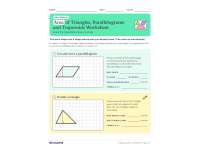
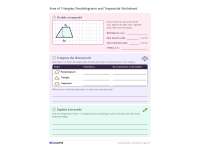
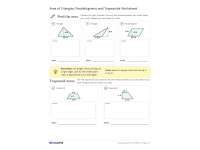
This area of triangles, parallelograms and trapezoids worksheet has students work out why each formula is true before they use it. On printed grid shapes, they cut and move part of a parallelogram to make a rectangle, then join two copies of a triangle, and two copies of a trapezoid, to make a parallelogram. From each drawing they write the area formula themselves.
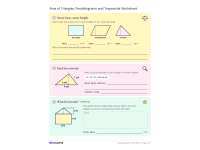
After the discovery pages, students compare the three proofs, explain why two formulas include one half, and describe in words how a drawing proves a formula. Practice follows with triangles (including one whose height falls outside the shape), a parallelogram with a slanted side to ignore, and two trapezoids, using whole-number and decimal measurements in inches and feet.
Later pages ask students to reason and apply: compare a rectangle, parallelogram and triangle with the same base and height, find the mistake in a student's triangle work, split a house-shaped garden bed into two shapes, work backwards from an area to a missing height or base, and draw their own shapes with a given area.
What's included: 5 student pages and a 2-page answer key.
- Page 1: discover the parallelogram and triangle formulas on grids
- Page 2: discover the trapezoid formula, compare the three proofs and explain one in words
- Page 3: find the area of two triangles, a parallelogram and two trapezoids, with a height and units tip
- Page 4: same base and same height, find the mistake, and a Which formula? challenge
- Page 5: work backwards to a missing measurement and make your own shapes
- Answer key with every answer, pictures showing why each formula works, a model explanation and common mix-ups to watch for
Grades: written for grades 6 and 7 geometry.
Formats: print it in color or in ink-saving black and white.
Related resources
More resources teachers may find useful
24 related resources were found using this product's title, contributor, categories and tags.


In the classroom
Teaching tips & learning objectives

Learning objectives
Derive the area formulas for a parallelogram, a triangle and a trapezoid by rearranging or doubling shapes on a grid.
Explain why the triangle and trapezoid formulas include one half and the parallelogram formula does not.
Find the area of triangles, parallelograms and trapezoids, choosing only the measurements needed.

Teaching tips
The key suggests letting students work through pages 1 and 2 alone or with a partner, about 25 minutes, before moving on to the practice on pages 3 to 5.
Point students to the tip strip on page 3: the height meets the base at a right angle, and a slanted side is not the height.
Use item 12, where a student forgets the one half, to start a class discussion about why the triangle is half of a parallelogram.

Skills covered
Formula derivation: students turn each shape into one whose area they already know and write the formula from their drawing.
Mathematical explanation: students compare the cut-and-move and two-copies methods and explain a proof using the words base and height.
Area calculation: students apply the three formulas to shapes with whole-number and decimal dimensions in square units.
Good to know
Questions teachers ask about this resource
Are the formulas given to students?
No. Students discover each formula on pages 1 and 2 by rearranging or doubling grid shapes, then use the formulas in the practice that follows.
Is there an answer key?
Yes. A two-page key gives every answer, pictures showing why each formula works, a model written explanation and a short list of common mix-ups.
What grades is it for?
It is written for grades 6 and 7 geometry and works well when introducing or reviewing area formulas.
Can students work in pairs?
Yes. The discovery pages can be done alone or with a partner, and the practice pages work well for independent work.

No reviews yet
Downloaded this resource? Tell other teachers how it went.
Curriculum
Standards, concepts & topics
Standards
 Standards
- 6.G.A.1 — Find the area of right triangles, other triangles, special quadrilaterals, and polygons by composing into rectangles or decomposing into triangles and other shapes; apply these techniques in the context of solving real-world and mathematical problems.
Core concepts
 Core concepts
area of a triangle
area of a parallelogram
area of a trapezoid
base and height
composite figures
 Topics
Explore more
Categories this resource belongs to
Explore related searches
More to explore
You may also like