Ascending and Descending Order Worksheets for Grades 2–4


- Grades
- Grades 2–4, Elementary
- Pages
- 8
- File type
- Preparation
- Print ready


- Subject
- Math, Numbers, Early Math
- Topic
- Ascending order worksheets, descending order practice
- Resource types
- Worksheets, Worksheets & Printables
- Preparation
- Print ready
About this resource
What's inside this resource
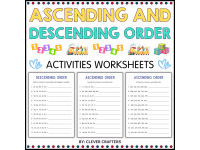
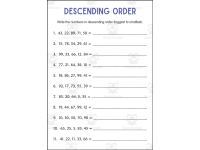
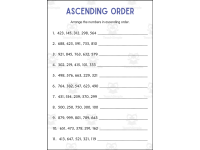
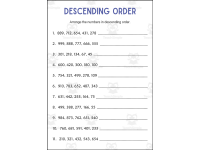
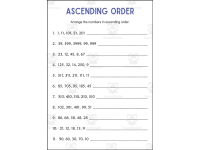
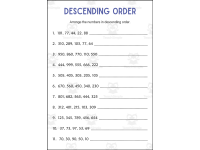
Eight worksheet pages give students sets of five numbers to reorder, alternating between an "Ascending Order" page (smallest to biggest) and a "Descending Order" page (biggest to smallest), four times over. The number range shifts with each pair of pages: two-digit numbers up to 100 on pages 1-2, three-digit numbers up to 999 on pages 3-4, a mixed set of one- to four-digit numbers (such as 1, 11, 101, 21, 201, or 39, 399, 3999, 99, 999) on pages 5-6, and single-digit numbers 0-9 on the final pair of pages. Each page has 10 or 11 five-number sets to reorder, with a blank line provided after each problem for the written answer, and no answer key or worked example appears anywhere in the file.
Related resources
More resources teachers may find useful
24 related resources were found using this product's title, contributor, categories and tags.


In the classroom
Teaching tips & learning objectives

Learning objectives
- Arrange a set of five two- or three-digit numbers from smallest to largest (ascending order)
- Arrange a set of five two- or three-digit numbers from largest to smallest (descending order)
- Compare numbers of differing digit lengths (e.g. 1, 11, 101, 21, 201) to determine correct order using place value rather than digit count alone

Teaching tips
- Prepare an answer key in advance or have students self-check in pairs, since none is included in the file
- Consider reordering the assignment sequence for a class building difficulty gradually, since the easiest tier (single-digit 0-9 ordering) falls on the last two pages rather than the first two
- Use the mixed-digit-length page (e.g. "39, 399, 3999, 99, 999") specifically to address the common error of ordering by first digit alone rather than by full place value

Skills covered
- Number comparison — students compare five values to determine which is smaller or larger.
- Ascending order — worksheets ask students to arrange number sets from smallest to largest.
- Descending order — paired pages require arranging number sets from largest to smallest.
Good to know
Questions teachers ask about this resource
Do the eight pages get progressively harder from page 1 to page 8, or does the difficulty order vary?
It varies rather than progressing steadily. Two- and three-digit ordering (pages 1-4) and mixed-length ordering (pages 5-6) come before the single-digit 0-9 pages (7-8), which are the easiest number range in the file and appear last rather than first.
Does any page mix ascending and descending problems together, or are they always kept separate?
Always separate. Each of the four number-range tiers gets its own dedicated "Ascending Order" page followed by its own dedicated "Descending Order" page; no page combines both types of problems.

No reviews yet
Downloaded this resource? Tell other teachers how it went.
Resource details
Concepts & topics
Core concepts
 Core concepts
- ascending and descending order
 Topics
Explore more
Categories this resource belongs to
Explore related searches
More to explore
You may also like