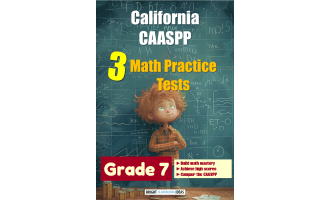
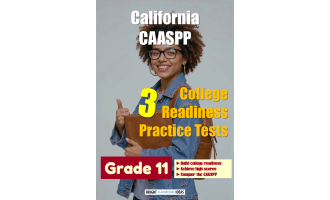
California CAASPP Math Practice Test for Grade 11


- Grades
- Grade 11, Homeschool Resources, High School
- Pages
- 23
- File type
- Answer key
- Included


- Subject
- Math
- Topic
- california, state test
- Resource types
- Assessments, Teacher Tools, Tests, Quizzes and Tests, Worksheets & Printables
- Answer key
- Included
- Standards
- HSN-CN.A.2 HSS-ID.C.8 +1
About this resource
What's inside this resource
11th Grade Algebra 2 / Pre-Calculus Practice Test | CAASPP Math Test Prep with Answer Key & Teacher Guide
Prepare your students for success on state assessments with this comprehensive 11th grade Algebra 2 / Pre-Calculus practice test aligned to CAASPP standards! This rigorous resource builds mastery across advanced math concepts while helping you assess readiness for college-level coursework.
✅ What’s Included
Full-length 11th grade math practice test (30 questions)
Complete answer key with detailed explanations and worked solutions
Teacher’s guide with scoring rubrics, pacing, and instructional strategies
Multiple-choice and open-response questions
CAASPP-style format (35 total points with partial credit opportunities)
📚 How It Works in the Classroom
This Algebra 2 / Pre-Calculus test prep resource is perfect for:
CAASPP and end-of-year exam preparation
Benchmark or summative assessments
Whole group testing or independent practice
Small group intervention and reteaching
Sub plans or structured review sessions
The teacher guide recommends flexible administration across two sessions for optimal pacing and student performance.
🎯 Standards & Learning Goals
This 11th grade math practice test covers key Algebra II and Pre-Calculus domains, including:
Complex Numbers & Polynomial Operations
Rational, Radical & Exponential Functions
Trigonometric Functions & Identities
Sequences, Series & Probability
Statistics & Data Analysis
As outlined in the teacher guide overview (page 1), this resource targets college and career readiness standards across major domains, ensuring full coverage of upper-level math expectations.
💛 Why Teachers Love It
Mirrors real CAASPP rigor and question types
Includes detailed answer explanations—not just answers
Teacher guide supports differentiation, scoring, and reteaching
Covers ALL major Algebra II / Pre-Calculus standards
Helps identify student gaps and prepare for advanced math courses
📥 Ready to prepare students for success in advanced math?
Download this 11th grade Algebra 2 / Pre-Calculus practice test and give your students the confidence and skills they need to excel on state assessments!
Related resources
More resources teachers may find useful
24 related resources were found using this product's title, contributor, categories and tags.


In the classroom
Teaching tips & learning objectives

Learning objectives
Students will demonstrate the ability to multiply and simplify complex numbers, factor and divide polynomials, and identify zeros using the Factor Theorem.
Students will solve rational, radical, exponential, and logarithmic equations, and evaluate trigonometric identities and equations.
Students will interpret statistical measures — mean, standard deviation, z-scores, and correlation coefficients — and reason about sampling variability.

Teaching tips
Have students complete all 25 multiple-choice questions before starting the five open-response problems, since the test separates them into a multiple-choice block (Sections 1-5) and a two-point open-response block (Section 6).
Use the score-band table (for example, 0-16 points is labeled 'Below Standard') to target re-teaching, since the guide ties each band to specific content gaps such as polynomial and rational functions.
Review the teacher's guide's per-question common-error notes before assigning the test — for instance, it flags that students often forget i² = -1 on the complex-number question, or confuse a hole with a vertical asymptote on the rational-function question.

Skills covered
Complex number operations — students multiply complex numbers using FOIL and simplify with i² = -1 (Question 1).
Polynomial and rational function analysis — students apply the Remainder Theorem, factor and simplify rational expressions, and identify asymptotes (Questions 2, 3, 6).
Trigonometric reasoning — students evaluate exact trig values, identify amplitude and period, and apply sum/difference and Pythagorean identities (Questions 11-16).
Good to know
Questions teachers ask about this resource
How are the open-response questions scored?
Each of the five open-response questions is worth 2 points, with partial credit awarded for substantial correct work that contains a minor error or a missing part, following the scoring models included with the test.
How does the test connect each question to a specific math standard?
The teacher's guide lists a standard code for every question — for example, the correlation-coefficient question aligns to interpreting a linear fit's correlation coefficient — along with a common-error note and a teaching tip specific to that item.

No reviews yet
Downloaded this resource? Tell other teachers how it went.
Curriculum
Standards, concepts & topics
Standards
 Standards
- HSN-CN.A.2 — Use the relation i 2 = –1 and the commutative, associative, and distributive properties to add, subtract, and multiply complex numbers.
- HSS-ID.C.8 — Compute (using technology) and interpret the correlation coefficient of a linear fit.
- HSF-IF.C.7 — Graph functions expressed symbolically and show key features of the graph, by hand in simple cases and using technology for more complicated cases. a. Graph linear and quadratic functions and show intercepts, maxima, and minima. b. Graph square root, cube root, and piecewise-defined functions, including step functions and absolute value functions. c. Graph polynomial functions, identifying zeros when suitable factorizations are available, and showing end behavior. d. Graph rational functions, identifying zeros and asymptotes when suitable factorizations are available, and showing end behavior. e. Graph exponential and logarithmic functions, showing intercepts and end behavior, and trigonometric functions, showing period, midline, and amplitude.
Core concepts
 Core concepts
Complex numbers
Polynomial and rational functions
Trigonometric identities
Sequences and series
Statistical inference
Topics
 Topics
Explore more
Categories this resource belongs to
Explore related searches
More to explore
You may also like