24 related resources

Grade 1 Language Arts Skills Practice Test

Ten skill-specific Grade 1 language arts practice tests cover phonics, vocabulary, reading, grammar, and sentence structure, with no answer key included.
Grades
Grade 1, Elementary
File type
PDF
Preparation
Print ready

Updated Sep 03, 2021

Subject
ELA
Topic
sentences, assessment
Resource types
Tests, Quizzes and Tests
Preparation
Print ready

About this resource

What's inside this resource

Practice worksheets provide excellent preparation for standardized testing!
—Consonant Sounds
—Vowels
—Blends and Digraphs
—Compound Words
—Contractions
—Synonyms and Antonyms
—Adjectives
—Sequencing and Story Mapping
—Capitalization
—Punctuation and Grammar

In the classroom

Teaching tips & learning objectives

Learning objectives

  • Identify beginning, ending, and vowel sounds in words by matching a pictured word to another word sharing the same sound.

  • Recognize compound words, form contractions from word pairs, and identify synonyms and antonyms.

  • Answer main-idea, sequence, and prediction questions about short reading passages.

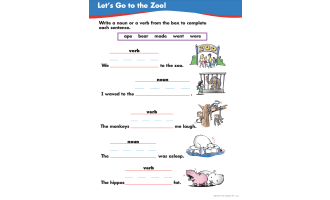
  • Apply writing mechanics (capitalization, punctuation, complete sentences) and identify nouns, verbs, and the naming/action parts of a sentence.

Teaching tips

  • Administer the first three sections (Consonant Sounds, Vowels, Blends and Digraphs) with the actual test booklet in hand, since those items depend on a picture at the start of each row that is not described anywhere in the surrounding text.

  • Treat this as a unit checkpoint within the broader Twin Sisters 'Premium Education Language Arts' program rather than a standalone first-time assessment, since several sections are labeled 'Unit 8.'

  • Since no answer key is included, score the test yourself in advance or prepare your own key before administering it.

Skills covered

  • Phonics and phonemic awareness — students match beginning, ending, and vowel sounds across picture-based items in the Consonant Sounds, Vowels, and Blends and Digraphs sections.

  • Vocabulary and word relationships — students select context-appropriate words, correctly spelled words, compound words, contractions, synonyms, and antonyms across four dedicated sections.

  • Reading comprehension — students answer main idea, sequence, and prediction questions about three short paragraphs.

  • Grammar and sentence structure — students identify correctly written sentences, nouns, verbs, and the naming/action parts of a sentence.

Good to know

Questions teachers ask about this resource

Which sections of the test rely on artwork rather than only the printed words?

The Consonant Sounds, Vowels, and Blends and Digraphs sections all instruct students to 'say the name of the picture' at the start of each row before choosing a matching-sound answer, so those three sections require the pictured item to be solved, unlike the remaining seven text-only sections.

No reviews yet

Downloaded this resource? Tell other teachers how it went.

Curriculum

Standards, concepts & topics

Standards

  • CCSS.L.1.2 — Demonstrate command of the conventions of standard English capitalization, punctuation, and spelling when writing. a. Capitalize dates and names of people. b. Use end punctuation for sentences. c. Use commas in dates and to separate single words in a series. d. Use conventional spelling for words with common spelling patterns and for frequently occurring irregular words. e. Spell untaught words phonetically, drawing on phonemic awareness and spelling conventions.
  • CCSS.L.1.1 — Demonstrate command of the conventions of standard English grammar and usage when writing or speaking. a. Print all upper- and lowercase letters. b. Use common, proper, and possessive nouns. c. Use singular and plural nouns with matching verbs in basic sentences (e.g., He hops; We hop). d. Use personal, possessive, and indefinite pronouns (e.g., I, me, my; they, them, their; anyone, everything). e. Use verbs to convey a sense of past, present, and future (e.g., Yesterday I walked home; Today I walk home; Tomorrow I will walk home). f. Use frequently occurring adjectives. g. Use frequently occurring conjunctions (e.g., and, but, or, so, because). h. Use determiners (e.g., articles, demonstratives). i. Use frequently occurring prepositions (e.g., during, beyond, toward). j. Produce and expand complete simple and compound declarative, interrogative, imperative, and exclamatory sentences in response to prompts
  • CCSS.RI.1.2 — Identify the main topic and retell key details of a text.

Core concepts

  • Phonics

  • Vocabulary

  • Reading comprehension

  • Grammar

  • Sentence structure

More to explore

You may also like