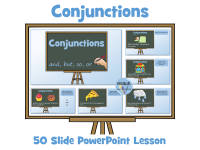
Conjunctions PowerPoint Lesson



- Grades
- Grade 1, Elementary
- File type
- Microsoft PowerPoint
- Use
- Digital activity


- Subject
- ELA, Grammar
- Topic
- conjunctions , powerpoint lesson
- Resource types
- Presentations
- Use
- Digital activity
- Standards
- CCSS.L.1.1 CCSS.L.1.6
About this resource
What's inside this resource
This resource contains a 50-slide PowerPoint lesson on coordinating conjunctions for Grade 1 students. The PowerPoint focuses on the conjunctions - ‘and’. ‘or’, ‘so’ and ‘but’.
The PowerPoint clearly explains what conjunctions are and provides many examples and opportunities for students to identify and use conjunctions. The PowerPoint also contains a link to a short video on coordinating conjunctions.
Related resources
More resources teachers may find useful
24 related resources were found using this product's title, contributor, categories and tags.


In the classroom
Teaching tips & learning objectives

Learning objectives
Students will define a conjunction as a word used to join words, groups of words, or sentences.
Students will identify the conjunction used within a given joined sentence.
Students will select an appropriate conjunction (and, but, so, or, because) to combine two related sentences.

Teaching tips
Pause after each practice slide before revealing the answer slide, since the lesson is structured as a question slide immediately followed by its answer.
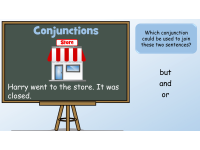
Use the two modeled 'Jake overslept' examples (joined first with 'and' and then with 'so') to discuss how conjunction choice changes meaning, not just sentence length.
Play the embedded conjunctions video from the recap section as a wrap-up or as an alternative introduction before the slide-based examples. Check understanding with this conjunction worksheet, selecting items that match the connectors taught.

Skills covered
Conjunction identification — students name the joining word already used in a combined sentence.
Conjunction selection — students choose the correct conjunction (and, but, so, or, because) from a short list to combine two given sentences.
Sentence combining — students see two short sentences joined into one longer, more fluent sentence using a conjunction.
Good to know
Questions teachers ask about this resource
How does changing the conjunction change the meaning of the same two sentences in the lesson's opening example?
"Jake overslept and he was late for school" simply reports both facts together, while "Jake overslept so he was late for school" shows a cause-and-effect relationship between the two events.

No reviews yet
Downloaded this resource? Tell other teachers how it went.
Curriculum
Standards, concepts & topics
Standards
 Standards
- CCSS.L.1.1 — Demonstrate command of the conventions of standard English grammar and usage when writing or speaking. a. Print all upper- and lowercase letters. b. Use common, proper, and possessive nouns. c. Use singular and plural nouns with matching verbs in basic sentences (e.g., He hops; We hop). d. Use personal, possessive, and indefinite pronouns (e.g., I, me, my; they, them, their; anyone, everything). e. Use verbs to convey a sense of past, present, and future (e.g., Yesterday I walked home; Today I walk home; Tomorrow I will walk home). f. Use frequently occurring adjectives. g. Use frequently occurring conjunctions (e.g., and, but, or, so, because). h. Use determiners (e.g., articles, demonstratives). i. Use frequently occurring prepositions (e.g., during, beyond, toward). j. Produce and expand complete simple and compound declarative, interrogative, imperative, and exclamatory sentences in response to prompts
- CCSS.L.1.6 — Use words and phrases acquired through conversations, reading and being read to, and responding to texts, including using frequently occurring conjunctions to signal simple relationships (e.g., because).
Core concepts
 Core concepts
conjunctions
sentence combining
grammar
 Topics
More to explore
You may also like