Crash Course Psychology #9: Sleep & Dreams
- Grades
- Grades 9–12
- Pages
- 8
- File type
- Multiple File Types
- Answer key
- Included


- Subject
- Social Emotional Learning (SEL), Health, Psychology
- Topic
- Psychology, Video
- Resource types
- Activities
- Answer key
- Included
Product description
From the author
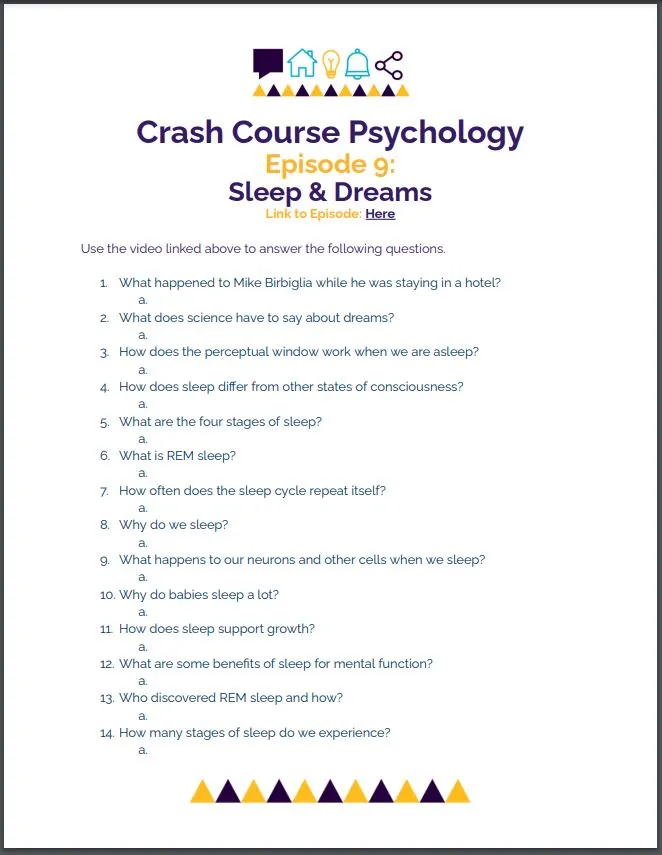
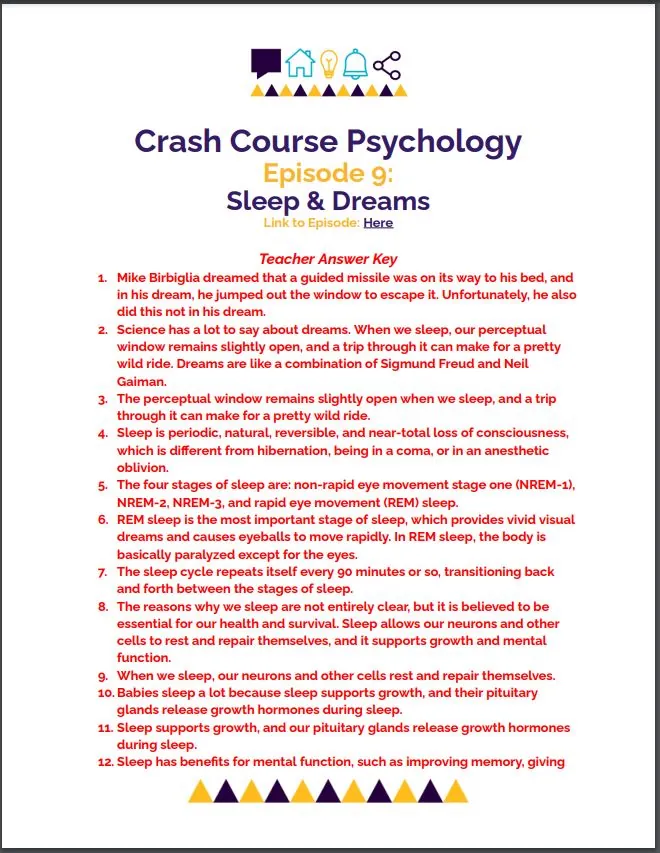
This two-page worksheet accompanies Crash Course Psychology Episode 9, Sleep & Dreams. Its 15 questions cover sleep stages and cycles, REM sleep, reasons for sleep and sleep’s effects on the brain and growth.
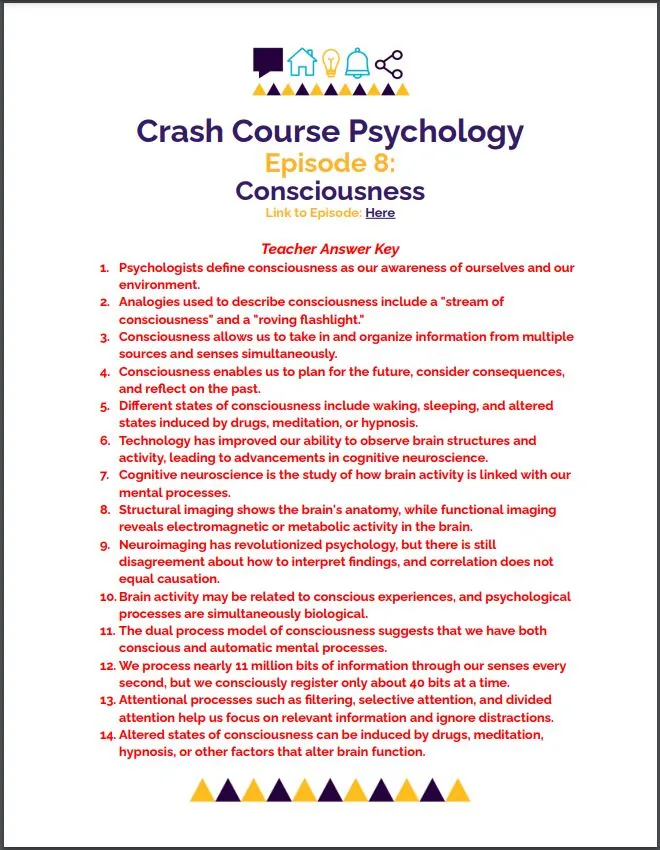
Student and teacher-answer files are included in both editable Word and PDF formats: eight physical pages across the four files. The episode is linked separately. Have students respond during or after viewing, then review their responses with the key.
Related classroom experiments are available separately; this download does not include an experiment activity.
Related resources
More resources teachers may find useful
24 related resources were found using this product's title, contributor, categories and tags.


In the classroom
Teaching tips & learning objectives

Learning objectives
Identify the four stages of sleep (NREM-1, NREM-2, NREM-3, and REM) and describe what distinguishes each.
Explain the biological purposes of sleep, including cell repair, growth-hormone release, and memory processing.
Summarize the length and structure of a typical sleep cycle.

Teaching tips
Play the linked Crash Course episode in class or assign it as homework before handing out the student guide, since every question depends on details from the video.
Use the editable Word file to trim or reorder the 15 questions if class time is limited, since both the worksheet and answer key are provided in .docx as well as PDF.
Pair question 13 (how REM sleep was discovered) with a short discussion of how scientific discoveries sometimes come from unexpected observations, since the answer key highlights an eight-year-old test subject.

Skills covered
Video-based note-taking — students extract specific facts (sleep-stage names, timing, biological function) from a documentary-style video and record them in their own words.
Scientific-concept recall — students identify the four sleep stages and the biological explanations for why sleep is necessary, as presented in the episode.
Cause-and-effect reasoning — several questions (e.g., 'Why do babies sleep a lot?') ask students to connect a sleep mechanism to its downstream effect on the body.
Good to know
Questions teachers ask about this resource
Does the worksheet need to be printed, or can it be filled out digitally?
Both work: the student guide is delivered as a Word document that can be typed into directly, as well as a matching PDF, so it can be completed on-screen or printed for handwritten answers.

No reviews yet
Downloaded this resource? Tell other teachers how it went.
Resource details
Concepts & topics
Core concepts
 Core concepts
Stages of sleep
REM sleep
Sleep cycle
Psychology
 Topics
Explore more
Categories this resource belongs to
Explore related searches
More to explore
You may also like