Cut and Paste Oceans - World Map


- Grades
- Not Grade Specific
- Pages
- 2
- File type
- Answer key
- Included


- Subject
- Social Studies, Geography
- Topic
- map, continents
- Resource types
- Worksheets & Printables, Worksheets
- Answer key
- Included
About this resource
What's inside this resource
Cut and Paste Oceans - World Map Oceans
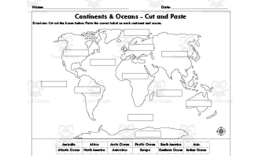
Cut and Paste Oceans - World Map Oceans is a fun and interactive worksheet that helps improve fine motor skills and promotes knowledge of the world's Oceans. Students are encouraged to actively participate in discovering and identifying the various Oceans on a global world map through this practical exercise.
Students will carefully cut out the labels for the Oceans of the world Indian Ocean, Arctic Ocean, Southern Ocean, Atlantic Ocean, and Pacific Ocean., and then carefully paste them onto the appropriate regions of the blank globe map on the worksheet. This tactile method improves manual dexterity and hand-eye coordination in addition to reinforcing geography information.
Students are more likely to remember facts about the Oceans of the world and their locations if they actively participate in the cutting and pasting process.
The Oceans of the world : Indian Ocean, Arctic Ocean, Southern Ocean, Atlantic Ocean, and Pacific Ocean.
Answer key is provided to allow for self-assessment and immediate feedback, encouraging students to take ownership of their educational journey.
Implementation Format: Letter size, landscape.
File types: pdf
Number of Pages: 2
Grades or ages: Grade 3, Grade 4, Grade 5, Grade 6, Grade 7, and Grade 8.
Related resources
More resources teachers may find useful
24 related resources were found using this product's title, contributor, categories and tags.


In the classroom
Teaching tips & learning objectives

Learning objectives
Name the five oceans of the world: Atlantic, Indian, Arctic, Pacific and Southern
Place each ocean name in its correct position on an unlabelled world map
Distinguish the Arctic Ocean at the top of the map from the Southern Ocean along the bottom

Teaching tips
Trim the row of labels away from the bottom of the sheet before handing it out to younger children, leaving only the five boxes to cut.
Hold one whole-class placement round on a projected copy before anyone reaches for glue, since a pasted label cannot be moved.
Print the student sheet on card when labels will be shuffled and repositioned during discussion rather than glued straight down. Build on ocean labeling by adding the continents on this world map worksheet.

Skills covered
Ocean identification — students position Atlantic, Indian, Arctic, Pacific and Southern labels on a blank world map.
Map reading — each label has to be matched to a region of an unlabelled global map before it is committed with glue.
Scissors and glue control — the five boxes are cut from one bottom strip and pasted individually onto the map.
Good to know
Questions teachers ask about this resource
Does the labelling include the Southern Ocean?
Yes. Five labels are supplied — Atlantic, Indian, Arctic, Pacific and Southern — and the fully labelled page places the Southern Ocean along the bottom of the map, below the Indian and Atlantic positions.
The two pages look almost identical — how do they differ?
Both carry the same heading, the same one-line direction and the same row of five boxes at the foot of the page. The difference is on the map itself: the second page also shows all five ocean names positioned across it, so it doubles as the marked-up copy.

No reviews yet
Downloaded this resource? Tell other teachers how it went.
Resource details
Concepts & topics
Core concepts
 Core concepts
Oceans
World map
Map labeling
Geography
Topics
 Topics
Explore more
Categories this resource belongs to
Explore related searches
More to explore
You may also like