Derivatives of Inverse Trig Functions – PowerPoint



- Grades
- Grades 11–12, Adult Education
- Pages
- 18
- File type
- Microsoft PowerPoint
- Answer key
- Included


- Subject
- Math, Calculus
- Topic
- Inverse trig derivatives, Calculus
- Resource types
- Presentations, Lesson Plans
- Answer key
- Included
Product description
From the author
PowerPoint presentation, 18 slides explaining how to recognize the derivatives of the standard inverse trigonometric functions.
Related resources
More resources teachers may find useful
16 related resources were found using this product's title, contributor, categories and tags.
In the classroom
Teaching tips & learning objectives

Learning objectives
Recognise the derivatives of the standard inverse trigonometric functions
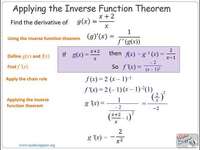
State the inverse function theorem and use it to differentiate the inverse of a given function
Derive the arcsine and arccosine derivatives from the definition of each inverse and the Pythagorean identity

Teaching tips
The two recap slides on differentiation rules and trig derivatives come before any new content, so they can be shown or skipped depending on how recently the class met them
Three warm-up applications of the inverse function theorem sit between the theorem and the inverse trig work, which makes them the natural pause point in a lesson

Skills covered
Applying the inverse function theorem - three slides work it on ordinary functions, using the quotient rule and the chain rule, before it is used on any inverse trig function.
Deriving the arcsine derivative - the deck moves from the definition of inverse sine to cos(sin⁻¹x), then uses the Pythagorean identity to reach a form students can actually use.
Deriving the arccosine derivative - the same route is repeated with −sin(cos⁻¹x), which lets the sign difference emerge from the working rather than being asserted.
Good to know
Questions teachers ask about this resource
Which derivations are worked through in full?
Arcsine and arccosine. Each is given three slides that run from the definition of the inverse, through the awkward first expression the theorem produces, to a usable form via the Pythagorean identity. The remaining four appear on a summary slide of all six results, with a note that they follow from the same theorem.
What does a class need to know before this deck lands?
The standard differentiation rules and the trig derivatives - both are recapped on slides 2 and 3 rather than taught - plus the Pythagorean identity, which the arcsine and arccosine derivations use without re-deriving it, and comfort with function inverses.

No reviews yet
Downloaded this resource? Tell other teachers how it went.
Resource details
Concepts & topics
Core concepts
 Core concepts
Inverse trigonometric functions
Derivatives
Inverse function theorem
Chain rule
Pythagorean identity
 Topics
Explore more
Categories this resource belongs to
Explore related searches
More to explore
You may also like