Desert Animals Adaptations – 3rd & 4th Grade Pack
- Grades
- Grades 3–4
- File type
- Multiple File Types
- Answer key
- Included


- Subject
- Science
- Topic
- Desert animals, Adaptations
- Resource types
- Worksheets, Activities, Presentations, Task Cards
- Answer key
- Included
- Standards
- CCSS.RI.3.1
Product description
From the author
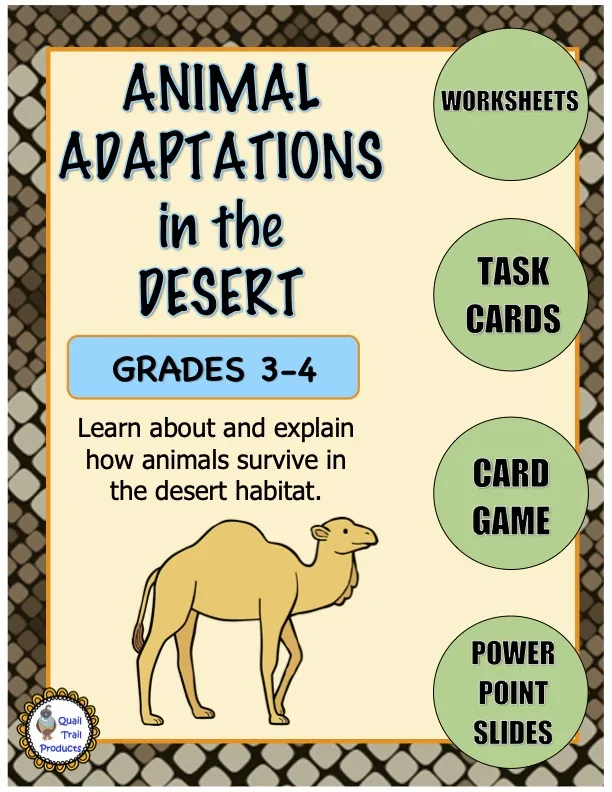
Are your 3rd or 4th graders learning about the desert habitat? Are you looking for a way to enhance the curriculum with fun and engaging activities? If so, look no further. You have found a product that will help your learners focus on the desert habitat, all while practicing their science, reading, writing, and critical thinking skills. The download includes the teaching files; supply a dictionary and the materials needed for cutting, gluing and card games. Most of the worksheets are print and go. All activities can be used in either a small or large group setting, or on an individual basis. A set of PowerPoint slides is included for you to display as learners delve into the world of desert animals and their unique adaptations. As learners work their way through this product, they will practice reading, reading comprehension, comparative writing, opinion writing, descriptive writing, vocabulary, dictionary skills, and much more. Most pages are available in color and black & white. PLEASE NOTE: color and b&w versions are IDENTICAL. Answer keys are provided for some worksheets. Others are not provided because your learners’ answers will vary.
When you purchase this product, you will receive:
Worksheets:
WORKSHEET 1: learners will cut out 5 animals and glue them next to their appropriate habitat.
WORKSHEET 2: learners will fill-in the sections of a K-W-L chart.
WORKSHEET 3: learners will draw lines matching sentences about desert vocabulary to their correct definitions.
WORKSHEET 4: learners will use a dictionary to locate the guide words for desert vocabulary words and write either a synonym or antonym for each vocabulary word.
WORKSHEET 5: learners will use the check-off list to draw a picture of a desert habitat, making sure to include items on the list.
WORKSHEET 6: learners will read sentences about specific desert animal adaptations and label each adaptation as either physical, behavioral, or life cycle.
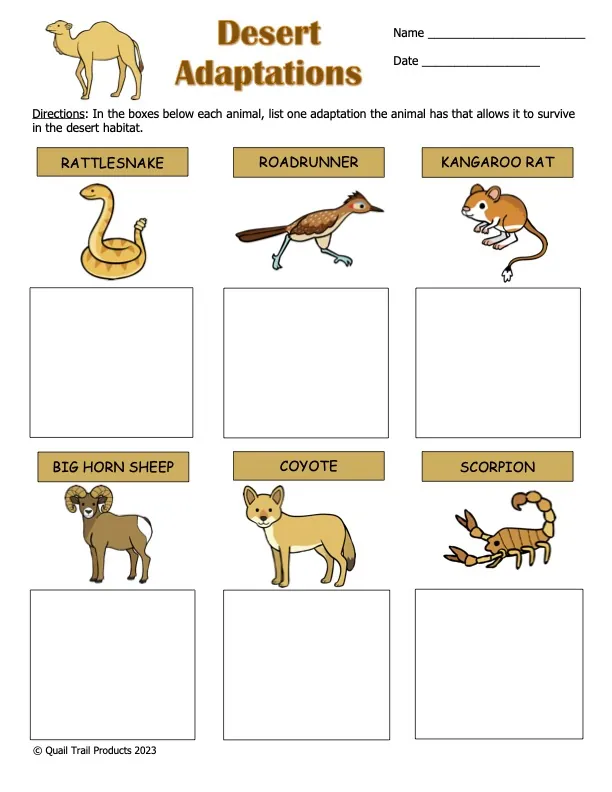
WORKSHEETS 7-9: learners will write either 1, 2, or 3 adaptations for the given desert animals.
WORKSHEETS 10-12: learners will write either 1, 2, or 3 adaptations for the given desert animals and non-desert animals.
WORKSHEET 13: learners will choose 1 desert animal and 1 non-desert animal and write a brief paragraph about each animal’s adaptations.
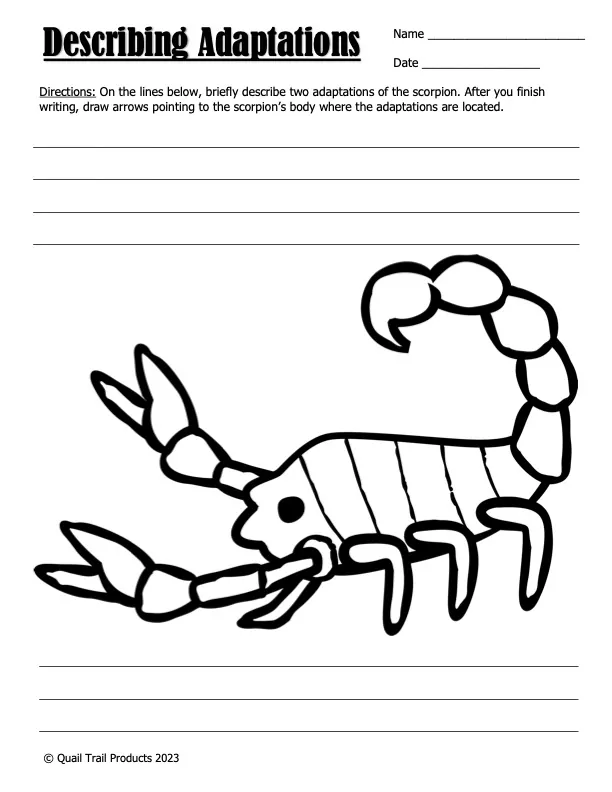
WORKSHEETS 14-21: learners will label 2-3 adaptations on a desert animal and briefly explain each adaptation.
WORKSHEET 22: learners will complete an organizer by listing 3 reasons they think a particular desert animal is the “coolest creature.”
WORKSHEETS 23-24: learners will use their reasons from worksheet 22 to write an opinion piece about their favorite desert animal.
WORKSHEET 25: learners will complete a wordsearch with various desert terms.
WORKSHEET 26: learners will create their own wordsearch using various desert terms.
WORKSHEET 27: learners will complete a crossword puzzle using clues about various desert animals.
Informational handouts:
HANDOUT 1: Information describing the definition of a habitat.
HANDOUT 2: 4 vocabulary words and definitions that learners will come across in their reading.
HANDOUT 3: 4 vocabulary words and definitions that learners will come across in their reading.
HANDOUT 4: Information about the desert habitat including: landforms, bodies of water, climate, plants, and where deserts are found on Earth.
HANDOUT 5: Information describing the definition of an adaptation, along with the three types of adaptations (physical, behavioral, life cycle).
HANDOUT 6: Information about 4 desert animals and their adaptations (camel, scorpion, coyote, and Kangaroo rat).
HANDOUT 7: Information about 4 desert animals and their adaptations (armadillo, Big Horn sheep, roadrunner, rattlesnake).
HANDOUT 8: Information about 3 non-desert animals and their adaptations (toucan, polar bear, porcupine).
Task cards:
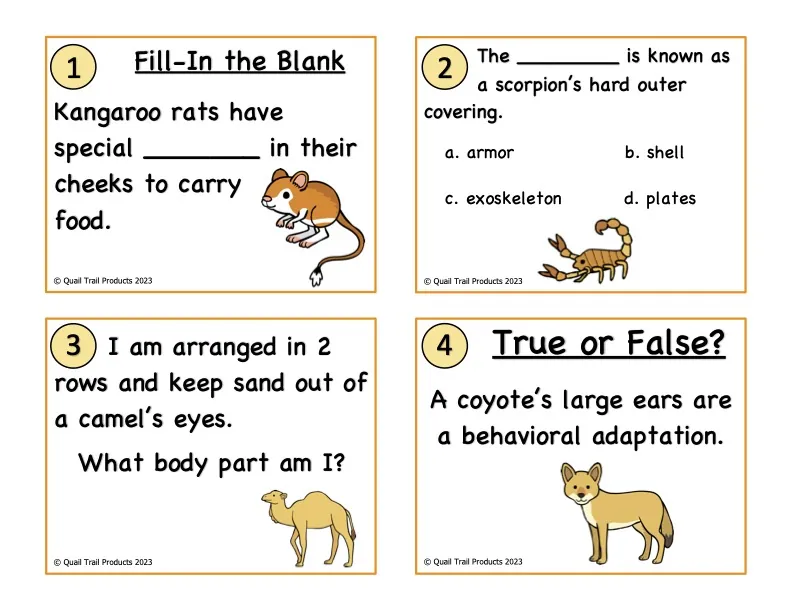
20 task cards (color version and b&w version) with questions about desert animal adaptations. Questions were created directly from informational handouts included in the product. Cards are fashioned in the following format:
5 cards: fill-in the blank
5 cards: multiple choice
5 cards: write the answer
5 cards: true or false
An answer recording page is included. In order to reduce ink and/or number of copies, two answer recording sheets are included on one page. Color and black & white version are available.
Card game:
3 versions of a learning game focusing on desert animals and their adaptations.
1 set of desert animal cards (color and black & white).
1 set of cards with desert animal adaptations listed (B&W only).
1 set of clue cards with desert animal adaptations listed (B&W only).
Powerpoint:
25 full-color slides matching information provided in the informational handouts.
Related resources
More resources teachers may find useful
24 related resources were found using this product's title, contributor, categories and tags.



In the classroom
Teaching tips & learning objectives

Learning objectives
Define a habitat and an adaptation, and distinguish behavioral, physical, and life-cycle adaptations
Explain how specific adaptations, such as a camel's fat-storing hump or a scorpion's stinger, help eight desert animals survive
Contrast desert animals with the toucan, polar bear, and porcupine, which are adapted to rainforest, arctic, and forest habitats

Teaching tips
Open with the PowerPoint's habitat and adaptation slides, then assign the matching packet readings so students meet the same eight animals in two formats
Print the task cards and game cards on cardstock and laminate them, as the educator notes recommend, before using them in centers or review rotations
The blank cards in the game set let students add desert animals from the brainstorming page, such as the javelina, Fennec fox, or Gila monster

Skills covered
Classifying adaptations — students label ten real examples, from an armadillo's armor plates to a rattlesnake's live birth, as physical, behavioral, or life cycle.
Reading informational text — students read paragraph profiles of eight desert animals and three non-desert animals, then list each animal's adaptations from the readings.
Puzzle solving — students complete a twelve-word desert wordsearch and a seven-clue animal crossword, then design their own wordsearch for a partner.
Good to know
Questions teachers ask about this resource
Which animals does the pack profile, and are any of them not desert animals?
Eight desert animals are profiled: camel, scorpion, coyote, kangaroo rat, armadillo, Big Horn sheep, roadrunner, and rattlesnake. The toucan, polar bear, and porcupine also appear as non-desert contrasts so students can compare adaptations across habitats.
Do students create anything of their own beyond completing the exercises?
Yes. They draw a desert habitat scene guided by a checklist, draw a desert survivor and a non-survivor in the Show What You Know task, design a wordsearch for a partner using desert words, and write an opinion piece about their favorite desert creature.

No reviews yet
Downloaded this resource? Tell other teachers how it went.
Curriculum
Standards, concepts & topics
Standards
 Standards
- CCSS.RI.3.1 — Ask and answer questions to demonstrate understanding of a text, referring explicitly to the text as the basis for the answers.
Core concepts
 Core concepts
Animal adaptations
Desert habitat
Informational reading
Opinion writing
Science vocabulary
 Topics
Explore more
Categories this resource belongs to
Explore related searches
More to explore
You may also like