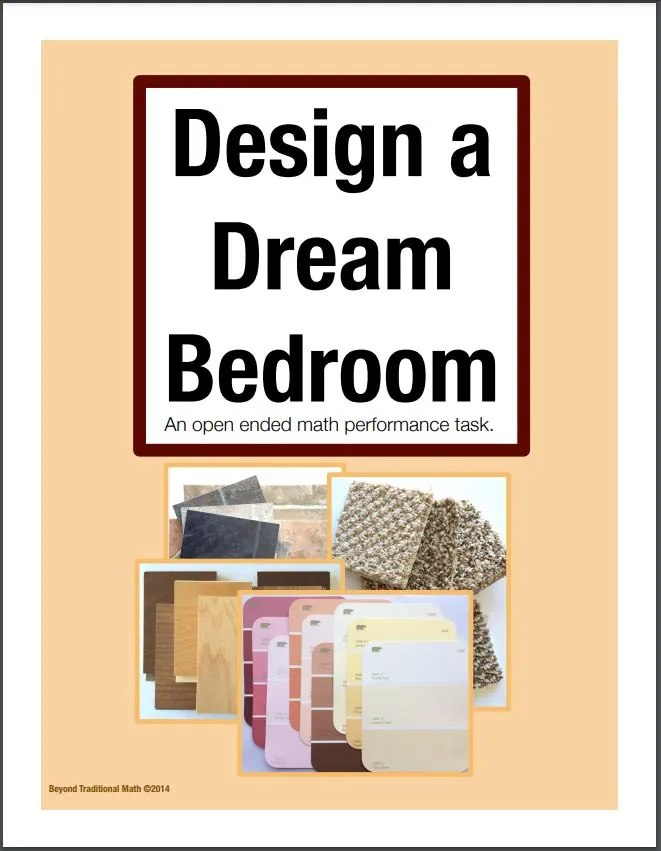
Design a Dream Bedroom – Area & Perimeter Project
- Grades
- Grades 3–5, Elementary
- Pages
- 16
- File type
- Preparation
- Print ready


- Subject
- Math, Geometry
- Topic
- geometry, multiplication
- Resource types
- Worksheets & Printables, Word Problems, Activities, Projects
- Preparation
- Print ready
About this resource
What's inside this resource
Product description
From the author
Related resources
More resources teachers may find useful
24 related resources were found using this product's title, contributor, categories and tags.


In the classroom
Teaching tips & learning objectives

Learning objectives
Students can calculate the area of a rectangular room in square feet from a labeled blueprint.
Students can calculate total cost across multiple pricing categories, including cost-per-square-foot flooring and per-unit furniture and accessories.
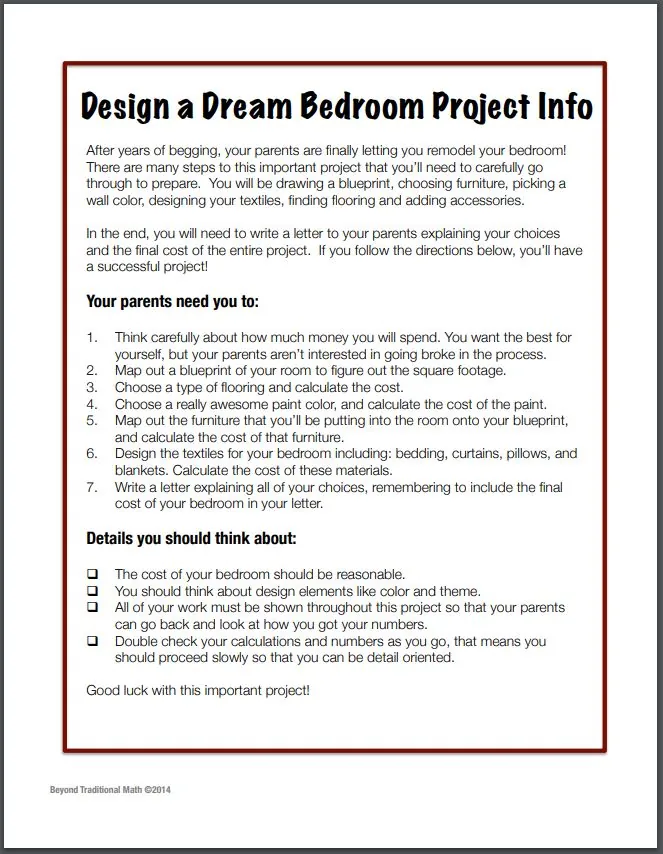
Students can create an accurate labeled blueprint (birds-eye view) showing room dimensions and furniture placement.

Teaching tips
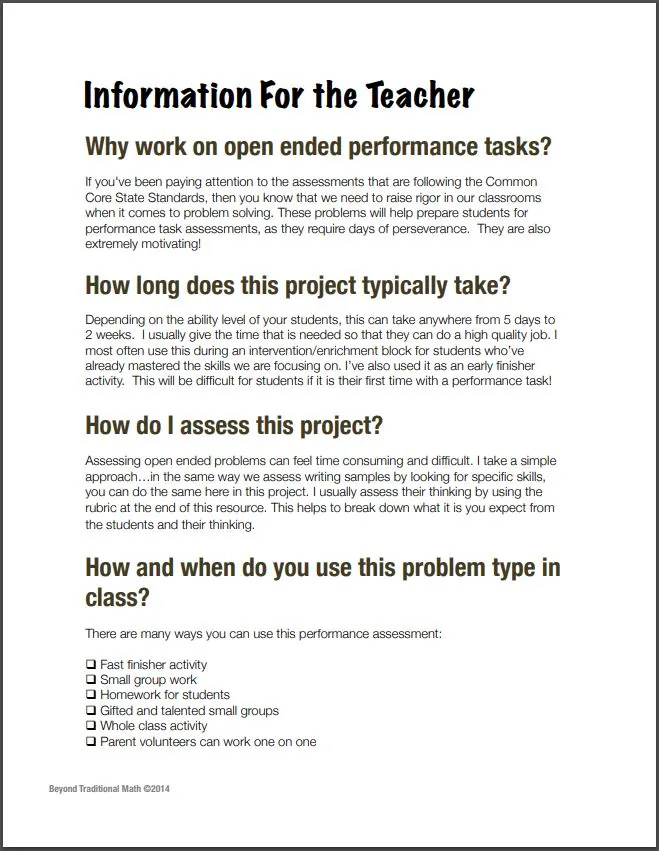
Plan for 5 days to 2 weeks of work time, since the teacher notes describe this as a multi-day project rather than a single-sitting worksheet.
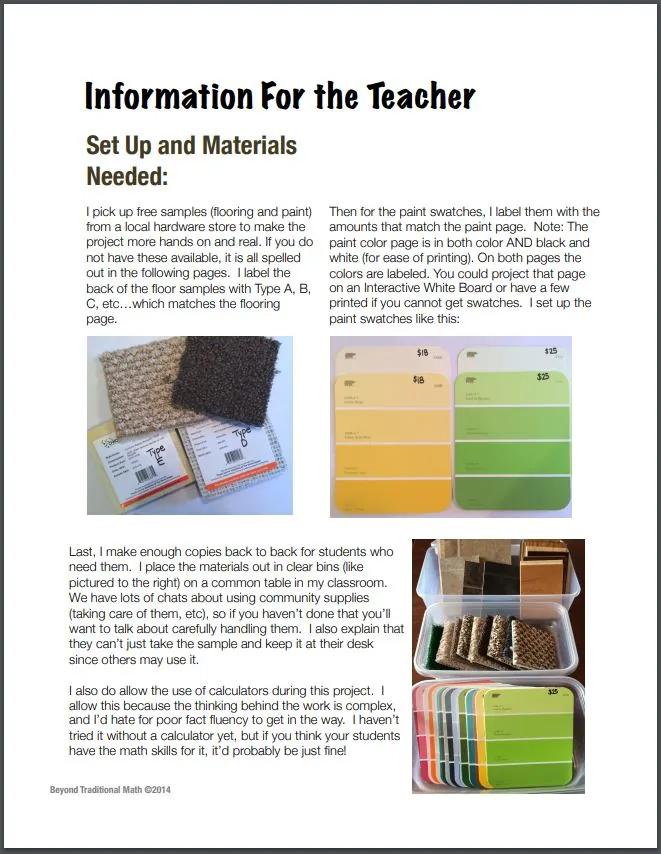
Allow calculators during the project, as the teacher notes explain that the complexity of the thinking is the point, not computational fluency.
Use the included scoring rubric to assess student thinking the way you would assess a writing sample, per the teacher notes' own suggested approach.

Skills covered
Area calculation — measuring a rectangular room's square footage from a hand-drawn, dimensioned blueprint.
Multi-step cost computation — multiplying per-square-foot flooring prices and summing per-item furniture, textile, and accessory costs into category and grand totals.
Scale/blueprint drawing — creating a labeled birds-eye-view floor plan with furniture placed within a maximum 30' x 35' footprint.
Good to know
Questions teachers ask about this resource
How open-ended is the final design and budget?
Entirely open-ended — students choose their own furniture, flooring, paint, textiles, and accessories from priced lists, so the totals and final design differ for every student.
What is the maximum room size students can design?
Wall dimensions cannot exceed 30 feet by 35 feet, per the blueprint guidelines.

No reviews yet
Downloaded this resource? Tell other teachers how it went.
Curriculum
Standards, concepts & topics
Standards
 Standards
- 4.MD.A.3 — Apply the area and perimeter formulas for rectangles in real world and mathematical problems. For example, find the width of a rectangular room given the area of the flooring and the length, by viewing the area formula as a multiplication equation with an unknown factor.
- 4.MD.A.2 — Use the four operations to solve word problems involving distances, intervals of time, liquid volumes, masses of objects, and money, including problems involving simple fractions or decimals, and problems that require expressing measurements given in a larger unit in terms of a smaller unit. Represent measurement quantities using diagrams such as number line diagrams that feature a measurement scale.
Core concepts
 Core concepts
area and perimeter
budgeting and cost calculation
blueprint/scale drawing
real-world math application
 Topics
Explore more
Categories this resource belongs to
Explore related searches
More to explore
You may also like