ESL Movie Guide Worksheets - Toy Story 5

- Grades
- Grades 7–12, Middle School, High School
- Pages
- 3
- File type
- Preparation
- Print ready


- Subject
- ELA, Language Development, ESL, Vocabulary, Formal Writing, Writing, Creative Writing
- Topic
- Toy Story 5, ESL Movie Guide
- Resource types
- Worksheets & Printables, Worksheets, Writing Prompts
- Preparation
- Print ready
- Standards
- W.7.3
Product description
From the author
This three-page printable PDF accompanies Toy Story 5 for English learners in grades 7–12. The vocabulary and response frames suit intermediate to advanced learners; provide language support or select fewer prompts when adapting it for other groups.
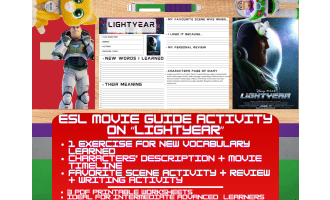
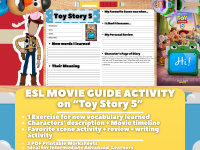
Within this ESL EFL Movie Guide on "Toy Story 5" (Pixar Animated Film) ESL EFL TESOL teachers can find the following English Second or Foreign Language (ESL - EFL - TESOL - TEFL) film activities:
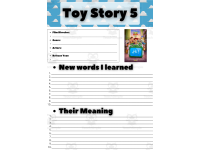
General Information – Students fill in key details about the film, including the director, genre, release year etc.
Vocabulary Builder – An activity dedicated to new words and phrases, to improve ESL EFL students’ English vocabulary
Character Analysis – Students describe the main characters, helping them practice descriptive language and comprehension.
Movie Timeline Activity – Students arrange scenes in chronological order to enhance their understanding of the storyline.
Favorite Scene Reflection – A writing activity where students describe and explain their favorite moments from the film.
Movie Review Writing – Learners express their opinions in a structured review, improving their evaluative writing skills.
Creative Writing Activity – Students imagine themselves as one of the characters and write three diary entries from that character’s perspective, deepening their connection with the storyline.
This "Toy Story 5" (Pixar Animated Film) movie guide is designed to create an enjoyable and stimulating learning experience for intermediate advanced ESL students.
Related resources
More resources teachers may find useful
24 related resources were found using this product's title, contributor, categories and tags.
In the classroom
Teaching tips & learning objectives

Learning objectives
Record a film's director, genre, cast and release year from its titles and credits
Collect ten unfamiliar words heard in the film and write a meaning for each
Give a personal opinion in writing — a favourite scene, why it appealed, and an overall review

Teaching tips
The vocabulary section is two matched columns, so it is meant to be filled during viewing and completed afterwards; agree with the class when to pause
Ten character boxes is a lot for one student, so splitting the page across pairs or groups and pooling the descriptions afterwards keeps the task moving
The credits header can be completed straight from the opening or closing titles, so complete it when those details are shown

Skills covered
Vocabulary capture in context — students log ten new words heard during the film and supply a meaning for each in the matching column.
Character description — ten boxes carry a named character apiece, so students write short descriptions that distinguish Buzz Lightyear from Woody, Forky from Atlas, and so on.
Sequencing events — a Movie Timeline section asks students to lay out the film's events in order rather than summarise them in prose.
Good to know
Questions teachers ask about this resource
Is the film or three blank diary pages included?
No. The download is a three-page response guide. Arrange film access separately and supply extra writing paper for the requested three diary entries.

No reviews yet
Downloaded this resource? Tell other teachers how it went.
Curriculum
Standards, concepts & topics
Standards
 Standards
- W.7.3
Core concepts
 Core concepts
Movie guide
Vocabulary log
Character description
Point of view writing
 Topics
Explore more
Categories this resource belongs to
Explore related searches
More to explore
You may also like