Finding Coordinates on a Grid

- Grades
- Grades 4–5
- Pages
- 2
- File type
- Preparation
- Print ready


- Subject
- Math, Geometry
- Topic
- Grid coordinates, Letter number grid
- Resource types
- Worksheets
- Preparation
- Print ready
Product description
From the author
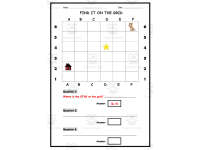
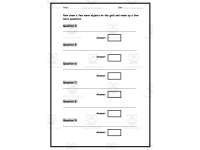
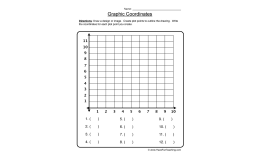
Students will practice Finding Coordinates on a Grid with this 2-page printable.
On the first page, they will write the coordinates of the symbols that are already on the grid.
Then they will add their own symbols to the grid and write the coordinates of those symbols on the next page.
Related resources
More resources teachers may find useful
24 related resources were found using this product's title, contributor, categories and tags.


In the classroom
Teaching tips & learning objectives

Learning objectives
Identify a point on a grid using a letter-number coordinate pair.
Locate a labeled object (a star) on a coordinate grid from a given worked example.
Add original objects in empty grid cells and write matching coordinate questions and answers.

Teaching tips
Use the worked example (star at D,4) to model coordinate notation before students attempt their own questions.
Have students swap papers after drawing their own objects so a partner answers each other's coordinate questions.
Reinforce that the column letter is read before the row number, since the worksheet's own answer format follows that order.

Skills covered
Coordinate grid reading — students locate a given object (a star) on a lettered/numbered grid and state its coordinate pair, e.g., (D,4).
Coordinate notation writing — students record location answers using the letter-then-number format modeled by the worked example.
Grid-based questioning — students add their own objects to the pictured grid and write original location questions for a peer to solve.
Good to know
Questions teachers ask about this resource
In what order should students write their coordinate answers — letter first or number first?
Letter first, then number, matching the worked example's answer of (D,4) for the star.

No reviews yet
Downloaded this resource? Tell other teachers how it went.
Resource details
Concepts & topics
Core concepts
 Core concepts
Coordinate grids
Ordered pairs
 Topics
Explore more
Categories this resource belongs to
Explore related searches
More to explore
You may also like