French Relative Pronouns Exercises with Answers: Dont and Où
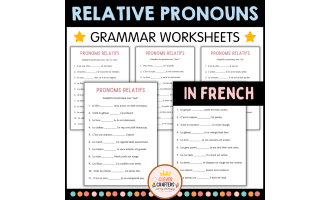
Students choose between the French relative pronouns dont and où in 20 sentences, correct three common errors and join seven sentence pairs, with every answer and its reason printed on the last page.

- Grades
- Grades 10–12, High School
- Pages
- 4
- File type
- Answer key
- Included


- Subject
- Foreign Languages, French
- Topic
- French worksheet, grammar worksheet
- Resource types
- Worksheets & Printables, Worksheets
- Answer key
- Included
About this resource
What's inside this resource
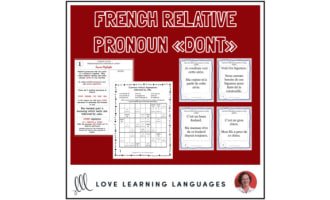
Dont replaces de plus a noun, and où points to a place or a time. Those two rules fill the side-by-side rule box that opens these French relative pronouns exercises, with model sentences such as C’est le voyage dont je rêve and C’est le café où nous nous retrouvons. The box lists common de-expressions (parler de, avoir besoin de, avoir peur de, être fier de, rêver de), shows dont for whose and notes that de drops out of the clause after dont.
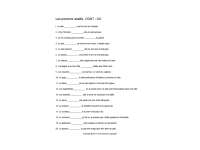
Part A spreads 20 one-blank sentences over two pages, 11 for dont and 9 for où in mixed order. Beyond verbs with de, the dont items include adjectives with de (content de, satisfait de), se servir de, s’occuper de and possession, while four où items follow a time word: le jour, l’été, l’année, le moment. Part B gives three sentences with a typical error to rewrite: que in place of dont, dont after a place, and an extra de after dont. In Part C, students join seven pairs of sentences, such as Voici le village. + Ma grand-mère est née dans ce village.
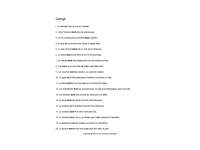
The last page gives all 30 answers with reasons, accepted word-order variants for two combined sentences, a quick-check table and an oral sentence starter.
Related resources
More resources teachers may find useful
24 related resources were found using this product's title, contributor, categories and tags.



In the classroom
Teaching tips & learning objectives

Learning objectives
- Use dont after verbs and expressions built with de, such as avoir besoin de, parler de and se servir de.
- Use dont after adjectives built with de, such as content de and satisfait de.
- Use dont to show possession, as in la fille dont le frère joue au foot.

Teaching tips
- Have students underline the verb, adjective or noun before each blank in Part A first; spotting avoir besoin, content, s’occuper or a place or time word settles the choice.
- Discuss item 3 before or after the task: du jour belongs to the main clause, and the blank is about time, so où is correct.
- Use items 9, 16 and 20 to show dont for whose before students reach the possession pairs in Part C (items 28 and 30).

Skills covered
- Dont with de-expressions — students complete C’est le livre ___ j’ai besoin and Voici l’ordinateur ___ je me sers tous les jours.
- Dont with adjectives — students complete C’est un projet ___ je suis très content.
- Dont for possession — students complete J’ai un vélo ___ les freins sont cassés and join Voici ma voisine with Le chat de ma voisine est très gentil.
Good to know
Questions teachers ask about this resource
Are qui, que and lequel practiced too?
The sheet focuses on dont and où only. Que appears once, in item 21, as the mistake students correct to dont, so the set works well after students already know qui and que.
Does où cover time as well as place?
Yes. The rule box gives le jour, l’année and le moment as examples, Part A items 3, 8, 14 and 17 use le jour, l’été, l’année and le moment, and item 27 joins Je n’oublierai jamais le jour with J’ai gagné le match ce jour-là.
Which uses of dont appear in Part A?
Verbs with de (avoir besoin de, parler de, avoir peur de, se servir de, s’occuper de), adjectives with de (content de, satisfait de) and possession, as in C’est l’auteur dont j’ai lu tous les romans. The key names the expression or the possession behind each answer.
Will students lose marks for a different word order in Part C?
The key accepts two orders for items 25 and 26, for example C’est un professeur dont les élèves parlent souvent and C’est un professeur dont parlent souvent les élèves. The other five combined sentences have one natural order.

No reviews yet
Downloaded this resource? Tell other teachers how it went.
Resource details
Concepts & topics
Core concepts
 Core concepts
- Relative pronouns
- Dont
- Où
- Verbs with de
- Relative clauses
 Topics
Explore more
Categories this resource belongs to
Explore related searches
More to explore
You may also like