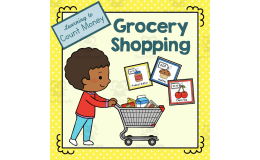
Grocery Shopping Math – Financial Literacy Grades 5-8 Price Comparison
Unit prices for eggs, rice, yogurt and more anchor eight grocery problems where grades 5–8 shoppers apply buy-2-get-1, percent-off and store-card deals and judge the best buy.


- Grades
- Grades 5–8, Elementary, Middle School
- Pages
- 6
- File type
- Answer key
- Included


- Subject
- Special Resources, Life Studies, Life Skills, Math, Percentages, Decimals, Money, Multiplication and Division, Multiplication, Home Economics
- Topic
- unit price, comparison shopping
- Resource types
- Worksheets & Printables, Word Problems, Activities, Worksheets
- Answer key
- Included
About this resource
What's inside this resource
Beyond the arithmetic, students explain a shopper's mistake about a lower price tag, weigh bus fare against a cheaper store across town and write a tip for a friend who thinks the biggest package always wins.
Related resources
More resources teachers may find useful
24 related resources were found using this product's title, contributor, categories and tags.



In the classroom
Teaching tips & learning objectives

Learning objectives
- Calculate unit prices and round to the nearest cent
- Find the price paid after a buy-2-get-1-free deal, a percent discount or a store-card discount
- Compare two or three offers to choose the best buy

Teaching tips
- Go over the deal decoder before students start, since four of the comparisons include a discount.
- Use the rice problem to talk about why comparing price tags alone can mislead a shopper.
- Have students share their Offer C from problem 7 and test whether each one really beats both prices.
Good to know
Questions teachers ask about this resource
Do students need calculators?
The problems involve dividing money amounts and rounding to the nearest cent, so a calculator helps many students. Each problem has a work box for showing the steps.

No reviews yet
Downloaded this resource? Tell other teachers how it went.
Curriculum
Standards, concepts & topics
Standards
 Standards
- 6.RP.A.3 — Use ratio and rate reasoning to solve real-world and mathematical problems, e.g., by reasoning about tables of equivalent ratios, tape diagrams, double number line diagrams, or equations. a. Make tables of equivalent ratios relating quantities with whole-number measurements, find missing values in the tables, and plot the pairs of values on the coordinate plane. Use tables to compare ratios. b. Solve unit rate problems including those involving unit pricing and constant speed. For example, if it took 7 hours to mow 4 lawns, then at that rate, how many lawns could be mowed in 35 hours? At what rate were lawns being mowed? c. Find a percent of a quantity as a rate per 100 (e.g., 30% of a quantity means 30/100 times the quantity); solve problems involving finding the whole, given a part and the percent. d. Use ratio reasoning to convert measurement units; manipulate and transform units appropriately when multiplying or dividing quantities.
- 6.RP.A.2 — Understand the concept of a unit rate a/b associated with a ratio a:b with b ≠ 0, and use rate language in the context of a ratio relationship. For example, “This recipe has a ratio of 3 cups of flour to 4 cups of sugar, so there is 3/4 cup of flour for each cup of sugar.” “We paid $75 for 15 hamburgers, which is a rate of $5 per hamburger.”1
- 7.RP.A.3 — Use proportional relationships to solve multistep ratio and percent problems. Examples: simple interest, tax, markups and markdowns, gratuities and commissions, fees, percent increase and decrease, percent error.
Core concepts
 Core concepts
- Unit price
- Discounts
- Comparison shopping
 Topics
Explore more
Categories this resource belongs to
Explore related searches
More to explore
You may also like