Letter T Cut and Paste Worksheets
- Grades
- Preschool–K
- Pages
- 3
- File type
- Preparation
- Print ready


- Subject
- ELA, Language Development, Phonics
- Topic
- Alphabet Activities, Alphabet Worksheets
- Resource types
- Worksheets & Printables, Worksheets
- Preparation
- Print ready
- Standards
- CCSS.RF.K.1d CCSS.RF.K.3.a
Product description
From the author
These cut and paste worksheets for the letter T are great for letter recognition and beginning sounds. They are a quick and easy activity to give students who need practice with recognizing the letter T from amongst other letters or for those students who need extra practice distinguishing between the initial sounds in words. It is a great resource for students to practice recognizing the letter, or to evaluate students on their knowledge of the letter and its sound at the beginning of words.
These cut and paste worksheets are perfect for preschoolers and kindergartners who are working on identifying the most common initial /t/ sound in words as well as students who are learning to recognize the letter T in both capital and lowercase form.
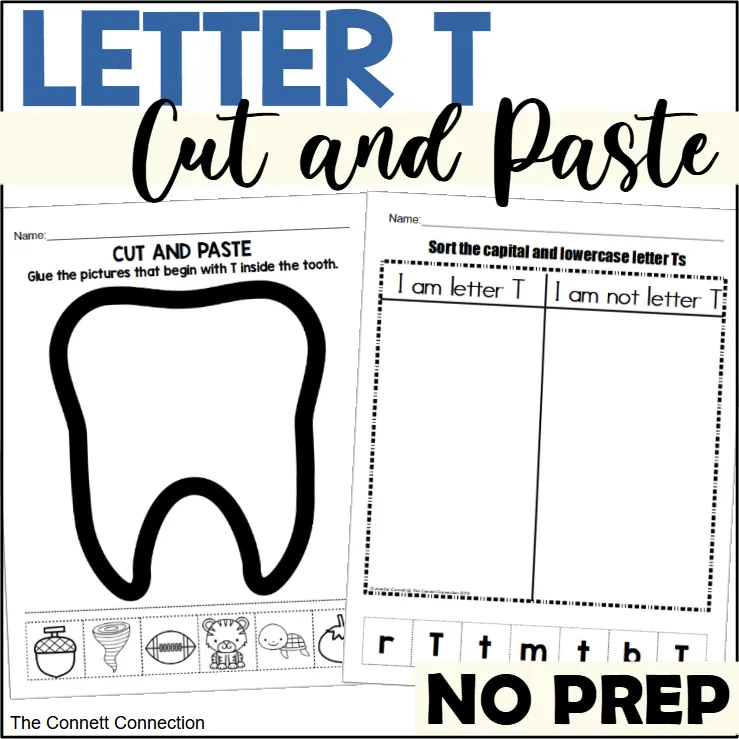
There are 3 different worksheets for students to use to practice the letter T
Sorting letters that are the letter T from letters that are not the letter T
Cut and paste page where students will glue the pictures that begin with the letter T on the tooth.
Sorting page where students will look through various forms of print and cut out examples of the letter and sort by capital letters and lowercase letters.
These alphabet worksheets can be used in the following ways
Literacy centers
Fine motor skills centers
Small group activities
Homework
Morning work
Emergency sub plans
Skills assessed with these letter T worksheets
Letter T Recognition
Initial Sound of the letter T
Cutting skills
Fine Motor Skills
Two of the worksheets are print and go. You only need to add scissors and glue. The other worksheet is low prep, as you need to gather printed materials for students to cut out examples of the letters in addition to scissors and glue. Students can work together or alone to complete the magazine cut and paste page.
Related resources
More resources teachers may find useful
24 related resources were found using this product's title, contributor, categories and tags.


In the classroom
Teaching tips & learning objectives

Learning objectives
Pick out pictures whose names begin with the letter T and separate them from those that do not
Tell the capital form T from the lowercase form t and place each in the matching column
Find the letter T among other letters, with r, m and b supplied as the alternatives

Teaching tips
All three pages are finished with scissors and glue, so the set works with children who recognise letters before they can write them
The two sorting pages are not the same task — one separates capital from lowercase, the other separates T from r, m and b — so read the column headers aloud rather than relying on the shared page heading
The tooth outline is the letter's own picture word; saying "tooth" as the page goes out ties the shape on the page to the sound being practised

Skills covered
Initial sound identification — the first page asks a child to glue only the pictures whose names begin with T inside the tooth outline.
Upper and lowercase matching — one sorting page heads a column with a capital T and the other with a lowercase t, so both piles are the same letter in different forms.
Letter discrimination — the second sorting page runs "I am letter T" against "I am not letter T" with r, m and b mixed into the cut-out row alongside T and t.
Good to know
Questions teachers ask about this resource
How do the two sorting pages differ from one another?
By what is being separated. One heads its columns with a capital T and a lowercase t, so every piece is a letter T and the sort is between the two forms. The other heads its columns "I am letter T" and "I am not letter T", and its cut-out row reads r, T, t, m, t, b, T, so the child is picking the letter out from among others.
Why a tooth?
Because it is a word that starts with the target letter. The direction reads "Glue the pictures that begin with T inside the tooth", so the shape the pictures are pasted into is itself an example of the sound being practised.
What does a child need to be able to do before starting?
Handle scissors and glue and name pictures aloud. No writing is asked for anywhere in the set — all three pages are completed by placing cut-out pieces — so it suits a child who is beginning to recognise letters but cannot yet form them.

No reviews yet
Downloaded this resource? Tell other teachers how it went.
Curriculum
Standards, concepts & topics
Standards
 Standards
- CCSS.RF.K.1d — Recognize and name all upper- and lowercase letters of the alphabet
- CCSS.RF.K.3.a — Demonstrate basic knowledge of one-to-one letter-sound correspondences by producing the primary sound or many of the most frequent sounds for each consonant.
Core concepts
 Core concepts
Letter recognition
Beginning sounds
Uppercase and lowercase
Cut and paste
 Topics
Explore more
Categories this resource belongs to
Explore related searches
More to explore
You may also like