Multiplication Strategy Cards: 14 Fact Strategies for Factors 0 to 10
Students learn a strategy for each multiplication factor from 0 to 10 using fourteen illustrated reference cards, then choose a card to solve facts and show their thinking steps.


- Grades
- Grades 2–5, Elementary
- Pages
- 9
- File type
- Answer key
- Included


- Subject
- Math, Multiplication and Division, Division
- Topic
- math flash cards, multiplication
- Resource types
- Worksheets & Printables, Flashcards
- Answer key
- Included
About this resource
What's inside this resource
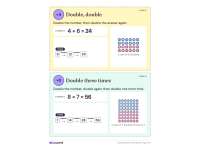
Fourteen half-page cards, two to a page with dashed cut lines, give one multiplication fact strategy each for factors 0 to 10. They run in teaching order: the zero rule, the one rule and the turn-around rule, then doubles for ×2, double-double for ×4 and double three times for ×8, place value for ×10 and half of ten for ×5, then double plus one more group for ×3, three then double for ×6, five plus two for ×7 and ten minus one group for ×9. Square numbers and a card of tricky facts such as 7 × 8 = 56 finish the set.
Every card shows the strategy name, a one-line rule, a solved example, a Think chain such as 3 × 7 = 21, doubled to 42, and a side panel, usually a dot array or place-value chart, that pictures the steps. Cards suit a math wall, a ring or a desk during practice.
The first page explains how to use the cards and has twelve pick-a-card facts plus two facts to solve with Think steps. A final page gives the answers, a card finder for each factor and the squares to 10 × 10.
Related resources
More resources teachers may find useful
24 related resources were found using this product's title, contributor, categories and tags.



In the classroom
Teaching tips & learning objectives

Learning objectives
- Use the zero, one and turn-around rules to find products quickly.
- Build ×4 and ×8 facts by doubling a ×2 fact.
- Find ×5 facts as half of ×10 and ×9 facts as ten groups minus one group.

Teaching tips
- Introduce the cards in the order printed on the key tip: 0, 1 and the turn-around rule, then the doubling family, then 10 and 5, then the cards that build on them.
- Cut the cards on the dashed lines and display them on a math wall or keep a set on a ring.
- When checking the pick-a-card page, accept any card whose steps work, since facts such as 8 × 9 can be solved with more than one card.

Skills covered
- Properties of multiplication — students apply the zero, one and turn-around rules with examples such as 8 × 3 = 3 × 8.
- Doubling strategies — students double 7 three times to reach 8 × 7 = 56 and double twice for ×4.
- Using known facts — students find 7 × 4 as 5 × 4 plus 2 × 4 and 9 × 6 as 60 minus 6.
Good to know
Questions teachers ask about this resource
How big are the cards?
Each card fills half a page, about 7.4 by 4.7 inches, so the rule and example are readable from a math wall. The seven card pages hold only cards, ready to cut on the dashed lines.
Which card should students use for a ×9 fact?
The ten minus one group card: find 10 times the number, then take away one group, as in 10 × 6 = 60, minus 6 is 54. It also shows a digit-sum check, 5 + 4 = 9.
What is on the tricky facts card?
It lists 6 × 7 = 42, 7 × 8 = 56 and 8 × 8 = 64 to learn by heart and shows how to rebuild 7 × 8 from 5 × 8 and 2 × 8 when a fact slips.

No reviews yet
Downloaded this resource? Tell other teachers how it went.
Resource details
Concepts & topics
Core concepts
 Core concepts
- Multiplication strategies
- Multiplication facts 0–10
- Commutative property
- Doubling
- Square numbers
 Topics
Explore more
Categories this resource belongs to
Explore related searches
More to explore
You may also like