Printable Good and Bad Manners Activity Worksheets for Grade 2, 3, 4

- Grades
- Grades 2–4, Elementary
- Pages
- 9
- File type
- Preparation
- Print ready


- Subject
- P.E. & Health, Social Emotional Learning (SEL), Special Resources
- Topic
- Good manners, Social skills
- Resource types
- Worksheets, Worksheets & Printables
- Preparation
- Print ready
Product description
From the author
Introduction
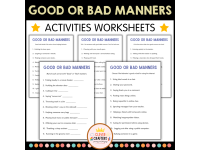
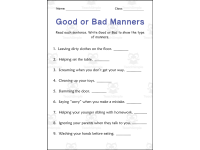
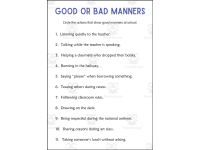
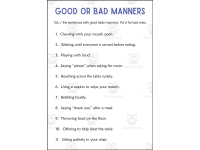
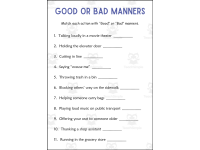
This set of Good or Bad Manners worksheets is designed to help students learn and understand appropriate social behaviors through interactive activities. By evaluating actions and deciding if they reflect good or bad manners, students practice social awareness and courtesy.
What’s Included:
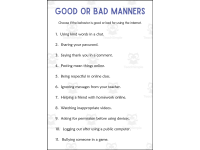
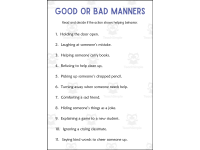
Activities to identify and categorize good and bad manners in various scenarios
Exercises focusing on good manners in school, at home, on the internet, and in public spaces
Activities that encourage the use of polite words like "please," "thank you," "sorry," and "excuse me"
Scenarios for practicing helpful behaviors, including helping peers and showing kindness
Drawing and matching exercises to reinforce learning about polite behavior
Grades / Ages:
Ideal for Grades 2–5
Implementation Format:
Perfect for classroom activities, homework assignments, and group discussions
A great resource for teaching respectful behavior and communication
Answer Key:
Not included
File Type:
PDF (Non-editable)
Number of Pages:
9 pages total
License:
Paid product for personal or single-classroom use only
Related resources
More resources teachers may find useful
24 related resources were found using this product's title, contributor, categories and tags.



In the classroom
Teaching tips & learning objectives

Learning objectives
Judge whether a described behavior reflects good or bad manners across home, school, table, public, and online contexts.
Select the correct polite word (please, thank you, excuse me, sorry) for a given social situation.
Distinguish situations that call for an apology from those that do not.

Teaching tips
Work through the nine pages across multiple short sessions rather than one sitting, since the pages vary their situations and response formats.
Discuss a few answers as a class on the internet-etiquette page (page 5), since online behavior may be less concrete for younger students than table or classroom manners.
Use the polite-words page (page 7) as a vocabulary check before or after the judgment-based pages, since it asks students to produce language rather than evaluate it.

Skills covered
Behavior judgment — students consider more than ninety manners-related situations across nine activity pages.
Situational vocabulary — students supply the correct polite word (please, thank you, excuse me, sorry) for a given scenario.
Empathy and social reasoning — students decide whether an apology is warranted for a specific situation on the closing page.

No reviews yet
Downloaded this resource? Tell other teachers how it went.
Resource details
Concepts & topics
Core concepts
 Core concepts
Manners
Polite language
Social behavior judgment
 Topics
Explore more
Categories this resource belongs to
Explore related searches
More to explore
You may also like