Relative Adverbs Practice Grammar Worksheets for Grade 2, 3, 4


- Grades
- Grades 2–4, Elementary
- Pages
- 6
- File type
- Preparation
- Print ready


- Subject
- ELA, Grammar, Language Development
- Topic
- Relative adverbs, Where when why
- Resource types
- Worksheets, Worksheets & Printables
- Preparation
- Print ready
- Standards
- L.4.1
Product description
From the author
Introduction
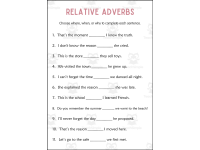
This set of worksheets focuses on relative adverbs and gives students practice using where, when, and why in sentences with relative clauses. The activities are based on familiar situations, helping students understand how these words connect ideas and add more detail.
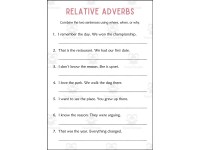
Students work through a mix of reading, choosing the correct word, combining sentences, and spotting mistakes, which helps reinforce their understanding step by step
What’s Included:
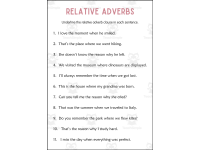
• Identifying relative adverbs in sentences
• Choosing between where, when, and why
• Sentence combining activities
• Practice with relative adverb clauses
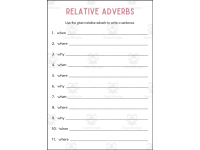
• Writing sentences using given relative adverbs
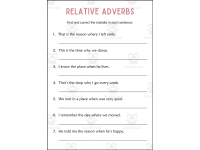
• Error correction exercises
Grades / Ages:
Choose these tasks for learners ready to work with clauses and sentence combining.
Implementation Format:
These worksheets can be used for:
• Grammar lessons
• Classroom practice
• Independent work
• Small group activities
• Homework
• Review
Answer Key:
Not included
File Type:
PDF (Non-editable)
Number of Pages:
6 pages total
License:
Paid product for personal or single-classroom use only
Related resources
More resources teachers may find useful
24 related resources were found using this product's title, contributor, categories and tags.


In the classroom
Teaching tips & learning objectives

Learning objectives
Identify the relative adverbs where, when, and why in complete sentences
Select the relative adverb that matches a sentence's meaning of place, time, or reason
Combine two related sentences into one using a relative adverb

Teaching tips
- Compare examples describing a place, a time and a reason before the selection tasks.
- Discuss more than one valid response for open sentence-writing items.
- Use the correction sheet to ask students why a revised sentence works.

Skills covered
Relative adverb identification — students circle where, when, or why in ten sentences and underline the full relative clause in eleven more.
Sentence combining — students merge pairs such as “I remember the day. We won the championship.” into one sentence with a relative adverb.
Proofreading — seven sentences use the wrong relative adverb (“This is the time why we dance”) and students find and correct each mistake.
Good to know
Questions teachers ask about this resource
Do students work only with given sentences, or write their own too?
Both. Four sheets work with provided sentences — circling adverbs, filling blanks, underlining clauses, and correcting errors — while the combining sheet merges sentence pairs and a full writing sheet has students compose eleven original sentences using an assigned when, where, or why.

No reviews yet
Downloaded this resource? Tell other teachers how it went.
Curriculum
Standards, concepts & topics
Standards
 Standards
- L.4.1
Core concepts
 Core concepts
Relative adverbs
Grammar
Sentence structure
 Topics
Explore more
Categories this resource belongs to
Explore related searches
More to explore
You may also like