



Research-Based Writing Rubric – Class Ready
- Grades
- Grades 3–6, Elementary, Middle School
- File type
- Preparation
- Print ready


- Subject
- ELA, Writing, Research
- Topic
- research, report
- Resource types
- Rubrics, Teacher Tools
- Preparation
- Print ready
- Standards
- CCSS.W.6.8 CCSS.W.3.8 +1
About this resource
What's inside this resource
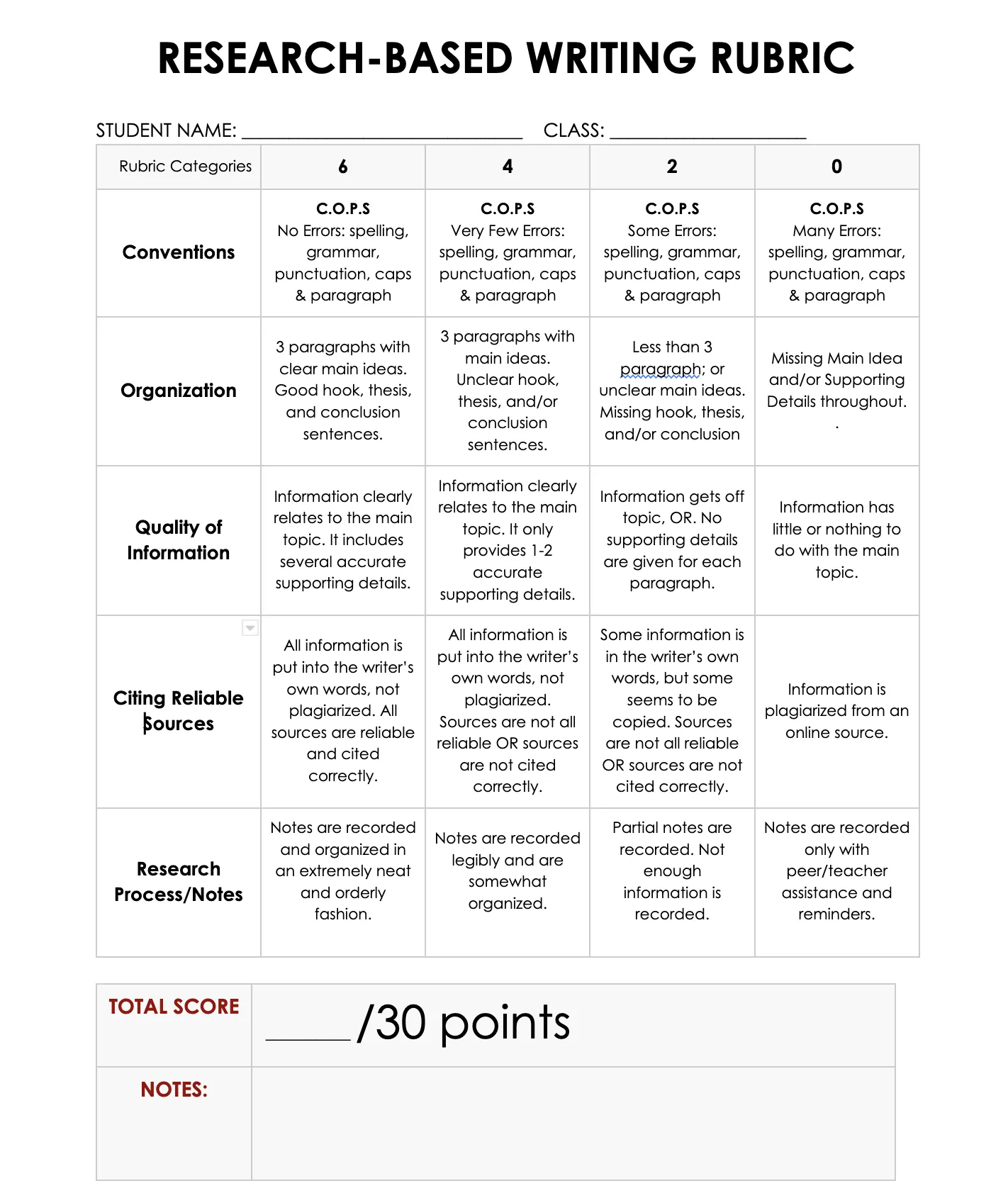
This resource is a Research-Based Writing Rubric.
When students are getting ready to write an informative research-based piece, this rubric is a great tool to score it.
This rubric covers:
- Conventions
- Organization
- Quality of information
- Citing reliable sources
- Research process/notes
Related resources
More resources teachers may find useful
24 related resources were found using this product's title, contributor, categories and tags.


In the classroom
Teaching tips & learning objectives

Teaching tips
Share the rubric with students before they begin drafting, since it specifies concrete expectations such as a three-paragraph structure with hook, thesis, and conclusion.
Use the Citing Reliable Sources row explicitly when teaching paraphrasing and plagiarism, since it distinguishes degrees of copied versus original wording.
Score the Research Process/Notes row during the drafting phase rather than only at final submission, since it assesses note-taking independence rather than the finished essay.

Skills covered
Assessment scoring — the teacher scores a student's research-based informative writing across five categories: conventions, organization, quality of information, source citation, and research notes.
Rubric-referenced feedback — the teacher uses written level descriptors (e.g., "3 paragraphs with clear main ideas" vs. "missing main idea") to explain a score to the student.

No reviews yet
Downloaded this resource? Tell other teachers how it went.
Curriculum
Standards, concepts & topics
Standards
 Standards
- CCSS.W.6.8 — Gather relevant information from multiple print and digital sources; assess the credibility of each source; and quote or paraphrase the data and conclusions of others while avoiding plagiarism and providing basic bibliographic information for sources
- CCSS.W.3.8 — Recall information from experiences or gather information from print and digital sources; take brief notes on sources and sort evidence into provided categories.
- CCSS.W.4.4 — Produce clear and coherent writing in which the development and organization are appropriate to task, purpose, and audience. (Grade-specific expectations for writing types are defined in standards 1–3 above.)
Core concepts
 Core concepts
writing rubric
research writing
source citation
informative writing
 Topics
Explore more
Categories this resource belongs to
Explore related searches
More to explore
You may also like


