Square Root Function Worksheet

- Grades
- Grades 9–12, High School
- File type
- Preparation
- Print ready


- Subject
- Math, Algebra
- Topic
- square root, cube root
- Resource types
- Worksheets & Printables, Worksheets
- Preparation
- Print ready
About this resource
What's inside this resource
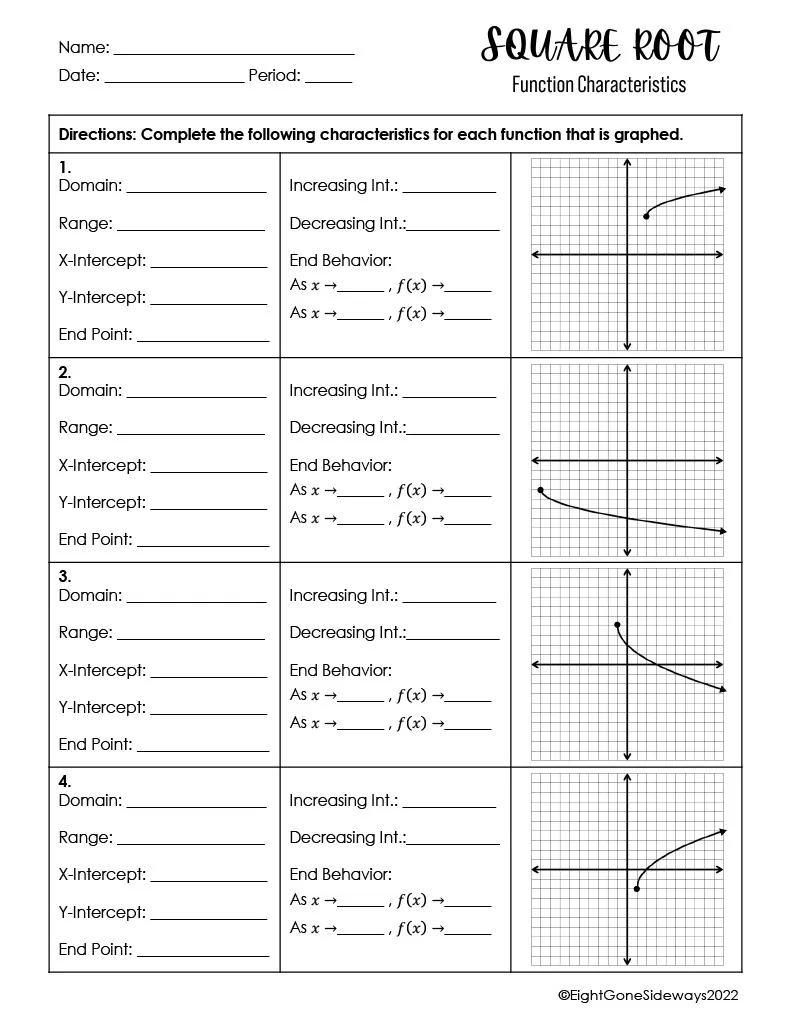
This is a Square Root printables/worksheets/worksheets-by-subject/math-worksheets/calculus-worksheets/functions-worksheet">Functions Worksheet that will give students practice with finding characteristics for graphs.
There are 8 problems - 4 per page.
Students will complete the characteristics for each function that is graphed.
Related resources
More resources teachers may find useful
24 related resources were found using this product's title, contributor, categories and tags.




In the classroom
Teaching tips & learning objectives

Learning objectives
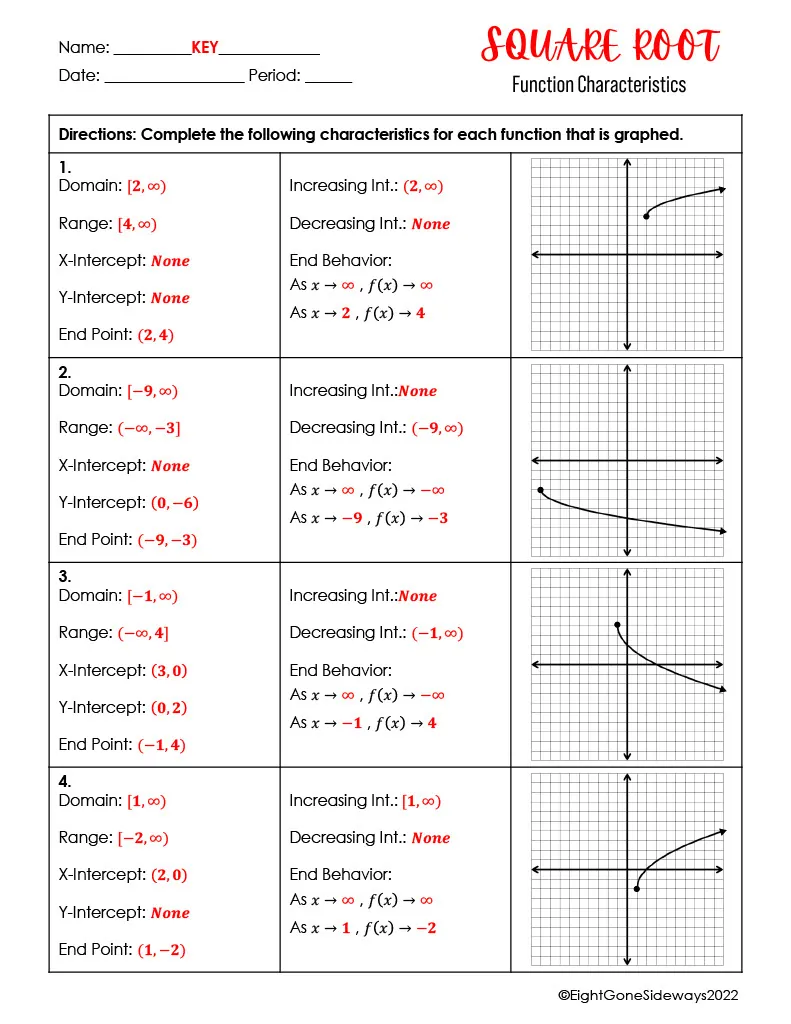
Locate the end point of a square root function by finding the value that makes the radicand zero, and read the domain from it
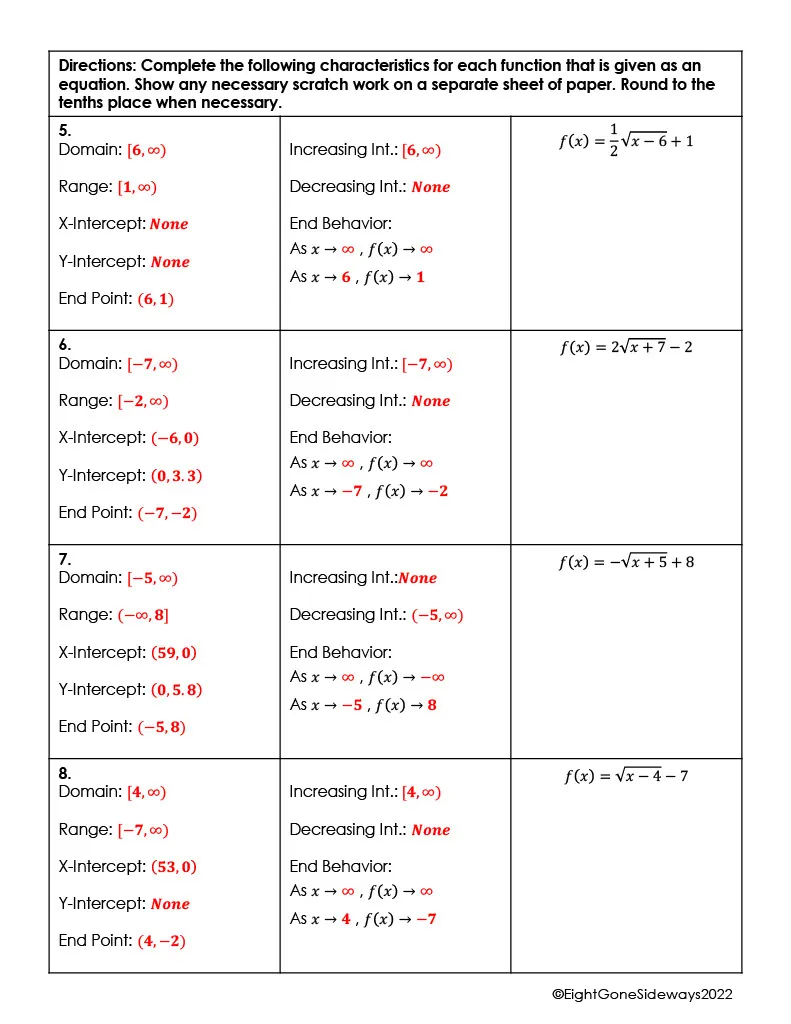
State the range from the end point and the direction of the curve, giving [−2, ∞) for an upward curve and (−∞, 8] for a downward one
Solve for the x-intercept by isolating the radical and squaring, as in √(x + 5) = 8 giving x = 59

Teaching tips
Page 1 reads the nine characteristics from pictures and page 2 derives them from symbols, so running page 1 first gives students the vocabulary before the algebra
Problem 7, f(x) = −√(x + 5) + 8, is the only equation with a negative in front of the radical, which reverses the range and turns the interval answer from increasing to decreasing — worth working together
The second end-behaviour line is not about infinity: it describes what happens as x approaches the end point, so the marking page writes "As x → −7, f(x) → −2" rather than a limit at −∞

Skills covered
Domain restriction from a radical — students find where the radicand turns negative, so f(x) = √(x − 4) − 7 is defined on [4, ∞) and f(x) = ½√(x − 6) + 1 on [6, ∞).
Reading a curve's start point — every problem asks for the End Point explicitly, from (2, 4) on the first graph to (−7, −2) for f(x) = 2√(x + 7) − 2.
Solving radical equations for an intercept — the x-intercept comes from isolating and squaring, giving 59 for −√(x + 5) + 8 and 53 for √(x − 4) − 7.
Good to know
Questions teachers ask about this resource
What is the End Point line asking for?
Where the curve begins. A square root function exists only from the value that makes the radicand zero, so f(x) = 2√(x + 7) − 2 starts at (−7, −2) and f(x) = −√(x + 5) + 8 at (−5, 8). That point fixes the domain and one end of the range at the same time.
How are the increasing and decreasing intervals answered here?
One of the two is always None. A square root curve turns in one direction only, so f(x) = √(x − 4) − 7 is increasing on [4, ∞) with no decreasing interval, while f(x) = −√(x + 5) + 8 is decreasing on (−5, ∞) with no increasing interval.
How precise do the answers need to be?
To the tenths place where a value is not exact, which the page states directly. The marking pages follow it: the y-intercept of 2√(x + 7) − 2 is 3.3 and of −√(x + 5) + 8 is 5.8, while exact results such as the x-intercepts 59 and 53 are written whole.

No reviews yet
Downloaded this resource? Tell other teachers how it went.
Resource details
Concepts & topics
Core concepts
 Core concepts
Square root functions
Domain and range
Radical equations
End behavior
Interval notation
 Topics
Explore more
Categories this resource belongs to
Explore related searches
More to explore
You may also like