



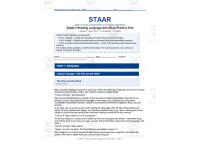
Texas STAAR Reading Practice Test for Grade 3



- Grades
- Grade 3
- Pages
- 20
- File type
- Answer key
- Included


- Subject
- ELA, Reading Comprehension
- Topic
- Texas STAAR, Grade 3 reading
- Resource types
- Tests, Assessments
- Answer key
- Included
- Standards
- RI.3.1
Product description
From the author
Practice reading comprehension, paired-text comparison, revising, editing and evidence-based writing. The 12-page test contains four reading passages, two student-writing drafts and 35 response tasks: 31 multiple-choice questions, three short responses and one extended response.
A three-page answer key supplies correct choices, short-response examples and scoring guidance. A five-page teacher guide includes an alignment table, administration suggestions and tracking material. Multiple-choice answers are mainly letters, rather than detailed explanations for every choice.
The source summaries state 41 questions and 52 points, which do not match the supplied tasks and listed point values. Check scoring before grading; equivalence to the current official STAAR format has not been established.
Related resources
More resources teachers may find useful
24 related resources were found using this product's title, contributor, categories and tags.


In the classroom
Teaching tips & learning objectives

Learning objectives
Determine central idea, author's purpose, and text structure in literary and informational passages.
Compare and connect information across paired passages on a shared topic.
Revise and edit a student writing draft for clarity, grammar, and sentence structure.

Teaching tips
- Ask students to explain why an edit improves the draft before comparing answers. Check the scoring scheme before grading because the source summaries do not match the supplied task count and point values.

Skills covered
Reading comprehension — students answer literal and inferential questions about a fiction passage, an informational passage, and paired texts.
Cross-text analysis — students identify shared ideas and connections between the river narrative and the water-cycle article.
Revising and editing — students identify grammar, punctuation, and clarity issues in two sample student drafts.
Good to know
Questions teachers ask about this resource
Can I use the writing section separately?
Yes. Select the revising and editing tasks or the extended response for a focused writing lesson, using the related text when the prompt requires it.

No reviews yet
Downloaded this resource? Tell other teachers how it went.
Curriculum
Standards, concepts & topics
Standards
 Standards
- RI.3.1
Core concepts
 Core concepts
Reading comprehension
Author's purpose
Text structure
Revising and editing
Extended constructed response
 Topics
Explore related searches
More to explore
You may also like


