Volcanic Magma Viscosity STEM Challenge (ESS02)


Science, STEM, Physics, Earth and Environmental Sciences, Environmental Science, Earth Sciences


About This Product
Bring magma viscosity (felsic vs. mafic), silica composition, fluid internal friction, gravitational incline vectors, volcano landform mechanics, and flow speed math to life with the Volcanic Magma Viscosity STEM Challenge (ESS02)! Designed for Middle School Earth & Space Science, Physical Science, Fluid Physics, Math, and STEM classes across Grades 6–8, this 3-page, print-ready lab packet challenges students to test lava flow velocity down adjustable model ramps.
What Is Included in This 3-Page Packet?
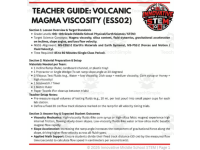
📋 Page 1: Teacher Guide & Lesson Plan
Features NGSS alignment (MS-ESS2-2 Earth's Surface Processes & Volcanology, MS-PS2-2 Forces & Motion), key fluid dynamics concepts, test fluid prep directions, speed math troubleshooting tips, and a full teacher answer key.
🌋 Page 2: Student Mission Card & Blueprint
Hooks students with a volcanology mission to model hazard zones for explosive vs. effusive eruptions. Includes material constraints (model ramp, protractor, 3 test fluids like water, dish soap, and corn syrup, stopwatch, 30 cm track rule) and a dedicated schematic sketching zone to diagram slope incline angles, fluid friction vectors, and lava flow fronts.
📊 Page 3: Testing Log & Scientific Reflection
Features a structured lab data table tracking fluid travel times in seconds, simulated silica content levels, and calculated flow speeds across 3 distinct fluid viscosities. Includes an applied math section to calculate Average Lava Flow Speed (Speed = Distance / Time) in centimeters per second (cm/s), followed by reflection questions analyzing internal fluid friction, gravitational incline vectors, and shield vs. composite/stratovolcano slope geometry.
Educational Value & Key Benefits:
Hands-On Earth & Physical Science: Connects chemical silica content and fluid viscosity directly to eruption styles and volcanic landform shapes.
Integrates Applied Math & Speed Calculations: Teaches students how to record metric distance measurements and compute average fluid velocity in cm/s.
Low-Cost High-Engagement STEM: Uses inexpensive household items like cardboard ramps, water, dish soap, corn syrup, and timers for an active physical science lab across Grades 6–8.
Resource Tags
0 Reviews
Check out these other great products