Wind Turbine Blade Aerodynamics STEM Challenge (ESS05)




About This Product
Bring renewable wind energy, aerodynamic lift vs. drag, blade pitch angle optimization, rotational kinetic energy, torque generation, and output math to life with the Wind Turbine Blade Aerodynamics STEM Challenge (ESS05)! Designed for Middle School Earth & Space Science, Environmental Science, Physical Science, Physics, Math, and STEM classes across Grades 6–8, this 3-page, print-ready lab packet challenges students to engineer high-efficiency wind turbine rotor blade assemblies.
What Is Included in This 3-Page Packet?
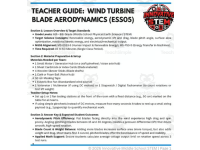
📋 Page 1: Teacher Guide & Lesson Plan
Features NGSS alignment (MS-ESS3-3 Renewable Energy Systems, MS-PS3-5 Energy Transfer & Conservation), key aerodynamic physics concepts, fan testing station setup guidelines, electrical voltage/RPM measuring tips, and a full teacher answer key.
💨 Page 2: Student Mission Card & Blueprint
Hooks students with a green energy engineering mission to design maximum-efficiency wind farm turbine blades. Includes material constraints (foam/cork hub, wooden skewers, cardstock or index cards, tape, metric ruler, protractor) and a dedicated schematic sketching zone to diagram blade curvature, surface area, pitch angle tilt vectors, and airfoil profiles.
📊 Page 3: Testing Log & Scientific Reflection
Features a structured lab data table tracking blade count (2, 3, or 4 blades), pitch angle setting in degrees, energy output performance, and rotational stability across 3 distinct test trials. Includes an applied math section to calculate Average Energy Output across testing runs, followed by reflection questions analyzing aerodynamic lift vs. parasitic drag, angle of attack, surface area friction trade-offs, and torque optimization.
Educational Value & Key Benefits:
Hands-On Green Technology & Physics: Connects wind kinetic energy directly to aerodynamic lift, rotor shaft torque, and electrical generation mechanics.
Integrates Applied Math & Data Averaging: Teaches students how to collect precision output readings and calculate multi-trial averages.
Low-Cost High-Engagement STEM: Uses accessible classroom supplies like cardstock, skewers, foam hubs, protractors, and a standard fan for an exhilarating renewable energy experiment across Grades 6–8.
Resource Tags
0 Reviews
Check out these other great products