World War 2 Timeline Worksheet with Answers


- Grades
- Grades 6–8
- Pages
- 3
- File type
- Answer key
- Included


- Subject
- Social Studies, History: World
- Topic
- World War II, Timeline
- Resource types
- Worksheets
- Answer key
- Included
Product description
From the author
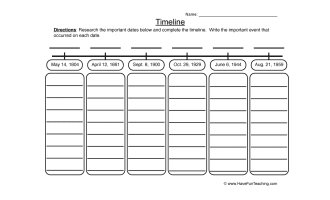
This three-page World War II worksheet set includes a timeline labeled 1938–1946, seven events to match with dates, and five wartime leaders to match with countries using a name bank. A completed answer page supports checking both matching tasks.
Use the worksheet after introducing the events, or provide a separate history reference for students to consult.
Related resources
More resources teachers may find useful
24 related resources were found using this product's title, contributor, categories and tags.


In the classroom
Teaching tips & learning objectives

Learning objectives
Sequence major World War II events, including the invasion of Poland, Pearl Harbor, D-Day, VE Day, and Japan's surrender, onto a timeline by year.
Match each of five WW2-era national leaders to the country they led.
Recall key end-of-war dates in the European and Pacific theaters, including 8 May 1945 (VE Day) and 15 August 1945 (Japan's surrender).

Teaching tips
Have students attempt the timeline and leader-matching page before comparing it to the included completed page for self-checking or peer-checking.
The timeline only spans 1938-1946, so pair it with a brief overview of pre-1938 causes if covering the war's origins is part of the lesson.
Read the five names in the word bank before students match them to countries.

Skills covered
Chronological sequencing — students place seven WW2 events onto a blank 1938-1946 timeline by year or date.
Historical figure identification — students match five wartime leaders (Churchill, Hitler, Mussolini, Roosevelt, Stalin) to the country each governed.
Cross-theater recall — students connect both European dates (invasion of Poland, D-Day, VE Day) and Pacific dates (Pearl Harbor, Japan's surrender) on one timeline.
Good to know
Questions teachers ask about this resource
Which theaters of the war does the timeline cover?
Both — most events are European (the invasion of Poland, D-Day, VE Day), but the timeline also covers the Pacific theater through Pearl Harbor and Japan's 15 August 1945 surrender.
How are the leader names supplied?
A name bank lists Churchill, Hitler, Mussolini, Roosevelt and Stalin. Students write each name beside the appropriate country.

No reviews yet
Downloaded this resource? Tell other teachers how it went.
Resource details
Concepts & topics
Core concepts
 Core concepts
World War II timeline
WW2 leaders
Historical sequencing
 Topics
Explore more
Categories this resource belongs to
Explore related searches
More to explore
You may also like