



3,989 products added recently
Page 72 - Science Activities
Ignite your students' interest in science with activities that make learning interactive and exciting. This collection offers experiments, demonstrations, and inquiry-based projects covering various scientific fields. By integrating these science activities into your lessons, you can encourage critical thinking, foster curiosity, and deepen understanding of scientific concepts.

 Show filters


Wind Energy Scavenger Hunt & WebQuest
Science, Physics, Grade 6, 7, 8, 9, 10, 11, Activities
This scavenger hunt guides students to research key facts about the history, technology, and innovations related to wind energy usage and storage. Key Concepts: What wind energy is and what causes wind, Basic components of a wind turbine, Ideal wind conditions and locations, Benefits and challenges of wind power, Current wind farms and the wind industry, Careers associated with wind technology, and more. It's an excellent way to get your students investigating the concept of wind power and how it has advanced over the years. It is perfect for middle or high school students can be done individually or in partners. Here are two example questions that your students will find on the scavenger hunt webquest. Wind Energy Scavenger Hunt WebQuest Task: Research the following questions online. What is wind energy and what causes wind to occur? What are the basic components of a wind turbine and how do they work together to generate electricity? All answers are included and your package also includes my Wind Energy STEM Challenge which will allow your students to explore the world of wind energy in an engineering challenge. Here is a portion of the challenge. Objective: Design and construct a wind-powered car that can travel 2 meters (6.5 feet) using only the wind generated by a fan. Your car must stay within a designated track of 1 meter (3.3 feet) in width. Materials: · Cardboard sheets. · Paper (for the sail) · Dowels or skewers for axles and structure. · Tape or glue. · Scissors. · Ruler or measuring tape. · Fan to provide wind power and markers or paint for decoration. Design Constraints: · The car must be primarily made of cardboard and paper. · The only allowed materials for the car's movement are dowels for axles and a paper sail. · The car cannot have any electronic or pre-made propulsion systems (e.g., no motors, batteries). · The vehicle must have at least two wheels. · The car must be freestanding and move straight on its own once the fan starts. · Decorations are permitted but cannot contribute to the car’s propulsion.
Author Teach With Fergy
Tags Wind Energy, Scavenger Hunt

Motion: Memory Match Game - FLASH-MAC
Science, Physics, Common Core, Grade 5, 6, 7, 8, Activities, Games
The Motion: Memory Match Game - FLASH-MAC This educational game is a highly engaging teaching resource specifically designed for Grades 5 through 8. With primary focus aimed at grasping concepts around the topic of Motion, it’s suited perfectly within classrooms and homeschooling environments imparting Science and Physics lessons. Format: This learning aid utilizes a memory match game format that involves six pairs of animals and their speeds hidden within the puzzle. Educational Benefits: Matrixed with Common Core State Standards, it ensures high-quality pedagogical content delivery not forgetting its alignment with Bloom’s Taxonomy principles for overall cognitive development. Versatility: This tool can be utilized during collective classroom sessions, smaller peer-led discussions or even assigned as homework material giving students ample room to pace themselves according to individual learning capacity. Compatibility:: Crafted as a software compatible specifically with Mac platforms, this product promises no glitches across such systems. In essence: The Motion: Memory Match Game-FLASH-MAC projects an innovative blend of gaming strategies rooted in modern education practices promising enhanced understanding of scientific concepts associated with motion – making physics fun-filled yet educative!
Author Classroom Complete Press
Tags Software (Mac)

Debugging (Unplugged Coding #6)
Science, Technology, Computer Science, Grade 1, 2, 3, 4, 5, 6, 7, 8, Activities
You want to introduce or teach your students about programming / coding however you don’t have access to computers? No problem. This “Unplugged Coding” resource works without computers. After completing these printable activities, your students can apply similar logic and strategies to coding websites and apps. This is a great alternative or additionally resource before using code.org or Scratch. This resource is apart of an unplugged coding series. In each, a different main concept is focused on. To use this resource, just print the PDF and have your students coding, unplugged today. The main focus of this resource is debugging. The purpose is to make students understand that errors and mistakes occur in code. This is normal and the code can be corrected. This resource includes the following type of activities and worksheets: Debugging Information page. Commands information page. The students use this page to understand how to debug the code. All the code includes basic logic, if / else, and loops. 8 Puzzles with code that needs to be debugged Each of the 8 contains an answer key These debugging challenges increase in difficulty.
Author Roombop
Tags Unplugged Coding, Coding, Programming, Printables

Science Reading Passages on Light Heat Electricity Magnetism (Videos)
Science, Physics, Common Core, ELA, ESL, Language Development, Reading Comprehension, Reading, Pre-Reading, Grade 2, 3, 4, Teacher Tools, Activities
Accompanying Videos Based on Reading Passages on Light Heat Electricity Magnetism for Physical Science These accompanying videos contain scripts extracted from the Science Reading Passages series. With stock footage, subtitles, voiceovers, animation and diagrams, they will help students understand the topic more. Ideal for starting or ending a lesson, each video runs at less than 5 minutes and is at least 95% identical to the passage itself. What's inside? Part 3 Videos - Light, Heat, Electricity & Magnetism. Reading Passage 1: Characteristics of Light: Reflection and Refraction Reading Passage 2: Heat, Sources of Heat, and Heat Conduction Reading Passage 3: Electricity, Electrical Circuits, and Energy Reading Passage 4: Symbols and Electric Circuits Reading Passage 5: Magnets Magnetism and Electromagnetism Science Reading Comprehension Outline: Targeted for students in 3rd and 4th grades, these reading passages are enhanced with illustrations and graphs to elucidate critical points. Each lesson aligns with the Common Core State Standards, allowing you to integrate science reading practice effortlessly, knowing that minimal preparation is needed on your part. Each passage comes with a variety of questions in different formats, including multiple-choice formats, data analysis, and fill-in-the-blanks. The topics covered strike a balance between engaging content and core curriculum-based science subjects. Versatile in application, these lessons are suitable for a variety of settings such as whole-class instruction, morning activities, independent desk work, small group discussions, contingency plans for substitute teachers, homework assignments, or even special holiday-themed tasks. FULL CATALOG OF DOWNLOAD LINKS HERE Grade 3/4 Links: Physical Science Part 1 - Properties of Objects and Materials Google Docs/Slides/Forms PDF PPT Word Free Supplementary Pack Accompanying Videos Physical Science Part 2 - Position and Motion of Objects Google Docs/Slides/Forms PDF PPT Word Free Supplementary Pack Accompanying Videos Physical Science Part 3 - Light, Heat, Electricity, Magnetism Google Docs/Slides/Forms PDF PPT Word Free Supplementary Pack Accompanying Videos Life Science Part 1 - Characteristics of Organisms Google Docs/Slides/Forms PDF PPT Word Free Supplementary Pack Accompanying Videos Life Science Part 2 - Life Cycles of Organisms Google Docs/Slides/Forms PDF PPT Word Free Supplementary Pack Accompanying Videos Life Science Part 3 - Organisms and Environments Google Docs/Slides/Forms PDF PPT Word Free Supplementary Pack Accompanying Videos Earth Science Part 1 - Properties of Earth Materials Google Docs/Slides/Forms PDF PPT Word Free Supplementary Pack Accompanying Videos Earth Science Part 2 - Changes in the Earth and Sky Google Docs/Slides/Forms PDF PPT Word Free Supplementary Pack Accompanying Videos Earth Science Part 3 - Objects in the Sky Google Docs/Slides/Forms PDF PPT Word Free Supplementary Pack Accompanying Videos For similar products and other frees, do check out Cored Group on TeachSimple .
Author Cored Education
Tags Science, Elementary, Reading, Comprehension, Vocabulary, Answers, Physics, Physical Science, Ccss, Common Core

Life Science Reading Comprehension Passage: Microevolution (Word)
Science, ELA, Reading, Reading Comprehension, Strategies, Resources for Teachers, Life Sciences, Biology, Grade 6, 7, 8, 9, 10, Writing Prompts, Worksheets & Printables, Centers, Activities, Teacher Tools, Assessments, Quizzes and Tests, Quizzes, Tests
Life Science Reading Comprehension Passage and Questions: Microevolution (Word) This very engaging science reading passage is about microevolution and the small inherited changes that occur within populations over many generations . It explains how traits and alleles can become more or less common through natural selection, mutation, genetic drift, the bottleneck and founder effects, gene flow, and non-random mating. Students explore clear examples such as insect camouflage, antibiotic-resistant bacteria, changing bird beaks, animal movement, pollen transfer, and mate-attracting traits. This passage is designed to bridge the gap between science and literacy by strengthening reading comprehension while sparking scientific curiosity in middle school students. It blends English Language Arts skills with accurate science content, helping students build background knowledge, understand key concepts, use evidence from the text, and explain scientific ideas clearly. This resource supports science classroom practice while also reinforcing important literacy skills such as main idea, vocabulary, comprehension, and summarizing. Ideal for interdisciplinary learning in ELA and Science. Suitable for Grade 9 review, too! Student Tasks for The Passage: 10 multiple-choice questions targeting main idea, key details, science concepts, comparison, and real-world applications 10 True/False statements to check understanding and address common misconceptions 5 text-based short-answer questions that require students to explain important ideas from the passage 5 vocabulary matching items with clear, student-friendly definitions 1 summary prompt that asks students to condense the central ideas accurately Full answer key for every section Available Formats for this Resource PDF Fillable PDF Google Docs FULL CATALOG OF DOWNLOADING LINKS HERE Product Details Length: 7 pages total Grades: 6–8, also suitable for Grade 9 review Use cases: close reading, stations, homework, intervention, test prep, and sub plans Standards support: Reinforces informational-text skills and supports NGSS-style sense-making by helping students read scientific explanations, connect evidence to key concepts, interpret real-world examples, and explain cause-and-effect relationships in science. Why Teachers Choose This Set Authentic science content paired with rigorous literacy practice Consistent task structure across all passages for easier planning and smoother student routines Clear, age-appropriate writing that builds confidence without oversimplifying Other Science Reading Collections and Topics You May Find in the Store: 1. Astronomy & Space Science 2. Volcanoes, Rocks, & Mountains 3. Rock Cycle, Soil, & Sinkholes 4. Mars, Glaciers, & Antarctica 5. Water Cycle, Acid Rain, & Wastewater 6. Insects, Animals, & Ecosystems 7. Bioluminescence & Insects 8. Animal Skin, Cats, & T. Rex 9. Human Body and Senses 10. Health & Applied Bioscience 11. Waves, Light, & Imaging 12. Electricity & Energy 13. Motion & Materials 14. Chemistry and Materials Science 15. Electromagnetism 16. Acids and Bases 17. Gas Laws 18. Biotechnology 19. Periodic Trends 20. Protists and Fungi 21. Microevolution 22. Blood 23. Chemical Bonding 24. Magnets 25. Muscles 26. Nuclear Chemistry 27. Electromagnetic Devices 28. Epigenetics 29. The Law of Conservation of Mass 30. Atomic Models 31. Isotopes and Ions 32. Light 33. Human-Environment Interaction 34. Theory of Evolution 35. Photosynthesis 36. Origins of Life and Early Earth 37. Gene Expression and Regulation 38. Thermochemistry 39. Allergies 40. Coevolution 41. Birth to Adulthood 42. Cells 43. Entropy and Free Energy 44. The Human Brain 45. Mixtures and Solutions 46. Invertebrates 47. Zoo Animals 48. Biochemistry 49. Animal Behavior 50. Population Ecology ...and many more engaging science reading passages that cover intriguing and important topics designed to spark curiosity and support student learning. Use this passage to reinforce ELA skills in science, to add literacy to your lessons, and to support independent work. The passages strengthen main idea, evidence use, vocabulary in context, inference, cause and effect, and summary writing. With ready-to-use assessments and complete answer keys, you can provide focused practice that is simple to run and fast to review.
Author Middle & High School - CORED Education
Rating
Tags Middle School, Reading Comprehension, Reading Strategies, ELA, Centers, Reading Passage, Assessments, Vocabulary, Biology, Life Science
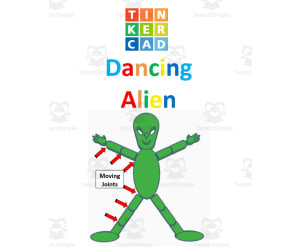
TinkerCAD step-by-step instructions for Dancing Alien
Special Resources, Science, Technology, Engineering, Computer Science, Grade 5, 6, 7, 8, 9, 10, 11, 12, Activities, Projects
TinkerCAD step-by-step instructions for Dancing Alien. Students only need to know the bare basics to complete this. I tested this with a fifth-grade class and most could complete it with no help. Designed to print with no supports for easy printing. Include TinkerCAD tool guide! Has a content page. Great beginners’ tool for learning to make 3D models and learn TinkerCAD. TinkerCAD is a free online program that makes 3D model that work on 3D printers, laser etching machines, water jets, plasma cutters and many more!! Tinkercad is an easy-to-use, browser-based computer-aided design (CAD) software developed by Autodesk. It is primarily used for creating and designing 3D models, particularly in the field of 3D printing. Tinkercad is popular among beginners and hobbyists due to its intuitive interface and simplified tools. Here are some key features and uses of Tinkercad: 1) 3D Modeling: Tinkercad allows users to create 3D models by combining basic shapes and manipulating them using tools such as scaling, rotating, and moving. It provides a wide range of primitive shapes like cubes, spheres, cylinders, and more, which can be customized to create complex designs. 2) Design Customization: Users can apply various modifications to their designs, including resizing, rounding edges, adding text, creating holes, and aligning objects. These tools help in refining the models and making them suitable for specific purposes or fitting them with other components. 3)Import and Export: Tinkercad supports the import of existing 3D models in STL and OBJ formats, allowing users to modify and incorporate them into their designs. It also offers export options to save the designs as STL files, which are widely used in 3D printing. 4) Collaboration and Sharing: Tinkercad provides features for collaboration, allowing multiple users to work on the same project simultaneously. It enables real-time sharing and editing, making it convenient for team projects or educational purposes. 5) Electronics Integration: One notable aspect of Tinkercad is its integration with electronics. It offers a range of electronic components, including resistors, LEDs, motors, and microcontrollers, which can be used to create interactive models and prototypes. Users can simulate circuit connections and test their designs before implementation. 6) Educational Tool: Tinkercad is widely used in educational settings, particularly for teaching students about 3D design, modeling, and prototyping. Its simple interface and beginner-friendly tools make it accessible to users of all ages and skill levels. Overall, Tinkercad is a versatile and user-friendly CAD software that allows individuals to create and customize 3D models. Whether you're a hobbyist, student, or professional, Tinkercad provides a valuable platform for designing, prototyping, and exploring the world of 3D printing and modeling. Total pages: 74 pages Commands to be learned: Group Ungroup Align Mirror Duplicate Holes Solids Rotate Move Drop Subjects: Geometry Engineering Career and technical education Types: Projects Handouts Printables
Author MontyWorks
Tags TinkerCAD, 3D Printing, 3D Printer, Projects

Reading Passages on Human Body Systems (Videos)
ELA, Reading, Reading Comprehension, Science, Life Sciences, Human Body, Biology, Common Core, ESL, Language Development, Grade 5, 6, 7, Teacher Tools, Activities
Accompanying Videos Based on Reading Passages on Human Body Systems for Life Science (Biology) These accompanying videos contain scripts extracted from the Science Reading Passages series. With stock footage, subtitles, voiceovers, animation and diagrams, they will help students understand the topic more. Ideal for starting or ending a lesson, each video runs at less than 5 minutes and is at least 95% identical to the passage itself. What's inside? Part 2 Videos - Human Body Systems Reading Passage 1: Skeletal & Muscular Systems Reading Passage 2: Circulatory & Respiratory Systems Reading Passage 3: Nervous System Reading Passage 4: Digestive System Reading Passage 5: Reproductive System Science Reading Comprehension Outline: Introducing a comprehensive resource tailored for 5th and 6th graders, this product offers enriching reading passages supplemented with illustrative pictures and graphs to clarify key concepts. Aligned with the Common Core State Standards (CCSS), it offers a hassle-free approach to teaching, given that the bulk of the preparation is already done for you. The passages present a diverse set of questions – from multiple choice to data analysis and fill-in-the-blanks. This ensures a rich blend of high-interest content and fundamental curriculum-based science themes. With its versatility, you can seamlessly integrate these lessons into various classroom settings, whether it's whole class discussions, morning exercises, independent desk tasks, small group engagements, contingency plans for substitute teachers, regular homework assignments, or even themed activities for holidays. FULL CATALOG OF DOWNLOAD LINKS HERE Grade 5/6 Links: Physical Science Part 1 - Physical and Chemical Properties Google Docs/Slides/Forms PDF PPT Word Free Supplementary Pack Accompanying Videos Physical Science Part 2 - Motion and Energy Google Docs/Slides/Forms PDF PPT Word Free Supplementary Pack Accompanying Videos Physical Science Part 3 - Electricity and Magnets Google Docs/Slides/Forms PDF PPT Word Free Supplementary Pack Accompanying Videos Life Science Part 1 - Cells, Reproduction and Genetics Google Docs/Slides/Forms PDF PPT Word Free Supplementary Pack Accompanying Videos Life Science Part 2 - Human Body Systems Google Docs/Slides/Forms PDF PPT Word Free Supplementary Pack Accompanying Videos Life Science Part 3 - Plant Parts and Ecosystems Google Docs/Slides/Forms PDF PPT Word Free Supplementary Pack Accompanying Videos Earth Science Part 1 - Plate Tectonics and Rock Cycle Google Docs/Slides/Forms PDF PPT Word Free Supplementary Pack Accompanying Videos Earth Science Part 2 - Ocean Exploration and Natural Resources Google Docs/Slides/Forms PDF PPT Word Free Supplementary Pack Accompanying Videos Earth Science Part 3 - Weather and Solar System Google Docs/Slides/Forms PDF PPT Word Free Supplementary Pack Accompanying Videos For similar products and other frees, do check out Cored Group on TeachSimple .
Author Cored Education
Rating
Tags Science, Elementary, Reading, Comprehension, Vocabulary, Answers, Biology, Life Science, Reading Comprehension Assessments, Science Assessments

Science Action Labs Insects: Hands-On Science Activities Ready for Student Use
Science, Life Sciences, Insects, Grade 1, 2, 3, Labs, Experiments, Activities
Science Action Labs Insects: Hands-On Science Activities Ready for Student Use This interactive science activity kit offers a riveting method of teaching elementary students, specifically those in grades 1 through 3, about the fascinating world of insects. This comprehensive resource unravels various aspects about different insects and their life cycles under a simple yet informative light. Dynamic Learning Experience The unique experience integrates demonstrations and experiments into lessons. Activites include: Writing poetry about bugs Holding grasshopper jumping contests Constructing honeycombs from scratch Guide characters C.D., Allie, and Orbit are presented throughout for systematic knowledge acquisition that renders comprehension easier for young learners. A Teacher-Friendly Resource with Different Implementations This rich-resource comes packed with 64 printable pages tailored to beginner scientists' needs. It's an excellent tool for educators introducing insects at primary grade level either through individual study or group studies within classrooms. The buzzing environment at our feet opens up wonders beyond any storybook ever could relay about mother nature's intricate designs. Truly, the learning journey into the insect kingdom ties closely with fun for enhanced learner engagement together with Science Action Labs Insects teachings on these vital players in nature's ecological dance.</p
Author Classroom Complete Press
Tags Science Action Lab, Insects, Hands-on, Science Activities
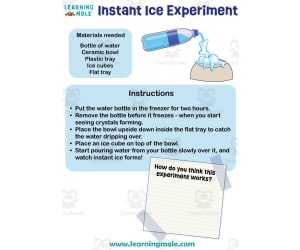
Instant Ice Experiment
Science, Creative Arts, Art, Grade 2, 3, 4, 5, 6, 7, 8, Activities
Activity Introduction An amazing activity /craft designed for the students to have fun learning about our daily activities or even to have fun doing some DIY crafts. Instant Ice Do you like group activities or crafts that you can enjoy with your friends and family? Or do you like individua activities and crafts that you can do on your own then show the world how creative you are? Have you ever tried to do a do it yourself craft? If yes tell us more about it, like has any one helped you, what was it about, what materials dd you use to create it and how much time did you suspend creating it? Do you like colouring? What is your favourite colour? Instant Ice Activity The activity is perfect for encouraging the creativity skills for the students, while having fun with our cool activities and crafts. Instant Ice This friendly designed worksheet is suitable for students at school, homeschooling, and as a group activity . Instructions Put the water bottle in the freezer for two hours. Remove the bottle before it freezes - when you start seeing crystals forming. Place the bowl upside down inside the flat tray to catch the water dripping over. Place an ice cube on top of the bowl. Start pouring water from your bottle slowly over it, and watch instant ice forms! Format Available in a PDF format.
Author Educational Voice
Tags Instant Ice Experiment, Ice Experiment, Ice, Ice Facts, Ice Facts For Kids, State Of Matters, State Of Matters Facts, State Of Matters Facts For Kids, Science Experiment, Science Experiments

Science Activity About Plants
Science, Life Sciences, Nature & Plants, Not Grade Specific, Activities
This resource is a Science Activity About Plants. Students will read about and discuss plant information. Then they will label a plant. Answer key included. The final page is a plant puzzle to be cut out.
Author Golden Promise
Tags Plant Puzzle, Science Cut And Paste, Plant Lesson, Label A Plant

Thanksgiving November | Kindergarten Unplugged / Digital Coding
Science, Technology, Computer Science, Preschool, Kindergarten, Grade 1, Activities
You want to introduce or teach your Kindergartens about programming / coding however you don’t have access to computers? Or maybe you do have access but want a fun STEM activity that is simplified. This is the resource for you! After completing these printable activities, your students can apply similar logic and strategies to coding websites and apps. This coding activity is based around the theme of Thanksgiving which is great for November. The main focus of this resource is basic logic puzzles which is great for Hour of Code. These are printable puzzles with cuttable commands. This resource includes the following type of activities and worksheets: How To Use for Educators How To Play for students Coding Map Map Pieces in color Crack the code recording sheet Crack the code chart for smartboard This resource comes in a standard size 11 x 8.5 printable PDF as well as an editable Google Slide. This means you can quickly change the code to work for you, and or remove unused slides to share with students.. You can print it out and provide the sheets to your students, or send it digitally inside your Google Class and allow the students to drag and drop. This makes for a great distance learning classroom activity .
Author Roombop
Tags Computer Sceince, Coding, Programming, Coding Kindergarten, Coding Activities For Kindergarten, Coding In Kindergarten
Tsunamis - A Science Reading Article - Grades 8 and above
Science, Earth and Environmental Sciences, Earth Sciences, Grade 8, 9, 10, 11, Activities
Tsunamis Reading Comprehension for Grade 8+ Engage your middle or high school students with this informative science article and activities on tsunamis. Students will learn what causes these destructive natural disasters and their environmental impact. The reading covers tsunami history, how they form, why they are so dangerous, and preparedness. It includes open-ended questions for analysis and class discussion. Use it to introduce earth science concepts, improve scientific literacy, challenge gifted students, or provide lesson plans for substitutes. This reading comprehension integrates easily with distance learning and Google Classroom. With Word, PDF, and Drive file types included, it works for any learning environment. Everything is pre-made and ready to assign to help your students become scientifically literate citizens.
Author Teach With Fergy
Tags Tsunamis

Alien Photoshop Activity
Science, Technology, Grade 7, 8, 9, 10, Activities
Students will work with digital tools in the Alien Photoshop Activity . Students will take a normal photo of themselves and turn it into a freaky photo of an alien. Step by step directions are included.
Author OK Products
Tags Science, Technology, Computer Class, Photoshop, Photopea, Aliens, Graphics, Clip Art, Digital Tools, Mobile Applications
Skydiving and Parachutes Reading Comprehension Article-Grade 8 and Up
Science, Basic Science, Grade 7, 8, 9, 10, Activities
Skydiving and Parachutes. This resource is suitable for students in grades 8 and up. Here's the first few paragraphs for your review. The sensation of free-falling through thousands of feet of open air is a dream for many thrill seekers and adrenaline junkies. But safely leaping from an airplane and drifting back to earth is made possible by several key scientific principles. The fields of physics and aerodynamics have unlocked the secrets behind achieving lift, managing velocity, and engineering parachute canopies capable of keeping skydivers and BASE jumpers alive. This reading will explore essential concepts like aerodynamics, free-fall, terminal velocity, and the engineering behind modern parachutes. Aerodynamics The physics of air pressure and airflow are essential for understanding how skydivers can safely jump from extreme heights. The branch of science called aerodynamics studies the properties and interactions of moving air, especially how it generates lift and drag forces. Lift is the upward push created by air moving over a wing or canopy surface, while drag is the backward resistance a falling object experiences moving through the atmosphere.
Author Teach With Fergy
Tags Microscopes, Readings, Science Reading, Microscope Parts
Ocean Animals Eggs Activity
Science, Biology, Life Sciences, Animals, Grade 1, 2, 3, 4, 5, 6, 7, 8, Activities
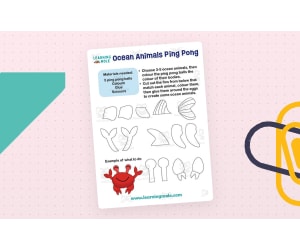
Activity Introduction An amazing activity designed for the students to learn more about animals in different countries. Ocean Animals Eggs Do you like animals? what is your favorite one? Do you own a pet? If yes, tell us more about it, like what its name? And what do you like most about it? What are the animal kingdoms? Can you write down the characteristics of each animal class like mammals, birds, reptiles, amphibian, fish and mollusks. Do you know that some animals can sing, can you name any of them? What is the largest and the smallest mammal in the world? What is the largest and the smallest bird in the world? What is the largest and the smallest fish in the world? Ocean Animals Eggs Activity The activity is perfect for encouraging the researching skills for the students, while learning more about this fantastic animal. Ocean Animals Eggs This friendly designed worksheet is suitable for students at school, homeschooling, and as a group activity. Instructions Choose 3-5 ocean animals, then colour the ping pong balls the colour of their bodies. Cut out the fins from below, that match each animal, colour them, then glue them around the eggs to create some ocean animals. Format Available in a PDF format.
Author Educational Voice
Tags Ocean Animals Eggs Activity, Ocean Animals Eggs, Ocean Animals, Ocean Animals Facts, Ocean Animals Facts For Kids, Ocean Animals Eggs Facts, Ocean Animals Eggs Facts For Kids, Animals
Chemistry - Atoms and Molecules Dominoes
Science, Chemistry, Grade 6, 7, 8, 9, Activities, Games
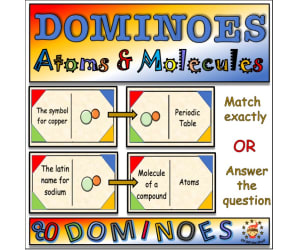
A dominoes game with questions and statements on forces and weight and mass instead of answers. Prior Knowledge Atoms are the building blocks of elements. All the atoms of one element are the same but are different to the atoms of other elements. Atoms combine to form molecules. If combining atoms are from the same element, a molecule of an element is formed but if they are from different elements, a molecule of a compound is formed. An element contains only one type of atom. A compound contains two or more different types of atom combined together chemically. Elements are listed in the periodic table. Each element has its own symbol. Some symbols are the capitalized first letter of the name of the element . Some symbols have two letters from the name with only the first capitalized. Some symbols are taken from the Latin name of the element. What You Get 80 dominos Animated PowerPoint explaining the rules and how to play. Rules of the Game Each player selects seven dominos from the top of the face-down pile and holds them in their hand like playing cards. The player whose surname begins with a letter closest to the letter A starts and play proceed in a clockwise direction. Dominos can be matched exactly, or a name can be matched with a symbol or descriptions, sketches and circuit diagrams can be matched. If a player thinks a match is wrong, they can challenge. If the challenger is correct, they give a card from their own hand to the challenged player. If the challenged player is correct, they give a card from their hand to the challenger. Pupils are encouraged to check their books for the correct answer and consult their teacher if a consensus is not reached. If a player cannot play a domino, they pick up from the face down pile and can play if possible or add it to their hand. See more Elf Off the Shelf resources on this topic and many others
Author Elf off the Shelf Resources
Tags Chemistry Game, Chemistry Dominos, Atoms Handout, Molecules Game, Science Dominoes

SAMPLE Science Reading Passage: Rocks, & Mountains (FILLABLE PDF)
Science, Earth and Environmental Sciences, ELA, Reading, Reading Comprehension, Strategies, Resources for Teachers, Earth Sciences, Geology, Grade 6, 7, 8, 9, Writing Prompts, Worksheets & Printables, Centers, Activities, Teacher Tools, Assessments, Quizzes and Tests, Quizzes, Tests
This is a ONE PASSAGE SAMPLE. The following is the description of the FULL resource and the downloading links: Volcanoes, Rocks, & Mountains: Reading Comprehension Passages (FILLABLE PDF) This very engaging and fillable collection of earth science reading passages about Mountains, Volcanoes, and Igneous Rocks is designed to bridge the gap between science and literacy through strengthening reading comprehension and sparking scientific curiosity in middle school students. Each passage blends English Language Arts skills with accurate science content that supports NGSS classroom practice. Ideal for interdisciplinary learning in ELA and Science. Suitable for Grade 9 review, too! These worksheets are designed as fillable PDFs , which means students can type their answers directly into the document on any computer or tablet . Each page includes highlighted text fields that show them exactly where to type! What Is Included? There are (3) informational passages: Mountains: From Plates to Peaks How Volcanoes Shape Our World Igneous Rocks: From Fire to Everyday Life Student Tasks for Each Passage: 5 multiple-choice questions targeting main idea, key details, inference, vocabulary in context, and use of evidence 5 vocabulary matching items with clear, student-friendly definitions 5 text-based questions that require citing specific lines or facts 1 summary prompt that asks students to condense central ideas accurately Full answer key for every section Available Formats for this Resource Word Docs Google Docs FULL CATALOG OF DOWNLOADING LINKS HERE Other Science Reading Collections and Topics You May Find in the Store: 1. Astronomy & Space Science 2. Volcanoes, Rocks, & Mountains 3. Rock Cycle, Soil, & Sinkholes 4. Mars, Glaciers, & Antarctica 5. Water Cycle, Acid Rain, & Wastewater 6. Insects, Animals, & Ecosystems 7. Bioluminescence & Insects 8. Animal Skin, Cats, & T. Rex 9. Human Body and Senses 10. Health & Applied Bioscience 11. Waves, Light, & Imaging 12. Electricity & Energy 13. Motion & Materials 14. Chemistry and Materials Science 15. Electromagnetism 16. Acids and Bases 17. Gas Laws 18. Biotechnology 19. Periodic Trends 20. Protists and Fungi 21. Microevolution 22. Blood 23. Chemical Bonding 24. Magnets 25. Muscles 26. Nuclear Chemistry 27. Electromagnetic Devices 28. Epigenetics 29. The Law of Conservation of Mass 30. Atomic Models 31. Isotopes and Ions 32. Light 33. Human-Environment Interaction 34. Theory of Evolution 35. Photosynthesis 36. Origins of Life and Early Earth 37. Gene Expression and Regulation 38. Thermochemistry 39. Allergies 40. Coevolution 41. Birth to Adulthood 42. Cells 43. Entropy and Free Energy 44. The Human Brain 45. Mixtures and Solutions 46. Invertebrates 47. Zoo Animals 48. Biochemistry 49. Animal Behavior 50. Population Ecology ...and many more engaging science reading passages that cover intriguing and important topics designed to spark curiosity and support student learning. How to Use These PDFs Click on the highlighted area to start typing your answer. Move to the next question by clicking in the next highlighted box. When you are finished, close the document and select SAVE so your answers stay recorded. If you want to keep a blank copy for later, choose Save As and give your completed version a new name. Product Details Length: 13 pages total Grades: 6–8, also suitable for Grade 9 review Use cases: close reading, stations, homework, intervention, test prep, and sub plans Standards support: reinforces informational-text skills and supports NGSS-style sense making through observation, modeling, and clear use of claim, evidence, and reasoning Why Teachers Choose This Set Authentic science content paired with rigorous literacy practice Consistent task structure across all passages for easier planning and smoother student routines Clear, age-appropriate writing that builds confidence without oversimplifying Use this set to reinforce ELA skills in science, to add literacy to your lessons, or to support independent work. The passages strengthen main idea, evidence use, vocabulary in context, inference, cause and effect, and summary writing. With ready-to-use assessments and complete answer keys, you can provide focused practice that is simple to run and fast to review.
Author Middle & High School - CORED Education
Rating
Tags Middle School, Reading Comprehension, Reading Strategies, Reading Passages, ELA, Centers, Reading Passage, Assessments, Vocabulary, Earth Science
Help Martin Sort ANIMALS -COMMON, FUN & STRANGE - Errorless & non-identical Activity
Special Resources, Special Education Needs (SEN), Science, Life Sciences, Animals, Math, Early Math, Kindergarten, Preschool, Grade 1, 2, 3, 4, 5, 6, Activities
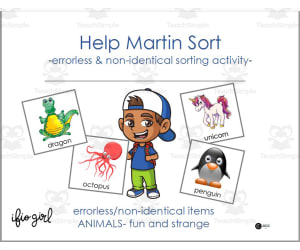
Help Students Categorize Animals with this Engaging Sorting Activity This 24-page printable allows students to sort various animals, including common pets, fun ocean creatures, and even fantasy animals like dragons and unicorns. Learners will be presented with 12 individual non-identical picture cards for each animal set. Their task is to observe details, compare similarities and differences, and group each set of animals accordingly. An additional identical picture sort is also included for errorless practice if needed. As students progress, the sorting becomes more challenging with additional animal categories introduced. This activity develops visual discrimination, categorization, and critical thinking in a hands-on, engaging format. It can be easily assembled for independent or small group work and adapted for various ages and abilities. The large, clear animal graphics help students focus on sorting rather than reading. With two sort options included, this versatile resource allows teachers to differentiate to meet each learner's needs.
Author IFIO girl - I'll Figure It Out
Tags Sort By Item, Sort By Function, Sort By Feature, Visual Discrimination, Early Learning, Dragons, Unicorns, ABLLS-R B, Autism, Discrete Trial, Non Identical Clothing
A fun paper craft to add to your earth science lessons! As you learn a
Science, Earth and Environmental Sciences, Grade 1, 2, 3, 4, Activities
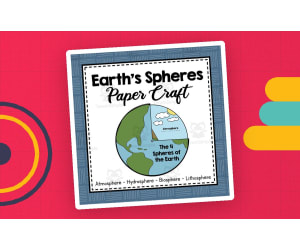
Interactive Earth’s Four Spheres Paper Craft for Science Lessons! Add some creativity to your earth science unit with this fun paper craft! As students explore Earth's four spheres—lithosphere, atmosphere, biosphere, and hydrosphere—they'll color and assemble their own sphere wheel to reinforce these key concepts. This hands-on activity boosts engagement while helping students retain what they’ve learned about earth's spheres. These are a great study resource, too! Perfect as a supplement to topics like dirt, composting, or environmental science, this craft fosters curiosity while making scientific exploration fun for all ages. Students love creating and personalizing their sphere wheels, and this project is always a classroom favorite! What’s Included: 4 colorful vocabulary strips with illustrations and definitions for each sphere 1 illustrated teacher poster explaining the four spheres Hang it in your classroom or print small versions for students! 1 black-and-white student version of the poster for coloring and labeling 2 pages of templates to build the Sphere Wheel
Author Simply Schoolgirl
Tags Earth Science Craft, Earth Sphere Craft, Earth Craft, Earth Science Activities

Horse Facts Activity
Science, Life Sciences, Biology, Animals, Grade 2, 3, 4, 5, 6, 7, Activities
Activity Introduction An amazing activity designed for the students to learn more about famous places in different countries. The Horses Do you like animals? what is your favorite one? Do you own a pet? If yes, tell us more about it, like what its name? And what do you like most about it? What are the animal kingdoms? Can you write down the characteristics of each animal class like mammals, birds, reptiles, amphibian, fish and mollusks. Do you know that some animals can sing, can you name any of them? What is the largest and the smallest mammal in the world? What is the largest and the smallest bird in the world? What is the largest and the smallest fish in the world? Horse Facts Activity The activity is perfect for encouraging the researching skills for the students, while learning more about this fantastic place. Horse Facts This friendly designed worksheet is suitable for students at school, homeschooling, and as a group activity. Instructions Can you label these body parts of the horse? What's the horse's diet? What are some interesting facts about horses? Format Available in a PDF format.
Author Educational Voice
Tags Horse Facts Activity, Horse, Horses, Horses Facts, Horses Facts For Kids, Animal, Animals, Animals Facts, Animals Facts For Kids
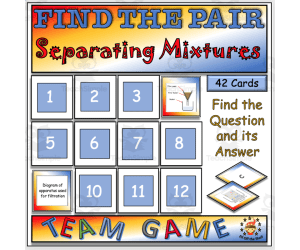
Separating Mixtures - Find the Pair Game for Middle School
Science, Chemistry, Grade 5, 6, 7, 8, 9, Activities, Games
This is an engaging and enjoyable memory game on separating mixtures including evaporation, distillation, fractional distillation, filtration and chromatography. Pupils work in teams of three or four. Each team lays out their 42 cards face down in a square and take it in turn to turn over two cards. If the cards are a question and its correct answer, the pupil keeps the pair. If they are not a match they are turned face down and the next pupil gets a turn. This process continues until all cards are matched and the winner is the pupil with the most pairs. If a team member thinks that the selectors pair is not a correct match, they can challenge. Pupils are encouraged to check their books for the correct answer but the teacher also has a quick-check answer sheet. If the challenge is correct, the challenger keeps the pair. Please note – This pack is best printed in color. Included in this Pack. > 42 question and answer cards > Teacher’s answer sheet. > Instruction sheet Preparation > Use double-sided printing to copy 1 set per group of 4 pupils. > Sheets could be laminated to enable year-on-year use. > Cut sheets into cards. Prior Knowledge Required > The composition and physical properties of mixtures > Evaporation to dryness and crystallisation > Distillation > Fractional distillation > Filtration > Chromatography See more Elf Off the Shelf resources on this topic and many others
Author Elf off the Shelf Resources
Tags Evaporation, Distillation, Fractional Distillation, Filtration, Chromatography

Natural Disasters – Lab Station Activity
Science, Earth and Environmental Sciences, Environmental Science, Grade 7, 8, 9, 10, 11, 12, Labs, Experiments, Activities
Natural Disasters Lab Station Activity Bring the science of natural disasters to life in your middle or high school classroom with this engaging lab station activity . Students will rotate through 9 stations testing their knowledge about topics like cloud formation, earthquakes, tsunamis, and climate change. Activities range from hands-on drawing and building to answering questions based on expert videos. With minimal prep required by the teacher, this self-guided experience equips students with the recording sheet they need to document their learning. This versatile resource works for both review and initial knowledge building. The content covers core ideas in environmental science and earth science curricula. As students move through thestations, their creativity and critical thinking skills are put to the test in a meaningful, memorable way. This activity brings interactive learning to a subject that lends itself perfectly to active engagement by students.
Author Teach With Fergy
Tags Weather, Climate, Tectonics, Natural Disasters, Lab Stations

Snowdrops Picture to Make
Creative Arts, Art, Science, Life Sciences, Nature & Plants, Preschool, Grade 1, 2, Activities, Crafts
Snowdrops Picture to Make is a fun resource for students to complete as culmination of a science unit, to welcome spring, or simply to put into practice their fine motor skills! Additionally, it can be used for art class, or for the study of flowers, or simply to make a card to give away. Instructions for making a sweet picture of snowdrops are included along with what is needed: • Green card A5 size • Blue/darker green and white paper • A green felt tip pen • A glue stick • Scissors • White/green/yellow/blue paint • A piece of stiff card • A cotton wool ball This activity is suitable for Grade 1 (Y2) and upwards. A total of 11 steps are included in the instructions. This activity is best implemented in small groups where the teacher, assistant, or parent is readily available to step in and help students. Older students may be able to work independently. During completion: name the parts of the flower such as: petal, stem, seed-vessel, leaves. After completion: encourage students to name the parts of the flower while describing their own flower. Mount the picture on a piece of folded A4 card and pin it up. You could even make it into a card and give it to someone!
Author Lilibette's Resources
Tags Snowdrop Craft, Snowdrop Picture To Make Young Children, Snowdrop Picture To Make, Snowdrops Craft, Botany For Grade 1, Art For Grade 1, Spring Craft
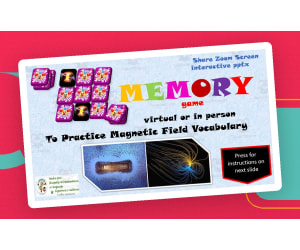
Free Science Interactive Memory Game / Magnetic Field Vocabulary
Science, Basic Science, Earth and Environmental Sciences, Earth Sciences, Environmental Science, Grade 8, Games, Activities
Magnetic Field Vocabulary Memory Game (Grade 8) Reinforce key science concepts related to magnetic fields with this interactive 8th grade vocabulary review game . Students will learn and practice 10 essential magnetic field terms by matching pairs of words and definitions. Engaging visuals, reviews, and a digital "memory game " format promote memorization, recognition, identification, and classification of key information. Use this flexible learning tool for whole group instruction, small group practice, or at-home review. Includes a ready-to-go editable 10 slide PowerPoint presentation to play in class or assign digitally. Aligned to grade 8 science curriculum.
Author ShapeUp-N-Matematicas y Lenguaje
Tags Magnetic Field, Compass, Transfer, Energy, Potential Energy, Kinetic Energy, Poles, Small Or Whole Group, Interactive Activity, Games