



Page 152 - Newest Teaching Resources

 Show filters

ESL Novel Study Worksheets - Mrs. Dalloway - Virginia Woolf
ELA, Language Development, ESL, Vocabulary, Literature, Writing, Creative Writing, Formal Writing, Grade 7, 8, 9, 10, 11, 12, Worksheets & Printables, Novel Studies, Worksheets, Writing Prompts
ESL Novel Study Worksheets - Mrs. Dalloway - Virginia Woolf This ESL - EFL - TESOL (English Second or Foreign Language) teaching resource is a comprehensive novel study worksheet activity (2 printable PDF pages; Worksheets) focused on the novel "Mrs. Dalloway" (Novel by British author Virginia Woolf - Literature). This Novel Study worksheets on "Mrs. Dalloway" (Novel by British author Virginia Woolf - Literature) is tailored for middle and high school ESL students (7th – 12th grade) and provide a variety of thought provoking and language building activities. Whether you're teaching English as a Second Language (ESL), English as a Foreign Language (EFL), or in a TESOL context, this resource is classroom-ready and easy to use. Within this ESL Novel Study on "Mrs. Dalloway - Virginia Woolf - Literature" (2 printable PDF worksheets pages), English Second or Foreign Language (ESL - EFL - TESOL - TEFL) teachers can find the following activities: General information activity (author, genre, publishing date) Vocabulary building section – new words from the novel 1 Story timeline Personal reflection on a favorite chapter Student novel review and rating Creative writing task : pretending being a character you personally liked and writing 3 diary pages for 3 scenes as if you were this character This English Second or Foreign Language (ESL EFL) Novel Study Activity Worksheets on the "Mrs. Dalloway" (Novel by British author Virginia Woolf - Literature) can be ideal for learners from 7th grade to 12th grade to study this Novel (middle school + High School Students + Adult learners + University Students) ESL with Alan is a high-quality ESL teaching resources that inspire both teachers and students. Our goal is to make learning English fun, interactive, and meaningful. Discover more English Second or Foreign Language activities by visiting our store – because learning English should always be fun! If you want to browse more of my English Language and Literature Novel Study Activity Teaching Resources, click here ESL with Alan!
Author Learning with Alan
Rating
Tags ESL, English, English Second Language, Literature, Novel Study, Mrs Dalloway, Virginia Woolf, Activity, Worksheets, Printable

Feelings Word Search & Color Activity | Printable SEL Game for Kids
ELA, Language Development, ESL, Vocabulary, Grade 1, 2, 3, 4, 5, Worksheets & Printables, Word Searches, Worksheets
Are you looking for a calming, low-stress activity to help your students practice Social Emotional Learning (SEL) vocabulary? This isn't your typical blocky word search grid! I designed these unique "Find and Color" puzzles to combine vocabulary retention with the relaxing benefits of coloring. What makes this resource unique: Unlike standard square word searches where students simply circle a word, this activity features a circular layout centered around a high-quality, expressive 3D character. Visual Connection: Students look at the character's facial expression to identify the emotion (e.g., Happy, Sad, Angry). Spelling & Focus: They must scan the ring of letters to find the matching word. Fine Motor Practice: Instead of just drawing a line, students color in the outlined letters. This requires more focus and helps improve fine motor control and hand-eye coordination. What is included: This printable PDF contains 10 different emotions. It is a fantastic resource for helping students connect written words to visual social cues. Print these out to add a splash of color to your vocabulary lessons!
Author English with Rita
Rating
Tags Cut-outs, Feelings, Emotions, Printable, Word Search, Color Activity, Esl, Vocabulary, Vocabulary Activity

Place Value Worksheet for Class 5
Math, Algebra, Grade 5, Worksheets & Printables
Introduction Adjective endings are one of those topics that almost every German student struggles with at some point. Even when they understand the rules, actually using the right ending in a sentence is a different story. I put these worksheets together because I kept seeing the same mistakes over and over, and my students just needed more practice — straightforward, no-fuss practice they could work through without getting overwhelmed. There are no complicated instructions here, no confusing layouts. Just clear exercises that give students the repetition they need to start getting these endings right on their own. Objective Students will practice German adjective endings with definite articles, indefinite articles, and without articles, covering the nominative, accusative, and dative cases. What's Included 10 grammar exercise sections, ready to hand out 10 sentences to practice in each section Nominative, accusative, and dative adjective endings Exercises with definite and indefinite articles Different activity types including fill in the blank, multiple choice, sentence rewriting, sentence building, and sentence completion Instructions written clearly so students can work independently Grades / Ages Works best for middle schoolers, beginner German learners, or older students who need to go back and review the basics. Implementation Format PDF — just print and go Non-editable Great for classwork, homework, review, or test prep Works for solo practice, partners, or the whole class
Author MultiLingual Grammar Lab
Rating
Tags Place Value Worksheet For Class 5, Place Value

ESL Novel Study Worksheets - Nim's Island - Wendy Orr
ELA, Language Development, ESL, Vocabulary, Creative Writing, Writing, Formal Writing, Grade 7, 8, 9, 10, 11, 12, Worksheets & Printables, Novel Studies, Worksheets, Writing Prompts
ESL Novel Study Worksheets - Nim's Island - Wendy Orr This ESL - EFL - TESOL (English Second or Foreign Language) teaching resource is a comprehensive novel study worksheet activity (2 printable PDF pages; Worksheets) focused on the novel "Nim's Island" (1999 Adventure Children Book by Canadian Australian author Wendy Orr). This Novel Study worksheets on "Nim's Island" (1999 Adventure Children Book by Canadian Australian author Wendy Orr) is tailored for middle and high school ESL students (7th – 12th grade) and provide a variety of thought provoking and language building activities. Whether you're teaching English as a Second Language (ESL), English as a Foreign Language (EFL), or in a TESOL context, this resource is classroom-ready and easy to use. Within this ESL Novel Study on "Nim's Island - Wendy Orr - J. M Barrie" (2 printable PDF worksheets pages), English Second or Foreign Language (ESL - EFL - TESOL - TEFL) teachers can find the following activities: General information activity (author, genre, publishing date) Vocabulary building section – new words from the novel 1 Story timeline Personal reflection on a favorite chapter Student novel review and rating Creative writing task : pretending being a character you personally liked and writing 3 diary pages for 3 scenes as if you were this character This English Second or Foreign Language (ESL - EFL) Novel Study Activity Worksheets on the "Nim's Island" (1999 Adventure Children Book by Canadian Australian author Wendy Orr) can be ideal for learners from 7th grade to 12th grade to study this Novel (middle school + High School Students + Adult learners + University Students) ESL with Alan is a high-quality ESL teaching resources that inspire both teachers and students. Our goal is to make learning English fun, interactive, and meaningful. Discover more English Second or Foreign Language activities by visiting our store – because learning English should always be fun! If you want to browse more of my English Language and Literature Novel Study Activity Teaching Resources, click here ESL with Alan!
Author Learning with Alan
Rating
Tags ESL, English Second Language, English, Novel Study, Books, Nim's Island, Worksheets, Printable, Activity, Writing Activity

ESL Novel Study Worksheets - Peter & Wendy - J.M Barrie
ELA, Language Development, ESL, Vocabulary, Literature, Writing, Creative Writing, Formal Writing, Grade 7, 8, 9, 10, 11, 12, Worksheets & Printables, Worksheets, Writing Prompts, Novel Studies
ESL Novel Study Worksheets - Peter & Wendy - J.M Barrie This ESL - EFL - TESOL (English Second or Foreign Language) teaching resource is a comprehensive novel study worksheet activity (2 printable PDF pages; Worksheets) focused on the novel "Peter & Wendy" (1911 fantasy children book - J. M. Barrie). This Novel Study worksheets on "Peter & Wendy" (1911 fantasy children book - J. M. Barrie) is tailored for middle and high school ESL students (7th – 12th grade) and provide a variety of thought provoking and language building activities. Whether you're teaching English as a Second Language (ESL), English as a Foreign Language (EFL), or in a TESOL context, this resource is classroom-ready and easy to use. Within this ESL Novel Study on "Peter & Wendy - J. M Barrie" (2 printable PDF worksheets pages), English Second or Foreign Language (ESL - EFL - TESOL - TEFL) teachers can find the following activities: General information activity (author, genre, publishing date) Vocabulary building section – new words from the novel 1 Story timeline Personal reflection on a favorite chapter Student novel review and rating Creative writing task : pretending being a character you personally liked and writing 3 diary pages for 3 scenes as if you were this character This English Second or Foreign Language (ESL - EFL) Novel Study Activity Worksheets on the "Peter & Wendy" (1911 fantasy children book - J. M. Barrie) can be ideal for learners from 7th grade to 12th grade to study this Novel (middle school + High School Students + Adult learners + University Students) ESL with Alan is a high-quality ESL teaching resources that inspire both teachers and students. Our goal is to make learning English fun, interactive, and meaningful. Discover more English Second or Foreign Language activities by visiting our store – because learning English should always be fun! If you want to browse more of my English Language and Literature Novel Study Activity Teaching Resources, click here ESL with Alan!
Author Learning with Alan
Rating
Tags ESL, English Second Language, English, Novel Study, Worksheets, Peter Pan, Activity, Writing Activity, Pritable, Children

Phonics Decodable Passages Bundle K-2 | Science of Reading
ELA, Common Core, Pre-K, Middle School, Early Learning, Worksheets & Printables
Ensure Your Students Develop a Solid Knowledge of Phonics — From CVC Words to Multisyllable Words — All in One Bundle. If you’ve always found yourself scouring the internet for phonics resources that complement each other, you finally have the bundle that can put an end to that hunt. With this comprehensive Phonics Decodable Passages Mega Bundle for Kindergarten, First Grade, and Second Grade, you will have 17 complete phonics packs based on the Science of Reading all tied up in one neat bundle. 🎯 Why This Bundle Works Traditional phonics instruction programs typically teach each phonics skill in isolation from others. However, this bundle offers students a scope and sequence of activities that are arranged based on the way our brain processes reading skills. It is designed using only decodable texts at all times. Your students will never have to guess words; they will decode them instead, improving their accuracy, fluency, and overall confidence when reading. 📦 What’s Included – 17 Phonics Packs Short Vowels (5 packs) – CVC decoding for Short A · Short E · Short I · Short O · Short U Consonant Blends (3 packs) – L Blends · R Blends · S Blends Digraphs (4 packs) – SH · CH · TH · WH Long Vowels & Vowel Teams (3 packs) – Long A · Long E · Long O Patterns Advanced Phonics (2 packs) – R-Controlled Vowels (ar, er, ir, or, ur) · Multisyllabic Words (VCCV, VCV, compound words) 📋 What’s Included In Each Pack: ✔ Decodable reading passages (skills specific, fully controlled text) ✔ Word sort activities (phonemic awareness exercises) ✔ Cut and paste sentences construction exercises ✔ Read and draw comprehension exercises ✔ 🏫 Perfect for: Phonics Centers · Whole Group Instruction · Small Group Instruction · Guided Reading · Morning Bins · Homework · Early Finishers · MTSS / RTI Support · Homeschooling Families 📚 Covered Skills (Kindergarten to Grade 2 Skills Progression): ✔ Short vowel word families (CVC words) ✔ Decoding consonant blends ✔ Decoding digraphs ✔ Decoding long vowels / vowel teams ✔ Decoding r-controlled vowels ✔ Decoding multisyllabic words ✔ Reading fluency & passage comprehension 📌 Aligned with: Common Core State Standards for ELA Reading Foundational Skills → RF.K.3 · RF.1.3 · RF.2.3 Supports Science of Reading and Structured Literacy approaches. 💗 This Bundle is Perfect for You If… ✅ You're looking for a phonics program rather than a random selection of worksheets. ✅ You require material that is decodable (no sight word clutter). ✅ You are integrating the Science of Reading in your instruction. ✅ You require a single purchase to teach K-2. ✅ You require a print-and-teach resource that will work immediately. --- 🖨️ PRINT. TEACH. WATCH YOUR STUDENTS READ. Everything is ready to print and use straight away. No matter if you are a classroom teacher, an intervention teacher, or a homeschooling parent, this bundle was created with you in mind.
Author Kids Activity Lab
Rating
Tags Phonics Bundle, Decodable Passages, Decodable Readers, Kindergarten Phonics, First Grade Phonics, Second Grade Phonics, K-2 Phonics, Short Vowels, Long Vowels

AI Reading Comprehension | Critical Thinking & Problem Solving
STEM, Resources for Teachers, Middle School, Homeschool Resources, Elementary, Worksheets & Printables
Introduce students to the exciting world of Artificial Intelligence with fun reading comprehension activities and practical case studies. It’s a great way to combine informational reading, critical thinking, problem solving and writing practice in a fun and meaningful way. Students learn about the use of AI in daily life while practicing key literacy and reasoning skills that meet upper elementary learning goals. Develop your ability to solve problems and have conversations. Discover the fundamentals of artificial intelligence. Boost your ability to write opinions and respond with facts Make links with the real world by discussing interesting AI subjects. Included in the Resource: AI Case Study Reading Passages Comprehension Questions Critical Thinking Activities Problem-Solving Scenarios Opinion Writing Prompts Reflection Activities Answer Keys Read the AI case study passage Highlight key information Answer comprehension questions Discuss ethical or real-world problems Complete writing response Share ideas with partners or groups Grades or Ages Grades: 3rd – 6th Ages: 8 – 12 years Implementation Format This resource can be used for: Independent Work Reading Centers Morning Work Early Finishers Small Group Activities Homework Sub Plans Literacy Stations STEM Integration Classroom Discussions
Author learnMix
Rating
Tags AI Reading Comprehension, Critical Thinking Activities, Problem Solving Worksheets, Opinion Writing Activities

Summer Break Color by Addition and Subtraction – Math Coloring Sheets
Addition and Subtraction, Math, Grade 1, 2, Coloring Pages, Worksheets, Worksheets & Printables
Practice basic math skills with this summer-themed color by code activity pack. Designed for early elementary students, this resource includes printable math coloring sheets focused on addition and subtraction review during summer break. Students solve addition and subtraction problems and use the answers to complete color-by-code pictures. The worksheets combine basic math practice with seasonal illustrations related to summer activities and vacation themes. This resource includes a variety of printable coloring pages arranged in a consistent format for classroom or independent use. The activities provide structured number practice while allowing students to complete simple coloring tasks. Ideal for summer review, end-of-the-year activities, math centers, or early finisher work, this no-prep resource can be used across multiple elementary grade levels. What’s Included: Summer-themed color by code worksheets Addition practice activities Subtraction review pages Printable math coloring sheets Student-friendly page layouts Ideal For: Summer math review End-of-the-year classroom activities Independent or small group work Math centers and homework Classroom or homeschool use Provide students with structured addition and subtraction review activities using these printable summer break math coloring sheets.
Author Bright Education
Rating
Tags Summer, Color By Code, Addition And Subtraction
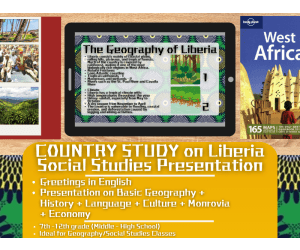
Country Study Presentation on Liberia - Geography - West Africa
Social Studies, Economics, Geography, History, History: African, Grade 7, 8, 9, 10, 11, 12, Presentations, Teacher Tools
Country Study Presentation on Liberia - Geography + Social Studies - West Africa Try this Teaching Resource on Liberia (Introductory Presentation Lesson - PDF Printable), designed for Geography + African History (West Africa) + Social Studies lessons. Suitable for Grades 7–12 (Middle school and High School students), this Introductory PDF Presentation offers a ready to use lesson that requires little to no preparation. Geography and Social Studies students will learn about Liberia ’s geography, history, culture, language and economy — making it perfect for classroom instruction, homeschooling, or online learning. 📘 Teachers can find the following topics in this Social Studies and Geograhy Teaching resource ✅ Greetings in English ✅ Geography of Liberia (West Africa) – Key facts, borders, and an interactive Google Maps link to its location. ✅ Quick Facts – Population, capital city, currency and other essential details. ✅ Languages of Liberia : English - introduction in the languages spoken + basic vocabuary ✅ History Overview – A concise summary of the most important events in the history of Liberia (West Africa) ✅ Geography & Environment – Details about the country’s land area, regions, and climate zones. ✅ Liberia's Economy – paragraph on Liberia ’s industries, exports, currency and economic strengths (West Africa) ✅ Monrovia – Explore the capital city of Liberia , its famous landmarks, and cultural highlights. ✅ Other Major Cities – A map showcasing additional important cities in Liberia (West Africa) ✅ Liberia's Culture & Traditions – A look at the customs and values that define Liberia (West Africa) ✅ Farewell in English 🎯 This Geography and Social Studies Teaching Resource can be perfect for: Geography classes Social Studies lessons World cultures units Country study projects Substitute teacher toolbox Digital learning In-class or online teaching 📂 Resource Details Format: PDF Digital Presentation Grade Levels: 7th–12th Grade (Middle School and High School students) Learning with Alan is an educational resource store created to help teachers, educators, and tutors reach their teaching goals while building a fun, engaging, and stimulating learning environment . Because learning should always be meaningful—and fun! 🎓✨ If you want to browse more of my Teaching Resources, click here Learning with Alan!!
Author Learning with Alan
Rating
Tags Country Study, Social Studies, Lesson, Presentation, Liberia, Africa, West Africa, Activity, Geography

dative prepositions german exercises with answers
Grammar, Language Development, ELA, Not Grade Specific, Worksheets & Printables
Introduction If you’re teaching German grammar and your students are having a hard time remembering which prepositions always take the dative case, this resource was made to give them extra practice in a simple and clear way. I created these exercises after noticing that many students understand the grammar rule but still make mistakes when using dative prepositions in sentences. So the goal here is simply to give them enough repetition to feel more confident with forms like mit dem, bei der, aus dem, and zu dem. Objective: Students will practice and reinforce their understanding of German dative prepositions by working through a variety of straightforward grammar activities. What’s Included: 6 no-prep grammar exercise sections Practice with common dative prepositions such as aus, bei, mit, nach, seit, von, zu, and gegenüber A mix of activities such as fill in the blanks, multiple choice, sentence correction, and sentence building Answer key included Grades / Ages: Best suited for Grade 6 students, beginner German learners, or German as a Foreign Language (DaF) classes Implementation Format: Printable PDF Non-editable Easy to print and use for classwork, homework, or review Works well for independent practice or whole-class activities
Author MultiLingual Grammar Lab
Rating
Tags Dative Prepositions , German Exercises With Answers
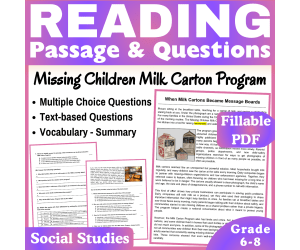
Social Studies Reading Passage: Milk Carton Program (Fillable PDF)
ELA, Reading, Reading Comprehension, Strategies, Resources for Teachers, Social Studies, Sociology, Grade 6, 7, 8, 9, Writing Prompts, Worksheets & Printables, Centers, Activities, Teacher Tools, Assessments, Quizzes and Tests, Quizzes, Tests
Missing Children Milk Carton Program: Social Studies Reading Comprehension Passage (Fillable PDF) This resource introduces a unique Social Studies reading comprehension passage with questions about The Missing Children Milk Carton Program. The passage is carefully designed to bridge the gap between social studies and literacy through strengthening reading comprehension and sparking knowledge curiosity in middle school students. Each passage blends English Language Arts skills with accurate social studies content . Ideal for interdisciplinary learning in ELA and Social Studies. Suitable for Grade 9 review, too! These worksheets are designed as fillable PDFs , which means students can type their answers directly into the document on any computer or tablet . Each page includes highlighted text fields that show them exactly where to type! Student Tasks throughout the passage: 5 multiple-choice questions targeting the following skills: main idea, key details, inference, vocabulary in context, and use of evidence 5 vocabulary matching items with clear, student-friendly definitions 5 text-based questions that require citing specific lines or facts 1 summary prompt that asks students to condense central ideas accurately Full answer key for every section Available Formats for this Resource: PDF Word Docs Google Docs Social Studies Reading Comprehension Collection Links: 1. Ancient Civilizations PDF Fillable PDF Word Docs Google Docs 2. Early Empires and Trade Networks PDF Fillable PDF Word Docs Google Docs 3. The Founding of the United States PDF Fillable PDF Word Docs Google Docs 4. Language, Culture, and Meaning PDF Fillable PDF Word Docs Google Docs 5. Psychology and Society PDF Fillable PDF Word Docs Google Docs 6. Global Festivals and Traditions PDF Fillable PDF Word Docs Google Docs 7. Extreme Environments and People PDF Fillable PDF Word Docs Google Docs 8. Food, Culture, and Preservation PDF Fillable PDF Word Docs Google Docs 9. Global Food Customs PDF Fillable PDF Word Docs Google Docs 10. Media, Communication, and Popular Culture PDF Fillable PDF Word Docs Google Docs 11. Human Impact on the Environment PDF Fillable PDF Word Docs Google Docs 12. Civic Action and Social Change PDF Fillable PDF Word Docs Google Docs 13. Fashion, Society, and Power PDF Fillable PDF Word Docs Google Docs 14. People, Places, and Unusual Histories PDF Fillable PDF Word Docs Google Docs Product Details: Length: 5 pages Grades: 6–8, also suitable for Grade 9 review Use cases: close reading, stations, homework, intervention, test prep, and sub plans Why Teachers Choose This Passage: Authentic social studies content paired with rigorous literacy practice Consistent task structure for easier planning and smoother student routines Clear, age-appropriate writing that builds confidence without oversimplifying Use this passage to reinforce ELA skills in social studies, to add literacy to your lessons, and to support independent work. The passage strengthens main idea, evidence use, vocabulary in context, inference, cause and effect, and summary writing. With ready-to-use assessments and complete answer keys, you can provide focused practice that is simple to run and fast to review.
Author EduNation Creative Store
Rating
Tags Middle School, Reading Comprehension, Reading Strategies, ELA, Centers, Reading Passage, Assessments, Vocabulary, Social Studies, Sociology

Social Studies Reading Passage: Milk Carton Program (PDF)
ELA, Reading, Reading Comprehension, Strategies, Resources for Teachers, Social Studies, Sociology, Grade 6, 7, 8, 9, Writing Prompts, Worksheets & Printables, Centers, Activities, Teacher Tools, Assessments, Quizzes and Tests, Quizzes, Tests
Missing Children Milk Carton Program: Social Studies Reading Comprehension Passage (PDF) This resource introduces a unique Social Studies reading comprehension passage with questions about The Missing Children Milk Carton Program. The passage is carefully designed to bridge the gap between social studies and literacy through strengthening reading comprehension and sparking knowledge curiosity in middle school students. Each passage blends English Language Arts skills with accurate social studies content . Ideal for interdisciplinary learning in ELA and Social Studies. Suitable for Grade 9 review, too! Student Tasks throughout the passage: 5 multiple-choice questions targeting the following skills: main idea, key details, inference, vocabulary in context, and use of evidence 5 vocabulary matching items with clear, student-friendly definitions 5 text-based questions that require citing specific lines or facts 1 summary prompt that asks students to condense central ideas accurately Full answer key for every section Available Formats for this Resource: Fillable PDF Word Docs Google Docs Social Studies Reading Comprehension Collection Links: 1. Ancient Civilizations PDF Fillable PDF Word Docs Google Docs 2. Early Empires and Trade Networks PDF Fillable PDF Word Docs Google Docs 3. The Founding of the United States PDF Fillable PDF Word Docs Google Docs 4. Language, Culture, and Meaning PDF Fillable PDF Word Docs Google Docs 5. Psychology and Society PDF Fillable PDF Word Docs Google Docs 6. Global Festivals and Traditions PDF Fillable PDF Word Docs Google Docs 7. Extreme Environments and People PDF Fillable PDF Word Docs Google Docs 8. Food, Culture, and Preservation PDF Fillable PDF Word Docs Google Docs 9. Global Food Customs PDF Fillable PDF Word Docs Google Docs 10. Media, Communication, and Popular Culture PDF Fillable PDF Word Docs Google Docs 11. Human Impact on the Environment PDF Fillable PDF Word Docs Google Docs 12. Civic Action and Social Change PDF Fillable PDF Word Docs Google Docs 13. Fashion, Society, and Power PDF Fillable PDF Word Docs Google Docs 14. People, Places, and Unusual Histories PDF Fillable PDF Word Docs Google Docs Product Details: Length: 5 pages Grades: 6–8, also suitable for Grade 9 review Use cases: close reading, stations, homework, intervention, test prep, and sub plans Why Teachers Choose This Passage: Authentic social studies content paired with rigorous literacy practice Consistent task structure for easier planning and smoother student routines Clear, age-appropriate writing that builds confidence without oversimplifying Use this passage to reinforce ELA skills in social studies, to add literacy to your lessons, and to support independent work. The passage strengthens main idea, evidence use, vocabulary in context, inference, cause and effect, and summary writing. With ready-to-use assessments and complete answer keys, you can provide focused practice that is simple to run and fast to review.
Author EduNation Creative Store
Rating
Tags Middle School, Reading Comprehension, Reading Strategies, ELA, Centers, Reading Passage, Assessments, Vocabulary, Social Studies, Sociology

Social Studies Reading Passage: Milk Carton Program (Word)
ELA, Reading, Reading Comprehension, Strategies, Resources for Teachers, Social Studies, Sociology, Grade 6, 7, 8, 9, Writing Prompts, Worksheets & Printables, Centers, Activities, Teacher Tools, Assessments, Quizzes and Tests, Quizzes, Tests
Missing Children Milk Carton Program: Social Studies Reading Comprehension Passage (Word) This resource introduces a unique Social Studies reading comprehension passage with questions about The Missing Children Milk Carton Program. The passage is carefully designed to bridge the gap between social studies and literacy through strengthening reading comprehension and sparking knowledge curiosity in middle school students. Each passage blends English Language Arts skills with accurate social studies content . Ideal for interdisciplinary learning in ELA and Social Studies. Suitable for Grade 9 review, too! Student Tasks throughout the passage: 5 multiple-choice questions targeting the following skills: main idea, key details, inference, vocabulary in context, and use of evidence 5 vocabulary matching items with clear, student-friendly definitions 5 text-based questions that require citing specific lines or facts 1 summary prompt that asks students to condense central ideas accurately Full answer key for every section Available Formats for this Resource: PDF Fillable PDF Google Docs Social Studies Reading Comprehension Collection Links: 1. Ancient Civilizations PDF Fillable PDF Word Docs Google Docs 2. Early Empires and Trade Networks PDF Fillable PDF Word Docs Google Docs 3. The Founding of the United States PDF Fillable PDF Word Docs Google Docs 4. Language, Culture, and Meaning PDF Fillable PDF Word Docs Google Docs 5. Psychology and Society PDF Fillable PDF Word Docs Google Docs 6. Global Festivals and Traditions PDF Fillable PDF Word Docs Google Docs 7. Extreme Environments and People PDF Fillable PDF Word Docs Google Docs 8. Food, Culture, and Preservation PDF Fillable PDF Word Docs Google Docs 9. Global Food Customs PDF Fillable PDF Word Docs Google Docs 10. Media, Communication, and Popular Culture PDF Fillable PDF Word Docs Google Docs 11. Human Impact on the Environment PDF Fillable PDF Word Docs Google Docs 12. Civic Action and Social Change PDF Fillable PDF Word Docs Google Docs 13. Fashion, Society, and Power PDF Fillable PDF Word Docs Google Docs 14. People, Places, and Unusual Histories PDF Fillable PDF Word Docs Google Docs Product Details: Length: 5 pages Grades: 6–8, also suitable for Grade 9 review Use cases: close reading, stations, homework, intervention, test prep, and sub plans Why Teachers Choose This Passage: Authentic social studies content paired with rigorous literacy practice Consistent task structure for easier planning and smoother student routines Clear, age-appropriate writing that builds confidence without oversimplifying Use this passage to reinforce ELA skills in social studies, to add literacy to your lessons, and to support independent work. The passage strengthens main idea, evidence use, vocabulary in context, inference, cause and effect, and summary writing. With ready-to-use assessments and complete answer keys, you can provide focused practice that is simple to run and fast to review.
Author EduNation Creative Store
Rating
Tags Middle School, Reading Comprehension, Reading Strategies, ELA, Centers, Reading Passage, Assessments, Vocabulary, Social Studies, Sociology
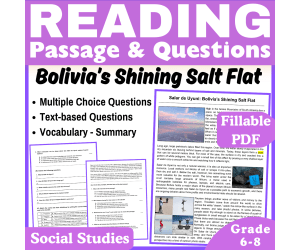
Social Studies Reading Passage: Salar de Uyuni in Bolivia Fillable PDF
ELA, Reading, Reading Comprehension, Strategies, Resources for Teachers, Social Studies, Geography, Grade 6, 7, 8, 9, Writing Prompts, Worksheets & Printables, Centers, Activities, Teacher Tools, Assessments, Quizzes and Tests, Quizzes, Tests
Bolivia’s Salt Flat: Salar de Uyuni : Social Studies Reading Comprehension Passage (Fillable PDF) This resource introduces a unique Social Studies reading comprehension passage with questions about The World's Largest Salt Flat: Bolivia’s Salar de Uyuni. The passage is carefully designed to bridge the gap between social studies and literacy through strengthening reading comprehension and sparking knowledge curiosity in middle school students. Each passage blends English Language Arts skills with accurate social studies content . Ideal for interdisciplinary learning in ELA and Social Studies. Suitable for Grade 9 review, too! This resource is designed as a fillable PDF , which means students can type their answers directly into the document on any computer or tablet . Each page includes highlighted text fields that show them exactly where to type! Student Tasks throughout the passage: 5 multiple-choice questions targeting the following skills: main idea, key details, inference, vocabulary in context, and use of evidence 5 vocabulary matching items with clear, student-friendly definitions 5 text-based questions that require citing specific lines or facts 1 summary prompt that asks students to condense central ideas accurately Full answer key for every section Available Formats for this Resource: PDF Word Docs Google Docs Social Studies Reading Comprehension Collection Links: 1. Ancient Civilizations PDF Fillable PDF Word Docs Google Docs 2. Early Empires and Trade Networks PDF Fillable PDF Word Docs Google Docs 3. The Founding of the United States PDF Fillable PDF Word Docs Google Docs 4. Language, Culture, and Meaning PDF Fillable PDF Word Docs Google Docs 5. Psychology and Society PDF Fillable PDF Word Docs Google Docs 6. Global Festivals and Traditions PDF Fillable PDF Word Docs Google Docs 7. Extreme Environments and People PDF Fillable PDF Word Docs Google Docs 8. Food, Culture, and Preservation PDF Fillable PDF Word Docs Google Docs 9. Global Food Customs PDF Fillable PDF Word Docs Google Docs 10. Media, Communication, and Popular Culture PDF Fillable PDF Word Docs Google Docs 11. Human Impact on the Environment PDF Fillable PDF Word Docs Google Docs 12. Civic Action and Social Change PDF Fillable PDF Word Docs Google Docs 13. Fashion, Society, and Power PDF Fillable PDF Word Docs Google Docs 14. People, Places, and Unusual Histories PDF Fillable PDF Word Docs Google Docs Product Details: Length: 5 pages Grades: 6–8, also suitable for Grade 9 review Use cases: close reading, stations, homework, intervention, test prep, and sub plans Why Teachers Choose This Passage: Authentic social studies content paired with rigorous literacy practice Consistent task structure for easier planning and smoother student routines Clear, age-appropriate writing that builds confidence without oversimplifying Use this passage to reinforce ELA skills in social studies, to add literacy to your lessons, and to support independent work. The passage strengthens main idea, evidence use, vocabulary in context, inference, cause and effect, and summary writing. With ready-to-use assessments and complete answer keys, you can provide focused practice that is simple to run and fast to review.
Author EduNation Creative Store
Rating
Tags Middle School, Reading Comprehension, Reading Strategies, ELA, Centers, Reading Passage, Assessments, Vocabulary, Social Studies, Geography
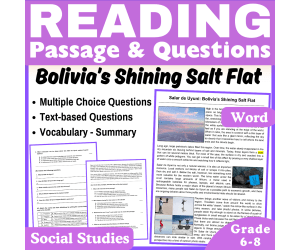
Social Studies Reading Passage: Salar de Uyuni in Bolivia (Word)
ELA, Reading, Reading Comprehension, Strategies, Resources for Teachers, Social Studies, Geography, Grade 6, 7, 8, 9, Writing Prompts, Worksheets & Printables, Centers, Activities, Teacher Tools, Assessments, Quizzes and Tests, Quizzes, Tests
Bolivia’s Salt Flat: Salar de Uyuni : Social Studies Reading Comprehension Passage (Word) This editable resource introduces an engaging Social Studies reading comprehension passage with engaging questions about The World's Largest Salt Flat: Bolivia’s Salar de Uyuni. The passage is carefully designed to bridge the gap between social studies and literacy through strengthening reading comprehension and sparking knowledge curiosity in middle school students. Each passage blends English Language Arts skills with accurate social studies content . Ideal for interdisciplinary learning in ELA and Social Studies. Suitable for Grade 9 review, too! Student Tasks throughout the passage: 5 multiple-choice questions targeting the following skills: main idea, key details, inference, vocabulary in context, and use of evidence 5 vocabulary matching items with clear, student-friendly definitions 5 text-based questions that require citing specific lines or facts 1 summary prompt that asks students to condense central ideas accurately Full answer key for every section Available Formats for this Resource: PDF Fillable PDF Google Docs Social Studies Reading Comprehension Collection Links: 1. Ancient Civilizations PDF Fillable PDF Word Docs Google Docs 2. Early Empires and Trade Networks PDF Fillable PDF Word Docs Google Docs 3. The Founding of the United States PDF Fillable PDF Word Docs Google Docs 4. Language, Culture, and Meaning PDF Fillable PDF Word Docs Google Docs 5. Psychology and Society PDF Fillable PDF Word Docs Google Docs 6. Global Festivals and Traditions PDF Fillable PDF Word Docs Google Docs 7. Extreme Environments and People PDF Fillable PDF Word Docs Google Docs 8. Food, Culture, and Preservation PDF Fillable PDF Word Docs Google Docs 9. Global Food Customs PDF Fillable PDF Word Docs Google Docs 10. Media, Communication, and Popular Culture PDF Fillable PDF Word Docs Google Docs 11. Human Impact on the Environment PDF Fillable PDF Word Docs Google Docs 12. Civic Action and Social Change PDF Fillable PDF Word Docs Google Docs 13. Fashion, Society, and Power PDF Fillable PDF Word Docs Google Docs 14. People, Places, and Unusual Histories PDF Fillable PDF Word Docs Google Docs Product Details: Length: 5 pages Grades: 6–8, also suitable for Grade 9 review Use cases: close reading, stations, homework, intervention, test prep, and sub plans Why Teachers Choose This Passage: Authentic social studies content paired with rigorous literacy practice Consistent task structure for easier planning and smoother student routines Clear, age-appropriate writing that builds confidence without oversimplifying Use this passage to reinforce ELA skills in social studies, to add literacy to your lessons, and to support independent work. The passage strengthens main idea, evidence use, vocabulary in context, inference, cause and effect, and summary writing. With ready-to-use assessments and complete answer keys, you can provide focused practice that is simple to run and fast to review.
Author EduNation Creative Store
Rating
Tags Middle School, Reading Comprehension, Reading Strategies, ELA, Centers, Reading Passage, Assessments, Vocabulary, Social Studies, Geography

Social Studies Reading Passage: Salar de Uyuni in Bolivia (PDF)
ELA, Reading, Reading Comprehension, Strategies, Resources for Teachers, Social Studies, Geography, Grade 6, 7, 8, 9, Writing Prompts, Worksheets & Printables, Centers, Activities, Teacher Tools, Assessments, Quizzes and Tests, Quizzes, Tests
Bolivia’s Salt Flat: Salar de Uyuni : Social Studies Reading Comprehension Passage (PDF) This resource introduces a unique Social Studies reading comprehension passage with questions about The World's Largest Salt Flat: Bolivia’s Salar de Uyuni. The passage is carefully designed to bridge the gap between social studies and literacy through strengthening reading comprehension and sparking knowledge curiosity in middle school students. Each passage blends English Language Arts skills with accurate social studies content . Ideal for interdisciplinary learning in ELA and Social Studies. Suitable for Grade 9 review, too! Student Tasks throughout the passage: 5 multiple-choice questions targeting the following skills: main idea, key details, inference, vocabulary in context, and use of evidence 5 vocabulary matching items with clear, student-friendly definitions 5 text-based questions that require citing specific lines or facts 1 summary prompt that asks students to condense central ideas accurately Full answer key for every section Available Formats for this Resource: Fillable PDF Word Docs Google Docs Social Studies Reading Comprehension Collection Links: 1. Ancient Civilizations PDF Fillable PDF Word Docs Google Docs 2. Early Empires and Trade Networks PDF Fillable PDF Word Docs Google Docs 3. The Founding of the United States PDF Fillable PDF Word Docs Google Docs 4. Language, Culture, and Meaning PDF Fillable PDF Word Docs Google Docs 5. Psychology and Society PDF Fillable PDF Word Docs Google Docs 6. Global Festivals and Traditions PDF Fillable PDF Word Docs Google Docs 7. Extreme Environments and People PDF Fillable PDF Word Docs Google Docs 8. Food, Culture, and Preservation PDF Fillable PDF Word Docs Google Docs 9. Global Food Customs PDF Fillable PDF Word Docs Google Docs 10. Media, Communication, and Popular Culture PDF Fillable PDF Word Docs Google Docs 11. Human Impact on the Environment PDF Fillable PDF Word Docs Google Docs 12. Civic Action and Social Change PDF Fillable PDF Word Docs Google Docs 13. Fashion, Society, and Power PDF Fillable PDF Word Docs Google Docs 14. People, Places, and Unusual Histories PDF Fillable PDF Word Docs Google Docs Product Details: Length: 5 pages Grades: 6–8, also suitable for Grade 9 review Use cases: close reading, stations, homework, intervention, test prep, and sub plans Why Teachers Choose This Passage: Authentic social studies content paired with rigorous literacy practice Consistent task structure for easier planning and smoother student routines Clear, age-appropriate writing that builds confidence without oversimplifying Use this passage to reinforce ELA skills in social studies, to add literacy to your lessons, and to support independent work. The passage strengthens main idea, evidence use, vocabulary in context, inference, cause and effect, and summary writing. With ready-to-use assessments and complete answer keys, you can provide focused practice that is simple to run and fast to review.
Author EduNation Creative Store
Rating
Tags Middle School, Reading Comprehension, Reading Strategies, ELA, Centers, Reading Passage, Assessments, Vocabulary, Social Studies, Geography

High School 2026 June ELA Bell Ringers Bundle
Reading, ELA, Writing, Research, Resources for Teachers, Vocabulary, Language Development, Spelling, Grammar, High School, Homeschool Resources, Teacher Tools, Assessments, Quizzes and Tests, Rubrics, Writing Prompts, Worksheets & Printables, Presentations
High school morning work should not feel like a waste of time. As a homeschool mom to a 10th grader and a curriculum creator, I know how hard it is to find daily ELA warm-ups that actually challenge teenagers without leaving you with hours of grading. I created this High School June 2026 ELA Bell Ringers Bundle to solve that exact problem. This High School June 2026 ELA Bell Ringers Bundle resource delivers 22 weekdays of rigorous exercises that push students/homeschoolers to think critically the second class begins. Instead of lazy, surface-level questions, each day features a fresh prompt focused on advanced language analysis, sentence structure experiments, and stylistic breakdowns. They fit beautifully into both a traditional high school classroom and a homeschool routine at the kitchen table. To make your mornings easier, I have included a complete grading framework and thorough instructional answers for every prompt. You get your time back, and your students/homeschoolers get an excellent language arts education. By blending grammar, creative writing, and literary analysis into a predictable routine, you will see their analytical skills improve all month long. INCLUDED IN THIS RESOURCE: 22 slides that cover all weekdays in June 2026. Complete answer keys right in PowerPoint notes. PDF answer key version for quick reference. Detailed guidelines to make grading objective and fast. TOPICS COVERED: Mastering the subjunctive mood and complex structures. Exploring creative style and author choices. Diving deep into poetry and symbolism. Exploring vocabulary etymology and sentence synthesis. Thank you for trusting my curriculum in your home or classroom. I’d love to hear how these prompts transform your daily discussions! If you and your students/homeschoolers enjoy this resource, please feel free to leave a review. Thank you for your support! Tina - Big Easy Homeschooling Mom
Author Homeschool with Big Easy Homeschooling Mom
Rating
Tags Secondary English Warm Ups, Daily Language Arts Exercises, High School Writing Prompts, Daily Grammar Review, Advanced Sentence Structure, Literary Devices Practice, High School Poetry Study, Rhetorical Analysis Worksheets, Sentence Synthesis Activities, High School Homeschool Curriculum

USA States Map Clip Art Mega Bundle 107 Graphics for Social Studies
Resources for Teachers, Social Studies, History, Geography, Not Grade Specific, Drawing Templates & Outlines, Worksheets & Printables
When creating instructional materials from scratch, having a trustworthy collection of US map visuals on hand saves a ton of time. This USA States clip art set gives resource creators a versatile, ready-to-use collection for a variety of geography-based projects. It contains 107 pictures covering each state as well as six complete USA maps. Each state is included in both full-color and black-and-white line art versions in the collection, making it simple to modify visuals based on the finished output. While the line art versions are perfect for labeling activities, blank map worksheets , and student fill-in exercises—common forms in basic social studies and geography units—colored graphics perform well in digital resources, slideshow presentations, and printed reference materials. This collection, which includes 107 graphics in one download, provides enough diversity to create several unique resources without the need to find photos elsewhere. Having individual state photos and complete national maps in the same bundle simplifies the process whether the final product is a cut-and-sort exercise, a state facts booklet, a geography test, or a U.S. regions unit. For educators and resource developers creating resources for grades K–5, this package is ideal, especially for social studies, U.S. geography, and civics topics. Any final project will have a polished, unified appearance thanks to the graphics' clear, uniform design. This set is worth having in your design library if you frequently develop elementary geography resources and find yourself looking for the same kinds of map graphics.
Author Teacher's Clipart
Rating
Tags Geography, MAP, USA , Simple Map Of Us States, United States Of America, Usa Maps, Region Clip Art, Us Geography, Digital Classroom Clipart

ESL Reading Comprehension + Writing Activity Worksheets - NASA
ELA, ESL, Language Development, Vocabulary, Reading Comprehension, Reading, Creative Writing, Writing, Formal Writing, Grade 7, 8, 9, 10, 11, 12, Worksheets & Printables, Writing Prompts, Worksheets
ESL Reading Comprehension + Writing Activity Worksheets - NASA - Space Agency This ESL - EFL Teaching Resource on "NASA - Space Agency - STEM" (3 PDF Worksheets Slides - Reading Comprehension + Writing Activity) can be ideal to improve Language skills in English. Ideal students for this ESL EFL TESOL Reading + Writing Activity are Foreign Students at middle and High School (7th - 12th Grade; teens) . Newcomers or any ESL Learner is also more than suitable for this ESL - EFL - TESOL - TEFL (English as a Second or Foreign Language) Activity on "NASA - Space Agency - STEM" (origins, background and history + past mission + current missions + impact and legacy). This Teaching Educational Resource Product can also be ideal for ESL EFL TESOL Centers worldwide or any English second language tutor. Intermediate Advanced English as a Second or Foreign Language (ESL - EFL - TESOL - TEFL) learners are suitable for this ESL EFL TESOL Teaching Resource on "NASA - Space Agency - STEM" (Worksheet; 3 PDF Printable slides) In this English Second or Foreign Language (ESL - EFL - TESOL - TEFL) Reading Comprehension + Essay Writing Activity Worksheet on "NASA - Space Agency - STEM" (origins, background and history + past mission + current missions + impact and legacy), the following ESL - EFL - TESOL - TEFL (English Second or Foreign Language) activities are included: 1 text on "NASA - Space Agency - STEM" (origins, background and history + past mission + current missions + impact and legacy) 27 Comprehension Questions related to the previous text on "NASA - Space Agency - STEM" (with related space where students can answer to this text's comprehension questions) 2 essay prompts for a writing activity on "NASA - Space Agency - STEM" (writing an essay on your own personal opinion on the future of NASA and its project + writing an essay on another space agency; describing it and comparing it to NASA) This ESL - EFL - TESOL - TEFL (English Second or Foreign Language) Teaching Resource Reading + Writing Activity (essay prompts) on "NASA - Space Agency - STEM" (origins, background and history + past mission + current missions + impact and legacy) is great for Intermediate Advanced English as a second or foreign language learners (ESL- EFL - TESOL - TEFL). This English Second Language Worksheet on "NASA - Space Agency - STEM" (origins, background and history + past mission + current missions + impact and legacy) aims to train and Reading Comprehension + Writing Skills. "Learning with Alan" is a teaching resources store that aims to provide high quality teaching resources and educational materials for ESL EFL TESOL (English Second or Foreign Language) teachers, tutors and educators. It aims to support teachers, educators, and tutors in both online and offline environments, helping them achieve their teaching goals while creating a fun, stimulating atmosphere for learning English. Always remember: learning is fun, and so is English! If you want to find more ESL - EFL - TESOL - TEFL (English Second or Foreign Language) Teaching Resources and Educational Material click here Learning with Alan!
Author Learning with Alan
Rating
Tags ESL, English Second Language, English, Reading Comprehension, Writing Activity, NASA, Space Agency, Space, STEM, Activity

Hands-On STEM Challenges – Simple Machine Building Worksheets
STEM, Science, Basic Science, Inventors, Theories, Technology, Engineering, Special Resources, Social Emotional Learning (SEL), Special Education Needs (SEN), Homeschool Curriculum, Homeschool Templates, Grade 3, 4, 5, 6, 7, Worksheets & Printables, Workbooks, Worksheets, Word Searches, Teacher Tools, Lesson Plans, Quizzes and Tests, Quizzes, Tests, Assessments
Incorporate Real World Engineering & Discovery into Your Science Classroom with a Comprehensive Simple Machines STEM Unit. Tired of trying to teach students about abstract concepts like force, work, and mechanical advantage in physics without providing a tangible and exciting way to understand them? This complete 5-Week STEM Unit is the all-in-one solution that you've been searching for! It includes everything you need to take your 3rd, 4th & 5th grade students from the theory of physics to creating their very own projects! This product is NOT just a bunch of worksheets, it is an entire educational experience! The resource contains 3 parts: a theoretical guide for teachers, an interactive student workbook & a complete teacher resource pack. The unit provides students with hands-on experiences as they explore 6 classical simple machines (levers, pulleys, inclined planes, wedges, wheels and axles, screws) by examining real-world case studies such as the pyramids of Giza through modern skyscrapers, & then participating in a series of hands-on, challenging activities. Constructivist approaches promote "productive struggle" within the context of providing students with a true understanding of the concepts in this unit, using low-cost, readily available, recycled materials. No more expensive kits, use real-world, authentic inquiry-based learning that develops a true engineering mindset! What This 38-Page Resource Includes: In-depth explanation of Simple Machines: Each of the 6 Simple Machines is explained to teachers in easy-to-understand language. Helpful historical case studies and concept reinforcement questions are included to aid understanding. Worksheets: 10 challenging worksheets designed for students, allow students to demonstrate an understanding of Simple Machines in real-world contexts. These worksheets include activities such as identifying simple machines in everyday objects, analyzing compound machines, calculating mechanical advantage, and working on a design project similar to a Rube Goldberg. Visuals & Helpful Teacher Tools: Three High Contrast Anchor Charts: Vector illustrations of the 6 Simple Machines, a Class 1 Lever (Mechanical Advantage) and the Engineering Design Cycle (STEM). For use in display and projection. Detailed Answer Key: Complete answer key for all 10 worksheets. Complete Teacher Implementation Guide: The Ultimate Resource Guide - Contains teaching reasoning, recommended 5 week pacing guide, list of readily available recycled materials for use in the "Maker Station" and how to facilitate hands on activities and productive struggles in the classroom, as written by seasoned pros. Simple machines, STEM activities, processes used in the design of mechanical systems (engineering design), the learning of physics, the learning of physics from the perspective of children, third grade, fourth grade, fifth-grade science, hands-on learning, project-based learning (PBL), the use of levers and pulleys, worksheets, STEM units or courses together with lesson plans requiring little or no preparation and low-cost preparation; utilizing mechanical advantages using acceleration. The Reasons Parents/Schools Value: Comprehensive & Ready to Use: This isn't just one thing to do; it is a full 5-week unit plan which includes theory, worksheets, visuals, and a detailed teacher's guide. This prepares the teacher for doing the lesson in dozens of hours less than would normally be required. Cost Effective & Easily Accessible: This unit plan was designed to be completed with items that are readily available to you such as cardboard, bottle caps, or string. There is no need to purchase expensive robotic kits that are specialized. Provides Deeper Conceptual Understanding: When students work through building challenges (e.g., utilizing force) they have a hands-on experience they will remember long after the activity is completed. Encourages Developing an Engineering Mindset: In addition to using the Engineering Design Cycle and creating "productive struggle", there is an emphasis on teaching students how to think like an engineer and to use real-world skills to solve problems, be resilient, implement multiple iterations of their solution, and critically think. Target group analysis : The text has an explicit statement of the target audience ("For students in grades 3-5"), so it's clear that the cognitive level of this audience is in the appropriate range. Because of these two factors, we have identified: 1. Primary audience Members consisting of 3rd through 5th Grade Teachers (from public, private and charter schools). 2. Secondary audience members of Homeschooling Families looking for a complete, structured STEM Curriculum. 3. Tertiary audience members will be STEM/STEAM Coordinators, After School Program Directors and Science Club Leaders or Facilitators. Copyright and Terms of Use : Syed Hammad Rizvi is the copyright holder of this resource. This resource is intended for personal and single classroom use only. You cannot modify, distribute or sell this resource. In other words, you cannot post on the Internet for the public to access and download. If you wish to share this resource with other teachers, please consider purchasing a separate license through Teachsimple. Thank you for understanding and following these terms of use. This product has been developed in partnership with Syed Hammad Rizvi
Author Creative Book Store
Rating
Tags SimpleMachines, STEM, STEMeducation, HandsOnLearning, ProjectBasedLearning, ScienceTeacher, TeachersOfInstagram, ITeachScience, ITeachSTEM, EngineeringForKids

Keyboard Typing Practice Pack - Worksheets Posters Mat Digital PDF
ELA, Language Development, Montessori, Special Resources, Life Skills, Homeschool Curriculum, Homeschool Templates, Grade 3, 4, 5, 6, 7, Activities, Centers, Assessments, Teacher Tools, Worksheets & Printables
Build a strong keyboard typing foundational skills for your young learners through this Keyboard Typing Practice Pack - Worksheets Posters Mat DigitalPDF. This dynamic set is designed for Grades 3, 4, 5 and 6 with the aim of developing and improving over all keyboard typing skills as well as building typing accuracy, finger placement, and speed. What’s Included: 1. Keyboard Typing Practice Mat and Posters Keyboard Typing Practice Mat Keyboard Typing Classroom Poster Finger Position Posters (Top Row Keys, Home Row Keys, Bottom Row Keys) 2. 21 Keyboard Typing Worksheets Color the correct finger keys Fill in a blank keyboard Match fingers to keys using color guides 3. Editable PDF Typing Passages and Activities Beginner to fluency typing passages Reading comprehension activities Printable and digital options This pack contains no-prep, easy to use, and flexible activities and projects for different learning environments. Including both printable and digital formats, this dynamic set is perfect for classroom, homeschool, computer lab, and distance learning use.
Author It's Teacher L
Rating
Tags Keyboard Typing, Digital, Typing Practice, Reading Comprehension, ELA, ELL, Life Skills, Posters, Typing Mat

Pack your Bento lunch pretend play for toddler and kids
Montessori, Common Core, Life Skills, Special Resources, Math, Addition and Subtraction, Money, Early Learning, Pre-K, Games, Activities
Everyone loves something cute and can't wait to get your hands on it. This is such an adorable printable where kids get to pack their own bento lunch with all these cute food. Now only that, they learn how to be creative, learn some simple math, and at the same time learn to take orders.. Totally adorable... You will get: 2 PDF files with 13 pages of the food items in printable template - A4 size and US letter 1 JPEG folder 1 PNG Folder 1 SVG folder Recommendation: To print this template in 120 - 140gsm weighted paper. Creation time - Approx. 10-20 mins Recommended Age: Suitable for children aged 5 and up; younger kids will need assistance from an adult. You will need to: 1. Print out the template 2. Cut the out the food items 3. Create / set up the games 4. Have fun with it Extra Info: If you gonna print using a cutting machine, please use the option flatten or print then cut as this SVG files is not the layered SVG files. When you upload the SVG file into your software, it may shrink the file as well. To maintain the size, you can choose to use PNG file which save you much time to resizing it. Suitable for: - Classroom - Homeschool - Screen free play at home - Build creativity, color, pattern and simple math counting
Author Jenstrokeandstyle
Rating
Tags Paper Toys, Pack Your Lunch, Cute Bento, Bento Lunch, Screen Free Activity, Kids Activity, Printable Games, Printable Craft, Memory Game, Food Game
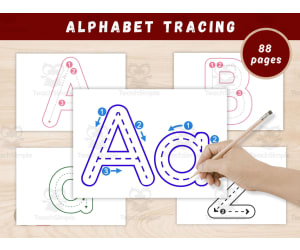
Alphabet Tracing – Printable Preschool Handwriting Practice
Spelling, Language Development, ELA, Handwriting, Writing, Montessori, Infant, Toddler, Kindergarten, Preschool, Drawing Templates & Outlines, Worksheets & Printables, Flashcards
Learn alphabet with this fun, big, and creative way. Instant download printable template that waste no time for the tiny hand to start with. This worksheet contains big letter, small letter, combination of both letters and numbers and combination of big and small letter and all these 88 pages can be printed in BIG sizes. You can easily trace them with pencils or crayons, and even make a fun games out to it using tiny vehicle, trace them with play dough or cotton bud, the creativity of games is totally up to you. With this, you will get: Total of 88 pages of the alphabet in Big, small letter, numbers and combination of both 1 PDF files in A4 and US letter size 1 JPEG files Suitable for: - Toodler - Teachers - Parents Can be use as: - Classroom decor - Tracing worksheet - Games - Flashcard - Uppercase and lower case matching
Author Jenstrokeandstyle
Rating
Tags Alphabet Tracing, Writing Practice, A-Z Practice, Toddler Learning, Writing Worksheet, Big Letter, Small Letter, Big Paper Alphabet
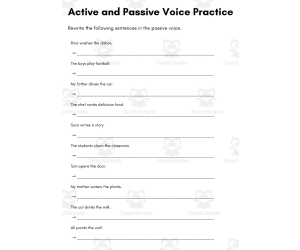
active and passive voice exercises with answers class 6
Grammar, Language Development, ELA, Not Grade Specific, Worksheets & Printables
Introduction If you’re teaching English grammar and your students are having a hard time understanding the difference between active and passive voice, this resource was made to give them extra practice in a simple and clear way. I created these exercises after noticing that many students understand the basic rule but still struggle when rewriting sentences or identifying the correct sentence structure. So the goal here is simply to give them enough practice to become more confident using both active and passive voice correctly. Objective: Students will practice and reinforce their understanding of active and passive voice by working through a variety of straightforward grammar activities. What’s Included: 6 no-prep grammar exercise sections Practice with active voice and passive voice sentence structures A mix of activities such as sentence rewriting, fill in the blanks, correcting mistakes, adding “by + doer,” and creating passive voice sentences from prompts Answer key included Grades / Ages: Best suited for Grade 6 students or beginner English grammar learners Implementation Format: Printable PDF Non-editable Easy to print and use for classwork, homework, or review Works well for independent practice or whole-class activities
Author MultiLingual Grammar Lab
Rating
Tags Active And Passive Voice , Exercises With Answers Class 6