


9,555 products added recently
Page 806 - Newest Teaching Resources

 Show filters


20 Phonemic Awareness Task Cards-CVC Short U
ELA, Language Development, Pre-Reading, Kindergarten, Preschool, Grade 1, Task Cards, Worksheets & Printables
Description: 20 Consonant-Vowel-Consonant(CVC) Phonemic Awareness Task Cards. Objective: Segmenting and blending CVC words; breaking down CVC words with short /u/ into individual phonemes( sounds). Using Elkonin boxes or sound boxes helps students build phonological awareness skills by learning how to segment words into sounds. Sound boxes teach students how to count the number of phonemes in a word (not the number of letters). Sound boxes also help students better understand the alphabetic principle in decoding and spelling. Grades: Kindergarten/First Grade. Implementation Format: a. See the word. b. Say the word aloud. c. Move It: Use your finger to move or trace the blue and red circles representing each sound(phoneme) in the word. d. Blend the phonemes to read the complete word. Answer Key: Included How to use and variations: Individually or group work mini-lesson in which the teacher models how to use the Elkonin boxes. Rhyme Time: play rhyming games by identifying word families and common phonetic patterns. Speed Reading for accuracy Missing vowel sound: cut up CVC words into individual phonemes (letters or digraphs). Mix them up and create a word. Aligns with common core standards for Phonological Awareness: "Isolate and pronounce the initial, medial vowel, and final sounds (phonemes) in three-phoneme (consonant-vowel-consonant, or CVC) words"- Kindergarten. File Types: PDF Number of Pages: 23.
Author JkGlobal Connections- Structured Literacy for Reading Success
Rating 4
Tags Phonemic Awareness, Oral Language, Pre Reading, Cvc, Short O, Ell, Structured Literacy, Segmenting Sounds, Science Of Reading, Elkonin Boxes

18 Phonemic Awareness Task Cards-CVC Short O
ELA, Language Development, Pre-Reading, Kindergarten, Preschool, Grade 1, Task Cards, Worksheets & Printables
18 English Phonemic Awareness Task Cards: See it, Say it, Move it 1. Introduction: The Phonemic Awareness Task Cards: See it, Say it, Move It, emphasize segmenting and blending skills with CVC (consonant-vowel-consonant) short /o/ words. Practice segmenting skills to strengthen decoding ability. 2. Objective: Develop students’ phonemic awareness by breaking down CVC words into individual phonemes. Focus on identifying initial consonants, middle vowels, and final consonants. 3. Directions: See: see the word on each task card. Say: Pronounce each sound (phoneme) you hear. Move It: Use your finger to trace the path of the blue circle (representing the consonant) as you say the sounds. Imagine the circle moving along the path. Blend: Combine the phonemes to read the complete word. 4. Grades or Ages: Early elementary students (kindergarten and beyond), ELLs, and learners developing early foundational oral language skills. 5. Implementation Format: Print the task cards for individual or group use. Recommend using dry-erase sleeves for sustainability and to print on cardstock paper which is thicker and more durable to minimize breakage and tearing. Project the cards on a screen for whole-class participation. 6. Answer Keys: An answer sheet is included for self-checking. Encourage students to verify their responses. 7. How to Use and Variations, beyond the basic steps, challenge students to: Alphabetize the CVC words. Create rhyming words. Form word families. Provide guided group practice for struggling learners. 8. Standards: Aligns with phonemic awareness standards, and reinforces decoding and spelling skills. 9. File Types: Available in PDF format. 10. Number of Pages: The product contains 18 task cards, Answer Key, and Instructors Directions resulting in 21 pages.
Author JkGlobal Connections- Structured Literacy for Reading Success
Tags Phonemic Awareness, Segmenting Sounds, CVC Words, Short Vowel /0/, Task Cards, Oral Language, Multisensory, Structured Literacy, SOR, ELL

Poland Country Study Worksheet - Europe - Geography
Social Studies, Geography, History, History: Europe, Grade 7, 8, 9, 10, 11, 12, Worksheets & Printables, Worksheets
Poland Country Study Worksheet - Europe - Geography This Geography Social Studies Teaching resource is great for Country Study Activities on Poland (Europe). This Printable Teaching Resource is a 2 pages PDF Worksheet on Poland. It can be suitable for Middle School and High School Geography and Social Studies Learners (7th-12th graders). This Teaching Material can be great for testing students on their knowledge on Poland and Polish Culture (basic information + language + history + geography + economy + Warsaw + culture). If You need any other teaching resources on Poland, you could try these products as well: Country Study Presentation on Poland Country Study on Poland - Research Project - Worksheet + Cards Country Study on Poland - Guess Who Cards Game on Famous Polish People Country Study on Poland - Snakes and Ladders Board Game PDF Printable In this Geography, Social Studies Country Study on Poland (PDF Printable Worksheets; 2 pages) there are included: a qr code linked to Poland's position on Google Maps questions on Geography questions on History questions on the Language questions of the Economy an exercise where it is asked to list some of the most famous sights in Warsaw (Capital) an exercise where it is asked to list other cities in Poland an exercise where it is asked to write about the Polish Culture This amazing Social Studies + Geography Country Study on Poland (Europe) PDF Digital Teaching Resource (2 PDF Printable Slides) can be great for learners from 7th grade to 12th grade to test Poland and its Culture. Learning with Alan is a Brand New Teaching Resource, Educational Material Store whose aim is to help Teachers, Educators and Tutors to achieve their teaching objectives while creating a fun and stimulating environment. Never Forget! If you want to browse more of my Teaching Resources, click here Learning with Alan
Author Learning with Alan
Tags Country Study, Geography, Social Studies, Poland, Europe, Worksheet, European, High School, Teaching Resource, Eastern Europe

Germany Country Study Worksheet - Europe - Geography
Social Studies, Geography, History, History: Europe, Grade 7, 8, 9, 10, 11, 12, Worksheets & Printables, Worksheets
Germany Country Study Worksheet - Europe - Geography This Geography Social Studies Teaching resource is great for Country Study Activities on Germany (Europe). This Printable Teaching Resource is a 2 pages PDF Worksheet on Germany. It can be suitable for Middle School and High School Geography and Social Studies Learners (7th-12th graders). This Teaching Material can be great for testing students on their knowledge on Germany and German Culture (basic information + language + history + geography + economy + Berlin + culture). If You need any other teaching resources on Germany, you could try these products as well: Country Study Presentation on Germany Country Study on Germany - Guess Who Game on famous German People Country Study on Germany Snakes and Ladders Board Game PDF Printable Country Study on Germany - Research Project + Cards + Worksheets In this Geography, Social Studies Country Study on Germany (PDF Printable Worksheets; 2 pages) there are included: a qr code linked to Germany's position on Google Maps questions on Geography questions on History questions on the Language questions of the Economy an exercise where it is asked to list some of the most famous sights in Berlin (Capital) an exercise where it is asked to list other cities in Germany an exercise where it is asked to write about the German Culture This amazing Social Studies + Geography Country Study on Germany (Europe) PDF Digital Teaching Resource (2 PDF Printable Slides) can be great for learners from 7th grade to 12th grade to test Germany and its Culture. Learning with Alan is a Brand New Teaching Resource, Educational Material Store whose aim is to help Teachers, Educators and Tutors to achieve their teaching objectives while creating a fun and stimulating environment. Never Forget! If you want to browse more of my Teaching Resources, click here Learning with Alan
Author Learning with Alan
Tags Germany, Worksheet, Country Study, Social Studies, Europe, Geography, Culture, German

France Country Study Worksheet - Europe - Geography
Social Studies, History, History: Europe, Geography, Research, Grade 7, 8, 9, 10, 11, 12, Worksheets & Printables, Worksheets
France Country Study Worksheet - Europe This Geography Social Studies Teaching resource is great for Country Study Activities on France (Europe). This Printable Teaching Resource is a 2 pages PDF Worksheet on France. It can be suitable for Middle School and High School Geography and Social Studies Learners (7th-12th graders). This Teaching Material can be great for testing students on their knowledge on France and French Culture (basic information + language + history + geography + economy + Paris + culture). If You need any other teaching resources on France, you could try these products as well: Country Study Presentation on France Country Study on France - Reseach Project + fishing Cards + Worksheet Country Study on France - Guess Who Game Cards on Famous French People Country Study on France Snakes and Ladders Board Game PDF Printable In this Geography, Social Studies Country Study on France (PDF Printable Worksheets; 2 pages) there are included: a qr code linked to France's position on Google Maps questions on Geography questions on History questions on the Language questions of the Economy an exercise where it is asked to list some of the most famous sights in Paris (Capital) an exercise where it is asked to list other cities in France an exercise where it is asked to write about the French Culture This amazing Social Studies + Geography Country Study on France (Europe) PDF Digital Teaching Resource (3 PDF Printable Slides) can be great for learners from 7th grade to 12th grade to test France and its Culture. Learning with Alan is a Brand New Teaching Resource, Educational Material Store whose aim is to help Teachers, Educators and Tutors to achieve their teaching objectives while creating a fun and stimulating environment. Never Forget! If you want to browse more of my Teaching Resources, click here Learning with Alan
Author Learning with Alan
Tags Country Study, Social Studies, Geography, Europe, France, French, Worksheet, Research, Project

SLANT Strategy Lesson-A lesson about paying attention and listening
Special Resources, Social Emotional Learning (SEL), Social Skills, Special Education Needs (SEN), Grade 3, 4, 5, 6, 7, 8, 9, 10, Teacher Tools, Lesson Plans
In this resource, students will learn about the strategy called S.L.A.N.T. This is a strategy to teach students how to pay attention and listen. This can be such a critical skill when students are in school, at home, and with their friends. SLANT stands for S-Sit up, L-Lean forward, A-Ask questions, N-Nod head, T-Track the speaker. Students will first be asked about what does "paying attention" and "listening" mean. They will also be encouraged to talk about who and what they need to pay attention to and listen to at home and school. Then they will learn about the SLANT strategy. They will be asked to participate in a partner activity in which they will tell about a happy memory for 2-3 minutes with a beginning, middle, and end for the story. They will then ask their partner a question about their memory to see if they were listening. The partner is allowed to ask 1-2 questions if they are unclear about some details. Next, they will swap roles and the person who shared is now the listener and vice versa. The PPT slideshow will prompt some questions about what was easy or challenging about this activity. The last part of the lesson is a fun game called "When someone claps twice." This is such a fun game that your students will want to play again and again. I placed this at the end of the lesson because you can play it as many times as time allows. There are 27 commands in the game. The teacher begins the game by passing out a strip of paper to each student. Some students may get 2 strips as there are 27 strips and you may not have 27 students. That is o.k.! It adds to the challenges. After the teacher claps twice, the student with the command "When the teacher claps twice, ..." needs to do the task on their strip of paper. Then the next student needs to do the task after the student does their task and so on. To reinforce the SLANT strategy, you can print off either slide 5 or 10 and put up in the classroom.
Author Jennifer Moyer Taylor
Tags SLANT, Listening, Paying Attention, Focus, School Counseling, Special Education, Social Skills, Friendship Skills, Behavior Management
Founding the 13 Colonies- Vocabulary & Reading & Analyzing a Table
Social Studies, Government, History, History: USA, Grade 6, 7, 8, Teacher Tools, Lesson Plans
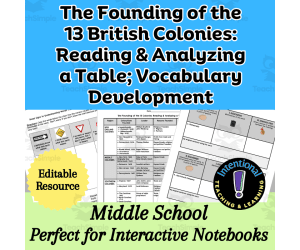
Two lessons focused on American Colonial History are included in the resource, provide Social Studies Skill Building Opportunities for your middle school students. The Founding of the 13 British Colonies- Vocabulary Development and Reading and Analyzing a Table. The first, Vocabulary Building: familiarizes students with key terms so they can develop greater understanding of the founding of the 13 colonies.The second, The Founding of the Colonies Chart: Reading and Analyzing a Table: provides students with the opportunity to learn and practice various reading strategies, such as drawing conclusions, making inferences and comparisons, and identifying similarities and differences. The questions students will answer guide them through the reading of the table. The first lesson, Vocabulary Development, provides students with two vocabulary development strategies. First, students identify which of the following 8 words they know (and how well, if at all, they know them) using the Road Signs to Understanding Words handout which front loads the 8 key terms: Theocracy, Proprietary, Democratic, Joint-stock Company, Elected Assembly, Profit, Debtors, and Buffer. From their, they explore each of the 8 words using the K.I.M. Vocabulary Strategy: Knowledge (information about the word, its part of speech, and its variations in parts of speech); Information ((Definition(s) of the word), and Memory Clue Draw a picture or symbol to represent the meaning). They then write an original sentence showing they understand the word. In the second lesson, The Founding of the Colonies Chart: Reading and Analyzing a Table, students will read and analyze a table with information about the founding of each of the 13 colonies: Colonial Region, Colony/Date Founded, Leader(s), Reasons Founded, Type of Government. Students often need help in navigating information-heavy charts, especially if there are words and concepts they are struggling with. This lesson guides students through how to read and analyzing these key details. The chart is accompanied by 11 analytical questions with the final two questions asking students to reflect on what was most and least challenging about this assignment and why. Finally, there is a vocabulary assessment with 5 short answer critical thinking questions, in which students are asked show their understanding of the key terms by comparing, contrasting, and explaining the words. The detailed, standards-aligned lessons provide interactive and collaborative ways to approach these activities and includes An About this Resource Chart that easily references all the materials in the resource, including the standards, objectives, learning targets, an Essential Question, 2 Guiding Questions, among other things. The two lessons should take between 2-3 days depending on how you approach the K.I.M. Vocabulary.
Author Intentional Teaching and Learning
Tags Social Studies Skillbuilding, Critical Thinking Questions, Vocabulary Strategies, British Colonies, English Colonies, Founding The Colonies, Colonial Regions, Vocabulary Assessment, Vocabulary Development, American Colonial History
13 Colonies- Analyzing Colonial Population 1660-1780 Table & Graph
Social Studies, Government, History, History: USA, Grade 6, 7, 8, Teacher Tools, Lesson Plans
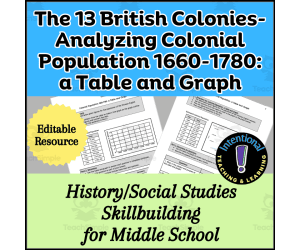
Middle School students often struggle with understanding how to read a table and a line graph, especially in history and social studies worksheets. In this easy-prep 8-page lesson, 1 50 minute period resource, The 13 British Colonies- Analyzing Colonial Population 1660-1780: a Table and Graph, students will learn or review what a table and line graph are and then how to turn the information from a table to a line graph to show how colonial populations changed over time. They will then analyze and interpret the line graph and table to answer thought-provoking and critical thinking questions. Finally, they will reflect on their experience by identifying what was challenging and what they learned. The pdf includes a force copy to the Google Document which is editable. The link to the Google Document is located at the top of the page called About this Resource. The resource includes the following: A handy reference page: About this Resource A Comprehensive standards-aligned lesson plan with objectives and learning targets An essential question and 2 guiding questions A worksheet with a table of colonial population information from 1660-1780, a blank line graph, questions and answer key The Essential Question is: Why is it important to study how populations have grown throughout history, and what can we learn from it? The Guiding Questions are: What were the key factors driving the growth of colonial populations from 1660 to 1780? How did economic opportunities and conditions impact population growth in different colonial regions? What role did slavery have in the growth of colonial populations? The Objectives are: Students will take statistical information from a table and place it into a line graph. Students will analyze and interpret the table and line graph to answer questions. Students will be able to explain how a line graph shows how colonial populations changed over time. The Learning Targets are: I can create a line graph from a table. I can analyze and interpret the line graph and table to answer questions. I can explain how colonial populations changed over time.
Author Intentional Teaching and Learning
Tags 13 British Colonies, Population Table, Population Graph, Analysis, Critical Thinking, Colonial History, Analytical Questions, Standards, Objectives And Learning Targets, Essential And Guiding QuestionsG

OO 3 Decodable stories; PowerPoints; Guided Reading + Activities
Special Resources, ELA, Special Education Needs (SEN), Language Development, Pre-Reading, Phonics, Spelling, Kindergarten, Preschool, Grade 1, 2, Literacy Readers, Teacher Tools
Three 'oo' decodable books for guided or individual learning in both PDF and POWERPOINT format with supporting activities to help build reading fluency. What is included: 3 'OO' decodable stories; 3 PowerPoints of the same, 50+ pages of resources. Your OO Lesson made easy! Suitable for: Class use Homeschool (where the printing of books is not affordable - as we advocate the use of physical books where possible Special needs education: processing difficulties inc. dyslexia, cerebral palsy, Down syndrome, autism, etc... It is expected that children be able to blend such words as mud and jump and know CK, before starting to incorporate OO words into their reading with these books. The decodable stories: Each book carefully builds on the vocabulary of those that have gone before, providing much repetition, without relying on predictable text. Pictures aid the storyline without encouraging reading from the pictures – i.e. guessing. The vocabulary is based on phonic families, which are introduced in a carefully planned way. True sight words – those that cannot be sounded out - are kept to the very minimum. Most words are introduced in their phonic family wherever possible. The PowerPoints: Have teaching tools: Move the orange rectangle under each word to help children track the text on the screen. Blue rectangles can be used to cover text so that it can be revealed as suited to the children's needs. The activity packs: These should be completed before reading the texts for the best use to be made of them: Flashcards of the ck words needed to read the books and sight words needed to be studied to read the books Develop phonemic awareness of the new sound Build strong word recognition once the words can be sounded out: this helps to build newly learned phonetic words into a child's true sight vocabulary - those words that they no longer have to sound out as they have seen them so many times Reading fluency triangles Tracking exercises for those with poor tracking skills Spell the new words in multiple ways Read the new words in multiple ways Activities to help children integrate their new skills into everyday reading and writing Provide multisensory learning through the powerful use of the hand in writing the words in fun ways Are designed for the young child, or the child with a short attention span - as such have many of those with a special need. Two, 1-page games to cement learning - you can send these home for extra practice! Suggested lesson plan: The lesson plan provided is the Reading Made Simple lesson plan but you can use your own. These guided reading books stem from the Reading Made Simple %100 systematic reading programme, helping all children become readers and writers! What is included: Full teaching instructions Flashcards 55 Pages of activities and worksheets 3 reading books 3 PowerPoints of the books 2 games .
Author Lilibette's Resources
Tags Fluency, Struggling Readers, Dyslexia, Special Needs, Phonics, Decodable Reading Books, Reading Fluency, Short Vowel E, Guided Reading, PowerPoints

Christmas Memory Writing Challenge | Community & Lessons
ELA, Writing, Creative Writing, Grammar, Grade 2, 3, 4, 5, Worksheets & Printables, Worksheets
Getting kids to enjoy writing during the early elementary years is key. One way we can do that is to tie in their interests to the writing process. Christmas memories range from time in community to cozy family moments! Learners will explore different activities, people they spend time with, surprising things that happened, and lessons they learned. Including the appropriate sequence of events, as well as a conflict is key. Thinking about the way we think is a foundational skill for growing the executive functions our kiddos will use in the editing process. For this reason, a short checklist has been included at the end of page 4 so that learners can begin to go back and check their work. This key skill in developing healthy executive functioning is intentionally made visible to students to prompt ownership over the quality of their writing. STANDARDS: Meets CCSS Writing standards for grades 2-5. Don't forget to check out the Chef's Toolbox, Superhero's Toolbox, and Astronaut's Toolbox activities for more fun! These activities can be used with a whole class in addition to the writing challenge printable. This printable is optimal for 2nd-5th graders who enjoy learning about space and demonstrating their knowledge of it. By using the included matrix to choose the setting, challenge, and characters in their story, they'll use the freedom afforded them to create something they love. *Note, some learners may require a basic explanation of what stocks, investments, and savings accounts are. BONUS: Take advantage of the 4 extension activity ideas included in this printable. These activities will take their writing beyond the page and bring it to life in STEAM-supported outlets. What you'll get: a 4 page PDF including instructions, extension activity ideas, and 3 student pages. One of these pages is simply writing space for you to print off as many copies as you need based on the amount your students are writing. You'll also find the editing checklist to prompt students to edit their own work for spelling, capitalization, and punctuation.
Author Melissa Is Teaching
Tags Writing Prompt, Narrative Writing, Editing Checklist, Creative Writing, Weather, Extreme Weather, Flood, Earthquake, Blizzard, Hurricane

Camping Trip Writing Challenge | Resilience & Creative Problem Solving
ELA, Writing, Creative Writing, Grammar, Grade 2, 3, 4, 5, Worksheets & Printables, Worksheets
Getting kids to enjoy writing during the early elementary years is key. One way we can do that is to tie in their interests to the writing process. Camping trips can be an impactful event in a young person's life. They teach efficiency, resilience, and creative problem solving. In this challenge, learners will choose their location, who's camping with them, something surprising that happened, and a lesson they learned! Including the appropriate sequence of events, as well as a conflict is key. Thinking about the way we think is a foundational skill for growing the executive functions our kiddos will use in the editing process. For this reason, a short checklist has been included at the end of page 4 so that learners can begin to go back and check their work. This key skill in developing healthy executive functioning is intentionally made visible to students to prompt ownership over the quality of their writing. STANDARDS: Meets CCSS Writing standards for grades 2-5. Don't forget to check out the Chef's Toolbox, Superhero's Toolbox, and Astronaut's Toolbox activities for more fun! These activities can be used with a whole class in addition to the writing challenge printable. This printable is optimal for 2nd-5th graders who enjoy learning about space and demonstrating their knowledge of it. By using the included matrix to choose the setting, challenge, and characters in their story, they'll use the freedom afforded them to create something they love. *Note, some learners may require a basic explanation of what stocks, investments, and savings accounts are. BONUS: Take advantage of the 4 extension activity ideas included in this printable. These activities will take their writing beyond the page and bring it to life in STEAM-supported outlets. What you'll get: a 4 page PDF including instructions, extension activity ideas, and 3 student pages. One of these pages is simply writing space for you to print off as many copies as you need based on the amount your students are writing. You'll also find the editing checklist to prompt students to edit their own work for spelling, capitalization, and punctuation.
Author Melissa Is Teaching
Tags Writing Prompt, Narrative Writing, Editing Checklist, Creative Writing, Weather, Extreme Weather, Flood, Earthquake, Blizzard, Hurricane

Sentence Building with Visual Structure Task Cards Center 2
Special Resources, ELA, Special Education Needs (SEN), Speech Therapy, Reading, Reading Comprehension, Language Development, Pre-Reading, ESL, Writing, Handwriting, Kindergarten, Preschool, Grade 1, 2, Task Cards, Worksheets & Printables
These interesting and engaging worksheets and activity cards can be a very useful teaching resource tool, if your pupils have trouble grasping sentence structure or constructing whole basic sentences . Starting with short sentence patterns and building length gradually, always centered around essential contrasting words, this material uses visual aids / cues to guide ( instructively and as self check ) while keeping motivation high . It employs illustrations or symbols together with written words as a visual assistance that can progressively fade and disappear, until only words are left to work with . For every visual subject, there are three ( 3 ) distinct sentence formats . One with more symbols, one with less symbols and finally one with no symbols . It also provides possibilities to trace the words in sentences and frames to copy the sentences . Furthermore, empty frames beneath every theme . Along with being provided separately, the sentences ( all three types plus a tracing type ) can also be used as strip cards to compare, work on your own projects, or cut and paste / hook and loop to task cards that only have the visual theme and blank frames ( missing text ) . You also get the picture themes in the form of smaller Flash Cards, to use individually or in combination with the sentence strips, mentioned before . The key words used are : in, next to, pink, brown, wide, narrow, picnic, shopping, boy's, girl's, candy, candies, basket. . For students with special education needs, literacy -challenged pupils, and young writers and readers in first and second grade, this sentence writing resource can serve as an organized teaching tool that will improve their ability to build sentences and communicate effectively . You can also check these resources for AAC Reading and Writing Development Task Cards AAC Sentence to Paragraph READING and WRITING Informational Text Basic Structure | Nonfiction Simple Passage Included: A pdf file with 161 pages .
Author WORDS ASIDE
Tags Visual Support, Sentence Building, Center, Reading, Writing, Autism, Attention, Structured Literacy, Key Words, Words Aside

Extreme Weather Writing Challenge | Types, Effects & Resilience
ELA, Writing, Creative Writing, Grammar, Grade 2, 3, 4, 5, Worksheets & Printables, Worksheets
Getting kids to enjoy writing during the early elementary years is key. One way we can do that is to tie in their interests to the writing process. Extreme weather is a topic many learners are fascinated by, but the effects of these events can make for a daunting lesson. Keep an eye out for the helpers (as Mr. Rogers would say), as learners craft their own stories of weather events followed by images of community resilience. Including the appropriate sequence of events, as well as a conflict is key. Thinking about the way we think is a foundational skill for growing the executive functions our kiddos will use in the editing process. For this reason, a short checklist has been included at the end of page 4 so that learners can begin to go back and check their work. This key skill in developing healthy executive functioning is intentionally made visible to students to prompt ownership over the quality of their writing. STANDARDS: Meets CCSS Writing standards for grades 2-5. Don't forget to check out the Chef's Toolbox, Superhero's Toolbox, and Astronaut's Toolbox activities for more fun! These activities can be used with a whole class in addition to the writing challenge printable. This printable is optimal for 2nd-5th graders who enjoy learning about space and demonstrating their knowledge of it. By using the included matrix to choose the setting, challenge, and characters in their story, they'll use the freedom afforded them to create something they love. *Note, some learners may require a basic explanation of what stocks, investments, and savings accounts are. BONUS: Take advantage of the 4 extension activity ideas included in this printable. These activities will take their writing beyond the page and bring it to life in STEAM-supported outlets. What you'll get: a 4 page PDF including instructions, extension activity ideas, and 3 student pages. One of these pages is simply writing space for you to print off as many copies as you need based on the amount your students are writing. You'll also find the editing checklist to prompt students to edit their own work for spelling, capitalization, and punctuation.
Author Melissa Is Teaching
Tags Writing Prompt, Narrative Writing, Editing Checklist, Creative Writing, Weather, Extreme Weather, Flood, Earthquake, Blizzard, Hurricane

GAME "i HAVE, WHO HAS?" - Numbers 1 to 100
Math, Numbers, Kindergarten, Preschool, Grade 1, 2, 3, Activities, Games
1. WHO ARE WE? Hello! Thank you very much for preferring the products of my editorial. We dedicate ourselves wholeheartedly to the development of fascinating products that will make your math classes totally different. 2. WHY IS IT IMPORTANT TO USE MATHEMATICAL RESOURCES? Remember that many pedagogues affirm that children love to learn by playing, using all their senses, for this reason, teachers should use a lot of their time to carefully plan their classes and especially those in mathematics. As you know, mathematics is one of the areas that children are most terrified of, so don't wait any longer and make the change now in your classroom. 3. BENEFITS OF USING TEACHING RESOURCES: - You will motivate your students' learning in the area of mathematics. - You will awaken their cognitive functions such as attention, interest and motivation. - You will encourage a change of perspective regarding mathematics. 4. GENERAL DESCRIPTIONS OF THIS PRODUCT: - Name or title of the resource: "I have, who has? Numbers from 1 to 100" - Total page content: This resource contains 25 fabulous pages, each page contains 4 flashcards. - Color or black and white: This resource has been specially prepared in color so that it is much more striking for your students. - Size and format: This resource has been prepared in PDF format and A4 size. - Standards: It has not been prepared based on any specific standard. - Keywords: Games, math games, educational games, number games, numbers from 1 to 50, numbers from 1 to 100. - Answer key: This document does not contain a specific answer key. Thank you very much once again for preferring my products. I also invite you to explore my store and discover that I also have other fabulous resources that will make your math classes from now on much more educational, beautiful, fun, happy and above all motivating for your children.
Author EDITORIAL LAURA EDUCA
Tags Numbers 1 To 100, Game Numbers, I Have Who Has?

GAME "I HAVE, WHO HAS?" - Numbers 1 to 30
Math, Numbers, Kindergarten, Preschool, Grade 1, 2, Activities, Games
WELCOME and thank you very much for preferring EDITORIAL ARENAS EDUCATIVAS products. We are dedicated to producing materials for teaching language and mathematics for primary school children, in PDF format and with total quality. Next, we will answer basic questions about this product that we are sure will be to your complete liking. 1. What type of teaching resource is it? This is a game to be applied as a dynamic in the classroom, you can apply it at the end of your class, or perhaps during the session, as a dynamic or practice. 2. What is the name of this document? "I have, who has? - Numbers from 1 to 30" 3. What topic will you address in this resource? This resource addresses the topic of numbers from 1 to 30. 4. For what ages is it recommended? It is recommended to be applied to children aged 4,5,6,7 who are already able to practice the first numbers from 1 to 30. 5. Who is the author of this document? EDITORIAL ARENAS EDUCATIVAS is the author of this fascinating resource for mathematics. 6. In what area of knowledge can it be applied? Apply it in teaching mathematics for children. 7. Should I apply it individually or in groups in my class? Preferably in groups, in groups of 2 to 4 children because they will solve it quickly. 8. What size and format is this resource in? It is available in PDF format and A4 size. 9. Do I need some extra elements to apply it? No, you will simply need to cut the chips. 10. Is it in color or black and white? In colors, so that it is more motivating and interesting for children. 11. Is this resource free or do I have to pay to use it? At the moment it is free, so take advantage of this magnificent opportunity. 12. How many pages make up this educational resource? It contains 8 pages. 13. Do you have an attached answer key? No, it does not contain it.
Author EDITORIAL LAURA EDUCA
Tags Numbers 1 To 30, Math Games, I Have Who Has?

GAME "I HAVE, WHO HAS?" - Numbers 1 to 20
Math, Numbers, Kindergarten, Preschool, Grade 1, Activities, Games
Thank you for being interested in my educational games. On this occasion I present to you this math game inspired by the numbers from 1 to 20. 1. GENERAL PRODUCT DESCRIPTIONS: - Product title: "I have, who has" - Numbers 1 to 20 - Number of pages: This teaching resource contains 5 fabulous pages, each page contains 4 cards, which would finally make a total of 20 cards with numbers from 1 to 20. - Color/black and white: This document is available in color so that it captures the immediate attention of your children, increasing their interest and motivation in the area of mathematics. - Document version and size: This educational resource is in PDF version and in A4 size. - Way to print it: I recommend that you print this document as it is, because I consider that the booklets are just the right size for children to view as well as manipulate them. Additionally, I recommend laminating them or laminating them using adhesive tape to make them more durable, or in any case, print them on cardboard or some other type of resistant material, because the children will directly manipulate the primers. - Way to apply it in the classroom: I recommend you apply this game in a group, with children of 3 to 4 children, because they will solve it very easily, you can even organize a competition between groups to see who solves the entire domino first. - Area in which it should be applied: Apply it in teaching mathematics for primary school children. - Ages in which it can be applied: In children aged 4,5,6,7 who are able to learn their first numbers from 1 to 20. Thank you so much for choosing my store for download your free resources, I am so happy for producing this type of resources for kids.
Author EDITORIAL LAURA EDUCA
Tags Math Games, Numbers 1 To 10, Numbers 1 To 20, I Have Who Has?

I Have, Who Has Numbers 1–50 – Math Game
Math, Numbers, Kindergarten, Preschool, Grade 1, 2, Activities, Games
Hello! Thank you very much for being here in my virtual resource store called EDITORIAL ARENAS EDUCATIVAS. 1. WHO ARE WE? EDITORIAL ARENAS EDUCATIVAS is an educational corporation that is dedicated to the development and creation of fabulous materials and/or digital resources that will help energize or make more interesting the education of thousands of children from 6 to 12 years old. We are exclusively dedicated to the development of digital materials for the areas of reading, writing, language and mathematics for young children. We do everything from the heart because we believe that children deserve to go to school to learn as happily as possible. 2. WHY SHOULD TEACHERS USE EDUCATIONAL MATERIALS? It has already been demonstrated in multiple investigations by psychologists and psychopedagogues that children learn better through playing and with physical materials than through old traditional methods. As is known, the old traditional method consists of making children simply repeat the knowledge without even analyzing anything about it or having any type of active participation within it. That is why we urge teachers to change their mentality and start using teaching materials for children now. 3. DESCRIPTIONS OF THIS PRODUCT: - Product name: "I have who has? the numbers from 1 to 50" - Number of pages: This document contains 13 fabulous colorful pages ready to be printed. On each page you will find 4 cards, which in total make 50 cards with numbers from 1 to 50. - How to play: You must cut out all the cards and distribute them among your students. Here it is important to emphasize that this group is preferably played in groups of 5 to 10 children. Then they will start with the number 1 or any other number. Then the child takes the card and says "Hey, pay attention, I have the number 5, and who has the number 23?" And so on until all the numbers from 1 to 50 are found. In this way, children will practice pronunciation as well as visual exercise and will be able to easily recognize the numbers from 1 to 50.
Author EDITORIAL LAURA EDUCA
Rating
Tags Game, I Have Who Has, Numbers 1 To 50

Trigraphs Read and Reveal Blending Cards
ELA, Language Development, Phonics, Reading, Kindergarten, Preschool, Grade 1, Worksheets & Printables, Flashcards
Allow students to independently practice blending and reading words with three letter blends with these trigraph Read and Reveal Cards! Teachers will love the independent nature of these cards! The self-correcting feature on the cards allow students to check their reading. What is Included: There are 48 words with trigraphs and three letter blends included in this packet. Included in the packet are illustrated directions on how to put the cards together. How to Use: Students will get a card from the pile. Students will practice reading the word on the card, using the dots and arrows as a finger guide to reading the word. Once they feel confident that they know the word they read, they will open the card to reveal a picture of the word they read. When to Use: Literacy Center - Students can work independently or with a partner to read these words Morning Tub or Basket - The cards can be placed in a morning bin for students to work on as students arrive to class. Small Group Activity - The teacher can choose a small group of students or a specific group of words for students to work on in a small group setting with the teacher. The fact that the teacher can easily choose which words to include inside a center or activity, allows the teacher to easily differentiate this activity for her students. The bold, colorful, easy to recognize pictures allow students to complete this center independently, by providing pictures they should already recognize that match the words they are practicing to read. The cards do require some prep work to put together, but once created, they will provide a long term center or activity for your classroom. They need to be printed, cut apart and folding into thirds to create the read and reveal nature of this activity.
Author The Connett Connection
Tags Read And Reveal, Blending Words, Segmenting Words, Trigraphs, 3 Letter Blends
Order of Operations – 5 Real-Life BEDMAS Scenarios
Math, Order Of Operations, Grade 5, 6, 7, Worksheets & Printables, Word Problems, Worksheets
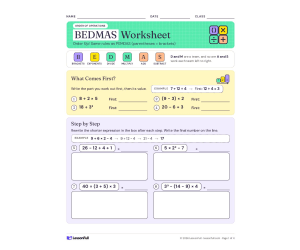
This BEDMAS worksheet builds order of operations one skill at a time across 19 problems. A banner at the top shows the six BEDMAS steps, notes that the rules match PEMDAS (parentheses = brackets), and reminds students that division and multiplication, like addition and subtraction, are worked left to right. Students begin by naming the first step in four short expressions, then rewrite expressions one step at a time, including some with exponents. Five real-life story problems follow: museum tickets with a coupon, gift boxes on sale, a lemonade cash box, miles biked over three days and a car wash fundraiser. Along the way students choose or write the matching expression, decide when brackets are needed, and find the step where a worked solution went wrong. The last two tasks ask them to place brackets to hit a target and to fill in missing operation signs. What's included Three student pages with 19 problems in seven formats, four of them introduced with a worked example An answer key page that shows every step, plus common mistakes to watch for Color and grayscale print PDF files of the whole worksheet Grade level: grades 5-7, for introducing or reviewing order of operations.
Author LessonFull.com
Rating
Tags Order Of Operations, Word Problems, Problem Solving, Real World Math, Applied Math, BEDMAS, Grade 5 Math, Grade 6 Math, Real Life Math, Worksheets

9th and 10th Graders Truth Seekers Detectives Fact or Fiction Activity
Special Resources, Social Skills, Life Skills, Grade 9, 10, Activities
Do you know how much news we hear every day can sometimes be fake, or a lie? News blasts from TVs, phones, and even family chats, but not everything you hear is the whole story. Sometimes information can be biased or even untrue. This activity booklet will give you superpowers to be an info detective! Learn to judge sources and spot the difference between fact and fiction. Are You a Girl Scout Leader? Great news if you are a Senior Girl Scout leader, this booklet was written for you. Use this to earn the Girl Scout Senior Truth Seeker Badge This is a PDF printable with 15 pages great for 9th and 10th graders. You could also use it with middle school kids as well. Activities in this booklet: Fake News vs. Real News: Crack the code on what makes news sources reliable. Learn to tell the difference between fact and fiction. Fact or Opinion ? Become an expert on spotting the difference in news articles, even those written by professionals! ️ Advertising A-Z: Uncover the tricks advertisers use and create your persuasive message! Finding Everyday Truths: Explore the concept of truth through fun activities, including watching a movie and discussing it with others. Citizen Journalist Training: Develop your critical thinking skills by analyzing headlines and learning how to identify fake news.
Author Leader Connecting Leaders
Tags Fact Or Fiction, Truth Seeker, Detective, Media

Sight Word Worksheets: can
ELA, Reading, Preschool, Grade 1, Worksheets, Worksheets & Printables
With these sight word worksheets, students will practice sight word recognition. Students will use these worksheets to find, spell, write, and read the target sight word. These worksheets are for the sight word: can. This product contains the following worksheets: With the Build a Sentence worksheet, students will cut out the words and unscramble a sentence using the target sight word. They will then draw a picture to illustrate the sentence. With the Sight Word Practice worksheet, students will color, trace, and write the sight word as well as cut out the letters that spell the word and glue them in the correct boxes. With the Sight Word Word Search worksheet, students will color, draw , and trace the sight word as well as locate the sight word in the word search. With the Sight Word Dab It worksheet, students will dab, color or cover the sight word. With the Sight Word Tracing worksheet, students can trace or rainbow write their sight word. With the Sight Word Color worksheet, students can color, rainbow write, or paint their sight words. With the Sight Word Write and Read worksheet, students will trace the sight word at the top of the page, write the sight word in the space in each sentence, and read the sentences. With the Sight Word Reading worksheet, students will read the story and then draw a picture to represent the story. Students can also circle or underline the target sight word. When to Use: Literacy Center - These worksheets can be used in literacy center for students to practice these sight words. Homework - These worksheets can be sent home from homework so parents can assist students in learning their sight words. Independent Practice - These worksheets make great independent practice for students learning sight words. Sub Plans - Since these worksheets have easy to follow directions, they make great activities to leave with substitutes.
Author The Connett Connection
Tags Sight Words, Sight Word Recognition, Sight Word Worksheets, Sight Word Can

Sentence Building with Visual Structure Task Cards Center 1
ELA, Special Resources, Reading, Reading Comprehension, Language Development, ESL, Writing, Handwriting, Pre-Reading, Special Education Needs (SEN), Speech Therapy, Kindergarten, Preschool, Grade 1, 2, Task Cards, Worksheets & Printables
These interesting and engaging worksheets and activity cards can be a very useful teaching resource tool, if your pupils have trouble grasping sentence structure or constructing whole basic sentences . Starting with short sentence patterns and building length gradually, always centered around essential contrasting words, this material uses visual aids / cues to guide ( instructively and as self check ) while keeping motivation high . It employs illustrations or symbols together with written words as a visual assistance that can progressively fade and disappear, until only words are left to work with . For every visual subject, there are three ( 3 ) distinct sentence formats . One with more symbols, one with less symbols and finally one with no symbols . It also provides possibilities to trace the words in sentences and frames to copy the sentences . Furthermore, empty frames beneath every theme . Along with being provided separately, the sentences ( all three types plus a tracing type ) can also be used as strip cards to compare, work on your own projects, or cut and paste / hook and loop to task cards that only have the visual theme and blank frames ( missing text ) . You also get the picture themes in the form of smaller Flash Cards, to use individually or in combination with the sentence strips, mentioned before . The key words used are : on, under, spoon, spoons, big, small, blue, green, dirty, clean, boy's, girl . For students with special education needs, literacy -challenged pupils, and young writers and readers in first and second grade, this sentence writing resource can serve as an organized teaching tool that will improve their ability to build sentences and communicate effectively . You can also check these resources for AAC Reading and Writing Development Task Cards AAC Sentence to Paragraph READING and WRITING Informational Text Basic Structure | Nonfiction Simple Passage Included: A pdf file with 161 pages .
Author WORDS ASIDE
Tags Visual Support, Sentence Building, Center, Reading, Writing, Autism, Attention, Structured Literacy, Key Words, Words Aside

CLIP CARDS - Addition to 20
Math, Addition and Subtraction, Addition, Preschool, Grade 1, 2, 3, Worksheets & Printables, Flashcards
INTRODUCTION: Hello, thank you very much for being in my store EDITORIAL ARENAS EDUCATIVAS again. We are in charge of the creation and design of these beautiful materials for both mathematics and the literacy learning area for children. For this reason, on this occasion we bring you these simple math worksheets on the topic of addition. IMPORTANCE OF USING EDUCATIONAL MATERIALS: As the great educational psychologist Jean Piaget said, children must use the greatest amount of material or concrete resources for their learning. In this way they will acquire learning in a more solid way or as he said "this way they will build their own knowledge"; which will be more durable over time. Also because according to natural laws, we know that children love to learn through play and through experience where they involve all their senses. CLIP CARDS are primers that allow children to practice any topic in a fun way. It also allows them to experiment, try one answer after another without fear of making mistakes because they can quickly correct their answer simply by moving the hook. Below I offer you this fantastic resource with some of its details: - Product name: "CLIP CARDS of sums up to 20" - Number of pages: Contains 5 pages ready to be printed. - Document size and format: PDF format and A4 size. - Author: Editorial Arenas Educativas. - Ages in which it can be applied: In children of 4,5,6 and even 7 years old who already know how to add up to 20. - How to print: I recommend you print this document as it is, because I consider that the booklets are the right size and you can also make an effort to print it in color, so that it is much more attractive for your children.
Author EDITORIAL LAURA EDUCA
Tags Flashcards, Addition Flashcards, Addition To 10, Addition To 20

CLIP CARDS - Alphabet Theme
ELA, Language Development, Spelling, Kindergarten, Preschool, Grade 1, Worksheets & Printables, Flashcards
Language is one of the main subjects taught to children, because society will then ask children to master reading and writing in daily life. And, as is known, every child's learning should be with the greatest amount of recreational materials possible so that this experience is one of the most unforgettable and interesting for them. It is said that if a child is interested in something she will learn it with much greater intensity and motivation. For this reason, at EDITORIAL ARENAS EDUCATIVAS we are dedicated to the development of educational resources and materials for teaching children, we put all our time and love to produce interesting resources. On this occasion I bring you this resource called "The alphabet A-Z through COUNT AND CLIP primers". Below I offer you more specific details on the topic: 1. Number of pages contained in this document: This resource contains 13 pages 2. Topic addressed in this document: The alphabet from A to Z 3. Children's ages to which it can be applied: This document can be applied to children from 4,5,6,7 years old who are on the path to learning reading and writing. 4. Version in which this resource is found: This resource is in PDF version, A4 size. 5. Way in which it should be printed: You have 2 options, you can print these sheets as exercises and just staple them and give them to your students or in another way you can cut card by card and then laminate them and use hooks so that your students can read them. Put in the appropriate and correct answer. 6. Standards based on which this resource was developed: It was not prepared based on any specific standard. 7. Author and credit: EDITORIAL ARENAS EDUCATIVAS 8. Free or paid? Take advantage of the fact that this resource is free for this time to download it now.
Author EDITORIAL LAURA EDUCA
Tags Flashcards, Alphabet, Abc For Kids, Alphabet Flashcards