
Reading responses
Problem and Solution Anchor Chart
Use the reference while discussing a shared story. Have students name the character’s need or difficulty, then locate the event that resolves it before completing the response frames.


Classroom resources
Browse by lesson focus
Choose the topic or kind of practice you need.
Showing 49–54 of 54 resources

 Show filters
Use the reference while discussing a shared story. Have students name the character’s need or difficulty, then locate the event that resolves it before completing the response frames.

Four ways to represent a fraction, parts of a set, parts of a whole, a strip diagram, and a number line, are illustrated on cut-and-assemble pieces designed to be glued onto anchor-chart paper for a classroom math display. A guide page walks the teacher through printing the title, circle labels, arrows, and rectangle illustrations in a chosen color scheme, then arranging and securing the pieces onto 24-by-32-inch chart paper using the included layout as a reference. A matching, reduced-size version of the same chart is provided for students to keep in their own math notebooks as a personal reference. The chart uses one shaded example, three-fifths, worked out identically across all four representation methods so students can compare them side by side. Once students can identify a fraction across these four representations, the pizza fractions project gives them a hands-on activity comparing fractions and writing their own word problems using paper-pizza toppings.

A five-step Somebody/Wanted/But/So/Then framework walks students through identifying a story's main character, goal, problem, attempted solution, and ending, and it appears twice — once fully worded as a teacher or display copy, and once with key words blanked out for students to fill in themselves. A second, matching chart titled ‘Summarizing’ explains that a summary retells a story's main events and lists the five elements to include (characters, setting, problem, events, solution) using the same SWBST acronym, again in both a complete and a fill-in-the-blank version. Together the four pages form a two-part anchor chart set meant to be posted for reference and then reinforced through an interactive-notebook-style blank version students complete in their own notes. The charts can support story retelling alongside a teacher-selected text.

Read a sentence aloud and identify its complete subject before discussing the predicate. Invite students to create a similar sentence and explain its two parts.

Assemble a classroom reference for acute, obtuse, right and straight angles using the printable header and four puzzle pieces. The guide explains how to print on colored paper and attach the pieces to an anchor-chart base. Two layout options for the smaller student reference let you pair the wall display with a notebook page for later angle work.
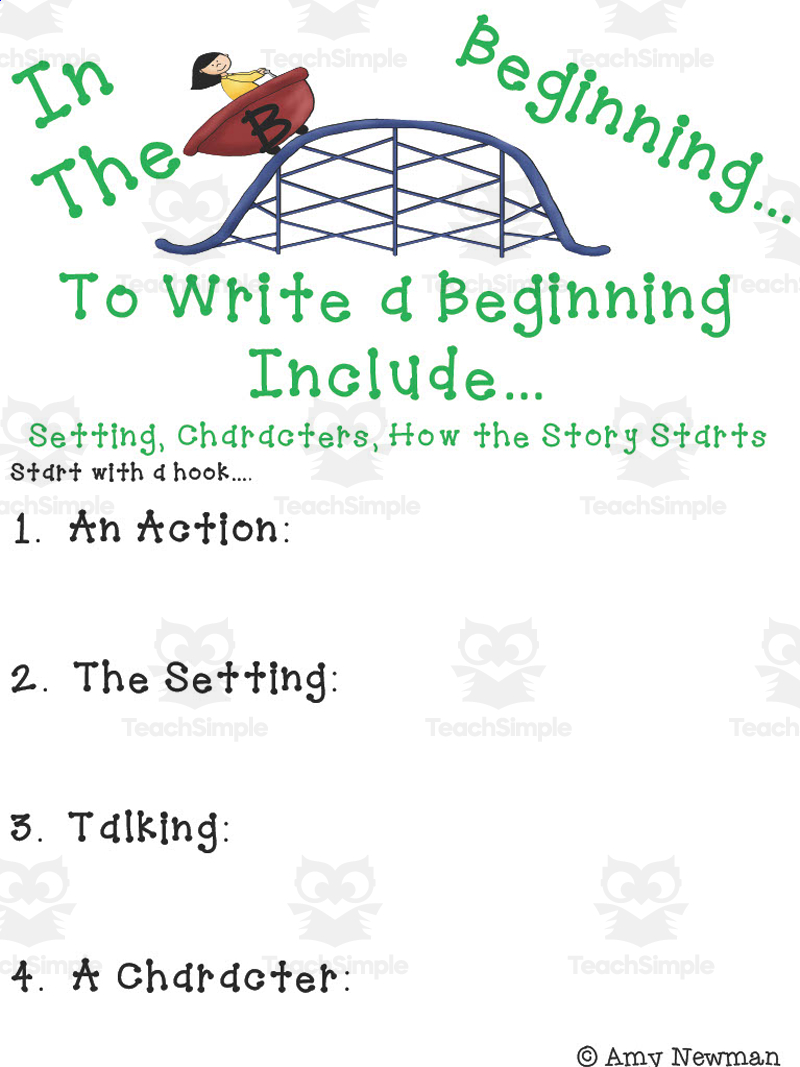
This resource is all about writing the beginning, middle and end. With this resource, students will talk about what each part of a story is to include. These posters can be printed and hung up.