



3,931 products added recently
Page 100 - Science Lesson Plans
Bring science to life with lesson plans that cover biology, chemistry, physics, and more. These resources offer experiments and interactive lessons to stimulate curiosity. Implement them to foster a deep understanding of scientific principles and a passion for discovery.

 Show filters


I WONDER - Where Are Sinkholes Formed | Animated Video Lesson
Government, Social Studies, Earth Sciences, Earth and Environmental Sciences, Science, Grade 4, 5, 6, 7, 8, 9, 10, Lesson Plans, Teacher Tools
Video Introduction An amazing video designed for the students to learn more about famous places in different countries. I WONDER - Where Are Sinkholes Formed | Animated Video Lesson What do you know about this place? Do you know in which part of the world it is? Have you ever visited this place? If yes, can you tell us more about your adventure, and what do you like the most about this place? Do you like reading about Geography? What is your favorite country in the whole world? If you are going on a trip where it will be? Which country? What you are going to see there? Does this country has a famous place to visit? I WONDER - Where Are Sinkholes Formed | Animated Video Lesson The activity is perfect for encouraging the researching skills for the students, while learning more about this fantastic place. I WONDER - Where Are Sinkholes Formed | Animated Video Lesson This friendly designed video is suitable for students at school, homeschooling, and as a group activity. Format Available in MP4 format.
Author Educational Voice
Tags Where Are Sinkholes Formed, Where Are Sinkholes Formed Video, Sinkholes, Sinkhole, Sinkholes Facts, Sinkholes Facts For Kids, Sinkholes Video, Sinkholes Video For Kids, Sinkhole Video

I WONDER - What Is An Incandescent Lightbulb | Animated Video Lesson
Physics, Science, Grade 6, 7, 8, 9, 10, 11, 12, Lesson Plans, Teacher Tools
Video Introduction An amazing activity designed for the students to learn more about STEM. I WONDER - I WONDER - What Is An Incandescent Lightbulb | Animated Video Lesson Do you like STEM subjects? what is your favorite one? Have you ever tried to plant a seed? If yes, tell us more about it. Or have you ever tried to invent something? If yes, tell us more about it. And how do you think it will help us? Have you ever seen a microorganism under a microscope? What was it? And how it looked like? Mathematics is a marvelous subject. Let' sharpen our brains and solve some equations. Do you like timetable tricks? What is your favorite one? Do you know how to code? Have you ever created an app or a game before? If yes, how was it like? I WONDER - I WONDER - What Is An Incandescent Lightbulb | Animated Video Lesson The video is perfect for encouraging the researching skills for the students, while learning more about this fantastic topic. I WONDER - I WONDER - What Is An Incandescent Lightbulb | Animated Video Lesson This friendly designed video is suitable for students at school, homeschooling, and as a group activity. Format Available in MP4 format.
Author Educational Voice
Tags What Is An Incandescent Lightbulb, What Is An Incandescent Lightbulb Video, Incandescent Lightbulb, Incandescent Lightbulb Facts, Incandescent Lightbulb Facts For Kids, Incandescent Lightbulb Video
I WONDER - Are Trees Important For The Environment | Animated Video
Environmental Science, Earth and Environmental Sciences, Science, Earth Sciences, Nature & Plants, Life Sciences, Grade 3, 4, 5, 6, 7, 8, 9, Lesson Plans, Teacher Tools
Video Introduction An amazing video designed for the students to learn more about STEM. I WONDER - Are Trees Important For The Environment | Animated Video Lesson Do you like STEM subjects? what is your favorite one? Have you ever tried to plant a seed? If yes, tell us more about it. Or have you ever tried to invent something? If yes, tell us more about it. And how do you think it will help us? Have you ever seen a microorganism under a microscope? What was it? And how it looked like? Mathematics is a marvelous subject. Let' sharpen our brains and solve some equations. Do you like timetable tricks? What is your favorite one? Do you know how to code? Have you ever created an app or a game before? If yes, how was it like? I WONDER - Are Trees Important For The Environment | Animated Video Lesson The video is perfect for encouraging the researching skills for the students, while learning more about this fantastic topic. I WONDER - Are Trees Important For The Environment | Animated Video Lesson This friendly designed video is suitable for students at school, homeschooling, and as a group activity. Format Available in MP4 format.
Author Educational Voice
Tags Are Trees Important For The Environment, Are Trees Important For The Environment Video, Trees Are Important For The Environment, Trees, Trees Facts, Trees Video, Trees Video For Kids, Trees Facts For Kids

I WONDER - How Are Enzymes Used In Daily Life | Animated Video Lesson
Human Body, Life Sciences, Science, Biology, STEM, Grade 6, 7, 8, 9, 10, 11, 12, Lesson Plans, Teacher Tools
Video Overview The human body is full of fascinating wonders to learn. This video is created to help the students recognize the anatomy and the job of the human body. I WONDER - How Are Enzymes Used In Daily Life | Animated Video Lesson Every part and organ in our human body is vital so let's see how important they are. Have you ever imagined how we look like if we didn't have a skeleton? Did you know that because we have our amazing muscles we can stand! Do you know how many teeth do we have? Have you ever wondered about the food journey inside our body? Can you name all the glands in our body? Why do we have skin? Our nervous system is really good at sending signals. Can you tell us more about it? Are you really good at Mathematics, painting, or any other thing? You should really thank your brain about it! The famous five senses are really doing a great work? Can you explain how every sense works? I WONDER - How Are Enzymes Used In Daily Life | Animated Video Lesson The video is perfect for encouraging the researching skills for the students, while learning more about our fantastic human body. I WONDER - How Are Enzymes Used In Daily Life | Animated Video Lesson This friendly designed video is suitable for students at school, homeschooling, and as a group activity. Format Available in MP4 format.
Author Educational Voice
Tags How Are Enzymes Used In Daily Life, How Are Enzymes Used In Daily Life Video, Enzymes, Enzyme, Enzymes Facts, Enzymes Facts For Kids, Enzymes Video, Enzymes Video For Kids

Study of Muscles & Movement (Gr. 5-8)
Science, Life Sciences, Human Body, Grade 5, 6, 7, 8, Teacher Tools, Lesson Plans
Study of Muscles & Movement: A Comprehensive Teaching Resource (Grades 5-8) Study of Muscles & Movement is a meticulously designed educational resource intended for grades 5 to 8, aimed to provide a comprehensive understanding of the human body, focusing particularly on the functionality of the muscular system in our movement. The course initiates by exploring the structure and function of cells, thereby establishing a basic foundation for further studies. An in-depth comprehension about how these fundamental life elements form tissues and organs leading up to complete organ systems follows next. The study proceeds into eight crucial human body systems: circulatory, respiratory, nervous, digestive, excretory, reproductive among others. Detailed learning modules for skeletal and muscular systems are provided thereafter which reinforce understanding of core biology concepts. Maintenance of student engagement: In spite maintaining academic rigor throughout; utmost importance is given to keeping students engaged through captivating reading passages followed by activities that enhance comprehension as well as encourage reflection. Supplementary material such as colourful mini posters enhances this learning experience. Moreover hands-on lab-like experiments bring real-life context making it more appealing! Categorized Comprehension Study: This resource diligently adheres to Bloom's taxonomy structuring cognitive levels systematically from base knowledge recall onto creation at apex! Notably it also wonderfully reflects STEM education targets unifying Science Technology Engineering Math themes thus encapsulating wholistic educative approach. Evaluation & Assessment : A refined test preparation section accommodates smooth transition into assessments with its state-standard content that prepares them substantive exams without them even realizing their double benefit! The availability exclusively in PDF format ensures editing isn’t required simplifying usage process further for educators making this tool as beneficial for educators it is for students! Adaptable & Inclusive: This resource stands as a vital tool suitable for both public school teachers and homeschoolers by being adaptable to all learning settings, may it be group-based learning or individual assignments. Further the balanced information ensures that even challenged learners benefit from this paper maintaining its captivating charm from starting till end!
Author Classroom Complete Press
Tags PDF
I WONDER - How Does A Tortoise Breathe Inside Its Shell
STEM, Biology, Life Sciences, Science, Animals, Grade 1, 2, 3, 4, 5, 6, 7, 8, Lesson Plans, Teacher Tools
Video Introduction Animal kingdoms are full of fascinating wonders to learn. This video is designed for the students to learn more about animals in different countries. I WONDER - How Does A Tortoise Breathe Inside Its Shell | Animated Video Lesson Do you like animals? what is your favorite one? Do you own a pet? If yes, tell us more about it, like what its name? And what do you like most about it? What are the animal kingdoms? Can you write down the characteristics of each animal class like mammals, birds, reptiles, amphibian, fish and mollusks. Do you know that some animals can sing, can you name any of them? What is the largest and the smallest mammal in the world? What is the largest and the smallest bird in the world? What is the largest and the smallest fish in the world? I WONDER - How Does A Tortoise Breathe Inside Its Shell | Animated Video Lesson The video is perfect for encouraging the researching skills for the students, while learning more about these fantastic animals. I WONDER - How Does A Tortoise Breathe Inside Its Shell | Animated Video Lesson This friendly designed video is suitable for students at school, homeschooling, and as a group activity. Format Available in MP4 format.
Author Educational Voice
Tags How Does A Tortoise Breathe Inside Its Shell, How Does A Tortoise Breathe Inside Its Shell Video, Tortoise Breathe Inside Its Shell, Tortoise Breathe Inside Its Shell Facts, Tortoise Shell, Tortoise Shell Facts, Tortoise Shell Facts For Kids

Free Science - Force and Motion Interactive Vocabulary Activity
Science, Physics, Grade 8, Teacher Tools, Lesson Plans
Free Science - Force and Motion Interactive Vocabulary Activity Engage your 8th grade science students with this interactive vocabulary review on force and motion. Students will learn 33 key terms through definitions and visuals. The activity allows students to practice the vocabulary before taking a multiple choice quiz to assess understanding. With this engaging PowerPoint, students will reinforce their knowledge of concepts like inertia, gravity, and acceleration. Use it whole-group on a projector, assign it individually, or have students work in small groups at stations. The activity provides immediate feedback to support student learning. Check out other 8th grade science vocabulary and review activities in our store to align with units on geology, astronomy, traits and reproduction. Spanish versions also available for math, reading, writing, and language practice. This force and motion presentation includes 33 interactive quiz slides.
Author ShapeUp-N-Matematicas y Lenguaje
Tags FORCE AND MOTION REVIEW, INTERACTIVE MULTIPLE CHOICE ACTIVITY, PHYSICS VOCABULARY, SMALL OR WHOLE GROUP, FORCE, MOTION, SCIENCE MULTIPLE CHOICE
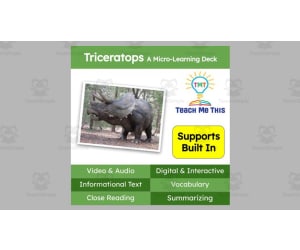
Triceratops | Interactive Science Lesson | Micro-Learning Deck
Science, Earth and Environmental Sciences, Grade 6, 7, 8, 9, Teacher Tools, Lesson Plans
This micro-learning deck is the perfect accessory to your Science instruction! This digital slideshow presents Triceratops. Within this slideshow, you will receive: -Video Lesson -Reading Passage w/ Audio -Close Reading -Quick Write The informational texts included in this resource alongside the informal assessments will keep your students engaged from beginning to end.
Author Teach Me This
Tags Triceratops, Dinosaurs, Extinct, Vocabulary, Interactive Science
I WONDER - How Was The Periodic Table Arranged | Animated Video Lesson
Chemistry, Science, Grade 4, 5, 6, 7, 8, 9, 10, Lesson Plans, Teacher Tools
Video Introduction An amazing activity designed for the students to learn more about STEM. I WONDER - How Was The Periodic Table Arranged | Animated Video Lesson Do you like STEM subjects? what is your favorite one? Have you ever tried to plant a seed? If yes, tell us more about it. Or have you ever tried to invent something? If yes, tell us more about it. And how do you think it will help us? Have you ever seen a microorganism under a microscope? What was it? And how it looked like? Mathematics is a marvelous subject. Let' sharpen our brains and solve some equations. Do you like timetable tricks? What is your favorite one? Do you know how to code? Have you ever created an app or a game before? If yes, how was it like? I WONDER - How Was The Periodic Table Arranged | Animated Video Lesson The video is perfect for encouraging the researching skills for the students, while learning more about this fantastic topic. I WONDER - How Was The Periodic Table Arranged | Animated Video Lesson This friendly designed video is suitable for students at school, homeschooling, and as a group activity. Format Available in MP4 format.
Author Educational Voice
Tags How Was The Periodic Table Arranged, How Was The Periodic Table Arranged Video, Periodic Table, Periodic Table Facts, Periodic Table Facts For Kids, Periodic Table Video, Periodic Table Video For Kids

I WONDER - How Did The Velociraptor Get Its Name | Animated Video
Animals, Life Sciences, Science, History: Ancient, History, Social Studies, History: World, Grade 3, 4, 5, 6, 7, 8, 9, Lesson Plans, Teacher Tools
Video Introduction An amazing video designed for the students to learn more about dinosaurs in different countries. I WONDER - How Did The Velociraptor Get Its Name | Animated Video Lesson Dinosaurs are really huge creatures. Do you think there was tiny dinosaurs living on earth? Or are there any dinosaurs live till now?! How big was the t-rex? And how heavy it was? Do you know how each dinosaur gets its name? And who named them? What do you think the dinosaurs favourite food? Do you think there were flying dinosaurs? I WONDER - How Did The Velociraptor Get Its Name | Animated Video Lesson The video is perfect for encouraging the researching skills for the students, while learning more about dinosaurs. I WONDER - How Did The Velociraptor Get Its Name | Animated Video Lesson This friendly designed video is suitable for students at school, homeschooling, and as a group activity. Format Available in MP4 format.
Author Educational Voice
Rating
Tags How Did The Velociraptor Get Its Name, Velociraptor, Velociraptor Facts, Velociraptor Video, Velociraptor Facts For Kids, Velociraptor Video For Kids, Velociraptors, Velociraptors Facts, Velociraptors Video

Life Cycle of a Watermelon Worksheet | Plants & Fruits Unit Study
Summer, Seasons, Holiday & Seasonal, Montessori, Life Sciences, Science, Biology, Nature & Plants, Kindergarten, Preschool, Grade 1, 2, 3, Bulletin Boards, Classroom Decor, Posters, Lesson Plans, Teacher Tools, Flashcards, Worksheets & Printables, Coloring Pages, Worksheets
Have you ever wondered how a tiny seed grows into a big, juicy watermelon? In this fun and interactive science unit, we will explore the amazing life cycle of a watermelon and discover fun facts about this delicious fruit. Get ready to learn, cut, paste, and color! What’s Inside Watermelon Fun Facts – Learn where watermelons grow, how they develop, and why they are so refreshing! Life Cycle Diagram – A simple and clear chart showing each stage of a watermelon's life, from seed to fully grown fruit. Cut-and-Paste Activity – Arrange the life cycle in the correct order by cutting and pasting the stages. Flashcards – Use these picture cards to remember each step in a watermelon's journey. Bonus Coloring Page – Get creative and color a bright, tasty watermelon! You can use this worksheet for: Makes learning about plants and fruit fun and interactive. Helps develop sequencing and problem-solving skills. Teaches the importance of plant growth and agriculture. Includes hands-on activities to reinforce learning. Let’s dive into the world of plants and discover how watermelons grow!
Author Perfect_Printables
Tags Watermelon Life Cycle, Fruit Unit Study, Watermelon Activities, Life Cycle Worksheets, Science Printables, Homeschool Science, Fruit Biology Lesson, Watermelon Theme, STEM ActivitieSTEM Activitiess

I WONDER - Can We See All The Milky Way | Animated Video Lesson
Space, Earth and Environmental Sciences, Science, Grade 2, 3, 4, 5, 6, 7, 8, Lesson Plans, Teacher Tools
Video Introduction An amazing video designed for the students to learn more about space facts. I WONDER - Can We See All The Milky Way | Animated Video Lesson Have you ever thought about travelling to space?! Join us with this amazing video about the Milky Way. what do you think a Milky is made of? How amazing is space! Let's discover some amazing facts about the Milky way! Do you know that we have two kinds of planets in our solar system? Can you name the planets based upon their core type? I WONDER - Can We See All The Milky Way | Animated Video Lesson The video is perfect for encouraging the researching skills for the students, while learning more about the fantastic space. I WONDER - Can We See All The Milky Way | Animated Video Lesson This friendly designed video is suitable for students at school, homeschooling, and as a group activity. Format Available in MP4 format.
Author Educational Voice
Rating
Tags Can We See All The Milky Way, The Milky Way, The Milky Way Facts, The Milky Way Video, The Milky Way Facts For Kids, The Milky Way Video For Kids, Space, Space Facts, Space Facts For Kids
I WONDER - What Is A Blizzard | Animated Video Lesson
Geography, Social Studies, Environmental Science, Earth and Environmental Sciences, Science, Earth Sciences, Grade 1, 2, 3, 4, 5, 6, 7, 8, Teacher Tools, Lesson Plans
Video Introduction An amazing video designed for the students to learn more about natural disasters in different countries. I WONDER - What Is A Blizzard | Animated Video Lesson What do you know about this natural disaster? Do you know in which part of the world this could happen? Have you ever read about the safety misusers that we could have to protect ourselves from this natural disaster? If yes, can you tell us more about them? Can you name other natural disasters? If yes, tell us more about where they are likely to happen? And how frequently? Do you like reading about Geography? What is your favorite country in the whole world? If you are going on a trip where it will be? Which country? What you are going to see there? Does this country has a famous place to visit? Do you like reading about Geology? If yes, what is your favourite topic? I WONDER - What Is A Blizzard | Animated Video Lesson The video is perfect for encouraging the researching skills for the students, while learning more about this fantastic phenomenon. I WONDER - What Is A Blizzard | Animated Video Lesson This friendly designed video is suitable for students at school, homeschooling, and as a group activity. Format Available in MP4 format.
Author Educational Voice
Tags What Is A Blizzard, What Is A Blizzard Video, Blizzard, Blizzards, Blizzard Facts, Blizzard Facts For Kids, Blizzard Video, Blizzard Video For Kids, Blizzards Facts, Blizzards Video
I WONDER - Why Are Spiders Not Insects | Animated Video Lesson
STEM, Animals, Life Sciences, Science, Biology, Grade 1, 2, 3, 4, 5, 6, 7, 8, Lesson Plans, Teacher Tools
Video Introduction Animal kingdoms are full of fascinating wonders to learn. This video is designed for the students to learn more about animals in different countries. I WONDER - Why Are Spiders Not Insects | Animated Video Lesson Do you like animals? what is your favorite one? Do you own a pet? If yes, tell us more about it, like what its name? And what do you like most about it? What are the animal kingdoms? Can you write down the characteristics of each animal class like mammals, birds, reptiles, amphibian, fish and mollusks. Do you know that some animals can sing, can you name any of them? What is the largest and the smallest mammal in the world? What is the largest and the smallest bird in the world? What is the largest and the smallest fish in the world? I WONDER - Why Are Spiders Not Insects | Animated Video Lesson The video is perfect for encouraging the researching skills for the students, while learning more about these fantastic animals. I WONDER - Why Are Spiders Not Insects | Animated Video Lesson This friendly designed video is suitable for students at school, homeschooling, and as a group activity. Format Available in MP4 format.
Author Educational Voice
Tags Why Are Spiders Not Insects, Why Are Spiders Not Insects Video, Spiders, Spider, Spiders Video, Spiders Video For Kids, Spiders Facts, Spiders Facts For Kids, Spider Video, Spider Facts

Egypt The Gift of the Nile: Guided Reading Level R with Lesson Plan
ELA, Resources for Teachers, Reading Comprehension, Reading, Science, Geography, Social Studies, History, Earth and Environmental Sciences, Technology, Grade 3, 4, 5, Worksheets & Printables, Worksheets, Teacher Tools, Centers, Activities, Literacy Readers, Quizzes, Quizzes and Tests, Assessments, Lesson Plans
This Egypt: The Gift of the Nile (level r) guided reading book with lesson plan includes: Guided Reading Color Label (front cover x1) This is a quick way to match the book’s demands to what students can generally handle.. The overall goal is to use the level/color to pick books for several smaller groups. To qualify for a certain level, a student is expected to read a book from that level with about 90–94% accuracy. If a student is consistently accurate and understands, move up a level. If the student is struggling at that level, drop down and add more support. Each student will improve at completely different rates, but it is generally one of the best ways to check progress across the class. DOWNLOAD THE CATALOG TO VIEW ALL GUIDED READING BOOKS AVAILABLE (SORTED LEVELS A-Z) Pre-Reading Question (x1) Teacher asks the prompt aloud, can be while showing the cover or first page. Students share what they already know, or make educated guesses from the cover. Prompt them to use the target vocabulary. Write some of their responses on the board to look back at during the reading. Vocabulary Words (x5) Introduce the five words, best doing it one at a time. Start by saying it, while students repeat and then see if anyone knows what it means before reading further. Read through the meaning and try to briefly connect each word to a picture or gesture so it’s meaningful. Ask students to flip through the book pages and point to where they see each of the vocabulary words. While reading the book pause upon coming across one of the vocab words or read the sentence twice to make sure students understand the word has appeared. Optional: Ask students to raise hands whenever they see/hear one of the new words. Guided Reading Pages (x10) Check the book snapshot (below) for: primary topic - do you need to prep extra reading or intro materials on this? what is taught best - decide on 1-2 bullets to focus on, use the prompt or words provided here for best results. learning goals - what you are checking for students to be able to do after the session, elicit answers using prompts or words provided. key vocabulary (see section above). questions overview - so you know what is coming up and if you need to prep extra materials to assist understanding. Run the lesson You may have already looked at a few of the pages together, but you can show them some of the pictures again first to set meaning. Depending on how much time you have and how familiar your students are with guided reading class, you may want to read the book aloud first with the group first. Students whisper or partner read, while you listen in. If time, do it as a group, one student reading a page each. Use the guided page’s prompts to coach: “Check the picture / does it make sense?” “Point under the words / try the first sound” “Reread the sentence smoothly”. Try to focus more on one student per session (rotating every time), so you can work out if they are ready to move up or need to move down a level. Comprehension Questions (back cover x3) This is your way to check that students didn’t just say the words, but actually understood the text. First, let students answer by pointing to the page/picture and saying a short sentence. After any answer, follow with: “Show me where you found that in the text.” In bigger groups, have partners answer first (10–20 seconds), then call on 2–3 students to share. Differentiation tips: Emerging speakers/struggling readers: oral + pointing On-level: oral in a full sentence Higher: one written sentence or draw + label Book Snapshot Title: Egypt: The Gift of the Nile Genre: Nonfiction Subject: Social Studies (Geography/History) Primary Topic: How the Nile shaped ancient and modern Egypt Estimated Guided Reading Level (A–Z): R What This Book Teaches Best How Egypt’s desert environment (Sahara Desert, little rain) made a single water source essential for a thriving civilization. Why the Nile River’s yearly floods mattered, including how receding water left fertile silt for growing food. Major symbols of ancient Egypt and what the text says they were for or represented (Great Pyramid of Giza; Great Sphinx). Key beliefs and systems of ancient Egypt, including pharaohs, the afterlife, hieroglyphics, and mummification. Connections between past and present by describing modern Cairo, the Suez Canal, tourism, and archaeologists’ discoveries. Learning Goals Students will describe Egypt’s location and explain how the Sahara Desert affects the land. Students will explain how Nile floods helped farmers grow food by using the text’s details about silt. Students will identify what the Great Pyramid of Giza was built for and describe one detail about its construction. Students will describe how ancient Egyptians recorded history and managed government using hieroglyphics and scribes. Students will explain why mummification was developed and describe what the text says happened during the process. Students will describe two details that show Egypt is a modern nation today (for example, Cairo and the Suez Canal). Key Vocabulary From the Text receded — moved back after being higher. silt — rich dark soil left by water. monumental — very large and important. hieroglyphics — picture symbols used as a writing system. mummification — preserving a body by drying and wrapping. Discussion Prompts Pre-reading question: How might a river help people live and farm in a desert place? Comprehension questions: What did the Nile River’s floods leave behind when the water receded, and why did that help farmers? Comprehension questions: What does the text say the Great Pyramid of Giza was built for? Comprehension questions: What two details from the text show Egypt is a modern nation today? Printing Tips 1. Best Printing Method (Recommended) “Booklet” Printing (Best if Available) If your printer or PDF viewer supports Booklet Printing , use this. Settings to use: Print mode: Booklet Paper size: Letter or A4 (either works) Orientation: Landscape Print on both sides: Yes Flip on: Short edge Scaling: Fit to printable area Booklet subset: First test: Front sides only Then: Back sides only This will automatically: Pair pages correctly Put the cover on the outside Align everything for folding After printing, fold in half and staple along the spine . 2. If “Booklet” Printing Is NOT Available You can still print this correctly with manual duplex printing . Step-by-step: Open the PDF. Choose Print . Set: Orientation: Landscape Pages per sheet: 1 Print on both sides: Yes Flip on: Short edge Print all pages . Because each PDF page already contains two facing book pages, the result will still fold cleanly into a book. Thousands of Cored Education products are included with your TeachSimple membership. Download links and encyclopedia index available here.
Author Cored Education
Rating
Tags Reading Comprehension, Reading Passages, Reading, Guided Reading, Guided Reading Lesson Plan, Guided Reading Activity, Pre-reading, Social Studies, Geography, History
I WONDER - When Did The Megalosaurus Roam The Earth | Animated Video
History: Ancient, History, Social Studies, History: World, Animals, Life Sciences, Science, Grade 4, 5, 6, 7, 8, 9, 10, Lesson Plans, Teacher Tools
Video Introduction An amazing video designed for the students to learn more about dinosaurs in different countries. I WONDER - When Did The Megalosaurus Roam The Earth | Animated Video Lesson Do you like dinosaurs? what is your favorite one? Do you own a pet? If yes, tell us more about it, like what its name? And what do you like most about it? Do you think that your pet has been evolved from a dinosaur? Can you write down the characteristics of your favourite dinosaur like it's shape, their rivals, where did it use to live and what was their favourite food? What is the largest and the smallest dinosaur that ever found? Why is the T-rex is so famous? Have you ever read any interesting facts about it? Can you name any of the carnivores or herbivores dinosaurs? I WONDER - When Did The Megalosaurus Roam The Earth | Animated Video Lesson The video is perfect for encouraging the researching skills for the students, while learning more about dinosaurs. I WONDER - When Did The Megalosaurus Roam The Earth | Animated Video Lesson This friendly designed video is suitable for students at school, homeschooling, and as a group activity. Format Available in MP4 format.
Author Educational Voice
Rating
Tags When Did The Megalosaurus Roam The Earth, When Did The Megalosaurus Roam The Earth Video, Megalosaurus, Megalosaurus Facts, Megalosaurus Video, Megalosaurus Facts For Kids, Megalosaurus Video For Kids

Volcanoes: A Comprehensive Hands-On Science Unit
Science, Earth and Environmental Sciences, Environmental Science, Grade 4, 5, 6, 7, 8, Teacher Tools, Lesson Plans
The Volcanoes: A Comprehensive Hands-On Science Unit A dependable teaching resource, precisely designed for facilitators intending to provide their students with thorough scientific learning. It suits perfectly for public school instructors as well as homeschoolers educating grades 4-8. Based in the comprehensive scope of environmental science, this well-rounded lesson plan explores the fascinating domain of volcanoes. Beyond Traditional Experiments These lessons move past the typical baking-soda-and-vinegar eruptions activity and aims to deliver an all-inclusive understanding of volcanic science. It elaborately analyzes a volcano's structure, interpreting all its parts, performances and processes during eruption phases while also shedding light on unique factors such as volcanic bombs, hair particles and tears. Focusing on Realistic Threats This unit prominently talks about ecological hazards posed by volcanoes beyond conventional eruptive events—significantly essential in imbibing realism among learners about environmental threats. All About Detailed Learning The unit comprises 32 print-ready PDF pages , decorated with vibrant illustrations and enriching text content for facilitating comprehension among students of varying capabilities across recommended grade levels. Suitable to be taught in both whole group sessions or smaller tutorial discussions Potentially divided into homework assignments when required, Orients towards different learner types promoting methodical knowledge uptake through scientifically grounded pedagogical tactics via adaptable lesson planning options according to a student's grasp rate ensuring acceptable curricular coverage. In summary, The Volcanoes: A Comprehensive Hands-On Science Unit is essentially your go-to resource if you wish your students traverse beyond mere textbook learning. A credible choice for all environment science teachers aiming to add a bit of adventure into their curriculum .
Author Classroom Complete Press
Tags Weather, Volcanoes, Hands-on Science, Experiments, Science Unit
I WONDER - What Are The Different Types Of Coffee Beans
Nature & Plants, Life Sciences, Science, Grade 6, 7, 8, 9, 10, 11, 12, Lesson Plans, Teacher Tools
Video Introduction An amazing activity designed for the students to learn more about STEM. I WONDER - What Are The Different Types Of Coffee Beans | Animated Video Lesson Do you like STEM subjects? what is your favorite one? Have you ever tried to plant a seed? If yes, tell us more about it. Or have you ever tried to invent something? If yes, tell us more about it. And how do you think it will help us? Have you ever seen a microorganism under a microscope? What was it? And how it looked like? Mathematics is a marvelous subject. Let' sharpen our brains and solve some equations. Do you like timetable tricks? What is your favorite one? Do you know how to code? Have you ever created an app or a game before? If yes, how was it like? I WONDER - What Are The Different Types Of Coffee Beans | Animated Video Lesson The video is perfect for encouraging the researching skills for the students, while learning more about this fantastic topic. I WONDER - What Are The Different Types Of Coffee Beans | Animated Video Lesson This friendly designed video is suitable for students at school, homeschooling, and as a group activity. Format Available in MP4 format.
Author Educational Voice
Tags What Are The Different Types Of Coffee Beans , What Are The Different Types Of Coffee Beans Video, Different Types Of Coffee Beans, Types Of Coffee Beans , Coffee Beans , Coffee Beans Facts, Coffee Beans Facts For Kids
I WONDER - How Do Pangolins Catch Their Food | Animated Video Lesson
STEM, Biology, Life Sciences, Science, Animals, Grade 1, 2, 3, 4, 5, 6, 7, 8, Lesson Plans, Teacher Tools
Video Introduction Animal kingdoms are full of fascinating wonders to learn. This video is designed for the students to learn more about animals in different countries. I WONDER - How Do Pangolins Catch Their Food | Animated Video Lesson Do you like animals? what is your favorite one? Do you own a pet? If yes, tell us more about it, like what its name? And what do you like most about it? What are the animal kingdoms? Can you write down the characteristics of each animal class like mammals, birds, reptiles, amphibian, fish and mollusks. Do you know that some animals can sing, can you name any of them? What is the largest and the smallest mammal in the world? What is the largest and the smallest bird in the world? What is the largest and the smallest fish in the world? I WONDER - How Do Pangolins Catch Their Food | Animated Video Lesson The video is perfect for encouraging the researching skills for the students, while learning more about these fantastic animals. I WONDER - How Do Pangolins Catch Their Food | Animated Video Lesson This friendly designed video is suitable for students at school, homeschooling, and as a group activity. Format Available in MP4 format.
Author Educational Voice
Tags How Do Pangolins Catch Their Food, How Do Pangolins Catch Their Food Video, Pangolins, Pangolins Food, Pangolins Food Facts, Pangolins Food Facts For Kids, Pangolins Food Video, Pangolins Food Video For Kids
I WONDER - How Does A Windmill Work | Animated Video Lesson
Environmental Science, Earth and Environmental Sciences, Science, Grade 6, 7, 8, 9, 10, 11, 12, Lesson Plans, Teacher Tools
Video Introduction An amazing video designed for the students to learn more about STEM. I WONDER - How Does A Windmill Work | Animated Video Lesson Do you like STEM subjects? what is your favorite one? Have you ever tried to plant a seed? If yes, tell us more about it. Or have you ever tried to invent something? If yes, tell us more about it. And how do you think it will help us? Have you ever seen a microorganism under a microscope? What was it? And how it looked like? Mathematics is a marvelous subject. Let' sharpen our brains and solve some equations. Do you like timetable tricks? What is your favorite one? Do you know how to code? Have you ever created an app or a game before? If yes, how was it like? I WONDER - How Does A Windmill Work | Animated Video Lesson The video is perfect for encouraging the researching skills for the students, while learning more about this fantastic topic. I WONDER - How Does A Windmill Work | Animated Video Lesson This friendly designed video is suitable for students at school, homeschooling, and as a group activity. Format Available in MP4 format.
Author Educational Voice
Tags How Does A Windmill Work, How Does A Windmill Work Video, Windmill, Windmill Facts, Windmill Facts For Kids, Windmill Video, Windmill Video For Kids, Renewable Energy, Renewable Energy Video
I WONDER - How Was The Erasable Pen Invented | Animated Video Lesson
History: World, History, Social Studies, History: USA, History: Europe, Inventors, Basic Science, Science, Grade 4, 5, 6, 7, 8, 9, 10, Lesson Plans, Teacher Tools
Video Introduction An amazing video designed for the students to learn more about history. I WONDER - How Was The Erasable Pen Invented | Animated Video Lesson Do you like history? Which topic do you really enjoy about history? Have you ever read an interesting fact about the Vikings? If yes, can you mention them? What do you like most about the Victorian era? Can you name all the Tudors? Have you ever wondered how people used to live in ancient Japan and ancient China? Do you know any interesting facts about ancient Egyptians and the Pharaohs? Have you ever visited South America? What do you know about Incas and Aztecs? Celtic culture was really one of a kind, can you name any of the places that Celts used to live in? Imagine yourself living during the ancient Roman empire, how your life will look like? Ancient Greece was an amazing place to live in. What do you know about ancient Greek life? I WONDER - How Was The Erasable Pen Invented | Animated Video Lesson The video is perfect for encouraging the researching skills for the students, while learning more about history. I WONDER - How Was The Erasable Pen Invented | Animated Video Lesson This friendly designed video is suitable for students at school, homeschooling, and as a group activity. Format Available in MP4 format.
Author Educational Voice
Tags How Was The Erasable Pen Invented, How Was The Erasable Pen Invented Video, The Erasable Pen, The Erasable Pen History, The Erasable Pen History Facts, The Erasable Pen History Video, The Erasable Pen Historyvideo For Kids
Global Warming EFFECTS: Melting Ice Sheets - FLASH-PC
Science, Earth and Environmental Sciences, Environmental Science, Common Core, Grade 5, 6, 7, 8, Teacher Tools, Lesson Plans
Global Warming EFFECTS: Melting Ice Sheets - FLASH-PC Overview FLASH-PC forms a key resource for comprehending this hot-topic issue. It systematically broadens the understanding of students on global warming effects, with a special focus on melting ice sheets. This product is designed to meet Common Core State Standards and is aligned with Bloom's Taxonomy to ensure comprehensive learning outcomes. Perfect for Educators (Fifth through Eighth-Grade curricula) Educators can effectively incorporate environmental science into their lesson plans by using our product. The tool goes beyond theoretical knowledge; it connects larger global warming concepts to tangible impacts seen around us, such as melting ice sheets. A Resource Above Others What makes Global Warming EFFECTS: Melting Ice Sheets - FLASH-PC stand out is its strategic blend of different learning elements like reading passages complemented by 'Before You Read' and 'After You Read' questions that enhance critical thinking skills. Vocabulary Flashcards : Simplify scientific language competency progression amongst learners over time. Interactive Activities: Foster active participation from visual or auditory learners through embedded videos and audios within the module. Versatile Classroom Implementation Opportunities This flexible resource fits well within varied classroom structures—it can be introduced during whole group sessions or used during smaller group discussions. It may also serve as effective material for home assignments encouraging independent observation opportunities outside school hours. In conclusion, Global Warming EFFECTS: Melting Ice Sheets - FLASH-PC breaks down complex environmental issues into digestible parts that are perfect for middle schoolers—to ease teachers' efforts in engaging young minds in such critical global concerns.
Author Classroom Complete Press
Tags Software (PC)
Global Warming EFFECTS: Climate and Human Health - FLASH-MAC
Science, Earth and Environmental Sciences, Environmental Science, Common Core, Grade 5, 6, 7, 8, Teacher Tools, Lesson Plans
Global Warming EFFECTS: Climate and Human Health - FLASH-MAC A comprehensive teaching resource, the Global Warming EFFECTS: Climate and Human Health - FLASH-MAC, has been designed meticulously to help teachers facilitate knowledge to students about global warming’s significant impact on climate and human health. Aimed at 5th to 8th graders, this lesson plan proves instrumental in educating about environmental science—a real-world issue that stands critical for present times. The resource works particularly well as a whole group instruction tool but can easily adapt for small group instruction or independent assignments. Furthermore, it fits seamlessly into a homework assignment framework—providing versatile utility for educators. As evidence of its meticulous development, the content aligns explicitly with the Common Core State Standards while hinging upon Bloom's Taxonomy, assuring educators that their teaching is grounded in recognized instructional principles. The material contained within encompasses reading passages coupled with 'before you read' and 'after you read' queries—prompting learners to actively investigate the subject matter not only during engagement with the text but also pre and post-reading. Additionally included are numerous printables along with vocabulary flashcards —aiding pupils in strengthening their scientific lexicon through consistent repetition. Educators acquire tools like video content crafted specifically for visual learners alongside audios—a boon for auditory learning enthusiasts. The package does not confine innovation to conventional mediums—it includes interactive activities too; an innovative learning approach stimulating student participation resulting in improved comprehension retention rates of the taught concepts related to global warming effects. In essence: this Mac compatible software serves as an indispensable aid simplifying explanation of complex environmental science topics without compromising on depth or detail—an intuitive tool equipping students with scientific knowledge whilst nurturing critical thinking skills about ecological implications of our actions.
Author Classroom Complete Press
Tags Software (Mac)

Your Pearly Whites: A Cross-Curricular Unit on Teeth
Science, Life Sciences, Human Body, Grade 1, 2, Teacher Tools, Lesson Plans
Your Pearly Whites: A Cross-Curricular Unit on Teeth As a comprehensive lesson plan, this resource is designed to make teaching about teeth and oral hygiene interactive and engaging for your students. Suitable for educators in first or second grade classrooms, your copy will be delivered as a PDF file consisting of seven ready-to-print pages packed with valuable information and stimulating activities. An Informative, Stimulating Resource This carefully curated learning tool offers essential tooth-related facts through an informative nonfiction article. The educational content is presented in language that's easy to understand for young learners without compromising the depth of information. Multifaceted Learning Strategies The material incorporates cross-curricular learning strategies designed to cater diverse learning styles. The included worksheets offer students opportunities to exercise critical thinking skills while enhancing literacy through activities such as: Reading Comprehension checks Writing prompts Easily Integrated into Your Current Curriculum This lesson unit aligns with science-learning directives under the human body sub-topic - making it easy to seamlessly incorporate into your existing teaching approach. Versatility at Its Best! The resource can be used effortlessly during whole group lessons led directly by educators but also works well during small group learning sessions where engaging discussions can take place among the students. Worksheets could also be assigned as homework tasks, with parents stepping into supporting roles; therby extending their child's classroom-based lessons right into their homes. In conclusion, Your Pearly Whites: A Cross-Curricular Unit on Teeth is an indispensable teaching tool crafted by teachers for other educators who seek practical resources that keep student interest high, yet meet rigorous academic standards. This resource combines factual knowledge about teeth with cross-disciplinary learning tactics- infusing flexibility into your teaching methods while facilitating a deep and holistic understanding amongst learners.
Author Classroom Complete Press
Tags The Human Body, Science Lesson, Teeth Lesson, Syllables, Vocabulary