



3,923 products added recently
Page 66 - Science Lesson Plans
Bring science to life with lesson plans that cover biology, chemistry, physics, and more. These resources offer experiments and interactive lessons to stimulate curiosity. Implement them to foster a deep understanding of scientific principles and a passion for discovery.

 Show filters


I WONDER - What Is A Carbohydrate | Animated Video Lesson
Biology, Life Sciences, Science, Human Body, STEM, Grade 1, 2, 3, 4, 5, 6, 7, 8, Lesson Plans, Teacher Tools
Video Overview The human body is full of fascinating wonders to learn. This video is created to help the students recognize the anatomy and the job of the human body. I WONDER - What Is A Carbohydrate | Animated Video Lesson Every part and organ in our human body is vital so let's see how important they are. Have you ever imagined how we look like if we didn't have a skeleton? Did you know that because we have our amazing muscles we can stand! Do you know how many teeth do we have? Have you ever wondered about the food journey inside our body? Can you name all the glands in our body? Why do we have skin? Our nervous system is really good at sending signals. Can you tell us more about it? Are you really good at Mathematics, painting, or any other thing? You should really thank your brain about it! The famous five senses are really doing a great work? Can you explain how every sense works? I WONDER - What Is A Carbohydrate | Animated Video Lesson The video is perfect for encouraging the researching skills for the students, while learning more about our fantastic human body. I WONDER - What Is A Carbohydrate | Animated Video Lesson This friendly designed video is suitable for students at school, homeschooling, and as a group activity. Format Available in MP4 format.
Author Educational Voice
Tags What Is A Carbohydrate, What Is A Carbohydrate Video, Carbohydrate, Carbohydrate Facts, Carbohydrates, Carbohydrates Facts, Carbohydrates Facts For Kids, Carbohydrates Video, Carbohydrates Video For Kids

Motion - Digital Lesson Plan Gr. 5-8 - FLASH-PC
Science, Physics, Grade 3, 4, 5, 6, 7, 8, Teacher Tools, Lesson Plans
The Motion - Digital Lesson Plan Gr. 5-8 - FLASH-PC An indispensable resource for educators in public schools or homeschooling settings who are aiming to give their students a deeper understanding of motion principles. This educational resource is packed with information and activities that cater to grade levels 5 through 8, ensuring a broad range of compatibility. Digital Lesson Plan Content This interactive tool boasts an impressive 80 screen-page digital lesson plan that demystifies the laws of motion. It discusses various types of motion including: Linear Motion Accelerating Motion Rotating Motion center >Oscillating Motions center > " These motions help demonstrate real-life applications and align with the students' daily experiences. Cultivating Scientific Skills % Having discussed measurement and graphing aspects within the lesson enhances various scientific skills such as observation and analysis while integrating mathematical concepts like speed, velocity, and acceleration. Prior-to-Readings Activities & Post-Readings Tasks % This tool includes interactive materials meant for learner engagement demonstrating theory followed by tests to reinforce knowledge gained via entertaining activities like memory match games, crosswords & word searches. The digital lesson plan also features multimodal support including: Reading Passages Related Videos & Audio Content moulded according each student's preference enhancing broader comprehension. The teaching mechanism adheres strictly to state standards as well as Bloom’s Taxonomy supporting pedagogical research best practices creating optimal ways for students to digest information. Be it a virtual or physical environment, individual or group assignment, this teaching resource fosters utmost flexibility supporting discovery and exploration progressing beyond the rudiments towards a more sophisticated sphere of scientific paradigms.
Author Classroom Complete Press
Tags Software (PC)
I WONDER - What Types Of Rock Are Part Of The Igneous Rock Family
Geography, Social Studies, Earth Sciences, Earth and Environmental Sciences, Science, Grade 4, 5, 6, 7, 8, 9, 10, Lesson Plans, Teacher Tools
Video Introduction An amazing video designed for the students to learn more about famous places in different countries. I WONDER - What Types Of Rock Are Part Of The Igneous Rock Family | Animated Video Lesson What do you know about this place? Do you know in which part of the world it is? Have you ever visited this place? If yes, can you tell us more about your adventure, and what do you like the most about this place? Do you like reading about Geography? What is your favorite country in the whole world? If you are going on a trip where it will be? Which country? What you are going to see there? Does this country has a famous place to visit? I WONDER - What Types Of Rock Are Part Of The Igneous Rock Family | Animated Video Lesson The activity is perfect for encouraging the researching skills for the students, while learning more about this fantastic place. I WONDER - What Types Of Rock Are Part Of The Igneous Rock Family | Animated Video Lesson This friendly designed video is suitable for students at school, homeschooling, and as a group activity. Format Available in MP4 format.
Author Educational Voice
Tags What Types Of Rock Are Part Of The Igneous Rock Family, What Types Of Rock Are Part Of The Igneous Rock Family Video, Igneous Rock, Igneous Rock Facts, Igneous Rock Facts For Kids, Igneous Rock Video

I WONDER - How Old Is Geothermal Energy | Animated Video Lesson
Environmental Science, Earth and Environmental Sciences, Science, Grade 6, 7, 8, 9, 10, 11, 12, Lesson Plans, Teacher Tools
Video Introduction An amazing video designed for the students to learn more about STEM. I WONDER - How Old Is Geothermal Energy | Animated Video Lesson Do you like STEM subjects? what is your favorite one? Have you ever tried to plant a seed? If yes, tell us more about it. Or have you ever tried to invent something? If yes, tell us more about it. And how do you think it will help us? Have you ever seen a microorganism under a microscope? What was it? And how it looked like? Mathematics is a marvelous subject. Let' sharpen our brains and solve some equations. Do you like timetable tricks? What is your favorite one? Do you know how to code? Have you ever created an app or a game before? If yes, how was it like? I WONDER - How Old Is Geothermal Energy | Animated Video Lesson The video is perfect for encouraging the researching skills for the students, while learning more about this fantastic topic. I WONDER - How Old Is Geothermal Energy | Animated Video Lesson This friendly designed video is suitable for students at school, homeschooling, and as a group activity. Format Available in MP4 format.
Author Educational Voice
Tags How Old Is Geothermal Energy, How Old Is Geothermal Energy Video, Geothermal Energy, Geothermal Energy Facts, Geothermal Energy Facts For Kids, Geothermal Energy Video, Geothermal Energy Video For Kids

Conservation: Fresh Water Resources: What Is Fresh Water? Gr. 5-8
Science, Earth and Environmental Sciences, Environmental Science, Grade 5, 6, 7, 8, Teacher Tools, Lesson Plans
Overview of "Conservation: Fresh Water Resources: What Is Fresh Water? Gr. 5-8" Conservation: Fresh Water Resources - What Is Fresh Water? Gr. 5-8 is a robust educational resource intended for middle school teachers, specifically those teaching grades 5 through 8. This resource offers an in-depth look at the topic of fresh water conservation while taking into account global scientific knowledge to aid in student comprehension. Main Topics Covered: Fundamental understanding of what constitutes fresh water and its geographical distribution. Impact of climate change on the purity and availability of this life-supporting resource. The importance and shared dependence on fresh water for personal usage and food cultivation. This material, which has been compiled with a focus on the preservation and respect of our fresh water resources, aligns with state standards as well as the principles outlined by Bloom's Taxonomy. Tailored Learning Objectives: Celebrate Understanding: Featuring reading passages that present intricate concepts in easily understandable formats along with comprehension questions to measure students' understanding. Embrace Practical Learning: Incorporating hands-on activities encouraging practical application alongside traditional learning methods to assure comprehensive coverage. The teaching material can be utilised within various educational settings – from whole group discussions, small group workshops or even assigned as independent homework tasks; thus promoting individual study habits while developing critical thinking skills among pupils. The learning experience is further enriched via included test preparation materials and colorful mini posters provided within this PDF product file. This invaluable addition falls under Science subject area (and specifically Environmental Science), making it an ideal fit for any educator’s toolbox catering to middle school education curriculum requirements.
Author Classroom Complete Press
Tags PDF

Motion: How to Graph Motion - FLASH-PC
Science, Physics, Common Core, Grade 5, 6, 7, 8, Teacher Tools, Lesson Plans
Motion: How to Graph Motion - FLASH-PC An innovative tool designed to simplify the teaching and understanding of the concepts involved in graphing motion. This resource has been thoughtfully crafted for educators aiming at grades 5 through 8, providing valuable content that aligns with Common Core State Standards. In The Realm Of Science And Physics Combining interactive elements and comprehensive theory in a user-friendly software format, this teaching aid navigates students through the intricate aspects of plotting motion on graphs. It presents engaging methods including reading passages with pre-reading questions (before you read) as well as assessment questions (after you read). A Multi-dimensional Learning Tool Lively audio for an auditory learning experience. Dynamic visual content and printable resources aiding in visual retention. Vocabulary flashcards add to its appeal making it an all-inclusive package suitable for teachers and homeschoolers alike. An Array of Possibilities... The hands-on activities that optimize student engagement while enhancing critical thinking skills according to Bloom's Taxonomy. The technology can be used for individual assignments or homework tasks thereby fostering independent learning, further more this immersive product can also serve as a platform for classroom experimentation or demonstrations. "Motion: How to Graph Motion - FLASH-PC" thus bridges gaps between textbook knowledge and real-world comprehension in an accessible way. Ideal For Varied Instructional Settings! Fostering group discussions during whole group instruction or center-focused small group activities. A useful addition to any science curriculum due to its abundant embedded tools offering numerous possibilities for lesson plans related to Physics concepts. Lastly, the added feature of video content aims at clarifying techniques needed when graphing motion — ensuring an all-around approach towards mastery of this subject matter. Overall, it serves as tool enhancing academic performance by strengthening student's understanding of complex scientific principles.
Author Classroom Complete Press
Tags Software (PC)
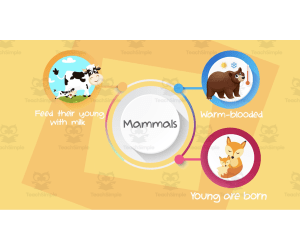
All About Mammals | Animated Animals Video Lesson
Science, Life Sciences, Animals, Grade 3, 4, 5, 6, 7, Lesson Plans, Teacher Tools
All About Mammals | Animated Animals Video Lesson All About Mammals | Animated Animals Video Lesson is an animated science video that seeks to make learning about animals, particularly mammals, a fun and engaging experience for students. It is designed for use in the field of zoology and is tailored towards students between Grade 3 and Grade 7. Benefits: With its captivating visuals, this video lesson becomes an effective teaching tool that simplifies complex scientific concepts. In just eight minutes, it delves into crucial topics about mammals - their characteristics, behaviours, habitat and so much more. This resource can be incorporated into different instructional methods depending on student needs or preferences. It could be used for whole group instruction or individual learners who may need additional help with these topics in zoology. If distance learning is necessitated due to factors such as health concerns or geographical barriers; educators can share this scientifically accurate yet entertaining material as part of assigned learning resources or homework activities – ensuring that learners stay informed even outside traditional classroom setting. All About Mammals | Animated Animals Video Lesson bridges entertainment with education – facilitating an enjoyable yet practical way of understanding Science content while sparking curiosity among young minds about their environment especially the enchanting world of mammals! Currently only available in mp4 file format; compatible with most digital devices making it flexible enough both for classrooms equipped with projectors & interactive whiteboards and home-based set-ups reliant mainly on personal computers & laptops. Overall All About Mammals | Animated Animals Video Lesson offers immense benefits both to educators seeking effective curricular materials & holistic development tools- keeping up pace with dynamic educational landscape while maintaining adherence to established academic standards.
Author Educational Voice
Tags Mammals, Zoology, Animals, Science Education, Animated Lesson
Atoms, Molecules & Elements: What Are Elements? Gr. 5-8
Science, Life Sciences, Biology, Grade 5, 6, 7, 8, Teacher Tools, Lesson Plans
Atoms, Molecules & Elements: What Are Elements? Gr. 5-8 A gripping teaching resource for educators that desire to engender a love for science in their pupils. Specially designed for grade ranges 5 to 8, this content plunges into the intriguing and hidden universe of atoms, molecules, and elements. Utilizing simple language and vocabulary, this product presents complex scientific concepts in an understandable format ideal for remedial learners. Included in the lesson plan is guidance on labeling various parts of an atom, thereby providing learners with a detailed understanding of its structure at a basic but comprehensive level. Exciting Student Experience In the subsequent sections of the lesson plan, students explore what makes up compounds while functioning as fledgling scientists! This immersive experience is designed to pique their interest in science while imparting essential knowledge about compound structures. Included are engaging hands-on activities within this package, students have the chance to probe into the mysteries housed within our universe's most fundamental building blocks by exploring patterns in periodic tables. Broadening Access To Science Basics The resource expands access to atomic science and chemistry basics through engaging hooks like exploring popular elements like calcium (Ca), chlorine (Cl), and helium (He); setting aside intimidation typically associated with these subjects. The learning materials feature varied tools that cater diverse learning styles: - Reading passages: These aid progression comprehension; - Student activities: For interactive learning; - Crosswords and word searches: Specially created for linguistic learners; - Colorful mini posters: Ideal for visual-oriented learners. The resource is thus perfectly suited not just for whole class instruction but also small group work or even homework tasks. Benchmarked By Bloom's Taxonomy Standards This ensures rigorous development of cognitive skills in alignment with STEM initiatives making sure your instruction material aligns with your State Standards while remaining sufficiently challenging. Ease Of Use Exclusively available in PDF format, this brings convenience and adaptability to any learning environment – be it classrooms or homes! Equip yourself with Atoms, Molecules & Elements: What Are Elements? Gr. 5-8 – an irreplaceable teaching instrument to throw light on the unknown domains of atoms, molecules, and elements for young budding scientists in your classrooms or homeschools. Happy learning!
Author Classroom Complete Press
Tags PDF
Discovering Dinosaurs Curriculum Pack
Creative Arts, Art, Social Studies, ELA, Language Development, Vocabulary, Math, Early Math, Science, Basic Science, Kindergarten, Lesson Plans, Teacher Tools
If your students are studying dinosaurs or are about to begin an animal unit, I have just the resource to provide you with everything you need and more! This is a Discovering Dinosaurs Curriculum Pack complete with an abundance of printable resources and engaging activities for students to complete. This curriculum was designed for your preschool students. The curriculum goal is to expand children’s knowledge base on the topic of prehistoric life, and assist in enhancing the abstract thought process, while encouraging imagination. The vocabulary that students will focus on is prehistoric, dinosaurs, carnivorous, stegosaurus, T – Rex, Brachiosaurus, herbivore, Brontosaurus, Pterodactyl, extinct, paleontologist, fossil, and triceratops. This curriculum will come with colors of the week (green and brown) and a letter of the week (D). This curriculum pack includes: --Sensory Table Ideas --Art Activities --Cooking Experience --Community Time --Math Activities --Home/School Connection Ideas --Science Table Enrichments --Science Concepts/Activities --Prop Box Ideas/Dramatic Play Enrichments --Movement and Motor --Playground/Walk Activities --Transition/Waiting Ideas --Block Area Enrichments --Flannel Board --Teacher Made Enrichment Ideas --Field Trip Ideas --Supplemental Learning Ideas/Activities At the start of this pack, you will receive a list of supplies needed for activities and projects. The worksheets, activities, and tasks included in this pack are intended to be completed in a variety of formats – whole group, small group, and independent work. I hope you enjoy!
Author Learning Foundations
Tags Dinosaurs, Science Vocabulary, Preschool, Reading Curriculum, Prehistoric Life, Animal Unit, Sensory Table, Art Activities, Learning Goals
Gliders Reading Comprehension Passage - Cored Ed Encyclopedia
ELA, Reading Comprehension, Reading, Science, Technology, Pre-Reading, Language Development, Physics, History, Social Studies, Grade 2, 3, 4, 5, Worksheets & Printables, Worksheets, Teacher Tools, Centers, Activities, Writing Prompts, Assessments, Quizzes and Tests, Quizzes, Lesson Plans
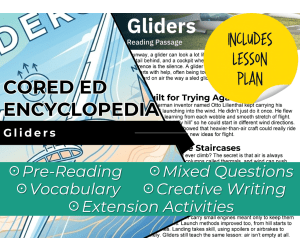
This gliders reading comprehension with lesson plan includes: Visualization (on the front cover) Start your lesson by taking a minute to think and share something about the topic. Read the script aloud (slowly), perhaps prepare some music or sound effects. Student close their eyes and let their imaginations wander. Students open their eyes, read the question aloud and give them a few minutes to complete. Ask a few students to share or keep answers until the end to compare with what they learn in the passage. Quick pause—thousands of Cored Education products are included with your TeachSimple membership. Download links and encyclopedia index available here. Pre-Reading Trivia Students will write down one thing they already know about the subject and then read five more facts and discuss. These facts are fun, and the students will enjoy learning about the subject before reading more. Give 1 minute for students to write what they already know (no pressure—best guess is fine). Read the five facts together. After each fact, do ask a student for their opinion, was it surprising? Set a purpose by asking students to highlight/underline one fact they want to learn more about during the reading. Reading Passage The text is a high-interest reading passage with set paragraphs, roughly three to four paragraphs long. It contains a variety of themes about the topic, anywhere from history to technology. The passage is between 250 and 350 words in length. First, ask students to look at the headings and see what they’ll learn about today. What do they know about the topic/heading? First read options: Teacher read-aloud (best for support). Partner reading (paragraph by paragraph). While reading, students underline important details, and vocabulary words they think may come up in the questions section. Mixed Questions The first question page contains four multiple-choice questions, each with a choice of four answers, and three written response questions that require a sentence or two from the student. Students complete the mcqs first independently, then review quickly as a class. For the 3 written responses, try to get students giving the answer with some form of evidence: “I think ___ because the text says ___.” If students get stuck, send them back to check the passage. Vocabulary Questions Practice seven key words from the text in this section across two activities. First section is scrambled words where students will unscramble three words given a clue for each. The second section is a word to meaning matching activity. Before starting, have some students read out words they underlined in the passage. Ask students to say the word and read aloud the sentence(s) around each word. Ask students to do scrambled words and the matching exercise in pairs then go through answers as a class. For the scrambled spelling task, get four pairs to come up to the board and write the words for extra practice with the other student reading out the clue. For the matching task, prompt students to give full sentences: “I matched ___ with ___ because ___.” Creative Writing In this question, the student will be required to write a five to eight sentence paragraph on a question related to the topic. Before starting, ask students write down 3 key ideas they are going to include in their piece. Ask students for ideas to share around the class to help those struggling. Pro writing expectations: 5–8 sentences At least 2 facts or details from the passage At least 2 vocabulary words from the previous page Students read their paragraphs while classmates listen for facts and vocabulary words. Extension Activities This page is optional for fast finishers or to take home. There are several activities, each one requiring a different skill. Do some, do none, do all, completely optional - but you will feel reassured knowing every possibility is planned for. Includes summary writting question and additional facts. Answer Key There are answers for the multiple-choice questions, written response questions have sample answers, vocabulary answers and if there is a summary question then a sample summary will be provided as well. Lesson Plan Included Customized lesson plan for this lesson is included. Lesson Snapshot Title: Gliders Genre: Nonfiction (informational text) Subject: Science (flight/engineering) Primary Topic: How gliders fly using lift and launch methods Estimated Guided Reading Level (A–Z): Q What This Lesson Teaches Best Explains what makes a glider different from a small airplane (no motor; quiet flight; “trade height for distance”). Describes how gliders get into the sky (help at the start, including being towed; later mentions aerotows and winches). Teaches how moving air helps a glider climb—especially rising warm air (“thermals”) and wind pushed upward at a ridge or hill. Shows how design features support gliding (long, narrow wings; smooth body; low drag to lose little energy). Connects gliders to early flight experiments through Otto Lilienthal’s repeated testing and “fly hill.” Learning Goals Students will describe how a glider is similar to and different from a small airplane. Students will explain how a glider usually starts flying using details from the text. Students will identify two kinds of lift described in the passage and tell how each helps a glider climb. Students will explain why long, narrow wings and low drag help a glider glide efficiently. Students will describe how gliders and launch methods changed over time, using examples from the text. Students will explain how spoilers or airbrakes help with landing safely. Key Vocabulary From the Text cockpit — where the pilot sits and reads instruments. thermals — rising columns of warm air. drag — air resistance that slows motion. aerotows — launches where an airplane tows the glider. spoilers — panels that help a glider slow down and descend. FULL CATALOG OF DOWNLOAD LINKS AND ENCYCLOPEDIA INDEX HERE
Author Cored Education
Rating
Tags Vocabulary, Reading Comprehension, Reading Passages, Lesson Plans, Ela Lesson Plans, Reading Comprehension Lesson Plans, Pre-reading, Science Lesson Plans, Physics, History

Climate Change: Causes: Greenhouse Gases: Nitrous Oxide Gr. 5-8
Science, Earth and Environmental Sciences, Environmental Science, Grade 5, 6, 7, 8, Teacher Tools, Lesson Plans
Climate Change: Causes: Greenhouse Gases: Nitrous Oxide Gr. 5-8 This is a critical teaching resource in our rapidly advancing world of scientific learning. It offers an in-depth understanding of our planet's atmosphere and the effects human activities have on Earth's health. Understanding Climate Change The study material provides a concrete view on climate change, aiding students distinguish facts from myths, and fostering informed future citizens. By exploring the many layers that constitute our planet’s atmosphere, students learn complex concepts about how radiation-absorbing object colours can significantly influence Earth’s climate via engaging experiments designed for middle-grade learners. Effects on Our Oceans and Life Students are guided to visualize and analyze the impact of rising temperatures on Earth's oceans – a crucial topic considering today’s high global warming trends. A significant understanding is developed regarding humanity’s influence over these developments and encourages independent interpretation by students. The Versatile Pack includes: - A comprehensive discussion on ozone implications for human health; offering real-world associations. - Detailed narratives focusing on nitrogen-fixing bacteria applications replacing nitrogen fertilizers contributing towards sustainable agricultural practices. An interactive learning experience involving: - Discovering intricacies of the carbon cycle through individual model creation. - Believing that strategic methane residence time could serve as a potent tool to lessen climate change effects with proper knowledge application leverage. This inclusive lesson plan notably adheres to STEAM guidelines by integrating science with creativity enhancement techniques such as crossword puzzles word searches promoting talent development without traditional learning constraints. The resource also provides: A preview with an answer key A comprehension quiz to evaluate student’s understanding. This single PDF file resource is precisely crafted to fit the curriculum of Grades 5-8, making it a versatile teaching tool across multiple grade levels. This product will serve as your science assistant, bringing environmental science alive in your classroom – emphasizing the importance of eco-conscious generation. ])
Author Classroom Complete Press
Tags PDF

I WONDER - Who Invented The Radio | Animated Video Lesson
Biographies, Social Studies, Inventors, Basic Science, Science, Grade 4, 5, 6, 7, 8, 9, 10, Lesson Plans, Teacher Tools
Video Introduction An amazing video designed for the students to learn more about famous people in different countries. I WONDER - Who Invented The Radio | Animated Video Lesson Do you know this person? How much do you know about him/her? Who is your idol? Why did you choose this person? Tell us more about him/her? Who is your favorite athlete? Or what is your favorite team? Have you recently heard a story about a famous person? Who was this person? Can you tell us more about him/her. Who is your favorite president, king, or queen? Why you chose that person? In your country, who are the most famous people? What did they do? Can you tell us more about them. What is your favorite invention? Who invented it? Who is your favorite artist? What is the most famous thing he/she have done? What is the most enjoyable you have read before? Who wrote it? I WONDER - Who Invented The Radio | Animated Video Lesson The video is perfect for encouraging the researching skills for the students, while learning more about this fantastic place. I WONDER - Who Invented The Radio | Animated Video Lesson This friendly designed video is suitable for students at school, homeschooling, and as a group activity. Format Available in MP4 format.
Author Educational Voice
Rating
Tags Who Invented The Radio, Who Invented The Radio Video, Radio Facts, Radio, Heinrich Hertz, Heinrich Hertz Facts, Heinrich Hertz Video, Heinrich Hertz Video For Kids, Heinrich Hertz Facts For Kids

Cell Membrane and Transport - Middle School Lesson & Notes
Science, Life Sciences, Biology, Grade 6, 7, 8, Teacher Tools, Lesson Plans
Cell Membrane and Transport Middle School - This Introductory Biology lesson Lesson is meant to be done over 2-3 days and is broken up accordingly. It discusses both the cell membrane (structure and function) as well as the different types of transport across the membrane. It is geared towards students who are unfamiliar with both. The lesson provides multiple guided opportunities for the students to create thinking maps and check their understanding. This lesson package includes the lesson (student and teacher versions), SIX embedded videos, a student lesson handout as a document, and a 4-question exit ticket. The lesson content includes: Cell Membrane Structure and Function Cell Membrane Channels Cell Membrane Transport Simple Diffusion and Temperature Facilitated Diffusion and Osmosis Passive Transport Hypo, Hyper, and Isotonic Solutions Active Transport Included in the lesson package: The teacher version of the presentation The student version of the presentation SIX embedded videos An auto-graded Exit Ticket Student lesson handout The student version of the presentation contains multiple blanks that need to be filled in throughout the lesson. These blanks are conveniently underlined and bolded on the teacher copy. I have found this to be the most effective means of keeping my students engaged and active without having them write everything out. This also leaves more time for discussion and activities. ----------------------------------------------- Google and Distance Learning Ready This lesson includes both Office and Google formats for ALL resources. The presentation is in PowerPoint and Google Slides while all documents contain Word and Google Doc versions. Your resource is perfect for distance learning and integrates seamlessly with Google Classroom as I've included a link that will automatically create a copy of the resources and put them directly into your Google Drive with one click. Purchase --> Open --> Click --> Assign to your students Having both options allows you to use either without worrying about formatting issues as all the work has already been done for you. It safeguards you in case your department or school decides to go Google 100% and allows you as well as your students to access everything no matter where you are or what kind of equipment is being used. Exit Ticket Included in your package is an Exit Ticket which can be directly accessed from the last Google Slide . Additionally, your purchase will create a copy of the Google Form Exit Ticket which you can edit to meet your class needs. Also, please visit my blog Teach With Fergy for my thoughts on teaching, learning, and everything in between.
Author Teach With Fergy
Tags Cells, Membrane, Transport, Biology Lesson
Design a Zoo Lesson Plan + Activity Guide
Science, Technology, Computer Science, Grade 1, 2, 3, 4, 5, 6, 7, 8, Lesson Plans, Teacher Tools
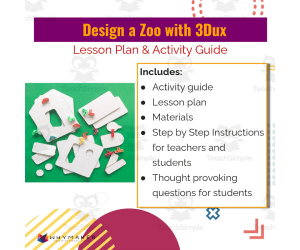
Everything you need to run a successful and fun lesson! Students will redesign an animal enclosure that provides the animal with all it’s needs being met. This fun and engaging activity comes a materials list and coupon code for the WhyMaker Store. However this can be done with cardboard, scissors and tape.
Author WhyMaker
Tags Computer Science - Technology, Instructional Technology, Engineering, Design A Zoo, Zoo Lesson Plans, Design A Zoo Project

I WONDER - What Is A Seed | Animated Video Lesson
Nature & Plants, Life Sciences, Science, Grade 4, 5, 6, 7, 8, 9, 10, Lesson Plans, Teacher Tools
Video Introduction An amazing activity designed for the students to learn more about STEM. I WONDER - What Is A Seed | Animated Video Lesson Do you like STEM subjects? what is your favorite one? Have you ever tried to plant a seed? If yes, tell us more about it. Or have you ever tried to invent something? If yes, tell us more about it. And how do you think it will help us? Have you ever seen a microorganism under a microscope? What was it? And how it looked like? Mathematics is a marvelous subject. Let' sharpen our brains and solve some equations. Do you like timetable tricks? What is your favorite one? Do you know how to code? Have you ever created an app or a game before? If yes, how was it like? I WONDER - What Is A Seed | Animated Video Lesson The video is perfect for encouraging the researching skills for the students, while learning more about this fantastic topic. I WONDER - What Is A Seed | Animated Video Lesson This friendly designed video is suitable for students at school, homeschooling, and as a group activity. Format Available in MP4 format.
Author Educational Voice
Tags What Is A Seed, What Is A Seed Video, Seed, Seed Facts, Seeds, Seeds Facts For Kids, Seeds Video, Seeds Video For Kids, Plant, Plants Facts

Circulatory, Digestive & Reproductive Systems: From Stomach to Fuel Gr. 5-8
Science, Life Sciences, Human Body, Grade 5, 6, 7, 8, Teacher Tools, Lesson Plans
The Circulatory, Digestive & Reproductive Systems: From Stomach to Fuel Teaching Resource This is a comprehensive teaching resource suitable for students from grades 5 to 8 with a focus on the circulatory, digestive, and reproductive systems. Major body systems are discussed in detail: Circulatory System: Detailed study about blood vessels and the heart. Digestive System: Highlights the path food takes from mouth to large intestine and how food is transformed into fuel. Auxillary Organ Functions: Understanding how organs like liver, lungs, skin work together in flushing out toxins from our bodies. Moving forward in complexity, it dives into biology subjects such as nephrology (study of kidneys)and gastroenterology (study of intestines). Finally free students learn "the makings of life" -- How sperm cell & egg cell merge leading up till birth. The educational tool serves best for: Whole group discussions - Enables interactive participation among learners > Small group activities > - Promotes supportive learning environment > Data Retention methods included: -*Engaging reading passages -*Interactive student-led classroom activities *Test preparation materials: -Assists in gauging learner's knowledge retention. -Includes set of color mini posters catering visual learners reinforcing comprehension. Bloom's Taxonomy principals fostering holistic growth: -The product promotes critical thinking abilities thus mapping STEM initiative encouraging scientific investigation skills. -This PDF aligns state standards with curriculum for science teachers dealing specifically with human body subtopics. -Lastly, it is a teaching tool designed to cater each learner type hence keeping classrooms engaging. An absolute ally for educators nurturing inquisitive young minds by manifesting wonder of science within themselves!
Author Classroom Complete Press
Tags PDF

I WONDER - When Does Wind Occur | Animated Video Lesson
Earth Sciences, Earth and Environmental Sciences, Science, Grade 4, 5, 6, 7, 8, 9, 10, Lesson Plans, Teacher Tools
Video Introduction An amazing video designed for the students to learn more about famous phenomena in different countries. I WONDER - When Does Wind Occur | Animated Video Lesson What do you know about this phenomenon? Where it happens? When it happens? What are the safety measures that we should take to be safe during this phenomenon? Are there any other places in the world that experienced this phenomenon? If yes, tell us more about them. Why do you think it happens? Do you like reading about Geography? What is your favorite country in the whole world? I WONDER - When Does Wind Occur | Animated Video Lesson The video is perfect for encouraging the researching skills for the students, while learning more about this fantastic phenomenon. I WONDER - When Does Wind Occur | Animated Video Lesson The video is perfect for encouraging the researching skills for the students, while learning more about this fantastic phenomenon. Format Available in a PDF format.
Author Educational Voice
Rating
Tags When Does Wind Occur, When Does Wind Occur Video, Wind, Wind Facts, Wind Video, Wind Facts For Kids, Wind Video For Kids, Winds, Winds Facts, Winds Video

Intermolecular Forces - Senior Chemistry Lesson
Science, Chemistry, Grade 10, 11, 12, Teacher Tools, Lesson Plans
Intermolecular Forces - Senior Chemistry Lesson Your lesson covers the four types of intermolecular forces. In order, the lesson teaches about; Dispersion Forces, Molecular Dipole, Dipole-Dipole Forces, the impact of Intermolecular Forces on Melting and Boiling points, and Hydrogen Bonds Your lesson includes the teacher and student version of the presentation, an auto-graded exit ticket, and a student lesson handout so the students can record the notes on a more condensed medium. This lesson is designed to be your go-to resource, whether you're in a traditional classroom or a virtual one. With both a teacher version and a student version, it seamlessly fits into your lesson plans, making learning engaging and adaptable. Assessment made easy We've included an auto-graded Exit Ticket and a quiz with an answer key because I know you don't have an excess of time. I know you don't, because I don't and I know I'll do whatever I can to reduce my grading time. Whether you use PowerPoint or Google Slides, prefer Word or Google Docs, this lesson has you covered. This lesson comes in both Office and Google formats for your convenience. The student version of the presentation has strategically placed blanks for them to fill in as you're teaching. It keeps them active and engaged, encourages discussion, and leaves more time for those "aha" moments.
Author Teach With Fergy
Tags Chemistry Lesson, Intermolecular Forces, Dispersion Forces, Molecular Dipole, Dipole-dipole Forces, Hydrogen Bonds, Hydrogen Bonding

I WONDER - What Did Jane Goodall Believe About Conservation
Biographies, Social Studies, Animals, Life Sciences, Science, Nature & Plants, Biology, Insects, Grade 4, 5, 6, 7, 8, 9, 10, Lesson Plans, Teacher Tools
Video Introduction An amazing video designed for the students to learn more about famous people in different countries. I WONDER - What Did Jane Goodall Believe About Conservation | Animated Video Lesson Do you know this person? How much do you know about him/her? Who is your idol? Why did you choose this person? Tell us more about him/her? Who is your favorite athlete? Or what is your favorite team? Have you recently heard a story about a famous person? Who was this person? Can you tell us more about him/her. Who is your favorite president, king, or queen? Why you chose that person? In your country, who are the most famous people? What did they do? Can you tell us more about them. What is your favorite invention? Who invented it? Who is your favorite artist? What is the most famous thing he/she have done? What is the most enjoyable you have read before? Who wrote it? I WONDER - What Did Jane Goodall Believe About Conservation | Animated Video Lesson The video is perfect for encouraging the researching skills for the students, while learning more about this fantastic place. I WONDER - What Did Jane Goodall Believe About Conservation | Animated Video Lesson This friendly designed video is suitable for students at school, homeschooling, and as a group activity. Format Available in MP4 format.
Author Educational Voice
Rating
Tags What Did Jane Goodall Believe About Conservation, What Did Jane Goodall Believe About Conservation Video, Jane Goodall, Jane Goodall Video, Jane Goodall Facts, Jane Goodall Facts For Kids, Jane Goodall Video For Kids

Lesson 3.5 - Newton's 3rd Law of Motion (Force Pairs)
Science, Chemistry, Physics, Grade 6, 7, 8, 9, 10, 11, 12, Lesson Plans, Teacher Tools
Lesson 3.5 - Newton's 3rd Law of Motion includes the following files: 3.5 3rd Law of Motion Notes Covers the concept of equal and opposite reactions and what they look like in the real world. This notes sheet comes with an (A) version that has blanks for students to fill out as well as a completed (B) version for students who are absent or may require accommodations. 3.5 3rd Law of Motion Practice Students practice identifying force pairs and drawing equal and opposite forces on diagrams . This practice sheet comes with an (A) version to be used for the majority of students as well as a shorter and/or different (B) version to be used for students who are absent or may require accommodations. 3.5 Objectives & Starter Questions PowerPoint Learning objectives and sample starter questions for the topic. 3.5 PowerPoint Notes Notes in PowerPoint format to make presentation to the class a breeze. The following 2016 Indiana State Standards for Integrated Chemistry & Physics are addressed in this resource: ICP.3.7 Develop pictorial and graphical representations which show that when two objects interact, the forces occur in pairs according to Newton’s third law and that the change in motion of each object is dependent on the mass of each object.
Author Integrated Chemistry and Physics
Tags Integrated Chemistry & Physics, Newton's 3rd Law, Action, Reaction, Lesson 3.5 Practice A, Forces Occur In Pairs
Climate Change: Causes Gr. 5-8
Science, Earth and Environmental Sciences, Environmental Science, Grade 5, 6, 7, 8, Teacher Tools, Lesson Plans
Climate Change: Causes GR. 5-8 - An educational resource for grades 5-8 This informative material focuses on blending scientific insights into climate change with hands-on activities, encouraging learners to distinguish between fact and fiction. Main Features: Covers critical topics in Environmental Science, such as the planet's atmosphere and human impact thereon. Fosters understanding through practical activities like color-based radiation absorption tests. Detailed exploration of increasing global temperatures and their effects on oceanic ecosystems. Individual model projects that illustrate carbon cycles and methane control. Ozone impact assessment highlighting its significant effect on human health. An out-of-the-box approach to learning is taken, combining theoretical knowledge with fun-filled yet impactful activities like crossword puzzles or word searches in line with Bloom's Taxonomy and STEAM initiatives. Bonus Features: Inclusive Learning Assistance: This resource also has numerous other types of support such as: Quizzes, answer keys providing immediate feedback for self- assessment , Lectures designed for both full-fledged classroom sessions or small group discussions, Homework assignments reinforcing class lessons ensuring better retention. Concisely wrapping up, Climate Change: Causes Gr. 5-8 can be a perfect tool for educators aiming to shape astute environmental stewards. Easily accessible in PDF format allows swift sharing among student groups. A comprehension quiz along with an answer key ensures expedited issue resolution.
Author Classroom Complete Press
Tags PDF
I WONDER - What Is The Largest Vertebrate In The World
STEM, Animals, Life Sciences, Science, Biology, Grade 1, 2, 3, 4, 5, 6, 7, 8, Lesson Plans, Teacher Tools
Video Introduction Animal kingdoms are full of fascinating wonders to learn. This video is designed for the students to learn more about animals in different countries. I WONDER - What Is The Largest Vertebrate In The World | Animated Video Lesson Do you like animals? what is your favorite one? Do you own a pet? If yes, tell us more about it, like what its name? And what do you like most about it? What are the animal kingdoms? Can you write down the characteristics of each animal class like mammals, birds, reptiles, amphibian, fish and mollusks. Do you know that some animals can sing, can you name any of them? What is the largest and the smallest mammal in the world? What is the largest and the smallest bird in the world? What is the largest and the smallest fish in the world? I WONDER - What Is The Largest Vertebrate In The World | Animated Video Lesson The video is perfect for encouraging the researching skills for the students, while learning more about these fantastic animals. I WONDER - What Is The Largest Vertebrate In The World | Animated Video Lesson This friendly designed video is suitable for students at school, homeschooling, and as a group activity. Format Available in MP4 format.
Author Educational Voice
Tags What Is The Largest Vertebrate In The World, What Is The Largest Vertebrate In The World Video, Largest Vertebrate In The World, Largest Vertebrate In The World Facts, Largest Vertebrate In The World Video, Largest Vertebrate In The World Video For Kids

I WONDER - What Jobs Do People Do At Wind Farms | Animated Video
Earth Sciences, Earth and Environmental Sciences, Science, Environmental Science, Grade 4, 5, 6, 7, 8, 9, 10, Lesson Plans, Teacher Tools
Video Introduction An amazing video designed for the students to learn more about STEM. I WONDER - What Jobs Do People Do At Wind Farms | Animated Video Lesson Do you like STEM subjects? what is your favorite one? Have you ever tried to plant a seed? If yes, tell us more about it. Or have you ever tried to invent something? If yes, tell us more about it. And how do you think it will help us? Have you ever seen a microorganism under a microscope? What was it? And how it looked like? Mathematics is a marvelous subject. Let' sharpen our brains and solve some equations. Do you like timetable tricks? What is your favorite one? Do you know how to code? Have you ever created an app or a game before? If yes, how was it like? I WONDER - What Jobs Do People Do At Wind Farms | Animated Video Lesson The video is perfect for encouraging the researching skills for the students, while learning more about this fantastic topic. I WONDER - What Jobs Do People Do At Wind Farms | Animated Video Lesson This friendly designed video is suitable for students at school, homeschooling, and as a group activity. Format Available in MP4 format.
Author Educational Voice
Tags What Jobs Do People Do At Wind Farms, What Jobs Do People Do At Wind Farms Video, Wind Farm, Wind Farms, Wind Farms Facts, Wind Farms Facts For Kids, Wind Farms Video, Wind Farms Video For Kids

I WONDER - How Does Recycling Metals Reduce Air Pollution
Earth Sciences, Earth and Environmental Sciences, Science, Environmental Science, Grade 5, 6, 7, 8, 9, 10, 11, Lesson Plans, Teacher Tools
Video Introduction An amazing video designed for the students to learn more about STEM. I WONDER - How Does Recycling Metals Reduce Air Pollution | Animated Video Lesson Do you like STEM subjects? what is your favorite one? Have you ever tried to plant a seed? If yes, tell us more about it. Or have you ever tried to invent something? If yes, tell us more about it. And how do you think it will help us? Have you ever seen a microorganism under a microscope? What was it? And how it looked like? Mathematics is a marvelous subject. Let' sharpen our brains and solve some equations. Do you like timetable tricks? What is your favorite one? Do you know how to code? Have you ever created an app or a game before? If yes, how was it like? I WONDER - How Does Recycling Metals Reduce Air Pollution | Animated Video Lesson The video is perfect for encouraging the researching skills for the students, while learning more about this fantastic topic. I WONDER - How Does Recycling Metals Reduce Air Pollution | Animated Video Lesson This friendly designed video is suitable for students at school, homeschooling, and as a group activity. Format Available in MP4 format.
Author Educational Voice
Tags How Does Recycling Metals Reduce Air Pollution, How Does Recycling Metals Reduce Air Pollution Video, Recycling Metals, Recycling Metals Facts, Recycling Metals Video, Air Pollution, Air Pollution Facts