



3,924 products added recently
Page 71 - Science Lesson Plans
Bring science to life with lesson plans that cover biology, chemistry, physics, and more. These resources offer experiments and interactive lessons to stimulate curiosity. Implement them to foster a deep understanding of scientific principles and a passion for discovery.

 Show filters


I WONDER - How Do Raspberries Grow | Animated Video Lesson
Nature & Plants, Life Sciences, Science, Grade 6, 7, 8, 9, 10, 11, 12, Lesson Plans, Teacher Tools
Video Introduction An amazing video designed for the students to learn more about STEM. I WONDER - How Do Raspberries Grow | Animated Video Lesson Do you like STEM subjects? what is your favorite one? Have you ever tried to plant a seed? If yes, tell us more about it. Or have you ever tried to invent something? If yes, tell us more about it. And how do you think it will help us? Have you ever seen a microorganism under a microscope? What was it? And how it looked like? Mathematics is a marvelous subject. Let' sharpen our brains and solve some equations. Do you like timetable tricks? What is your favorite one? Do you know how to code? Have you ever created an app or a game before? If yes, how was it like? I WONDER - How Do Raspberries Grow | Animated Video Lesson The video is perfect for encouraging the researching skills for the students, while learning more about this fantastic topic. I WONDER - How Do Raspberries Grow | Animated Video Lesson This friendly designed video is suitable for students at school, homeschooling, and as a group activity. Format Available in MP4 format.
Author Educational Voice
Tags How Do Raspberries Grow, How Do Raspberries Grow Video, Raspberries, Raspberry, Raspberries Facts, Raspberries Facts For Kids, Raspberries Video, Raspberries Video For Kids, Raspberries Facts Video For Kids
I WONDER - Are There Different Types Of Rocks | Animated Video Lesson
Earth Sciences, Earth and Environmental Sciences, Science, Grade 4, 5, 6, 7, 8, 9, 10, Lesson Plans, Teacher Tools
Video Introduction An amazing video designed for the students to learn more about famous places in different countries. I WONDER - Are There Different Types Of Rocks | Animated Video Lesson What do you know about this place? Do you know in which part of the world it is? Have you ever visited this place? If yes, can you tell us more about your adventure, and what do you like the most about this place? Do you like reading about Geography? What is your favorite country in the whole world? If you are going on a trip where it will be? Which country? What you are going to see there? Does this country has a famous place to visit? I WONDER - Are There Different Types Of Rocks | Animated Video Lesson The activity is perfect for encouraging the researching skills for the students, while learning more about this fantastic place. I WONDER - Are There Different Types Of Rocks | Animated Video Lesson This friendly designed video is suitable for students at school, homeschooling, and as a group activity. Format Available in MP4 format.
Author Educational Voice
Tags Are There Different Types Of Rocks, Are There Different Types Of Rocks Video, Different Types Of Rocks, Different Types Of Rocks Facts, Different Types Of Rocks Facts For Kids, Different Types Of Rocks Video

Earthquake!: A Cross-Curricular Unit
Science, Earth and Environmental Sciences, Environmental Science, Grade 5, 6, Teacher Tools, Lesson Plans
Earthquake!: A Cross-Curricular Unit Introduction: As a comprehensive educational resource, Earthquake!: A Cross-Curricular Unit offers enriched pedagogical content for Grade 5 and Grade 6 educators looking to impart environmental science lessons. It boasts valuable insights on plate tectonics and earthquakes, ensuring students understand the vast geological operations happening within our planet. Main Content: The unit commences with an informative article that clarifies queries surrounding earthquakes - from their origin at fault zones to their measurement using the Richter scale. This deeply engaging content presents complex scientific data in a manner easily digestible for fifth and sixth graders. Cross-Curricular Worksheets: The unit expands past the main article, offering cross-curricular worksheets that test comprehension while encouraging critical thinking—a broader learning scope that combines aspects across academic fields. Worksheets also serve as perfect stimuli for class debates, reinforcing active learning processes further. Interactive Activities: Beyond theoretical knowledge, this packet suggests various activity ideas designed to enhance classroom interaction or at-home study (for homeschooling purposes). This hands-on conceptual practice strives to make education fun yet academically enriching. The unit can be utilized in larger interactive group sessions or smaller tutor-led teachings alike. It also proves ideal as a homework assignment—seamlessly extending classroom lessons into home-based review exercises the following day. All instructional materials included in this enlightening unit come compiled into one easy-to-use PDF composed of six ready-to-print pages; thus simplifying planning efforts for teachers everywhere. In Conclusion : "Earthquake!": A Cross-Curricular Unit leverages this all-in-one platform to offer theoretical knowledge through easily understandable articles, application practice via comprehensive worksheets, and interactive student engagement through thought-provoking activities—housed within a single, streamlined file. It's the ideal asset for any environmental science lesson plan portfolio.
Author Classroom Complete Press
Tags Lesson Plan, Science Lesson, Earthquakes, Vocabulary Builder, Tectonic Plates, Earthquakes Lesson Plans Middle School, Earthquake Lesson Plans Middle School

I WONDER - What Is Special About The Element Hydrogen | Animated Video
Environmental Science, Earth and Environmental Sciences, Science, Earth Sciences, Grade 6, 7, 8, 9, 10, 11, 12, Lesson Plans, Teacher Tools
Video Introduction An amazing video designed for the students to learn more about STEM. I WONDER - What Is Special About The Element Hydrogen | Animated Video Lesson Do you like STEM subjects? what is your favorite one? Have you ever tried to plant a seed? If yes, tell us more about it. Or have you ever tried to invent something? If yes, tell us more about it. And how do you think it will help us? Have you ever seen a microorganism under a microscope? What was it? And how it looked like? Mathematics is a marvelous subject. Let' sharpen our brains and solve some equations. Do you like timetable tricks? What is your favorite one? Do you know how to code? Have you ever created an app or a game before? If yes, how was it like? I WONDER - What Is Special About The Element Hydrogen | Animated Video Lesson The video is perfect for encouraging the researching skills for the students, while learning more about this fantastic topic. I WONDER - What Is Special About The Element Hydrogen | Animated Video Lesson This friendly designed video is suitable for students at school, homeschooling, and as a group activity. Format Available in MP4 format.
Author Educational Voice
Tags What Is Special About The Element Hydrogen, What Is Special About The Element Hydrogen Video, The Element Hydrogen, The Element Hydrogen Facts, The Element Hydrogen Facts For Kids, The Element Hydrogen Video

I WONDER - How Long Is A Day On Saturn | Animated Video Lesson
Space, Earth and Environmental Sciences, Science, Grade 3, 4, 5, 6, 7, 8, 9, Lesson Plans, Teacher Tools
Video Introduction An amazing video designed for the students to learn more about space facts. I WONDER - How Long Is A Day On Saturn | Animated Video Lesson Have you ever thought about travelling to space?! Join us with this amazing video about Saturn. Do you think we can visit Saturn some day? How amazing is space! Let's discover some amazing facts about planets, asteroids, our solar system and the milky way! Do you know that we have two kinds of planets in our solar system? Can you name the planets based upon their core type? I WONDER - How Long Is A Day On Saturn | Animated Video Lesson The video is perfect for encouraging the researching skills for the students, while learning more about the fantastic space. I WONDER - How Long Is A Day On Saturn | Animated Video Lesson This friendly designed video is suitable for students at school, homeschooling, and as a group activity. Format Available in MP4 format.
Author Educational Voice
Rating
Tags How Long Is A Day On Saturn, A Day On Saturn, A Day On Saturn Facts, A Day On Saturn Facts For Kids, A Day On Saturn Video, A Day On Saturn Video For Kids, Saturn, Saturn Video, Saturn Facts

Science Fast Facts: Animals, Human Body, Insects and Arachnids, Oceaography, Solar System, Weather
Science, Basic Science, Grade 3, 4, 5, 6, Teacher Tools, Lesson Plans
Science Fast Facts: Animals, Human Body, Insects and Arachnids, Oceanography, Solar System, Weather This education resource is designed to make science engaging and fun for students in grades 3 through 6. It covers six broad scientific subjects: Animals The Human Body Insects and Arachnids Oceanography The Solar System Weather. Packed into this single product file are six 'sections' of cards - each section focuses on a particular scientific topic of interest. These cards are multifunctional which sets them apart from generic flashcards! Besides rote memorization or review sessions which they're perfect for; these could be repurposed for trivia games or as learning center prompts to encourage further discovery about these topics in creative ways. The Science Fast Facts cards also function phenomenally well as efficient fill-in tools during those occasional extra minutes at the end of class periods. All you need to do is copy them out from your downloaded PDF copy onto sturdy cardstock paper or laminate it after printing - You have durable study aids ready in no time! Educators – traditional classroom teachers or homeschoolers - will find this tool excitingly versatile offering organized yet entertaining knowledge nuggets about all things science! Cover all your bases with lesson plans that stimulate curiosity while reinforcing fundamental knowledge using these Science Fast Fact materials encompassing significant topics within basic science. This teaching resource assures that retaining vital facts relevant to their curriculum can be an enjoyable journey of scientific exploration instead of being tedious.
Author Classroom Complete Press
Tags PDF

I WONDER - What Is A Baobab Tree | Animated Video Lesson
Nature & Plants, Life Sciences, Science, Biology, Grade 4, 5, 6, 7, 8, 9, 10, Lesson Plans, Teacher Tools
Video Introduction An amazing activity designed for the students to learn more about STEM. I WONDER - What Is A Baobab Tree | Animated Video Lesson Do you like STEM subjects? what is your favorite one? Have you ever tried to plant a seed? If yes, tell us more about it. Or have you ever tried to invent something? If yes, tell us more about it. And how do you think it will help us? Have you ever seen a microorganism under a microscope? What was it? And how it looked like? Mathematics is a marvelous subject. Let' sharpen our brains and solve some equations. Do you like timetable tricks? What is your favorite one? Do you know how to code? Have you ever created an app or a game before? If yes, how was it like? I WONDER - What Is A Baobab Tree | Animated Video Lesson The video is perfect for encouraging the researching skills for the students, while learning more about this fantastic topic. I WONDER - What Is A Baobab Tree | Animated Video Lesson This friendly designed video is suitable for students at school, homeschooling, and as a group activity. Format Available in MP4 format.
Author Educational Voice
Tags What Is A Baobab Tree, What Is A Baobab Tree Video, Baobab Tree, Baobab Tree Facts, Baobab Tree Facts For Kids, Baobab Tree Video, Baobab Tree Video For Kids, Tree, Tree Facts, Tree Video

I WONDER - What Is An Acid Indicator | Animated Video Lesson
Chemistry, Science, Grade 6, 7, 8, 9, 10, 11, 12, Lesson Plans, Teacher Tools
Video Introduction An amazing video designed for the students to learn more about STEM. I WONDER - What Is An Acid Indicator | Animated Video Lesson Do you like STEM subjects? what is your favorite one? Have you ever tried to plant a seed? If yes, tell us more about it. Or have you ever tried to invent something? If yes, tell us more about it. And how do you think it will help us? Have you ever seen a microorganism under a microscope? What was it? And how it looked like? Mathematics is a marvelous subject. Let' sharpen our brains and solve some equations. Do you like timetable tricks? What is your favorite one? Do you know how to code? Have you ever created an app or a game before? If yes, how was it like? I WONDER - What Is An Acid Indicator | Animated Video Lesson The video is perfect for encouraging the researching skills for the students, while learning more about this fantastic topic. I WONDER - What Is An Acid Indicator | Animated Video Lesson This friendly designed video is suitable for students at school, homeschooling, and as a group activity. Format Available in MP4 format.
Author Educational Voice
Tags What Is An Acid Indicator, What Is An Acid Indicator Facts, Acid Indicator, Acid Indicator Facts, Acid Indicator Facts For Kids, Acid Indicator Video, Acid Indicator Video For Kids, Chemistry

Global Warming CAUSES: Greenhouse Gases: Carbon Dioxide - FLASH-MAC
Science, Earth and Environmental Sciences, Environmental Science, Common Core, Grade 5, 6, 7, 8, Teacher Tools, Lesson Plans
Global Warming CAUSES: Greenhouse Gases: Carbon Dioxide - FLASH-MAC This product serves as a powerful teaching resource on the vital topic of global warming, with special attention to greenhouse gases and their role in climate change. It caters to students from grade 5 through grade 8, fitting well into science and environmental science curricula. The Package includes: Detailed reading passages on environmental elements. 'Before you read' and 'After you read' questions to foster student discussions. Printable materials with colorful graphics to engage learners visually. Vocabulary flashcards as learning aids or supplement discussions around environmental science topics. An integrated audiovisual feature providing a multidimensional approach to teaching complex concepts effectively. The resources can be utilized for whole group lesson plans or broken down into smaller assignments. The product's resources encourage active student engagement while creating room for differing perspectives about causes of climate change. Pedagogical Standards: This educational tool aligns seamlessly with Common Core State Standards adhering strictly to guidelines detailed within Bloom's Taxonomy — a renowned educational framework that highlights effective instruction methods boosting cognitive levels amongst learners progressively using specific questioning techniques based on understanding complexity. In Summary: "Global Warming CAUSES: Greenhouse Gases: Carbon Dioxide - FLASH-MAC offers a comprehensive, factual guide that stirs student interest while helping educators teach this critical environmental topic in an engaging and illustrative fashion."
Author Classroom Complete Press
Tags Software (Mac)

Eek! A Spider!: Emergency Lesson Plan
Science, Life Sciences, Animals, Grade 3, 4, Teacher Tools, Lesson Plans
Eek! A Spider!: Emergency Lesson Plan A fundamental teaching resource, offering a comprehensive yet easy-to-deploy lesson plan appropriate for Grade 3 and Grade 4. This resource is centered primarily on the captivating subject of Science, specifically delving into the fascinating subtopic of Zoology. About this Resource Meticulously crafted to teach students about spiders in an exciting way. The core component of this unit is a nonfiction article packed with information about spider webs, spider diets, and other exclusive details pertaining to these creatures. The Eek! A Spider! Emergency Lesson Plan serves as an essential educational backup during occasions when circumstances prevent teachers from directly engaging the class or they need short but meaningful content for periods before school-wide events such as assemblies. Included Features An informative article on spiders to boost factual knowledge in students. Diverse worksheets with tasks intended to emphasize understanding while maintaining student engagement. Extension activities beyond the lesson plan that encourage deeper comprehension and ongoing student curiosity about spiders. Format Availability & Usage Possibilities This product―provided in PDF format―can be seamlessly used across devices or printed if needed. Thus, it supports traditional teachers and homeschooling parents alike. It proves versatile, functioning effectively in whole group instruction, small personalized learning groups or even assigned as homework. Note:This extensive cross-curricular science unit on spiders demonstrates educators' dedication towards fostering consistent, engaging, quality education irrespective of situational constraints.
Author Classroom Complete Press
Tags PDF
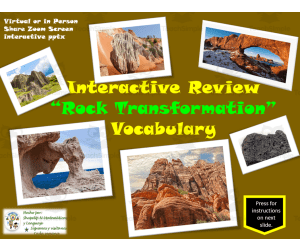
Free Science Rock Transformation Interactive Vocabulary Review
Science, Earth and Environmental Sciences, Basic Science, Earth Sciences, Grade 7, Teacher Tools, Lesson Plans
Free Science Rock Transformation Interactive Vocabulary Review Engage your 7th grade science students with this interactive PowerPoint to learn key vocabulary about rock transformations. Students will review 32 slides that define terms and concepts related to the rock cycle , along with visuals to aid understanding. Our resource can be used for whole-class instruction, small group review, or independent practice. To use: first, introduce the vocab words. Then, have students review and read words aloud. They select a multiple choice answer; correct choices reveal the definition, while incorrect answers are marked with a red X. Press the down arrow to advance slides. Check back for more 7th grade science vocabulary and concept review resources from ShapeUp-N-Matematicas y Lenguaje. We offer engaging activities like human microbiome and metabolism to support learning. Spanish language arts resources also available.
Author ShapeUp-N-Matematicas y Lenguaje
Tags Rock Transformation, Igneous Rock, Magma, Plate, Plate Boundary, Sediment, Sedimentary Rocks, Rocks, Small Or Whole Group, Game

I WONDER - What Is The Brain Made Of | Animated Video Lesson
Biology, Life Sciences, Science, Human Body, Grade 6, 7, 8, 9, 10, 11, 12, Lesson Plans, Teacher Tools
Video Overview The human body is full of fascinating wonders to learn. This video is created to help the students recognize the anatomy and the job of the human body. I WONDER - What Is The Brain Made Of | Animated Video Lesson Every part and organ in our human body is vital so let's see how important they are. Have you ever imagined how we look like if we didn't have a skeleton? Did you know that because we have our amazing muscles we can stand! Do you know how many teeth do we have? Have you ever wondered about the food journey inside our body? Can you name all the glands in our body? Why do we have skin? Our nervous system is really good at sending signals. Can you tell us more about it? Are you really good at Mathematics, painting, or any other thing? You should really thank your brain about it! The famous five senses are really doing a great work? Can you explain how every sense works? I WONDER - What Is The Brain Made Of | Animated Video Lesson The video is perfect for encouraging the researching skills for the students, while learning more about our fantastic human body. I WONDER - What Is The Brain Made Of | Animated Video Lesson This friendly designed video is suitable for students at school, homeschooling, and as a group activity. Format Available in MP4 format.
Author Educational Voice
Tags What Is The Brain Made Of, What Is The Brain Made Of Video, The Brain, The Human Brain, The Human Brain Facts, The Human Brain Facts For Kids, The Human Brain Video, The Human Brain Video For Kids

All About Skeleton Facts | Human Body Video Lesson
Science, Life Sciences, Human Body, Not Grade Specific, Lesson Plans, Teacher Tools
All About Skeleton Facts | Human Body Video Lesson This educational resource is a perfect blend of curiosity and fascination specially designed for science enthusiasts. It aims to provide an intriguing subject on human skeletal anatomy, making it useful for all educators either in a public school setting or homeschooling. Core Content The main part of this resource is a 4-minute video lesson that intricately explores different aspects about the skeleton. This human body video lesson makes teaching children about skeleton facts easy with its perfect blend of information and engagement. Innovative Teaching Tool This teaching tool promotes visual learning using dynamic graphics that help students visualize complex concepts easily. Ideal for integrating into existing curriculum during class time or as after-class review material at home. The format used is MP4 which ensures compatibility across myriad devices; be it personal computers, tablets, or smartphones. This proves beneficial for teachers keen on utilizing digital platforms for enhanced student learning. Versatility & Focus This resource while not grade-specific is carefully constructed to fit comfortably within Science subjects aimed specifically at introducing students to human anatomy. The primary focus remains strongly tethered towards guiding learners through intriguing details about the Human Body - its sub-subject. In essence, the All About Skeleton Facts | Human Body Video Lesson isn't just another teaching resource - it’s an experience that empowers educators by aiding them clarify one of nature's most intricate structures eagerly waiting to be discovered by eager young minds.
Author Educational Voice
Tags Skeleton Facts, Human Body, Video Lesson, Anatomy, Educational Resource

Animal Science Unit | All About Sharks | Learning about Animals
Science, Life Sciences, Animals, Kindergarten, Preschool, Grade 1, 2, Lesson Plans, Teacher Tools
Animal Science Unit | Exploring Sharks This unit introduces young explorers to the mysterious and amazing world of sharks. Through engaging articles, vivid photographs, crafts, games, and more, students will uncover shark habitats, adaptations, life cycles, and other captivating details. Differentiated materials allow implementation in diverse classroom settings, from pre-K to grade 2. Students read leveled nonfiction articles and fictional stories, complete vocabulary worksheets, create shark crafts like articulated paper sharks, analyze macro photographs in a guessing game , and more. Writing templates for various skills and group collaboration support personalized learning. Extension ideas facilitate interdisciplinary connections. Compare shark teeth to human teeth or track global shark habitats on a map. Contrast great white shark adaptations with goldfish traits. Use the 12 high-quality habitat photos to inspire descriptive writing. Possibilities are endless for an exciting shark adventure!
Author Simply Schoolgirl
Tags Zoology, Ocean Animals, Fish, Predator, Predators, Sea Animals, Shark Crafts, Shark Lesson, Shark Printables, Shark Worksheets

I WONDER - Where Does Lava Come From | Animated Video
Geography, Social Studies, Environmental Science, Earth and Environmental Sciences, Science, Earth Sciences, Grade 4, 5, 6, 7, 8, 9, 10, Lesson Plans, Teacher Tools
Video Introduction An amazing video designed for the students to learn more about natural disasters in different countries. I WONDER - Where Does Lava Come From | Animated Video Lesson What do you know about this natural disaster? Do you know in which part of the world this could happen? Have you ever read about the safety misusers that we could have to protect ourselves from this natural disaster? If yes, can you tell us more about them? Can you name other natural disasters? If yes, tell us more about where they are likely to happen? And how frequently? Do you like reading about Geography? What is your favorite country in the whole world? If you are going on a trip where it will be? Which country? What you are going to see there? Does this country has a famous place to visit? Do you like reading about Geology? If yes, what is your favourite topic? I WONDER - Where Does Lava Come From | Animated Video Lesson The video is perfect for encouraging the researching skills for the students, while learning more about this fantastic phenomenon. I WONDER - Where Does Lava Come From | Animated Video Lesson This friendly designed video is suitable for students at school, homeschooling, and as a group activity. Format Available in MP4 format.
Author Educational Voice
Tags Where Does Lava Come From, Where Does Lava Come From Video, Lava, Lava Facts, Lava Facts For Kids, Lava Video, Lava Video For Kids, Volcano, Volcanoes, Volcanoes Video

I WONDER - When Was The Most Dangerous Volcanic Eruption In History
Geography, Social Studies, Earth Sciences, Earth and Environmental Sciences, Science, Environmental Science, Grade 6, 7, 8, 9, 10, 11, 12, Lesson Plans, Teacher Tools
Video Introduction An amazing video designed for the students to learn more about natural disasters in different countries. I WONDER - When Was The Most Dangerous Volcanic Eruption In History | Animated Video Lesson What do you know about this natural disaster? Do you know in which part of the world this could happen? Have you ever read about the safety misusers that we could have to protect ourselves from this natural disaster? If yes, can you tell us more about them? Can you name other natural disasters? If yes, tell us more about where they are likely to happen? And how frequently? Do you like reading about Geography? What is your favorite country in the whole world? If you are going on a trip where it will be? Which country? What you are going to see there? Does this country has a famous place to visit? Do you like reading about Geology? If yes, what is your favourite topic? I WONDER - When Was The Most Dangerous Volcanic Eruption In History | Animated Video Lesson The video is perfect for encouraging the researching skills for the students, while learning more about this fantastic phenomenon. I WONDER - When Was The Most Dangerous Volcanic Eruption In History | Animated Video Lesson This friendly designed video is suitable for students at school, homeschooling, and as a group activity. Format Available in MP4 format.
Author Educational Voice
Tags When Was The Most Dangerous Volcanic Eruption In History, When Was The Most Dangerous Volcanic Eruption In History Video, The Most Dangerous Volcanic Eruption, The Most Dangerous Volcanic Eruption Video, The Most Dangerous Volcanic Eruption Facts
I WONDER - What Did The Quetzalcoatlus Look Like | Animated Video
History: Ancient, History, Social Studies, History: World, Animals, Life Sciences, Science, Grade 4, 5, 6, 7, 8, 9, 10, Lesson Plans, Teacher Tools
Video Introduction An amazing video designed for the students to learn more about dinosaurs in different countries. I WONDER - What Did The Quetzalcoatlus Look Like | Animated Video Lesson Do you like dinosaurs? what is your favorite one? Do you own a pet? If yes, tell us more about it, like what its name? And what do you like most about it? Do you think that your pet has been evolved from a dinosaur? Can you write down the characteristics of your favourite dinosaur like it's shape, their rivals, where did it use to live and what was their favourite food? What is the largest and the smallest dinosaur that ever found? Why is the T-rex is so famous? Have you ever read any interesting facts about it? Can you name any of the carnivores or herbivores dinosaurs? I WONDER - What Did The Quetzalcoatlus Look Like | Animated Video Lesson The video is perfect for encouraging the researching skills for the students, while learning more about dinosaurs. I WONDER - What Did The Quetzalcoatlus Look Like | Animated Video Lesson This friendly designed video is suitable for students at school, homeschooling, and as a group activity. Format Available in MP4 format.
Author Educational Voice
Rating
Tags What Did The Quetzalcoatlus Look Like, What Did The Quetzalcoatlus Look Like Video, Quetzalcoatlus, Quetzalcoatlus Facts, Quetzalcoatlus Video, Quetzalcoatlus Video For Kids, Quetzalcoatlus Facts For Kids

I WONDER - Where Did The Allosaurus Live | Animated Video Lesson
History: Ancient, History, Social Studies, History: World, Life Sciences, Science, Animals, Grade 4, 5, 6, 7, 8, 9, 10, Lesson Plans, Teacher Tools
Video Introduction An amazing video designed for the students to learn more about dinosaurs in different countries. I WONDER - Where Did The Allosaurus Live | Animated Video Lesson Do you like dinosaurs? what is your favorite one? Do you own a pet? If yes, tell us more about it, like what its name? And what do you like most about it? Do you think that your pet has been evolved from a dinosaur? Can you write down the characteristics of your favourite dinosaur like it's shape, their rivals, where did it use to live and what was their favourite food? What is the largest and the smallest dinosaur that ever found? Why is the T-rex is so famous? Have you ever read any interesting facts about it? Can you name any of the carnivores or herbivores dinosaurs? I WONDER - Where Did The Allosaurus Live | Animated Video Lesson The video is perfect for encouraging the researching skills for the students, while learning more about dinosaurs. I WONDER - Where Did The Allosaurus Live | Animated Video Lesson This friendly designed video is suitable for students at school, homeschooling, and as a group activity. Format Available in MP4 format.
Author Educational Voice
Rating
Tags Where Did The Allosaurus Live, Where Did The Allosaurus Live Video, Allosaurus, Allosaurus Facts, Allosaurus Video, Allosaurus Video For Kids, Allosaurus Facts For Kids, Dinosaur, Dinosaurs
I WONDER - How Long Are Orangutan's Arms | Animated Video Lesson
STEM, Biology, Life Sciences, Science, Animals, Grade 2, 3, 4, 5, 6, 7, 8, Lesson Plans, Teacher Tools
Video Introduction Animal kingdoms are full of fascinating wonders to learn. This video is designed for the students to learn more about animals in different countries. I WONDER - How Long Are Orangutan's Arms | Animated Video Lesson Do you like animals? what is your favorite one? Do you own a pet? If yes, tell us more about it, like what its name? And what do you like most about it? What are the animal kingdoms? Can you write down the characteristics of each animal class like mammals, birds, reptiles, amphibian, fish and mollusks. Do you know that some animals can sing, can you name any of them? What is the largest and the smallest mammal in the world? What is the largest and the smallest bird in the world? What is the largest and the smallest fish in the world? I WONDER - How Long Are Orangutan's Arms | Animated Video Lesson The video is perfect for encouraging the researching skills for the students, while learning more about these fantastic animals. I WONDER - How Long Are Orangutan's Arms | Animated Video Lesson This friendly designed video is suitable for students at school, homeschooling, and as a group activity. Format Available in MP4 format.
Author Educational Voice
Tags How Long Are Orangutan's Arms, How Long Are Orangutan's Arms Video, Orangutan's Arms, Orangutan's Arms Facts, Orangutan's Arms Facts For Kids, Orangutan's Arms Video, Orangutan's Arms Video For Kids

Xylophones Reading Comprehension Passage - Cored Ed Encyclopedia
ELA, Language Development, Reading Comprehension, Reading, Science, Physics, History, Social Studies, Music, Creative Arts, Grade 2, 3, 4, 5, Worksheets & Printables, Worksheets, Teacher Tools, Centers, Activities, Writing Prompts, Assessments, Quizzes and Tests, Quizzes, Lesson Plans
This xylophones reading comprehension with lesson plan includes: Visualization (on the front cover) Start your lesson by taking a minute to think and share something about the topic. Read the script aloud (slowly), perhaps prepare some music or sound effects. Student close their eyes and let their imaginations wander. Students open their eyes, read the question aloud and give them a few minutes to complete. Ask a few students to share or keep answers until the end to compare with what they learn in the passage. Quick pause—thousands of Cored Education products are included with your TeachSimple membership. Download links and encyclopedia index available here. Pre-Reading Trivia Students will write down one thing they already know about the subject and then read five more facts and discuss. These facts are fun, and the students will enjoy learning about the subject before reading more. Give 1 minute for students to write what they already know (no pressure—best guess is fine). Read the five facts together. After each fact, do ask a student for their opinion, was it surprising? Set a purpose by asking students to highlight/underline one fact they want to learn more about during the reading. Reading Passage The text is a high-interest reading passage with set paragraphs, roughly three to four paragraphs long. It contains a variety of themes about the topic, anywhere from history to technology. The passage is between 250 and 350 words in length. First, ask students to look at the headings and see what they’ll learn about today. What do they know about the topic/heading? First read options: Teacher read-aloud (best for support). Partner reading (paragraph by paragraph). While reading, students underline important details, and vocabulary words they think may come up in the questions section. Mixed Questions The first question page contains four multiple-choice questions, each with a choice of four answers, and three written response questions that require a sentence or two from the student. Students complete the mcqs first independently, then review quickly as a class. For the 3 written responses, try to get students giving the answer with some form of evidence: “I think ___ because the text says ___.” If students get stuck, send them back to check the passage. Vocabulary Questions Practice seven key words from the text in this section across two activities. First section is scrambled words where students will unscramble three words given a clue for each. The second section is a word to meaning matching activity. Before starting, have some students read out words they underlined in the passage. Ask students to say the word and read aloud the sentence(s) around each word. Ask students to do scrambled words and the matching exercise in pairs then go through answers as a class. For the scrambled spelling task, get four pairs to come up to the board and write the words for extra practice with the other student reading out the clue. For the matching task, prompt students to give full sentences: “I matched ___ with ___ because ___.” Creative Writing In this question, the student will be required to write a five to eight sentence paragraph on a question related to the topic. Before starting, ask students write down 3 key ideas they are going to include in their piece. Ask students for ideas to share around the class to help those struggling. Pro writing expectations: 5–8 sentences At least 2 facts or details from the passage At least 2 vocabulary words from the previous page Students read their paragraphs while classmates listen for facts and vocabulary words. Extension Activities This page is optional for fast finishers or to take home. There are several activities, each one requiring a different skill. Do some, do none, do all, completely optional - but you will feel reassured knowing every possibility is planned for. Includes summary writting question. Answer Key There are answers for the multiple-choice questions, written response questions have sample answers, vocabulary answers and if there is a summary question then a sample summary will be provided as well. Lesson Plan Included Customized lesson plan for this lesson is included. Lesson Snapshot Title: Xylophones Genre: Nonfiction (informational text) Subject: Music / Science of Sound (Informational Reading) Primary Topic: How xylophones make sound and their history Estimated Guided Reading Level (A–Z): Q Support pages present: Visualization prompt, pre-reading trivia, mixed questions, vocabulary activities, creative writing, extension activities, and an answer key. What This Lesson Teaches Best Explains how a xylophone’s “keys” are wooden bars that make notes when tapped with a mallet . Teaches the relationship between bar length and pitch (long bars = low sounds; short bars = high sounds). Shows a core sound concept: the wood vibrates to create the note, and resonators underneath help the sound carry. Builds historical understanding of xylophone-like instruments across Africa and Asia, including early designs using logs, pits, and gourds to boost sound. Connects music history and school use: the xylophone spread into Europe, appears in orchestras (including Camille Saint-Saëns and Danse Macabre), and is used in classrooms to learn melody and rhythm (including Orff-Schulwerk). Learning Goals Students will describe how tapping a bar with a mallet makes a xylophone note. Students will explain how bar length changes pitch using details from the text. Students will identify what resonators do and where they are located on some xylophones. Students will summarize how xylophone-like instruments were made long ago and how sound was boosted. Students will sequence key points in the xylophone’s timeline (early instruments, later written descriptions, and later orchestra use). Key Vocabulary From the Text resonators — tubes/shapes under bars that help sound carry. vibrates — shakes back and forth to make sound. documented — recorded in writing. orchestra — a large group of musicians playing together. octave — a set of notes from one pitch to next. FULL CATALOG OF DOWNLOAD LINKS AND ENCYCLOPEDIA INDEX HERE
Author Cored Education
Rating
Tags Vocabulary, Reading Comprehension, Reading Passages, Lesson Plans, Ela Lesson Plans, Reading Comprehension Lesson Plans, Pre-reading, History Lesson Plans, Physics, Music Lesson Plans

I WONDER - Can The Colugo Actually Fly | Animated Video Lesson
STEM, Animals, Life Sciences, Science, Biology, Grade 3, 4, 5, 6, 7, 8, 9, Lesson Plans, Teacher Tools
Video Introduction Animal kingdoms are full of fascinating wonders to learn. This video is designed for the students to learn more about animals in different countries. I WONDER - Can The Colugo Actually Fly | Animated Video Lesson Do you like animals? what is your favorite one? Do you own a pet? If yes, tell us more about it, like what its name? And what do you like most about it? What are the animal kingdoms? Can you write down the characteristics of each animal class like mammals, birds, reptiles, amphibian, fish and mollusks. Do you know that some animals can sing, can you name any of them? What is the largest and the smallest mammal in the world? What is the largest and the smallest bird in the world? What is the largest and the smallest fish in the world? I WONDER - Can The Colugo Actually Fly | Animated Video Lesson The video is perfect for encouraging the researching skills for the students, while learning more about these fantastic animals. I WONDER - Can The Colugo Actually Fly | Animated Video Lesson This friendly designed video is suitable for students at school, homeschooling, and as a group activity. Format Available in MP4 format.
Author Educational Voice
Tags Can The Colugo Actually Fly, Can The Colugo Actually Fly Video, Colugo, Colugo Facts, Colugo Facts For Kids, Colugo Video, Colugo Video For Kids, Flying Colugo, Flying Colugo Video

Rhino Unit Study (Endangered Animals Lesson Plan, Videos, Activities)
ELA, Grammar, Reading, Language Development, Spelling, Writing, Science, Life Sciences, Animals, Grade 1, 2, 3, Lesson Plans, Teacher Tools
Rhino Unit Study Rhino Unit Study is a comprehensive, no-prep learning resource that provides five days of immersive lessons about the endangered rhino. Utilizing various disciplines, including language arts, science and more, this set of instructional materials delivers an in-depth exploration into the life and environment of these magnificent animals. Daily Learning Activities Engage students with activities ranging from drawing to research. A pinch of art will spark creativity as children get to illustrate through coloring and sketching. Segments on English language arts, grammar, reading, spelling and writing integrate a holistic approach towards strengthening literacy skills. Incorporation Science Aspects Science aspects are evident in discussions regarding enticing details about the rhino's diet or discerning its predators. The study also offers exploration into their elusive habitats illuminating their unique living conditions. Daily Worksheets & Interactive Notebook Daily worksheets allow students to keep track of new information acquired every day. Comprehensive details like descriptions about rhinos’ lifecycle are made available for discussion initiating insightful classroom interactions among students while incorporating active recall into their comprehensive knowledge database. An interactive notebook serves as an excellent tool for students to organize all related documents easily while adding a personal touch to each learning journey they embark on with this unit. This organizational tool activates a child’s analytical skills by letting them figure out how it evolves throughout the study period based on their individual learning pace and style! Note:Lessions can effortlessly be adapted depending upon student age group, reading proficiency level or personal interests ensuring inclusivity within classrooms. Project-based Activity Suggestions and Additional Support Project-based activity suggestions add another layer for explorative learning bringing classrooms alive as group dynamics interact intrinsically promoting teamwork among budding scholars! Towards additional support providing relevant nonfiction resources is advised along with facilitating deeper research opportunities utilizing optional readings. @ Incorporation Options: Incorporation options include small group workshops where complex topics can be broken down effectively understanding individual strengths within teams; whole groups benefiting from integrated discussions or even off-time engagements such as homework assignments proving to be systematically planned opportunities for independent learning! Rest assured that Rhino Unit Study is an engaging teaching resource adept at integrating multiple subjects seamlessly within one topic, benefiting both public school educators and homeschoolers alike. Factual, concise, and easily adaptable in meeting different learners’ needs, it ensures a vital learning experience within classrooms!
Author Heather Huhman
Tags Rhino Conservation, Interdisciplinary Study, Endangered Species, Animal Habitats, Language Arts

Producer Consumer Decomposer - Digital Mini Lesson Practice
Science, Life Sciences, Biology, Grade 6, 7, Lesson Plans, Teacher Tools
Introducing the Producer Consumer Decomposer - Digital Mini Lesson Practice This educational tool, primarily designed for 6th and 7th grade students, provides simplified yet comprehensive insights into distinguishing between producers, consumers, and decomposers. Digital Format & Self-Grading Feature The mini-lesson activity is presented via Google Forms, making it an exclusive for digital classrooms. A standout feature is its automatic marking functionality. Each question in the algebra activity is a standalone section, supporting students by isolating individual problems until correctly resolved. Meticulous Design for Inclusive Learning This stepwise teaching methodology pays dividends with English Language Learners (ELLs) or those who require alternative learning strategies due to distinct learning needs. Accompanied by detailed visual prompts, instructions are clearer to follow making the overall instruction delivery more inclusive. In-Class Use: The form primarily serves during classroom sessions as part of group activities or individual practice while covering topics on producers consumers decomposers. Holistic Learning Opportunities: Use it as a revision tool or even assign it as homework to facilitate additional engagement beyond school hours. Easily Customizable: The questions in this mini-lesson can be modified according to your focus areas within biology teaching. Kindly note that this resource doesn't offer any printing options owing to its purely digital format. In Conclusion... The Producer Consumer Decomposer - Digital Mini Lesson Practice serves excellently well in offering efficient ways of captivating students' attention while effectively embedding key academic concepts!
Author Sheltered Language Resources
Tags Biology Education, Producers, Consumers, Decomposers, Digital Learning, Decomposer Producer Consumer, Producer-consumer-decomposer

I WONDER - What Did Velociraptors Eat | Animated Video Lesson
History: Ancient, History, Social Studies, History: World, Animals, Life Sciences, Science, Grade 4, 5, 6, 7, 8, 9, 10, Lesson Plans, Teacher Tools
Video Introduction An amazing video designed for the students to learn more about dinosaurs in different countries. I WONDER - What Did Velociraptors Eat | Animated Video Lesson Do you like dinosaurs? what is your favorite one? Do you own a pet? If yes, tell us more about it, like what its name? And what do you like most about it? Do you think that your pet has been evolved from a dinosaur? Can you write down the characteristics of your favourite dinosaur like it's shape, their rivals, where did it use to live and what was their favourite food? What is the largest and the smallest dinosaur that ever found? Why is the T-rex is so famous? Have you ever read any interesting facts about it? Can you name any of the carnivores or herbivores dinosaurs? I WONDER - What Did Velociraptors Eat | Animated Video Lesson The video is perfect for encouraging the researching skills for the students, while learning more about dinosaurs. I WONDER - What Did Velociraptors Eat | Animated Video Lesson This friendly designed video is suitable for students at school, homeschooling, and as a group activity. Format Available in MP4 format.
Author Educational Voice
Rating
Tags What Did Velociraptors Eat, What Did Velociraptors Eat Video, Velociraptors, Velociraptors Video, Velociraptors Facts, Velociraptors Video For Kids, Velociraptors Facts For Kids, Dinosaur, Dinosaurs