



3,928 products added recently
Page 86 - Science Lesson Plans
Bring science to life with lesson plans that cover biology, chemistry, physics, and more. These resources offer experiments and interactive lessons to stimulate curiosity. Implement them to foster a deep understanding of scientific principles and a passion for discovery.

 Show filters


Animal Science Unit | All About Kangaroos | Learning about Animals
Science, Life Sciences, Animals, Kindergarten, Preschool, Grade 1, 2, Lesson Plans, Teacher Tools
This huge collection of animal resources has been designed to help you create an amazing curriculum to learn about KANGAROOS. You'll find real photos, non-fiction articles and other reading material, arts and crafts, worksheets, and writing activities to help you create an animal science unit. A variety of differentiated materials is provided so these resources can work with students pre-K through 2nd grade. You'll be stunned with the amazing resources in this unit study! Great care has been taken while creating these unit to provide high-quality and thorough information, photos, and activities. I am currently updating all these animal units to make them even more amazing so please check back soon! How to Use This: Carefully study all the provided resources, then print the parts you like the most! Print enough worksheets and activities for each student. Then jump right in and have a great time! What You Get: Teacher Resources: Discussion questions, project and activity ideas, book list, links to related videos...... Printables: Animal classification poster, type of eater poster, life cycle poster, animal species poster, collectible animal cards, vocabulary strips with definitions, map showing where the animal is native, and 12 high-quality photographs of animal habitats, behaviors, and physical characteristics. Worksheets: A ton of adorable and helpful worksheets to learn about animal adaptations, habitats, life cycles, vocabulary words, eating habits, and animal anatomy. Reading Material: Lots of reading resources including nonfiction article about this animal provided in two differentiated reading levels with comprehension questions. Also included is a fictional story about a child naturalist studying this animal provided in two reading levels. Several cute bookmarks featuring this animal. Writing Opportunities: You'll be blown away by the number of writing templates and options provided here including a full page blank booklet for young students, a half-page booklet with photos to add, nature journal covers, animal report planners provided in two levels, a few other writing prompts. You'll find something for every level of writing ability and skill. Crafts: Cute animal photo cut-outs, animal art outlines to support in depth art projects, jointed (articulated) paper craft, paper bag puppet, animal mask, animal footprint cut-outs, and coloring pages. Games: A macro-photo guessing game and a cute memory game to review this animal's behaviors, physical characteristics, and habitat.
Author Simply Schoolgirl
Tags Zoology, Australian Animals, Marsupials, Marsupial, Outback, Kangaroo Lesson Plans, Kangaroo Crafts, Kangaroo Printables, Kangaroo Worksheets

I WONDER - How Big Is The International Space Station | Animated Video
Space, Earth and Environmental Sciences, Science, Grade 4, 5, 6, 7, 8, 9, 10, Lesson Plans, Teacher Tools
Video Introduction An amazing video designed for the students to learn more about space facts. I WONDER - How Big Is The International Space Station | Animated Video Lesson Do you like reading about space? If yes, what is your favorite topic? What do you know about our solar system? What is the smallest planet in our solar system? What is the biggest planet in our solar system? What is the hottest planet in our solar system? And what is the coldest one? Do you think there are aliens? If yes, what do you think they look like? What do they eat and how they speak to each other? Where do they live? What is a galaxy? And what is a milky way? Have you recently saw a shooting star? If yes, tell us more about it, like when did it happen and where? What is a blackhole? Can a blackhole gets bigger by time? Do you like counting the stars? What do you think a star is made of? I WONDER - How Big Is The International Space Station | Animated Video Lesson The video is perfect for encouraging the researching skills for the students, while learning more about the fantastic space. I WONDER - How Big Is The International Space Station | Animated Video Lesson This friendly designed video is suitable for students at school, homeschooling, and as a group activity. Format Available in MP4 format.
Author Educational Voice
Tags How Big Is The International Space Station, How Big Is The International Space Station Video, International Space Station, International Space Station Facts, International Space Station Facts For Kids, International Space Station Video

I WONDER - How Did The Quetzalcoatlus Eat | Animated Video Lesson
History: Ancient, History, Social Studies, History: World, Animals, Life Sciences, Science, Grade 4, 5, 6, 7, 8, 9, 10, Lesson Plans, Teacher Tools
Video Introduction An amazing video designed for the students to learn more about dinosaurs in different countries. I WONDER - How Did The Quetzalcoatlus Eat | Animated Video Lesson Do you like dinosaurs? what is your favorite one? Do you own a pet? If yes, tell us more about it, like what its name? And what do you like most about it? Do you think that your pet has been evolved from a dinosaur? Can you write down the characteristics of your favourite dinosaur like it's shape, their rivals, where did it use to live and what was their favourite food? What is the largest and the smallest dinosaur that ever found? Why is the T-rex is so famous? Have you ever read any interesting facts about it? Can you name any of the carnivores or herbivores dinosaurs? I WONDER - How Did The Quetzalcoatlus Eat | Animated Video Lesson The video is perfect for encouraging the researching skills for the students, while learning more about dinosaurs. I WONDER - How Did The Quetzalcoatlus Eat | Animated Video Lesson This friendly designed video is suitable for students at school, homeschooling, and as a group activity. Format Available in MP4 format.
Author Educational Voice
Rating
Tags How Did The Quetzalcoatlus Eat, How Did The Quetzalcoatlus Eat Video, Quetzalcoatlus, Quetzalcoatlus Facts, Quetzalcoatlus Video, Quetzalcoatlus Video For Kids, Quetzalcoatlus Facts For Kids
I WONDER - How Many Thunderstorms Are There Each Year
Earth Sciences, Earth and Environmental Sciences, Science, Grade 2, 3, 4, 5, 6, 7, 8, Lesson Plans, Teacher Tools
Video Introduction An amazing video designed for the students to learn more about famous phenomena in different countries. I WONDER - How Many Thunderstorms Are There Each Year | Animated Video Lesson What do you know about this phenomenon? Where it happens? When it happens? What are the safety measures that we should take to be safe during this phenomenon? Are there any other places in the world that experienced this phenomenon? If yes, tell us more about them. Why do you think it happens? Do you like reading about Geography? What is your favorite country in the whole world? I WONDER - How Many Thunderstorms Are There Each Year | Animated Video Lesson The video is perfect for encouraging the researching skills for the students, while learning more about this fantastic phenomenon. I WONDER - How Many Thunderstorms Are There Each Year | Animated Video Lesson The video is perfect for encouraging the researching skills for the students, while learning more about this fantastic phenomenon. Format Available in a PDF format.
Author Educational Voice
Rating
Tags How Many Thunderstorms Are There Each Year, How Many Thunderstorms Are There Each Year Video, Thunderstorms, Thunderstorms Facts, Thunderstorms Video, Thunderstorms Video For Kids, Thunderstorms Facts For Kids

Galaxies & The Universe - Digital Lesson Plan Gr. 5-8 | MAC Software
Science, Earth and Environmental Sciences, Space, Grade 3, 4, 5, 6, 7, 8, Teacher Tools, Lesson Plans
Product Description: Galaxies and the Universe, an engaging and highly interactive digital lesson plan designed specifically for grades 5 through 8. Journey from microscopic particles to entire star systems with this MAC software resource without leaving your classroom. Detailed Overview: The digital lesson plan includes: A rich 80 screen-page presentation packed with information about our universe. An exploration of the makeup of space - everything that exists within its boundless expanse. An understanding of light's role in space exploration, speed of light, pulsars, neutron stars and quasars. This design permits multiple forms of student interaction – group sessions, individual or small cohorts interactions during specific activities like research projects or independent study periods. It can also be utilized as homework assignments providing a comprehensive learning experience outside classroom parameters. Main Features include: Reading passages Interactive pre-and-post-reading tasks A variety game styles like memory matching and crosswords puzzles enhancing retention rate . Text-to-speech accessibility feature offering content in English & Spanish . Pupil understanding can be evaluated via a provided Comprehension Quiz. Developed keeping State Standards and Bloom's Taxonomy in mind; it facilitates immersive quality education on any MAC device instantly on opening the included zip file. The course "Galaxies & The Universe", is sure to provide learners an unforgettable exploratory trip across galaxies & throughout our cosmos!</P
Author Classroom Complete Press
Tags Digital Lesson Plan, Galaxies Lesson Plan, Astronomy Reading Passage, Science Interactive Activity

I WONDER - Does Sugar Come In Different Forms | Animated Video Lesson
Human Body, Life Sciences, Science, Biology, STEM, Grade 4, 5, 6, 7, 8, 9, 10, Lesson Plans, Teacher Tools
Video Overview The human body is full of fascinating wonders to learn. This video is created to help the students recognize the anatomy and the job of the human body. I WONDER - Does Sugar Come In Different Forms | Animated Video Lesson Every part and organ in our human body is vital so let's see how important they are. Have you ever imagined how we look like if we didn't have a skeleton? Did you know that because we have our amazing muscles we can stand! Do you know how many teeth do we have? Have you ever wondered about the food journey inside our body? Can you name all the glands in our body? Why do we have skin? Our nervous system is really good at sending signals. Can you tell us more about it? Are you really good at Mathematics, painting, or any other thing? You should really thank your brain about it! The famous five senses are really doing a great work? Can you explain how every sense works? I WONDER - Does Sugar Come In Different Forms | Animated Video Lesson The video is perfect for encouraging the researching skills for the students, while learning more about our fantastic human body. I WONDER - Does Sugar Come In Different Forms | Animated Video Lesson This friendly designed video is suitable for students at school, homeschooling, and as a group activity. Format Available in MP4 format.
Author Educational Voice
Tags Does Sugar Come In Different Forms, Does Sugar Come In Different Forms Video, Different Forms Of Sugar, Different Forms Of Sugar Facts, Different Forms Of Sugar Facts For Kids, Different Forms Of Sugar Video
I WONDER - How Did The Archaeopteryx Get Its Name | Animated Video
History: Ancient, History, Social Studies, History: World, Animals, Life Sciences, Science, Grade 4, 5, 6, 7, 8, 9, 10, Lesson Plans, Teacher Tools
Video Introduction An amazing video designed for the students to learn more about dinosaurs in different countries. I WONDER - How Did The Archaeopteryx Get Its Name | Animated Video Lesson Do you like dinosaurs? what is your favorite one? Do you own a pet? If yes, tell us more about it, like what its name? And what do you like most about it? Do you think that your pet has been evolved from a dinosaur? Can you write down the characteristics of your favourite dinosaur like it's shape, their rivals, where did it use to live and what was their favourite food? What is the largest and the smallest dinosaur that ever found? Why is the T-rex is so famous? Have you ever read any interesting facts about it? Can you name any of the carnivores or herbivores dinosaurs? I WONDER - How Did The Archaeopteryx Get Its Name | Animated Video Lesson The video is perfect for encouraging the researching skills for the students, while learning more about dinosaurs. I WONDER - How Did The Archaeopteryx Get Its Name | Animated Video Lesson This friendly designed video is suitable for students at school, homeschooling, and as a group activity. Format Available in MP4 format.
Author Educational Voice
Rating
Tags How Did The Archaeopteryx Get Its Name, How Did The Archaeopteryx Get Its Name Video, Archaeopteryx, Archaeopteryx Video, Archaeopteryx Facts, Archaeopteryx Facts For Kids, Archaeopteryx Video For Kids

Arctic Fox Unit Study (Arctic Animals Lesson Plan, Videos, Activities)
Science, Life Sciences, Animals, Grade 1, 2, 3, Lesson Plans, Teacher Tools
A 5-day NO PREP arctic (polar) animal unit study of the arctic fox. This comprehensive resource includes a lesson plan, videos, daily worksheets and activities, interactive notebook pieces, and more. It makes a great addition to your winter or arctic animals unit study, writing lessons or centers , or science class. Perfect for first grade, second grade, and third grade classrooms, homeschool families, and cooperatives. You can easily customize lessons based on student age, reading and comprehension level, interests, and learning style! Additionally, all worksheets can be completed in an interactive notebook or simply discussed aloud if you desire to reduce the number of pages you print.
Author Heather Huhman
Tags Arctic Fox, Arctic Animals, Winter, Zoology, Science, Animals In Winter Lesson Plan

All About Atmosphere | Earth Science Unit
Science, Earth and Environmental Sciences, Earth Sciences, Grade 1, 2, 3, 4, Lesson Plans, Teacher Tools
All About Atmosphere | Earth Science Unit This is an inclusive earth science resource that turns the process of teaching into an exciting adventure! The unit uses captivating resources to walk learners through all the layers of knowledge about our atmosphere. Get ready to be their guide! Atmospheric Layers: Covering different levels such as troposphere, stratosphere etc. Ozone Layer Importance: Discusses its crucial role in protecting us from harmful solar radiations. Temperature and Air Pressure Differences: Illustrating air pressure and how it changes with temperature across various atmospheric layers You also get access to additional teaching aids designed for your Google classroom like interactive posters which make sessions highly engaging while improving pupils' retention ability. You're given a multitude of different options - pick what suits your unique teaching style and lesson plans while keeping learning under no monotonous umbrella! This variety in resources provides adaptability options to accommodate group activities, individual tutoring or assigning homeworks based on our worksheets that adhere exactly to grade-level requirements. Inclusions in the Package: Lesson Plan Schedules: Suggested lesson structures for earth science themes along with project assignments & video references (QR codes & URLs). Vocabulary Props: Aid in prepping students around technical terminology like Exosphere, Atmospheric Pressure etc. related to Earth's atmospheric study. Educational Posters: "What Does The Atmosphere Do?" series feature visually pleasing slides covering topics like sun radiation protection or climate formation process explanation! Worksheets focus on: "Moving Through The Atmosphere": A two-page article "The Ozone Layer": : A comprehensive analysis Composition and Structure of Atmosphere: Another exciting feature is the atmospheric layers' folding craft model and creative writing prompts—both made to make learning more fun! The Ultimate Review Game! The capstone is a quick review game for students to recap what they’ve learned. With rules emphasizing the reiteration of taught subjects, this game makes education truly delightful! This product pack includes a Google Doc listing all materials along with pictures showcasing activities and an easy-to-print PDF (49-pages) embracing the entire content. Get ready to explore, educate, and explain! Dive into the greatness that lies within Earth's atmospheric study brought alive by our All About Atmosphere | Earth Science Unit.
Author Simply Schoolgirl
Tags Atmospheric Layers, Ozone Layer, Temperature Fluctuation, Air Pressure, Earth Science
I WONDDR - How Is Silk Created | Animated Video Lesson
Animals, Life Sciences, Science, Biology, STEM, Grade 1, 2, 3, 4, 5, 6, 7, 8, Lesson Plans, Teacher Tools
Video Introduction Animal kingdoms are full of fascinating wonders to learn. This video is designed for the students to learn more about animals in different countries. I WONDER - How Is Silk Created | Animated Video Lesson Do you like animals? what is your favorite one? Do you own a pet? If yes, tell us more about it, like what its name? And what do you like most about it? What are the animal kingdoms? Can you write down the characteristics of each animal class like mammals, birds, reptiles, amphibian, fish and mollusks. Do you know that some animals can sing, can you name any of them? What is the largest and the smallest mammal in the world? What is the largest and the smallest bird in the world? What is the largest and the smallest fish in the world? I WONDER - How Is Silk Created | Animated Video Lesson The video is perfect for encouraging the researching skills for the students, while learning more about these fantastic animals. I WONDER - How Is Silk Created | Animated Video Lesson This friendly designed video is suitable for students at school, homeschooling, and as a group activity. Format Available in MP4 format.
Author Educational Voice
Tags How Is Silk Created, How Is Silk Created Video, Silk, Silk Facts, Silk Facts For Kids, Silk Video, Silk Video For Kids, Silk Worm, Silk Worms, Silk Worm Video

I Wonder - Is Bio Energy A Renewable Energy Source | Animated Video
Earth and Environmental Sciences, Science, Environmental Science, Grade 6, 7, 8, 9, 10, 11, 12, Lesson Plans, Teacher Tools
Video Introduction An amazing video designed for the students to learn more about STEM. I WONDER - Is Bio Energy A Renewable Energy Source | Animated Video Lesson Do you like STEM subjects? what is your favorite one? Have you ever tried to plant a seed? If yes, tell us more about it. Or have you ever tried to invent something? If yes, tell us more about it. And how do you think it will help us? Have you ever seen a microorganism under a microscope? What was it? And how it looked like? Mathematics is a marvelous subject. Let' sharpen our brains and solve some equations. Do you like timetable tricks? What is your favorite one? Do you know how to code? Have you ever created an app or a game before? If yes, how was it like? I WONDER - Is Bio Energy A Renewable Energy Source | Animated Video Lesson The video is perfect for encouraging the researching skills for the students, while learning more about this fantastic topic. I WONDER - Is Bio Energy A Renewable Energy Source | Animated Video Lesson This friendly designed video is suitable for students at school, homeschooling, and as a group activity. Format Available in MP4 format.
Author Educational Voice
Tags Is Bio Energy A Renewable Energy Source, Is Bio Energy A Renewable Energy Source Video, Renewable Energy Source, Renewable Energy Sources, Renewable Energy Source Facts, Renewable Energy Source Facts For Kids

I WONDER - What Makes The Megalosaurus's Name Unique | Animated Video
Animals, Life Sciences, Science, History: Ancient, History, Social Studies, History: World, Grade 4, 5, 6, 7, 8, 9, 10, Lesson Plans, Teacher Tools
Video Introduction An amazing video designed for the students to learn more about dinosaurs in different countries. I WONDER - What Makes The Megalosaurus's Name Unique | Animated Video Lesson Do you like dinosaurs? what is your favorite one? Do you own a pet? If yes, tell us more about it, like what its name? And what do you like most about it? Do you think that your pet has been evolved from a dinosaur? Can you write down the characteristics of your favourite dinosaur like it's shape, their rivals, where did it use to live and what was their favourite food? What is the largest and the smallest dinosaur that ever found? Why is the T-rex is so famous? Have you ever read any interesting facts about it? Can you name any of the carnivores or herbivores dinosaurs? I WONDER - What Makes The Megalosaurus's Name Unique | Animated Video Lesson The video is perfect for encouraging the researching skills for the students, while learning more about dinosaurs. I WONDER - What Makes The Megalosaurus's Name Unique | Animated Video Lesson This friendly designed video is suitable for students at school, homeschooling, and as a group activity. Format Available in MP4 format.
Author Educational Voice
Rating
Tags What Makes The Megalosaurus's Name Unique, What Makes The Megalosaurus's Name Unique Video, Megalosaurus's Name, Megalosaurus's Name Facts, Megalosaurus's Name Video, Megalosaurus's Name Video For Kids

Bears Theme VALUE PACK Gr. PK-2
Science, Life Sciences, Animals, Kindergarten, Preschool, Grade 1, 2, Teacher Tools, Lesson Plans
Bears Theme VALUE PACK Gr. PK-2 This pack is a comprehensive learning aid that focuses on providing education about the magnificent world of bears to students aged between preschool and second grade. With its primary focus being on science, in particular, Zoology, this pack provides an array of teaching aids. Package Content: Bing Bear's Balloons: A unit which includes engaging activities for fostering creative skills amongst learners such as picture patterns for large and small book creation. Colour Bear: This unit includes hands-on tasks that cater to enhancing color recognition among pupils whilst boosting their visual learning capabilities. Good Shapes for a Hungry Bear: The aim of this particular unit is to stir interest in mathematics by teaching them number recognition from 1-8 through practical activities. I Love My Learning Centres: Including themed name tags for improving word familiarity and reading passages focusing on Zoological exploration. The product — a single PDF file consists of 103 printable educational pages all set to be employed into various classroom settings - be it entire group lessons or individual assignments. This resource offers exhaustive coverage suiting early childhood development needs across primary-grade levels (Preschool through Grade 2). This pack serves as an indispensable toolset with remarkable comprehensiveness coupled with practical application potentials not just limited to school settings but also home-based tutoring scenarios hence making necessary strides towards holistically nurturing young minds.
Author Classroom Complete Press
Tags Reading Passages, Bear Theme Decor, Big Book Assembly, Bear Name Tags, Counting Skills

I WONDER - Why Is It Important Not To Waste Water | Animated Video
Environmental Science, Earth and Environmental Sciences, Science, Grade 1, 2, 3, 4, 5, 6, 7, 8, Lesson Plans, Teacher Tools
Video Introduction An amazing video designed for the students to learn more about STEM. I WONDER - Why Is It Important Not To Waste Water | Animated Video Lesson Do you like STEM subjects? what is your favorite one? Have you ever tried to plant a seed? If yes, tell us more about it. Or have you ever tried to invent something? If yes, tell us more about it. And how do you think it will help us? Have you ever seen a microorganism under a microscope? What was it? And how it looked like? Mathematics is a marvelous subject. Let' sharpen our brains and solve some equations. Do you like timetable tricks? What is your favorite one? Do you know how to code? Have you ever created an app or a game before? If yes, how was it like? I WONDER - Why Is It Important Not To Waste Water | Animated Video Lesson The video is perfect for encouraging the researching skills for the students, while learning more about this fantastic topic. I WONDER - Why Is It Important Not To Waste Water | Animated Video Lesson This friendly designed video is suitable for students at school, homeschooling, and as a group activity. Format Available in MP4 format.
Author Educational Voice
Tags Why Is It Important Not To Waste Water, Why Is It Important Not To Waste Water Video, Water Waste, Water Waste Facts, Water Waste Facts For Kids, Water Waste Video, Water Waste Video For Kids
I WONDER - What Are Saturn's Rings Made Of | Animated Video Lesson
Space, Earth and Environmental Sciences, Science, Grade 4, 5, 6, 7, 8, 9, 10, Lesson Plans, Teacher Tools
Video Introduction An amazing video designed for the students to learn more about space facts. I WONDER - What Are Saturn's Rings Made Of | Animated Video Lesson Do you like reading about space? If yes, what is your favorite topic? What do you know about our solar system? What is the smallest planet in our solar system? What is the biggest planet in our solar system? What is the hottest planet in our solar system? And what is the coldest one? Do you think there are aliens? If yes, what do you think they look like? What do they eat and how they speak to each other? Where do they live? What is a galaxy? And what is a milky way? Have you recently saw a shooting star? If yes, tell us more about it, like when did it happen and where? What is a blackhole? Can a blackhole gets bigger by time? Do you like counting the stars? What do you think a star is made of? I WONDER - What Are Saturn's Rings Made Of | Animated Video Lesson The video is perfect for encouraging the researching skills for the students, while learning more about the fantastic space. I WONDER - What Are Saturn's Rings Made Of | Animated Video Lesson This friendly designed video is suitable for students at school, homeschooling, and as a group activity. Format Available in MP4 format.
Author Educational Voice
Tags What Are Saturn's Rings Made Of, What Are Saturn's Rings Made Of Video, Saturn's Rings, Saturn's Rings Facts, Saturn's Rings Facts For Kids, Saturn's Rings Video, Saturn's Rings Video For Kids, Saturn

Simple Machines - Digital Lesson Plan Gr. 5-8 | MAC Software
Science, Physics, Grade 3, 4, 5, 6, 7, 8, Teacher Tools, Lesson Plans
Simple Machines - Digital Lesson Plan for Grades 5-8 An ideal resource for teaching science, particularly physics, to middle grade students. This MAC software package is streamlined for educators and simplifies the understanding and application of compound and simple machines. Fundamental Topics Covered Levers Inclined Planes Wedges Screws Pulleys Wheel & Axles The software provides comprehensive teaching material presented across a substantial number of interactive screens. A unique selling point of this resource is the high level of interaction it affords students. Interactive activities are provided before and after reading sessions—promoting comprehension skills while making learning enjoyable. Built-in Assessments Features: Test Prep Features: High-resolution memory match games designed to reinforce learned concepts. Crossword puzzles aimed at improving vocabulary. A word search feature for recognizing key terms pertinent to lessons on force and motion. This digital lesson plan encapsulates all these captivating methods within a single easy-to-manage zip file containing MAC software. All elements in this product are aligned with State Standards and rooted deeply in Bloom's Taxonomy principles—making learning simpler while maintaining academic rigor—a perfect blend regardless if the platform is catered for whole group discussions or small-group breakout activities; even as an enriching homework assignment .
Author Classroom Complete Press
Tags Digital Lesson Plan, Simple Machines, Machines Lesson Plan, Simple Machines Activity, Levers And Pulleys

I WONDER - Is The Universe Flat | Animated Video Lesson
Earth and Environmental Sciences, Science, Space, Grade 6, 7, 8, 9, 10, 11, 12, Lesson Plans, Teacher Tools
Video Introduction An amazing video designed for the students to learn more about space facts. I WONDER - Is The Universe Flat | Animated Video Lesson Do you like reading about space? If yes, what is your favorite topic? What do you know about our solar system? What is the smallest planet in our solar system? What is the biggest planet in our solar system? What is the hottest planet in our solar system? And what is the coldest one? Do you think there are aliens? If yes, what do you think they look like? What do they eat and how they speak to each other? Where do they live? What is a galaxy? And what is a milky way? Have you recently saw a shooting star? If yes, tell us more about it, like when did it happen and where? What is a blackhole? Can a blackhole gets bigger by time? Do you like counting the stars? What do you think a star is made of? I WONDER - Is The Universe Flat | Animated Video Lesson The video is perfect for encouraging the researching skills for the students, while learning more about the fantastic space. I WONDER - Is The Universe Flat | Animated Video Lesson This friendly designed video is suitable for students at school, homeschooling, and as a group activity. Format Available in MP4 format.
Author Educational Voice
Tags Is The Universe Flat, Is The Universe Flat Video, The Universe, The Universe Facts, The Universe Facts For Kids, The Universe Video, The Universe Video For Kids, Space, Space Facts, Space Video
I WONDER - What Did The Oviraptor Look Like | Animated Video Lesson
History: Ancient, History, Social Studies, History: World, Animals, Life Sciences, Science, Grade 4, 5, 6, 7, 8, 9, 10, Lesson Plans, Teacher Tools
Video Introduction An amazing video designed for the students to learn more about dinosaurs in different countries. I WONDER - What Did The Oviraptor Look Like | Animated Video Lesson Do you like dinosaurs? what is your favorite one? Do you own a pet? If yes, tell us more about it, like what its name? And what do you like most about it? Do you think that your pet has been evolved from a dinosaur? Can you write down the characteristics of your favourite dinosaur like it's shape, their rivals, where did it use to live and what was their favourite food? What is the largest and the smallest dinosaur that ever found? Why is the T-rex is so famous? Have you ever read any interesting facts about it? Can you name any of the carnivores or herbivores dinosaurs? I WONDER - What Did The Oviraptor Look Like | Animated Video Lesson The video is perfect for encouraging the researching skills for the students, while learning more about dinosaurs. I WONDER - What Did The Oviraptor Look Like | Animated Video Lesson This friendly designed video is suitable for students at school, homeschooling, and as a group activity. Format Available in MP4 format.
Author Educational Voice
Rating
Tags What Did The Oviraptor Look Like, What Did The Oviraptor Look Like Video, Oviraptor, Oviraptor Facts, Oviraptor Video, Oviraptor Facts For Kids, Oviraptor Video For Kids, Dinosaur, Dinosaurs
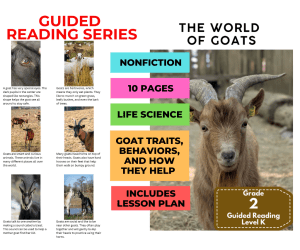
Guided Reading Level K - The World of Goats (with Lesson Plan)
ELA, Resources for Teachers, Reading Comprehension, Reading, Science, Language Development, Life Sciences, Animals, Pre-Reading, Vocabulary, Grade 2, 3, 4, Worksheets & Printables, Worksheets, Teacher Tools, Centers, Activities, Literacy Readers, Quizzes, Quizzes and Tests, Assessments, Lesson Plans
This Guided Reading Book - The World of Goats (Level K) with lesson plan includes: Guided Reading Color Label (front cover x1) This is a quick way to match the book’s demands to what students can generally handle.. The overall goal is to use the level/color to pick books for several smaller groups. To qualify for a certain level, a student is expected to read a book from that level with about 90–94% accuracy. If a student is consistently accurate and understands, move up a level. If the student is struggling at that level, drop down and add more support. Each student will improve at completely different rates, but it is generally one of the best ways to check progress across the class. DOWNLOAD THE CATALOG TO VIEW ALL GUIDED READING BOOKS AVAILABLE (SORTED LEVELS A-Z) Pre-Reading Question (x1) Teacher asks the prompt aloud, can be while showing the cover or first page. Students share what they already know, or make educated guesses from the cover. Prompt them to use the target vocabulary. Write some of their responses on the board to look back at during the reading. Vocabulary Words (x5) Introduce the five words, best doing it one at a time. Start by saying it, while students repeat and then see if anyone knows what it means before reading further. Read through the meaning and try to briefly connect each word to a picture or gesture so it’s meaningful. Ask students to flip through the book pages and point to where they see each of the vocabulary words. While reading the book pause upon coming across one of the vocab words or read the sentence twice to make sure students understand the word has appeared. Optional: Ask students to raise hands whenever they see/hear one of the new words. Guided Reading Pages (x10) Check the book snapshot (below) for: primary topic - do you need to prep extra reading or intro materials on this? what is taught best - decide on 1-2 bullets to focus on, use the prompt or words provided here for best results. learning goals - what you are checking for students to be able to do after the session, elicit answers using prompts or words provided. key vocabulary (see section above). questions overview - so you know what is coming up and if you need to prep extra materials to assist understanding. Run the lesson You may have already looked at a few of the pages together, but you can show them some of the pictures again first to set meaning. Depending on how much time you have and how familiar your students are with guided reading class, you may want to read the book aloud first with the group first. Students whisper or partner read, while you listen in. If time, do it as a group, one student reading a page each. Use the guided page’s prompts to coach: “Check the picture / does it make sense?” “Point under the words / try the first sound” “Reread the sentence smoothly”. Try to focus more on one student per session (rotating every time), so you can work out if they are ready to move up or need to move down a level. Comprehension Questions (back cover x3) This is your way to check that students didn’t just say the words, but actually understood the text. First, let students answer by pointing to the page/picture and saying a short sentence. After any answer, follow with: “Show me where you found that in the text.” In bigger groups, have partners answer first (10–20 seconds), then call on 2–3 students to share. Differentiation tips: Emerging speakers/struggling readers: oral + pointing On-level: oral in a full sentence Higher: one written sentence or draw + label Book Snapshot Title: The World of Goats Genre: Nonfiction (informational text) Subject: Life Science + Reading (Informational Text) Primary Topic: Goat traits, behaviors, and how they help Estimated Guided Reading Level (A–Z): K What This Book Teaches Best Describes goats as “smart and curious” animals that live in many places around the world. Explains body parts that help goats move and stay safe (horns, hooves, and special eyes that help them “see all around”). Teaches what goats eat by defining them as “herbivores” and naming plants they munch on (grass, leafy bushes, bark). Highlights goat abilities and behaviors (climbing steep, rocky cliffs; kids running and jumping; goats playing and gently bumping heads). Connects goats to farm life by stating they provide milk and wool. Learning Goals Students will identify key goat traits and behaviors described in the text. Students will explain how horns and hooves help goats, using details from the text. Students will describe how a goat’s special eyes help it stay safe. Students will explain what herbivores eat and list plants goats munch on from the text. Students will describe how goats communicate and what a “bleat” can help a mother goat do. Students will describe how goats can be helpful to people on a farm, according to the text. Key Vocabulary From the Text curious — wanting to learn more by exploring. hooves — hard feet that help goats walk. rectangles — shapes with four sides and four corners. herbivores — animals that eat only plants. bleat — the sound a goat makes. Discussion Prompts Pre-reading question: What features might help goats live in different places? Comprehension questions: How do a goat’s special eyes help it stay safe? Comprehension questions: What kinds of plants does the book say goats like to munch on? Comprehension questions: Why do goats gently bump their heads when they play together? Printing Tips 1. Best Printing Method (Recommended) “Booklet” Printing (Best if Available) If your printer or PDF viewer supports Booklet Printing , use this. Settings to use: Print mode: Booklet Paper size: Letter or A4 (either works) Orientation: Landscape Print on both sides: Yes Flip on: Short edge Scaling: Fit to printable area Booklet subset: First test: Front sides only Then: Back sides only This will automatically: Pair pages correctly Put the cover on the outside Align everything for folding After printing, fold in half and staple along the spine . 2. If “Booklet” Printing Is NOT Available You can still print this correctly with manual duplex printing . Step-by-step: Open the PDF. Choose Print . Set: Orientation: Landscape Pages per sheet: 1 Print on both sides: Yes Flip on: Short edge Print all pages . Because each PDF page already contains two facing book pages, the result will still fold cleanly into a book. Thousands of Cored Education products are included with your TeachSimple membership. Download links and encyclopedia index available here.
Author Cored Education
Rating
Tags Reading Comprehension, Reading Passages, Reading, Guided Reading, Guided Reading Lesson Plan, Guided Reading Activity, Pre-reading, Science Lesson Plans, Life Science, Animals
I WONDER - How Long Do Peacock Feather Take To Grow | Animated Video
Biology, Life Sciences, Science, Animals, STEM, Grade 1, 2, 3, 4, 5, 6, 7, 8, Lesson Plans, Teacher Tools
Video Introduction Animal kingdoms are full of fascinating wonders to learn. This video is designed for the students to learn more about animals in different countries. I WONDER - How Long Do Peacock Feather Take To Grow | Animated Video Lesson Do you like animals? what is your favorite one? Do you own a pet? If yes, tell us more about it, like what its name? And what do you like most about it? What are the animal kingdoms? Can you write down the characteristics of each animal class like mammals, birds, reptiles, amphibian, fish and mollusks. Do you know that some animals can sing, can you name any of them? What is the largest and the smallest mammal in the world? What is the largest and the smallest bird in the world? What is the largest and the smallest fish in the world? I WONDER - How Long Do Peacock Feather Take To Grow | Animated Video Lesson The video is perfect for encouraging the researching skills for the students, while learning more about these fantastic animals. I WONDER - How Long Do Peacock Feather Take To Grow | Animated Video Lesson This friendly designed video is suitable for students at school, homeschooling, and as a group activity. Format Available in MP4 format.
Author Educational Voice
Tags How Long Do Peacock Feather Take To Grow, How Long Do Peacock Feather Take To Grow Video, Peacock Feather, Peacock Feather Facts, Peacock Feather Facts For Kids, Peacock Feather Video, Peacock Feather Video For Kids

Chemical Reactions and Balancing - Senior Chemistry Lesson
Science, Chemistry, Grade 10, 11, 12, Teacher Tools, Lesson Plans
Chemical Reactions and Balancing - Senior Chemistry Lesson Your lesson covers chemical reactions and balancing. In order, the lesson teaches about; Chemical Reactions, Energy in Reactions, Chemical Change Clues, Writing Chemical Formulas, the Law of Conservation of Mass, and Balancing Chemical Reactions. Your lesson includes the teacher and student version of the presentation, TWO worksheets, an auto-graded exit ticket, and a student lesson handout so the students can record the notes on a more condensed medium. This lesson is designed to be your go-to resource, whether you're in a traditional classroom or a virtual one. With both a teacher version and a student version, it seamlessly fits into your lesson plans, making learning engaging and adaptable. Assessment made easy We've included an auto-graded Exit Ticket and a quiz with an answer key because I know you don't have an excess of time. I know you don't, because I don't and I know I'll do whatever I can to reduce my grading time. Whether you use PowerPoint or Google Slides, prefer Word or Google Docs, this lesson has you covered. This lesson comes in both Office and Google formats for your convenience. The student version of the presentation has strategically placed blanks for them to fill in as you're teaching. It keeps them active and engaged, encourages discussion, and leaves more time for those "aha" moments.
Author Teach With Fergy
Tags Chemistry Lesson, Writing Reactions, Synthesis Reactions, Combustion Reactions

I WONDER - Where Did The Gallimimus Live | Animated Video Lesson
History: Ancient, History, Social Studies, History: World, Animals, Life Sciences, Science, Grade 4, 5, 6, 7, 8, 9, 10, Lesson Plans, Teacher Tools
Video Introduction An amazing video designed for the students to learn more about dinosaurs in different countries. I WONDER - Where Did The Gallimimus Live | Animated Video Lesson Do you like dinosaurs? what is your favorite one? Do you own a pet? If yes, tell us more about it, like what its name? And what do you like most about it? Do you think that your pet has been evolved from a dinosaur? Can you write down the characteristics of your favourite dinosaur like it's shape, their rivals, where did it use to live and what was their favourite food? What is the largest and the smallest dinosaur that ever found? Why is the T-rex is so famous? Have you ever read any interesting facts about it? Can you name any of the carnivores or herbivores dinosaurs? I WONDER - Where Did The Gallimimus Live | Animated Video Lesson The video is perfect for encouraging the researching skills for the students, while learning more about dinosaurs. I WONDER - Where Did The Gallimimus Live | Animated Video Lesson This friendly designed video is suitable for students at school, homeschooling, and as a group activity. Format Available in MP4 format.
Author Educational Voice
Rating
Tags Where Did The Gallimimus Live, Where Did The Gallimimus Live Video, Gallimimus, Gallimimus Facts, Gallimimus Video, Gallimimus Facts For Kids, Gallimimus Video For Kids, Dinosaurs, Dinosaurs Video
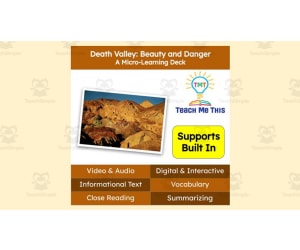
Death Valley | Interactive Science Lesson | Micro-Learning Deck
Science, Earth and Environmental Sciences, Earth Sciences, Grade 5, 6, 7, Teacher Tools, Lesson Plans
Death Valley | Interactive Science Lesson | Micro-Learning Deck Transport students to the beautiful yet dangerous landscape of Death Valley with this engaging science lesson. Through a digital slideshow, educators guide learners to analyze informational texts and video about the unique geography and climate of this desert environment. Interactive components like close reading passages, short writes, and audio recordings actively involve a range of learning styles. Use the lesson to introduce earth sciences concepts, review key ideas, or provide enrichment. With differentiated materials for whole group instruction or independent practice, this versatile resource enhances science literacy for grades 5-7. Apply the materials creatively to inspire curiosity about the world while building essential literacy skills.
Author Teach Me This
Tags Informational Text, Death Valley, The Oasis, Interactive Science, Reading Passage

The Respiratory Tract (Pathway of Air)
Science, Life Sciences, Human Body, Grade 9, 10, Teacher Tools, Lesson Plans
Full PowerPoint lesson presentation reviewing the respiratory tract, and the route air takes as it passes from outside the body down into the lungs. Learning Objectives: All must be able to state the 6 components of the respiratory tract. Most should be able describe a feature of each component and place them in the correct order.
Author The PE Tutor
Tags Respiration, Respiratory, Pulmonary Ventilation, Lungs, Trachea