



3,980 products added recently
Page 219 - Teacher Tools
Equip yourself with tools that streamline your teaching process and enrich your classroom experience. This collection includes organizational planners, assessment templates, and classroom management strategies. By integrating these resources, you can focus on delivering impactful instruction and fostering student success.

 Show filters

Professor Cody Teaches Kids to Code using Scratch: Lesson 4
Science, Technology, Computer Science, Grade 5, 6, 7, Teacher Tools
Professor Cody Teaches Kids to Code using Scratch: Lesson 4 An evidence-based tool crafted for educators aiming to acquaint students aged between 8-14 years with coding and its nuances. Lesson Details: Ideal for grade 5,6 and 7 settings where applied sciences commence. This is the fourth lesson in a six-series pack focusing on ease of understanding technical aspects using Scratch 3.0: an accessible visual programming language designed for kids. The major task includes arousing curiosity whilst nurturing knowledge about coding via fun-filled activities. Resource Structure: The resource comprises of 13 detailed PDF pages, ready-to-use both in classrooms or customized home-school programs. Fully adaptable according to diverse learning patterns making them suitable for teaching as a full class on the smartboard or pair work/shared devices or even individual assignments at home. Tutorial Videos & Activities: A well-rounded video tutorial catering primarily towards children covers critical components like Iteration (Repetition), creation of programs with repeat loops and forever loops etc ensuring thorough understanding by revisiting essential lessons multiple times throughout this resource. Students will be guided through creating geometric shapes via repeat loop function leading into designing a ‘scary game ’ that extensively uses learned concepts about repetition. Code Templates & More: The necessary Scratch templates that are required for all activities including challenges post each topic can be downloaded hassle-free from Edulito, offering controlled freedom to code different tasks thereby cementing theoretical coding concepts and improving computational thinking skills among learners. In conclusion, Professor Cody Teaches Kids To Code Using Scratch: Lesson 4 marries theory and practicality to provide a meaningful interactive learning experience, aiming to enrich computer science knowledge whilst keeping learners thoroughly engaged.
Author Edulito
Tags Coding, Programming, Scratch 30, Visual Programming, Computational Thinking

How to Write a Paragraph: Prewriting Your Paragraph
ELA, Writing, Common Core, Grade 5, 6, 7, 8, Teacher Tools, Lesson Plans
How to Write a Paragraph: Prewriting Your Paragraph - A Teaching Resource How to Write a Paragraph: Prewriting Your Paragraph is developed for educators devoted to improving their students' writing abilities. Primarily designed for 5th to 8th grade students, it integrates seamlessly into any language arts curriculum with a focus on writing. The resource simplifies the seemingly complex process of crafting paragraphs, providing learners the foundational skills needed for them to transition into articulate writers. It places emphasis on prewriting strategies. Core Features: Presents four types of paragraph forms supported by engaging practice worksheets across 24 print-ready PDF pages. Incorporates graphic organizers for efficient mastery of prewriting strategies. Suits both standalone reading programs and independent student work due to its design based on Bloom’s Taxonomy objectives. A User-friendly Instructional Tool: In addition to these features, this resource includes an extensive implementation guide that aids teachers in using it effectively. Other conveniences include: An assessment rubric tailored for students (helps measure progress) A set of word puzzles and comprehension quiz for reinforcing concepts taught Six colored graphic organizers (assists in introductory sessions and throughout the course) Fits Multiple Instruction Modes: The flexibility in application makes this tool perfect not only for whole-group instruction but also small group activities or homework assignments. With it, lessons become vibrant interactive experiences which make learning nothing but pleasurable. Integrating How to Write a Paragraph: Prewriting Your Paragraph into your classroom or homeschool curriculum will undeniably boost student confidence and enhance their writing skills significantly!
Author Classroom Complete Press
Tags Language Arts, Writing Task, Writing A Paragraph, Crossword Puzzles, Comprehension Quiz

I WONDER - Who Was Cupid | Animated Video Lesson
History: Europe, History, Social Studies, History: Ancient, Grade 4, 5, 6, 7, 8, 9, 10, Lesson Plans, Teacher Tools
Video Introduction An amazing video designed for the students to learn more about history. I WONDER - Who Was Cupid | Animated Video Lesson Do you like history? Which topic do you really enjoy about history? Have you ever read an interesting fact about the Vikings? If yes, can you mention them? What do you like most about the Victorian era? Can you name all the Tudors? Have you ever wondered how people used to live in ancient Japan and ancient China? Do you know any interesting facts about ancient Egyptians and the Pharaohs? Have you ever visited South America? What do you know about Incas and Aztecs? Celtic culture was really one of a kind, can you name any of the places that Celts used to live in? Imagine yourself living during the ancient Roman empire, how your life will look like? Ancient Greece was an amazing place to live in. What do you know about ancient Greek life? I WONDER - Who Was Cupid | Animated Video Lesson The video is perfect for encouraging the researching skills for the students, while learning more about history. I WONDER - Who Was Cupid | Animated Video Lesson This friendly designed video is suitable for students at school, homeschooling, and as a group activity. Format Available in MP4 format.
Author Educational Voice
Tags Who Was Cupid, Who Was Cupid Video, Cupid, Cupid Facts, Cupid Video, Cupid Facts For Kids, Cupid Video For Kids, Roman God, Roman God Facts, Roman God Video

Force: Kinds of Force - FLASH-PC
Science, Physics, Common Core, Grade 5, 6, 7, 8, Teacher Tools, Lesson Plans
Force: Kinds of Force - FLASH-PC FLASH-PC, a comprehensive teaching resource, has been expertly crafted for educators as an effective digital educational tool. This product enhances students’ knowledge about force and its various manifestations, with distinct alignment to Common Core State Standards and a purposeful adaptation to Bloom’s Taxonomy. A Unique Multimedia Package The learning journey begins with engaging reading passages for the earliest exposure to the topic. Complementary questions for pre-reading anticipation and post-reading reflection help students develop their predictive skills and encourage thoughtful responses after each passage. Suitable for Grade 5 through Grade 8. Supplementary Printables The package extends learning beyond the digital sphere with intensive review materials that aid in memory retention - crucial for internalizing complex scientific principles such as force. Detailed Vocabulary Flashcards Varying methods of instruction cater to individual student's needs. Students can learn at their own pace. Filled with instrumental tools in navigating intricate science concepts while accommodating different learning styles. Multimedia Elements Videos, Audios,, and other immersive components provide an intriguing interaction with complex physics principles, leading us closer in forming a comprehensive understanding of forces' captivating world. The Fun Learning! Interactive Activities! Puzzles, games, quizzes – all aimed towards entertainment infused learning! Indeed! Witness your classrooms buzzing over exciting scientific exploration! In summary, if you're seeking an engaging way to present gravity or inertia concepts through modern technology applications designed specifically for today's classroom settings, then Force: Kinds of Force - FLASH-PC will undoubtedly breathe life into your lesson plans. Experience firsthand why countless educators value this innovative resource encased within one downloadable product file from TeachSimple! Step up your teaching approach with us - TeachSimple’s Kinds of Force educational resource. Leverage it today!
Author Classroom Complete Press
Tags Software (PC)
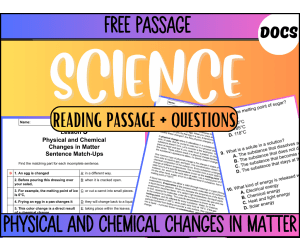
Reading Passage 3: Physical and Chemical Changes in Matter Google Docs
ELA, Reading, Reading Comprehension, Science, Physics, Common Core, Resources for Teachers, ESL, Language Development, Grade 5, 6, 7, Centers, Activities, Assessments, Teacher Tools, Tests, Quizzes and Tests, Worksheets, Worksheets & Printables
Free Reading Passage on Physical and Chemical Changes in Matter for Physical Science What's inside this free product? Science Reading Comprehension Passage: Physical and Chemical Changes in Matter Independent Google Docs Version: This is the independent Google Docs version containingone lesson. Product Info: 8 PAGES (US English with Answers) Google Docs Version Teaching Duration: 90 Minutes Science Reading Comprehension Outline: Introducing a comprehensive resource tailored for 5th and 6th graders, this product offers enriching reading passages supplemented with illustrative pictures and graphs to clarify key concepts. Aligned with the Common Core State Standards (CCSS), it offers a hassle-free approach to teaching, given that the bulk of the preparation is already done for you. The passages present a diverse set of questions – from multiple choice to data analysis and fill-in-the-blanks. This ensures a rich blend of high-interest content and fundamental curriculum-based science themes. With its versatility, you can seamlessly integrate these lessons into various classroom settings, whether it's whole class discussions, morning exercises, independent desk tasks, small group engagements, contingency plans for substitute teachers, regular homework assignments, or even themed activities for holidays. FULL CATALOG OF DOWNLOAD LINKS HERE Grade 5/6 Links: Physical Science Part 1 - Physical and Chemical Properties Google Docs/Slides/Forms PDF PPT Word Free Supplementary Pack Accompanying Videos Physical Science Part 2 - Motion and Energy Google Docs/Slides/Forms PDF PPT Word Free Supplementary Pack Accompanying Videos Physical Science Part 3 - Electricity and Magnets Google Docs/Slides/Forms PDF PPT Word Free Supplementary Pack Accompanying Videos Life Science Part 1 - Cells, Reproduction and Genetics Google Docs/Slides/Forms PDF PPT Word Free Supplementary Pack Accompanying Videos Life Science Part 2 - Human Body Systems Google Docs/Slides/Forms PDF PPT Word Free Supplementary Pack Accompanying Videos Life Science Part 3 - Plant Parts and Ecosystems Google Docs/Slides/Forms PDF PPT Word Free Supplementary Pack Accompanying Videos Earth Science Part 1 - Plate Tectonics and Rock Cycle Google Docs/Slides/Forms PDF PPT Word Free Supplementary Pack Accompanying Videos Earth Science Part 2 - Ocean Exploration and Natural Resources Google Docs/Slides/Forms PDF PPT Word Free Supplementary Pack Accompanying Videos Earth Science Part 3 - Weather and Solar System Google Docs/Slides/Forms PDF PPT Word Free Supplementary Pack Accompanying Videos For similar products and other frees, do check out Cored Group on TeachSimple .
Author Cored Education
Tags Science, Elementary, Reading, Comprehension, Vocabulary, Answers, Physics, Physical Science, Ccss, Digital Centers
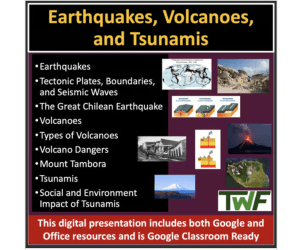
Earthquakes, Volcanoes, and Tsunamis - Senior Earth and Space lesson
Science, Earth and Environmental Sciences, Space, Earth Sciences, Grade 10, 11, 12, Teacher Tools, Lesson Plans
Earthquakes, Volcanoes, and Tsunamis - Senior High School Earth and Space Lesson Your lesson covers the causes and impacts of Earthquakes, Volcanoes, and Tsunamis on Earth. In order, the lesson teaches about; Earthquakes, Tectonic Plates, Boundaries, and Seismic Waves, the Great Chilean Earthquake, Volcanoes, Types of Volcanoes, Volcano Dangers, Mount Tambora, Tsunamis, and the Social and Environmental Impact of Tsunamis. Your lesson includes the teacher and student version of the presentation, NINE embedded videos, an auto-graded exit ticket, and a student lesson handout so the students can record the notes on a more condensed medium. This lesson is designed to be your go-to resource, whether you're in a traditional classroom or a virtual one. With both a teacher version and a student version, it seamlessly fits into your lesson plans, making learning engaging and adaptable. Assessment made easy We've included an auto-graded Exit Ticket and a quiz with an answer key because I know you don't have an excess of time. I know you don't, because I don't and I know I'll do whatever I can to reduce my grading time. Whether you use PowerPoint or Google Slides, prefer Word or Google Docs, this lesson has you covered. This lesson comes in both Office and Google formats for your convenience. The student version of the presentation has strategically placed blanks for them to fill in as you're teaching. It keeps them active and engaged, encourages discussion, and leaves more time for those "aha" moments.
Author Teach With Fergy
Tags Space Science, Tectonic Plates, Earthquakes, VOLCANOES, TSUNAMIS, Mount Tambora
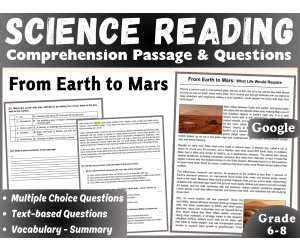
Earth Science Reading Comprehension Passage: From Earth to Mars (Docs)
Science, ELA, Reading, Reading Comprehension, Strategies, Resources for Teachers, Earth and Environmental Sciences, Space, Grade 6, 7, 8, 9, Writing Prompts, Worksheets & Printables, Centers, Activities, Teacher Tools, Assessments, Quizzes and Tests, Quizzes, Tests
Science Reading Comprehension Passages and Questions: From Earth to Mars (Docs) This very engaging earth science reading passage about Mars is designed to bridge the gap between science and literacy through strengthening reading comprehension and sparking scientific curiosity in middle school students. The passage blends English Language Arts skills with accurate science content that supports NGSS classroom practice. Ideal for interdisciplinary learning in ELA and Science. Suitable for Grade 9 review, too! Student Tasks for The Passage: 5 multiple-choice questions targeting main idea, key details, inference, vocabulary in context, and use of evidence 5 vocabulary matching items with clear, student-friendly definitions 5 text-based questions that require citing specific lines or facts 1 summary prompt that asks students to condense central ideas accurately Full answer key for every section Available Formats for this Resource PDF Fillable PDF Word Docs FULL CATALOG OF DOWNLOADING LINKS HERE Product Details Length: 5 pages total Grades: 6–8, also suitable for Grade 9 review Use cases: close reading, stations, homework, intervention, test prep, and sub plans Standards support: reinforces informational-text skills and supports NGSS-style sense making through observation, modeling, and clear use of claim, evidence, and reasoning Why Teachers Choose This Set Authentic science content paired with rigorous literacy practice Consistent task structure across all passages for easier planning and smoother student routines Clear, age-appropriate writing that builds confidence without oversimplifying Other Science Reading Collections you May find in the store: 1. Astronomy & Space Science 2. Volcanoes, Rocks, & Mountains 3. Rock Cycle, Soil, & Sinkholes 4. Mars, Glaciers, & Antarctica 5. Water Cycle, Acid Rain, & Wastewater 6. Insects, Animals, & Ecosystems 7. Bioluminescence & Insects 8. Animal Skin, Cats, & T. Rex 9. Human Body and Senses 10. Health & Applied Bioscience 11. Waves, Light, & Imaging 12. Electricity & Energy 13. Motion & Materials 14. Chemistry and Materials Science Use this set to reinforce ELA skills in science, to add literacy to your lessons, and to support independent work. The passages strengthen main idea, evidence use, vocabulary in context, inference, cause and effect, and summary writing. With ready-to-use assessments and complete answer keys, you can provide focused practice that is simple to run and fast to review.
Author Middle & High School - CORED Education
Rating
Tags Middle School, Reading Comprehension, Reading Strategies, ELA, Centers, Reading Passage, Assessments, Vocabulary, Environmental Science, Space

Unicellular & Multicellular Organisms – PowerPoint
Science, Life Sciences, Biology, Grade 5, Presentations, Teacher Tools
Unicellular and Multicellular Organisms - PowerPoint Lesson A comprehensive resource for educators in the upper elementary and middle school grade levels. This PowerPoint lesson is structured clearly, easy to follow, and provides novel ways of conveying complex biology without overwhelming young minds. Understanding Unicells and Multicells The lesson breaks down the world of unicells with examples such as bacteria, protozoa, fungi, and amoeba. It neatly transitions into multicells territory with depictions of plants, animals along with several species of fungi and algae. Videos for Visualisation This journey includes five videos which visualize these organisms ensuring greater student participation. A useful student handout extends learning beyond class hours; an ideal tool for homework or extra self-study assignments. How organisms meet life needs? The material delves into how these creatures meet essential life needs like feeding movement reproduction gas exchange. Teachers can engage stimulating debates comparing unicellular organisms' sustenance mechanisms against those of multicellular beings. Educator-friendly features: Dual versions: One teacher's version complete with underlined correct answers; another student’s version designed to stimulate active engagement from children. Potential applications in multiple settings:= Use this resource during whole group plenaries or small group activities that promote collaborative discussions about categories of organisms. This is part of a complete unit on Cells: Understanding Life Systems offering broader content for students interested in life sciences.
Author Teach With Fergy
Rating
Tags Unicellular Organisms, Multicellular Organisms, Biology, Life Science, PowerPoint Presentation

Science Mega Bundle: 3 Topics-in-1 Complete Teaching Kit for Grade 1-4
Science, Basic Science, Earth and Environmental Sciences, Grade 1, 2, 3, 4, Worksheets & Printables, Lesson Plans, Teacher Tools, Presentations, Templates, Quizzes and Tests, Classroom Decor
🌿 Science Mega Bundle: Plants, Animals & Habitats Make science teaching simple and engaging with this MEGA bundle covering three key topics: Parts of the Plant, Animal Adaptations, and Exploring Habitats. It helps students learn how living things grow, survive, and interact with their environment. Each topic includes: ✔ Editable PowerPoint Lesson with Assessment ✔ Editable Lesson Plan ✔ Worksheets (no prep) with Answer Key ✔ Classroom Posters Best For: Grade 1–4, Homeschooling, Tutoring How to Use: Use as full lessons or small activities for classroom, online, or independent learning. Use slides for teaching, worksheets for practice, and posters for classroom display. Differentiate tasks based on learner ability. Perfect For: Grade 1–4, Homeschooling, Tutoring Aligned with early primary science learning on living things and environments. Format: PDF, PNG, Editable PowerPoint, and lesson plans. Number of Pages: 50+ resources total. Tags #ScienceBundle #PrimaryScience #PlantsandAnimals #Habitats #NoPrepLessons 📥 Instant Download after purchase.
Author Pinay Digitals
Rating
Tags #PrimaryScience, #ScienceMegaBundle, #TeachingResources, #DigitalTeachingTools, #NoPrepResources, #ScienceWorksheets, #ElementaryScience, #TeacherCreatedResources, #HomeschoolScience

Boiling Water | Animated Kitchen Science Video Lesson
, Not Grade Specific, Lesson Plans, Teacher Tools
This kitchen science video lesson is all about boiling water. Students will love this engaging and interactive video. This video serves as a great introduction or review video for your learners. This is a 9-minute video lesson.
Author Educational Voice
Tags Science Videos, Temperature, Electricity, Physical Science, Physics Lesson

RF.5.3 Fifth Grade Common Core Lesson
Reading, ELA, Language Development, Pre-Reading, Vocabulary, Common Core, Grade 5, Teacher Tools
This RF.5.3 Fifth Grade Common Core Lesson will help your students master RF.5.3. The lesson includes worksheets, activities, assessment , and a poster.
Author Have Fun Teaching
Tags Syllables
I WONDER - Are X-Rays Safe | Animated Video Lesson
Physics, Science, Grade 6, 7, 8, 9, 10, 11, 12, Lesson Plans, Teacher Tools
Video Introduction An amazing activity designed for the students to learn more about STEM. I WONDER - Are X-Rays Safe | Animated Video Lesson Do you like STEM subjects? what is your favorite one? Have you ever tried to plant a seed? If yes, tell us more about it. Or have you ever tried to invent something? If yes, tell us more about it. And how do you think it will help us? Have you ever seen a microorganism under a microscope? What was it? And how it looked like? Mathematics is a marvelous subject. Let' sharpen our brains and solve some equations. Do you like timetable tricks? What is your favorite one? Do you know how to code? Have you ever created an app or a game before? If yes, how was it like? I WONDER - Are X-Rays Safe | Animated Video Lesson The video is perfect for encouraging the researching skills for the students, while learning more about this fantastic topic. I WONDER - Are X-Rays Safe | Animated Video Lesson This friendly designed video is suitable for students at school, homeschooling, and as a group activity. Format Available in MP4 format.
Author Educational Voice
Tags Are X-Rays Safe, Are X-Rays Safe Video, X-Rays, X-Ray, X-Rays Facts, X-Rays Facts For Kids, X-Rays Video, X-Rays Video For Kids, Science, Stem
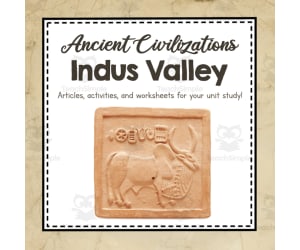
Ancient Civilizations: Indus Valley Unit Study
Social Studies, History, History: Ancient, Grade 3, 4, 5, 6, Lesson Plans, Teacher Tools
Ancient Civilizations: Indus Valley Unit Study A comprehensive educational resource, specifically designed to engage students from grades 3 to 6 in exploring the history of Ancient India's Indus Valley, or Harappan civilization. This resource is a perfect ensemble of books recommendation, charts, articles and arts and crafts that bring out the essence of one of the world's oldest civilizations. Engaging Content Well-detailed maps for coloring and creative representation. Relevant projects such as creating an artifact museum, designing terracotta pots or crafting bronze bracelets. Seven varied writing prompts across different genres thereby encouraging even budding writers to incorporate their understanding into their literary works smoothly. Articles about key aspects such as ancient architecture; navigations around transport resources at that time; detailed information on food habits; weather conditions; wardrobe choices prevalent during this era among others. Promoting Visual Learning Includes three popular places' posters (City of Harappa, City Of Mohenjo-Daro and The Great Bath) - aimed at further enhancing visual learning associated with locations linked with this civilization. An interesting addition for game-loving learners is the trading card game which simulates trades within the cultural context offering them insights on merchandise interactions during those times. Ancient Civilizations: Indus Valley Unit Study can also be effectively used within various frameworks be it regular classrooms; homeschooling modules or extracurricular history clubs. A useful integration can be imagined by including aspects from this unit study to weekly homework assignments thus ensuring continual learning outside school hours too.
Author Simply Schoolgirl
Tags Ancient India, Indus Valley Civilization, History Education, Hands-on Activities, Geography, Indus Valley Social Structure, Which Continent Was The Ancient Indus Valley Civilization Located In, Which Continent Was The Ancient Indus Valley Civilization Located In?
Building Comprehension - Grade 5
ELA, Reading, Reading Comprehension, Grade 5, Teacher Tools, Lesson Plans
Building Comprehension - Grade 5 A teaching resource designed especially for grade five language arts educators. This product file contains: Captivating stories from various genres and themes. Biographies about famous individuals. Accounts on sports stars and events. Riddles, mysteries and astonishing facts about science and nature. The primary focus is to keep student interest piqued, spur their imaginations, ensuring understanding and boosting reading confidence among the students. Follow-up Questions & Lesson Plans The resource also includes follow-up questions targeting essential comprehension skills reinforcement. It offers effective lesson plans in an easily accessible PDF format facilitating preparations for teachers as well as understanding of the students during learning cycles. Versatility & Usecases This teaching material supports a versatile application adaptable to both small group demonstrations or whole group discussions effectively. Not limited to classrooms alone, it's also practical for homeschooling sessions dedicated towards enhancing comprehension skills among fifth graders at home. Furthermore, it can be integrated into homework assignments aiding learners retain concepts outside regular school hours significantly. In Conclusion, make use of this trusted educational resource endorsed by educators worldwide for optimal development of Grade 5 students' language arts skills offering them an engagingly inclusive look at language arts comprehension.
Author Classroom Complete Press
Tags PDF
I WONDER - How Common Are Fossils | Animated Video Lesson
Geology, Earth and Environmental Sciences, Science, Earth Sciences, Grade 4, 5, 6, 7, 8, 9, 10, Lesson Plans, Teacher Tools
Video Introduction An amazing activity designed for the students to learn more about STEM. I WONDER - How Common Are Fossils | Animated Video Lesson Do you like STEM subjects? what is your favorite one? Have you ever tried to plant a seed? If yes, tell us more about it. Or have you ever tried to invent something? If yes, tell us more about it. And how do you think it will help us? Have you ever seen a microorganism under a microscope? What was it? And how it looked like? Mathematics is a marvelous subject. Let' sharpen our brains and solve some equations. Do you like timetable tricks? What is your favorite one? Do you know how to code? Have you ever created an app or a game before? If yes, how was it like? I WONDER - How Common Are Fossils | Animated Video Lesson The video is perfect for encouraging the researching skills for the students, while learning more about this fantastic topic. I WONDER - How Common Are Fossils | Animated Video Lesson This friendly designed video is suitable for students at school, homeschooling, and as a group activity. Format Available in MP4 format.
Author Educational Voice
Tags How Common Are Fossils, How Common Are Fossils Video, Fossils, Fossils Facts, Fossils Facts For Kids, Fossils Video, Fossils Video For Kids, Fossils Facts Video For Kids, Stem Video For Kids

Country Study Presentation - Zimbabwe - Geography - Africa
Social Studies, First Peoples (Native), Government, History: African, History, Grade 7, 8, 9, 10, 11, 12, Presentations, Teacher Tools, Lesson Plans
Country Study Presentation - Zimbabwe - Geography + Social Studies - Southern Africa Try this Teaching Resource on Zimbabwe (Introductory Presentation Lesson - PDF Printable), designed for Geography + African History (Southern Africa) + Social Studies lessons. Suitable for Grades 7–12 (Middle school and High School students), this Introductory PDF Presentation offers a ready to use lesson that requires little to no preparation. Geography and Social Studies students will learn about Zimbabwe ’s geography, history, culture, language and economy — making it perfect for classroom instruction, homeschooling, or online learning. 📘 Teachers can find the following topics in this Social Studies and Geograhy Teaching resource ✅ Greetings in Shona ✅ Geography of Zimbabwe (Southern Africa) – Key facts, borders, and an interactive Google Maps link to its location. ✅ Quick Facts – Population, capital city, currency and other essential details. ✅ Languages of Zimbabwe : Shona - introduction in the languages spoken + basic vocabuary ✅ History Overview – A concise summary of the most important events in the history of Zimbabwe (Southern Africa) ✅ Geography & Environment – Details about the country’s land area, regions, and climate zones. ✅ Zimbabwe's Economy – paragraph on Zimbabwe ’s industries, exports, currency and economic strengths (Southern Africa) ✅ Harare – Explore the capital city of Zimbabwe , its famous landmarks, and cultural highlights. ✅ Other Major Cities – A map showcasing additional important cities in Zimbabwe (Southern Africa) ✅ Zimbabwe's Culture & Traditions – A look at the customs and values that define Zimbabwe (Southern Africa) ✅ Farewell in Shona 🎯 This Geography and Social Studies Teaching Resource can be perfect for: Geography classes Social Studies lessons World cultures units Country study projects Substitute teacher toolbox Digital learning In-class or online teaching 📂 Resource Details Format: PDF Digital Presentation Grade Levels: 7th–12th Grade (Middle School and High School students) Learning with Alan is an educational resource store created to help teachers, educators, and tutors reach their teaching goals while building a fun, engaging, and stimulating learning environment . Because learning should always be meaningful—and fun! 🎓✨ If you want to browse more of my Teaching Resources, click here Learning with Alan!!
Author Learning with Alan
Rating
Tags Social Studies, Geography, History, Africa, Zimbabwe, Country Study, Presentation, Lesson, Introduction, Activity

Saving Electricity Campaign: Social Studies Reading Passage (Word)
ELA, Reading, Reading Comprehension, Strategies, Resources for Teachers, Social Studies, Sociology, Grade 6, 7, 8, 9, Writing Prompts, Worksheets & Printables, Centers, Activities, Teacher Tools, Assessments, Quizzes and Tests, Quizzes, Tests
Saving Electricity Campaign: Social Studies Reading Comprehension Passage (Word) This resource introduces a unique Social Studies reading comprehension passage with questions about Saving Electricity Campaign. The passage is carefully designed to bridge the gap between social studies and literacy through strengthening reading comprehension and sparking knowledge curiosity in middle school students. Each passage blends English Language Arts skills with accurate social studies content . Ideal for interdisciplinary learning in ELA and Social Studies. Suitable for Grade 9 review, too! Student Tasks throughout the passage: 5 multiple-choice questions targeting the following skills: main idea, key details, inference, vocabulary in context, and use of evidence 5 vocabulary matching items with clear, student-friendly definitions 5 text-based questions that require citing specific lines or facts 1 summary prompt that asks students to condense central ideas accurately Full answer key for every section Available Formats for this Resource: PDF Fillable PDF Google Docs FULL CATALOG OF DOWNLOADING LINKS HERE Social Studies Reading Comprehension Collection Links: 1. Ancient Civilizations PDF Fillable PDF Word Docs Google Docs 2. Early Empires and Trade Networks PDF Fillable PDF Word Docs Google Docs 3. The Founding of the United States PDF Fillable PDF Word Docs Google Docs 4. Language, Culture, and Meaning PDF Fillable PDF Word Docs Google Docs 5. Psychology and Society PDF Fillable PDF Word Docs Google Docs 6. Global Festivals and Traditions PDF Fillable PDF Word Docs Google Docs 7. Extreme Environments and People PDF Fillable PDF Word Docs Google Docs 8. Food, Culture, and Preservation PDF Fillable PDF Word Docs Google Docs 9. Global Food Customs PDF Fillable PDF Word Docs Google Docs 10. Media, Communication, and Popular Culture PDF Fillable PDF Word Docs Google Docs 11. Human Impact on the Environment PDF Fillable PDF Word Docs Google Docs 12. Civic Action and Social Change PDF Fillable PDF Word Docs Google Docs 13. Fashion, Society, and Power PDF Fillable PDF Word Docs Google Docs 14. People, Places, and Unusual Histories PDF Fillable PDF Word Docs Google Docs Product Details: Length: 5 pages Grades: 6–8, also suitable for Grade 9 review Use cases: close reading, stations, homework, intervention, test prep, and sub plans Why Teachers Choose This Passage: Authentic social studies content paired with rigorous literacy practice Consistent task structure for easier planning and smoother student routines Clear, age-appropriate writing that builds confidence without oversimplifying Use this passage to reinforce ELA skills in social studies, to add literacy to your lessons, and to support independent work. The passage strengthens main idea, evidence use, vocabulary in context, inference, cause and effect, and summary writing. With ready-to-use assessments and complete answer keys, you can provide focused practice that is simple to run and fast to review.
Author Middle & High School - CORED Education
Rating
Tags Middle School, Reading Comprehension, Reading Strategies, ELA, Centers, Reading Passage, Assessments, Vocabulary, Social Studies, Sociology
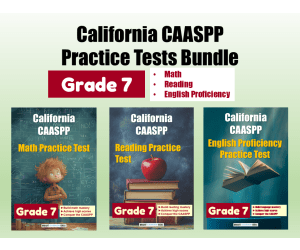
California CAASPP Practice Tests Bundle for Grade 7
ELA, Math, Grade 7, Assessments, Teacher Tools, Tests, Quizzes and Tests, Worksheets & Printables
Prepare your students for success with this Grade 7 CAASPP Practice Tests Bundle . This all-in-one resource includes Math, Reading, and English Proficiency practice tests. It helps students build confidence and become familiar with real test-style questions. It is clear, structured, and easy to use. The bundle includes three full practice tests that mirror CAASPP format and expectations. Students practice math skills such as ratios and expressions, reading comprehension and critical analysis, and academic language development. The questions support deeper thinking and real test readiness. Each test includes an answer key for quick and easy grading. All materials are printable and ready for classroom use. Teachers can use this bundle for test prep sessions, review lessons, small group instruction, or independent work. It also works well for homework, assessment days, or sub plans. Students build skills across multiple subjects while learning how to approach questions with confidence. Just print and use. This Grade 7 CAASPP bundle makes test prep simple and helps students feel confident and ready to succeed.
Author Bright Classroom Ideas Marketplace
Rating
Tags California, Caaspp, State Test, Math, Reading, English Proficiency
Atoms, Molecules & Elements: Properties of Important Elements Gr. 5-8
Science, Life Sciences, Biology, Grade 5, 6, 7, 8, Teacher Tools, Lesson Plans
Atoms, Molecules & Elements: Properties of Important Elements Gr. 5-8 This is a fantastic teaching resource that makes complex scientific topics like atoms, molecules, and elements entertaining and easy-to-understand for students between grades 5 through 8. Key Features: Comprehensive Reading Passages: Simplified explanations to help students grasp concepts about atoms and their constituents. Focused Learning on Periodic Table: Use patterns to identify elements such as calcium (Ca), chlorine (Cl), and helium (He). Inclusive Hands-on Student Activities: Encouraging active learning through label exercises, crosswords, word searches etc. Evaluation Tools: Comprehension quiz to gauge student's understanding post lesson. The package also includes color mini posters which are designed to serve multiple purposes - acting as vibrant classroom decorations while providing quick reference points during lessons or revision sessions. Suitability & Alignment with Education Standards: Versatility - Equally effective for whole class instruction, small-group work or homework assignments. curriculum relevance. . To cater a wide range of educators need the material is produced in printable PDF format consisting one file per purchase. This makes Atoms, Molecules & Elements: Properties of Important Elements Gr an indispensable resource towards teaching captivating biology lessons on atoms and elements for grade 5-8 students!
Author Classroom Complete Press
Tags PDF

Measurement: Measuring Time - Learn the Skill - FLASH-PC
Math, Measurements, Common Core, Grade 1, 2, Teacher Tools, Lesson Plans
Measurement: Measuring Time - Learn the Skill - Flash-PC Educators, we introduce a dynamic way of teaching grade 1 and grade 2 students with a focus on measurement concepts particularly measuring time. The Measurement: Measuring Time - Learn the Skill - Flash-PC digital resource offers potent content that is both aligned with curriculum and applicable in daily life contexts. This multifaceted teaching tool upgrades traditional textbooks by providing: Engaging problem-solving scenarios from everyday life situations. A hands-on math toolbox that can be adjusted to various difficulty levels promoting an advanced understanding of measuring time. It caters to diverse student needs during whole classes, small group activities or for homework tasks. A bilingual feature optimal for both English and Spanish-speaking students. They can choose between English voice over and text options or Spanish voice overs based on their preference. An exciting element that indeed sets this apart is its alignment with Common Core State Standards, STEM initiatives, as well as principles set out by NCTM (National Council Of Teachers of Mathematics). Rest assured that it conforms to stringent educational standards offering solid foundation in measurements specifically time. The Power of Progressive Learning Spearhead constructive learning while boosting comprehension using relatable examples supported by stable metrics. Explore the benefits brought upon by this interactive teaching resource known as 'Measurement: Measuring Time – Learn The Skill – Flash-PC.'' Emphasize the value of every minute when nurturing our future scientists!
Author Classroom Complete Press
Tags Software (PC)

8th Grade Science Diagnostic Assessment & Review System
Science, Grade 8, Assessments, Teacher Tools, Lesson Plans, Worksheets & Printables
Start the year with a clear picture of student readiness using this 8th grade beginning of year science assessment and targeted skills system. With a 50-question diagnostic worth 114 points , scoring and analysis tools, instructional grouping support, 11 targeted follow-up practice pages , scientific reading passages, CER tasks, and complete explained answer keys, this resource helps teachers move from assessment results to focused instruction. Designed as a complete Assess → Analyze → Group → Review → Reteach system, this Grade 8 science resource emphasizes the reasoning demands students need as they prepare for high school science. Students analyze multi-step problems, real-world scenarios, data tables, experimental setups, scientific models, graphs, reading passages, and Claim-Evidence-Reasoning tasks across Life Science, Physical Science, Earth & Space Science, and Scientific Practices & Reading . What’s Included This 8th grade science assessment and review system includes: ✅ 50-question beginning-of-year science diagnostic ✅ 114 total assessment points ✅ Life Science questions ✅ Physical Science questions ✅ Earth & Space Science questions ✅ Scientific Practices & Reading questions ✅ Multiple-choice questions ✅ Short-answer questions ✅ Diagram and model interpretation ✅ Data tables ✅ Graph reading ✅ Multi-step reasoning tasks ✅ Scientific scenarios ✅ Vocabulary-in-context questions ✅ Claim-Evidence-Reasoning (CER) tasks ✅ 2 short scientific reading passages ✅ Evidence-based reading questions ✅ Pedigree interpretation ✅ Natural selection and adaptation analysis ✅ Finch selection data ✅ Cladogram interpretation ✅ Predator-prey data ✅ Periodic table patterns ✅ Chemical equation reasoning ✅ Conservation of mass data ✅ Velocity-time graph analysis ✅ Wave anatomy ✅ Transverse and longitudinal wave comparison ✅ Electromagnetic spectrum interpretation ✅ Seafloor-spreading model ✅ Spreading-rate calculation ✅ Star life-cycle model ✅ Atmospheric CO₂ graph analysis ✅ Experimental design and reliability ✅ Mean and outlier analysis ✅ Two-series graph interpretation ✅ Answer recording sheet ✅ Quick-reference answer key ✅ Skill-by-skill scoring chart ✅ Strand analysis tool ✅ Secure, Developing, and Needs Support performance bands ✅ Individual Student Performance Profile ✅ Whole-class data tracker ✅ Suggested instructional groups ✅ 11 targeted follow-up science practice pages ✅ “Key Concept” refresher on every follow-up page ✅ “Extension” task for students who are Secure ✅ All-new follow-up practice with no repeated assessment questions ✅ Reading-for-evidence follow-up practice ✅ CER writing follow-up practice ✅ Complete answer keys ✅ Suggested short-answer responses ✅ Suggested reading-response answers ✅ Completed visual and diagram answers ✅ Sample CER responses ✅ Short “why” explanation for every assessment item ✅ Partial-credit guidance Part 1 contains 50 rigorous mixed-format questions worth 114 total points . The Teacher Guide recommends two 45-minute sessions and explains that the diagnostic emphasizes multi-step reasoning, evidence-based conclusions, data tables, experimental setups, model interpretation, and reading scientific text for evidence. Part 2 turns student responses into actionable data with an answer recording sheet, quick-reference key, skill-by-skill scoring chart, strand analysis, performance bands, individual student profiles, a whole-class data tracker, and suggested instructional groups. Part 3 includes 11 ready-to-assign targeted follow-up pages with all-new practice. Every page includes a concise Key Concept refresher and an Extension task, and the set includes dedicated pages for Reading Science for Evidence and CER Writing . Part 4 provides correct answers for all 50 questions, explanations of why answers are correct, suggested responses for short-answer and reading tasks, completed diagrams, sample CER responses, and partial-credit guidance. How It Works in the Classroom Use this 8th grade beginning of year science assessment during the first weeks of school to identify what students retained from prior science learning, how well they reason through multi-step problems, and where instruction should begin. The resource follows a practical five-step system: 🔎 Assess — Students complete the 50-item mixed-format science diagnostic 📊 Analyze — Score by skill and strand to identify patterns and gaps 👥 Group — Form targeted instructional groups based on shared needs 📝 Review — Assign focused follow-up practice by strand or skill 🎯 Reteach — Use complete explanations, worked visuals, and model CER responses to support next steps The Assess → Reteach System chart on page 2 of Part 1 directly connects each stage to the matching component of the four-part resource. The same page summarizes the 50 questions, 114 points, broad format range, four reporting areas, two scientific reading passages, and suggested administration time. Use this resource for: ⭐ Beginning-of-year science assessment ⭐ 8th grade science diagnostic ⭐ Middle school science pre-assessment ⭐ Back-to-school science review ⭐ High school science readiness ⭐ Science readiness check ⭐ Formative assessment ⭐ Small-group planning ⭐ Science intervention ⭐ Targeted reteaching ⭐ Data-driven instruction ⭐ Skill-based grouping ⭐ Independent follow-up practice ⭐ Science stations ⭐ CER practice ⭐ Reading in science ⭐ Text-evidence practice ⭐ Graph and data interpretation ⭐ Multi-step science reasoning The Scoring at a Glance chart on page 2 of Part 2 breaks the assessment into four strand totals: Life Science /31, Physical Science /40, Earth & Space Science /24, and Scientific Practices /19 , for 114 total points . It also defines three performance bands: Secure (80%–100%) , Developing (50%–79%) , and Needs Support (below 50%) . The Student Performance Profile on page 15 of Part 2 gives teachers a one-page strand snapshot with space for strengths, focus areas, assigned Part 3 practice pages, and group placement. The Class Data Tracker on page 16 provides a whole-class view so teachers can scan columns for class-wide gaps and rows for individual grouping needs. Standards & Learning Goals This eighth grade science diagnostic assessment reviews foundational science concepts and advanced scientific reasoning across four major areas: 🌱 Life Science — levels of biological organization, homeostasis, interacting body systems, pedigrees, mutations, natural selection, evolution, adaptations, selection pressure, inheritance, cladograms, common ancestry, predator-prey relationships, biodiversity, ecosystem resilience, and evolution CER reasoning ⚛️ Physical Science — periodic table patterns, atomic number, protons, groups and periods, valence electrons, periodic trends, balancing chemical equations, conservation of mass, open and closed systems, exothermic and endothermic reactions, velocity-time graphs, Newton’s second law, kinetic energy, potential and kinetic energy transformations, wave anatomy, transverse and longitudinal waves, wavelength and frequency, electromagnetic spectrum, and wave-energy transfer 🌎 Earth & Space Science — seafloor spreading, magnetic stripes, evidence for plate tectonics, mantle convection, spreading-rate calculations, star life cycles, gravity and orbits, light-years, tides, atmospheric CO₂ trends, and Earth-and-space CER reasoning 🔬 Scientific Practices & Reading — reliable experimental design, repeated trials, control groups, identifying experimental flaws, graph analysis, comparing data series, calculating means, identifying outliers, reading scientific texts for evidence, connecting evidence to science concepts, drawing evidence-based conclusions, and reading-based CER Students demonstrate understanding through varied science tasks rather than one question type. The diagnostic includes a pedigree , finch beak-depth data , cladogram , natural-selection sequence , predator-prey table , periodic table model , Group 1 reactivity data , open-versus-sealed reaction mass data , velocity-time graph , wave anatomy model , wave-type comparison , electromagnetic spectrum , seafloor-spreading diagram , seafloor age data , Sun-like star life cycle , atmospheric CO₂ graph , bacteria-growth comparison graph , and repeated-trial data analysis. The Skill-by-Skill Scoring Chart on pages 11–13 of Part 2 helps teachers pinpoint specific gaps instead of relying only on one overall score. Skills include homeostasis, pedigrees, mutations, natural selection, selection data, cladograms, adaptation, biodiversity, periodic patterns, valence electrons, balancing equations, conservation of mass, exothermic and endothermic reactions, motion graphs, Newton’s second law, kinetic energy, wave anatomy, wave types, electromagnetic spectrum, seafloor spreading, tectonic evidence, spreading rates, star life cycles, gravity and orbits, experimental reliability, identifying flaws, mean and outlier analysis, reading for evidence, and reading-based CER. A particularly valuable feature is the integration of science literacy . Part 1 includes two short scientific texts with evidence-based questions. Students read “Why Antibiotics Can Stop Working” to connect mutation, survival, reproduction, and antibiotic resistance to natural selection, and “Healing the Ozone Layer” to analyze evidence connected to CFC reduction and ozone recovery. Why Teachers Love It ✨ Move beyond a single test score. Results can be analyzed by strand and individual skill, helping teachers see exactly where students are secure and where review is needed. ✨ Prepare students for high school science reasoning. The Teacher Guide explicitly emphasizes multi-step problems, evidence-based conclusions, data tables, experimental setups, model interpretation, and scientific reading—the kinds of demands students increasingly encounter in advanced science coursework. ✨ Turn assessment data into an instructional plan. The scoring tools connect results to performance bands, student profiles, instructional groups, and targeted follow-up practice instead of leaving teachers with a stack of completed tests. ✨ Measure both science knowledge and reasoning. Students do more than recall vocabulary. They interpret models, calculate rates, compare data, explain mechanisms, evaluate evidence, analyze graphs, and justify conclusions. ✨ Integrate science and reading skills. Two short scientific passages ask students to cite evidence, connect text details to science concepts, interpret measured changes, and construct evidence-based responses. ✨ Use relevant scientific topics for reading practice. Students analyze antibiotic resistance and ozone-layer recovery, connecting real scientific evidence to natural selection, environmental change, and evidence-based reasoning. ✨ Strengthen evolution and natural selection understanding. Students work with finch data, beetle camouflage, selection pressure, adaptation, inheritance, cladograms, mutations, and CER reasoning. ✨ Build readiness for chemistry concepts. Students interpret periodic table patterns, atomic numbers, valence electrons, reactivity trends, balanced equations, conservation of mass, and exothermic versus endothermic reactions. ✨ Strengthen physics reasoning. Students analyze velocity-time graphs, apply F = m × a , reason about kinetic energy, explain potential-to-kinetic energy transformations, interpret wave features, compare transverse and longitudinal waves, and analyze the electromagnetic spectrum. ✨ Connect Earth science models to quantitative reasoning. Students interpret seafloor spreading, use age-and-distance data to calculate a spreading rate, analyze magnetic-stripe evidence, and connect mantle convection to plate movement. ✨ Support data-driven small groups. Part 2 includes suggested instructional groups that help teachers sort students by shared gaps and connect them to matching Part 3 practice. ✨ Differentiate with clear performance bands. Use Secure, Developing, and Needs Support ranges to guide enrichment, targeted practice, or foundational small-group reteaching. ✨ Assign only the review students need. The 11 targeted follow-up pages include: Cells & Genetics Review Evolution & Adaptation Review Ecosystems Review Atoms & Reactions Review Forces, Energy & Motion Review Waves Review Plate Tectonics & Earth Systems Review Space Science Review Experimental Design & Data Review Reading Science for Evidence Review CER Writing Review The Practice Page Menu on page 2 of Part 3 directly matches common student difficulties to specific follow-up pages, making targeted assignment faster. ✨ Refresh key concepts before practice. Every targeted page includes a concise Key Concept section. For example, the Atoms & Reactions page reviews atomic number, groups, periods, conservation of mass, and exothermic versus endothermic reactions before students begin fresh practice. ✨ Extend learning for students who are already secure. Every follow-up page includes an Extension task that pushes students into explanation, application, prediction, argument, or investigation design. ✨ Use fresh follow-up practice instead of repeating the diagnostic. Part 3 explicitly provides all-new practice so students can demonstrate understanding with new examples and situations. ✨ Teach students how to read science for evidence. The dedicated Reading Science for Evidence Review page includes a new passage about a warming mountain lake and changing trout and bass populations. Students identify evidence, explain biological relationships using the text, connect the passage to life science, and generate a testable follow-up question. ✨ Build stronger Claim-Evidence-Reasoning responses. CER appears throughout the diagnostic and receives its own targeted follow-up page. At Grade 8, students are expected to connect specific evidence to a named scientific principle rather than simply restating the data. ✨ Make grading more manageable. Part 4 provides correct answers, short explanations of why, suggested responses for open-ended and reading items, completed diagrams, sample CER responses, and partial-credit guidance. ✨ Use completed diagrams for faster checking. The Completed Diagrams Quick View on page 2 of Part 4 points teachers to fully worked versions of the pedigree, cladogram, natural-selection model, periodic table, wave anatomy, wave types, electromagnetic spectrum, seafloor spreading, and star life cycle. ✨ Score open-ended work more consistently. Part 4 explains that multi-part items can receive point-by-point partial credit and that CER and reading items should be evaluated for a reasonable claim, specific text or data evidence, and reasoning that links them. ✨ Keep the instructional loop connected. Assessment, analysis, grouping, targeted review, science literacy practice, reteaching, and answer support are designed as one coordinated system rather than disconnected activities. Start the year knowing what students understand, how well they reason through complex science tasks, and what they need next with this 8th grade beginning of year science assessment . Download this complete middle school science diagnostic and targeted review system to assess readiness, analyze results by strand and skill, create focused instructional groups, assign specific follow-up practice, strengthen science reading and CER writing, and support reteaching with complete explained answer keys. Perfect for teachers searching for an 8th grade science diagnostic assessment , beginning-of-year science review, middle school science pre-assessment, back-to-school science assessment, eighth grade science review, high school science readiness, Life Science review, Physical Science review, Earth and Space Science review, Scientific Practices assessment, genetics, pedigrees, natural selection, evolution, cladograms, ecosystems, periodic table, chemical reactions, conservation of mass, Newton’s laws, forces and motion, energy transformations, waves, electromagnetic spectrum, plate tectonics, seafloor spreading, star life cycles, experimental design, graph analysis, reading science for evidence, CER practice, science intervention, small-group science planning, data-driven instruction, or targeted science reteaching.
Author Bright Classroom Ideas Marketplace
Rating
Tags Science, Assessment, Worksheet, Back To School, Review
I WONDER - What Entertainment Did The Romans Have | Animated Video Les
History: Ancient, History, Social Studies, History: Europe, Grade 6, 7, 8, 9, 10, 11, 12, Lesson Plans, Teacher Tools
Video Introduction An amazing video designed for the students to learn more about history. I WONDER - What Entertainment Did The Romans Have | Animated Video Lesson Do you like history? Which topic do you really enjoy about history? Have you ever read an interesting fact about the Vikings? If yes, can you mention them? What do you like most about the Victorian era? Can you name all the Tudors? Have you ever wondered how people used to live in ancient Japan and ancient China? Do you know any interesting facts about ancient Egyptians and the Pharaohs? Have you ever visited South America? What do you know about Incas and Aztecs? Celtic culture was really one of a kind, can you name any of the places that Celts used to live in? Imagine yourself living during the ancient Roman empire, how your life will look like? Ancient Greece was an amazing place to live in. What do you know about ancient Greek life? I WONDER - What Entertainment Did The Romans Have | Animated Video Lesson The video is perfect for encouraging the researching skills for the students, while learning more about history. I WONDER - What Entertainment Did The Romans Have | Animated Video Lesson This friendly designed video is suitable for students at school, homeschooling, and as a group activity. Format Available in MP4 format.
Author Educational Voice
Tags What Entertainment Did The Romans Have, What Entertainment Did The Romans Have Video, Romans Entertainment, Romans Entertainment Facts, Romans Entertainment Video, Romans Entertainment Video For Kids

U.S. Representative Erin Houchin (IN - 9th) BIO PPT
Social Studies, History, History: USA, Government, Not Grade Specific, Teacher Tools, Presentations
Introducing a 20-page biography PowerPoint about Erin Houchin, the U.S. Representative from Indiana's 9th congressional district since 2023. Previously, Rep. Houchin served as a member of the Indiana State Senate from 2014-2022. This informative presentation details key aspects of Rep. Houchin's background, including her birthdate and hometown, education at Harrison High School and Indiana University Southeast, career experience, elected offices held, political accomplishments, and more. Ideal for social studies teachers and homeschoolers, this PowerPoint can facilitate lessons and discussions about modern government, civics, and influential legislators. The engaging slides use photos, text, and basic design elements to spotlight Rep. Erin Houchin's path to becoming a Congresswoman.
Author Mr. Matthews Teacher Store
Tags Erin Houchin, Biography, PowerPoint, Congress, Civics, Government, Indiana, Legislator

Fiscal Policy Slides, Guided Notes & Game
Social Studies, Economics, Government, Grade 9, 10, 11, 12, Presentations, Teacher Tools
Without a doubt, history is a topic that can be easily overlooked by our students. Sometimes, it can be difficult for them to make connections with the past in a way that makes sense to them. Being able to provide students with meaningful resources is the best way to get over this learning curve. Whenever you have a social studies topic to introduce or review, you want to find engaging products that you know your students will be able to learn from. Within my store, you will find a plethora of social studies resources to utilize with your students. What You Get: This is a set ofFiscal Policy Slides, Guided Notes + Game Resource. There are 34 slides in the presentation and 1 page for the guided notes, which is an editable Word document. The presentation will cover how the federal government uses fiscal policy to affect changes in the nation’s economic conditions. The worksheet will allow students to write as they follow along with the presentation. This gives them a chance to follow up on what they have learned. The Fiscal Ship Game will be a fun and interactive way for students to reflect on the challenge of tackling the Federal Debt. How To Implement This Resource: You should print off enough copies of the lecture notes for each student to have, so they can make notes on it as they follow along with the presentation. As students work from slide-to-slide learning about fiscal policy, look for opportunities to engage them. Engagement may look like: -- Having them discuss their thoughts on combating inflation -- Doing a quick write about the purpose of stimulus checks -- Having a small group discussion about debt versus deficit I hope you enjoy! Take A Look At More Of My Best Sellers: Major Supreme Court Cases Slides Crash Course Government Episode 5 Worksheet Constitutional Clauses Slides + Worksheet Arctic Survival Team Building Activity American Election Slides + Guided Notes Crash Course Government Episode 18 Worksheet Enjoy More From My Store Here: https://teachsimple.com/contributor/active-social-studies
Author Ed Dynamic
Tags Fiscal Policy, Government Lesson, Government Game, Guided Notes, Government Spending, Economics, Taxes, Government Budget