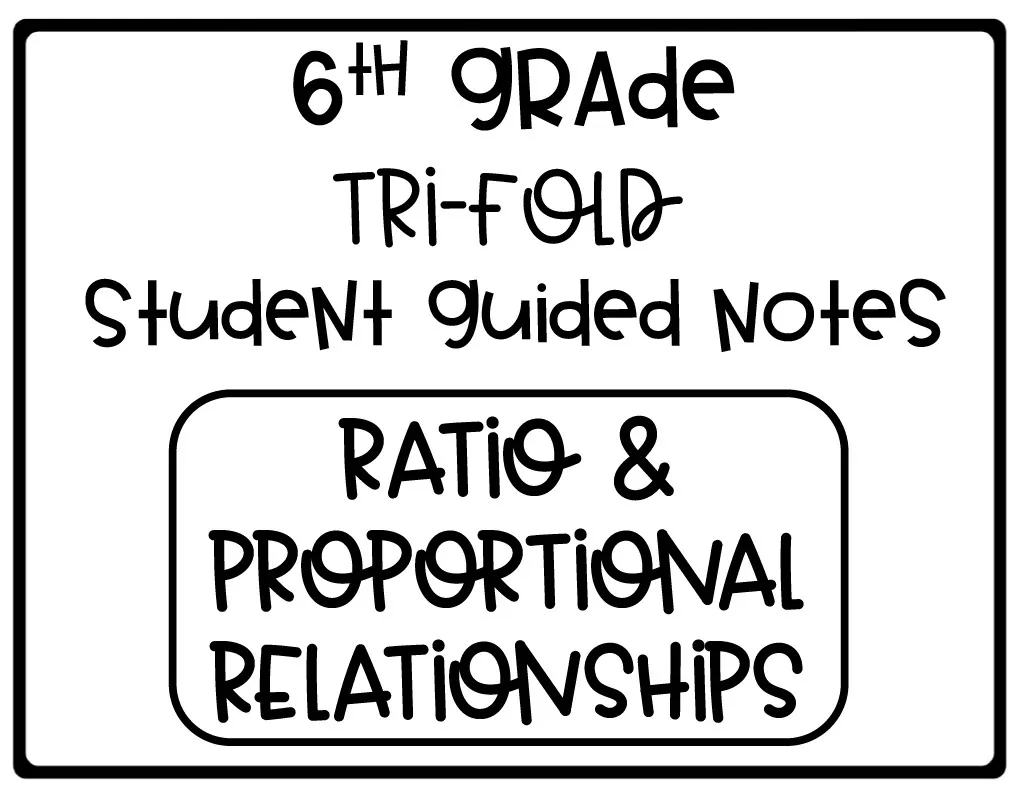
6th Grade Ratios & Proportions – Guided Notes Trifold
- Grades
- Grade 6, Middle School
- File type
- Preparation
- Print ready


- Subject
- Math, Percentages
- Topic
- ratios, percents
- Preparation
- Print ready
About this resource
What's inside this resource
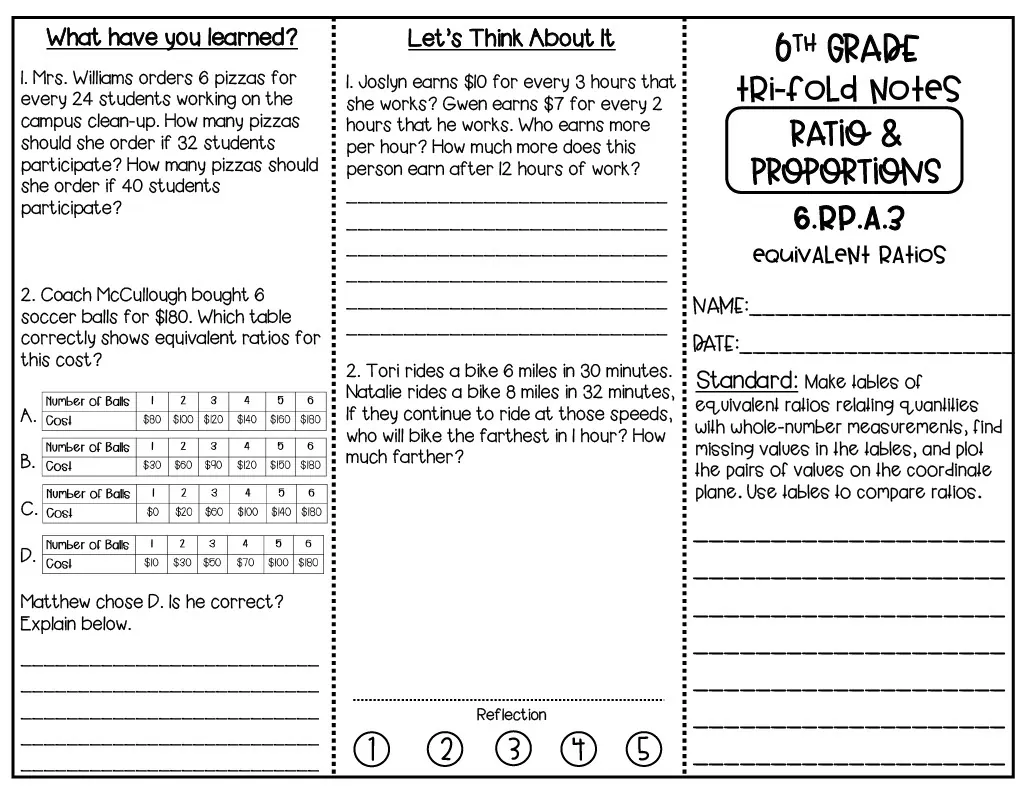
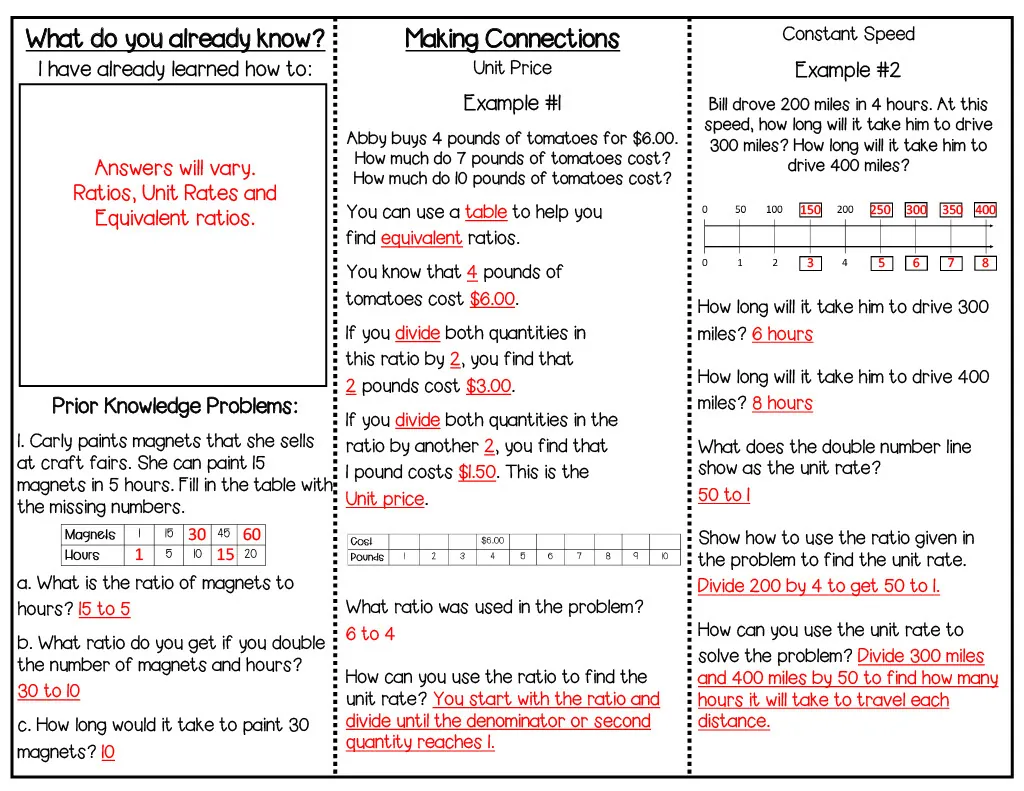
The 6th Grade Ratios + Proportional Relationships: Student Guided Notes is a great packet to hand out to students during your ratio unit.
This is a great way for students to keep track of their learning.
You can use these during whole group instruction or even small group remediation
These notes are detailed with graphic organizers and fill in the blanks.
Answer keys are included.
Related resources
More resources teachers may find useful
24 related resources were found using this product's title, contributor, categories and tags.

In the classroom
Teaching tips & learning objectives

Learning objectives
Students use ratio language to describe the relationship between two quantities (6.RP.A.1).
Students find and use unit rates to solve real-world rate problems (6.RP.A.2).
Students make tables of equivalent ratios and use them to compare ratios (6.RP.A.3a).

Teaching tips
Fold and store the notes in a folder, binder or glued-in composition-book pocket. The trifold itself needs no gluing.
Project each notes page and complete it alongside students during whole-group instruction, or use the pages for small-group review.
When printing, select 'Shrink Oversized Pages' so the trifold layout prints correctly. Use these equivalent ratio notes when students need more worked examples.

Skills covered
Ratio language — students describe relationships between two quantities using ratio vocabulary (6.RP.A.1).
Unit rate reasoning — students calculate and apply unit rates to compare costs, speeds, and quantities (6.RP.A.2).
Equivalent ratio tables — students build and use tables of equivalent ratios to compare and find missing values (6.RP.A.3a).

No reviews yet
Downloaded this resource? Tell other teachers how it went.
Curriculum
Standards, concepts & topics
Standards
 Standards
- 6.RP.A.1 — Understand the concept of a ratio and use ratio language to describe a ratio relationship between two quantities. For example, “The ratio of wings to beaks in the bird house at the zoo was 2:1, because for every 2 wings there was 1 beak.” “For every vote candidate A received, candidate C received nearly three votes.”
- 6.RP.A.2 — Understand the concept of a unit rate a/b associated with a ratio a:b with b ≠ 0, and use rate language in the context of a ratio relationship. For example, “This recipe has a ratio of 3 cups of flour to 4 cups of sugar, so there is 3/4 cup of flour for each cup of sugar.” “We paid $75 for 15 hamburgers, which is a rate of $5 per hamburger.”1
- 6.RP.A.3 — Use ratio and rate reasoning to solve real-world and mathematical problems, e.g., by reasoning about tables of equivalent ratios, tape diagrams, double number line diagrams, or equations. a. Make tables of equivalent ratios relating quantities with whole-number measurements, find missing values in the tables, and plot the pairs of values on the coordinate plane. Use tables to compare ratios. b. Solve unit rate problems including those involving unit pricing and constant speed. For example, if it took 7 hours to mow 4 lawns, then at that rate, how many lawns could be mowed in 35 hours? At what rate were lawns being mowed? c. Find a percent of a quantity as a rate per 100 (e.g., 30% of a quantity means 30/100 times the quantity); solve problems involving finding the whole, given a part and the percent. d. Use ratio reasoning to convert measurement units; manipulate and transform units appropriately when multiplying or dividing quantities.
Core concepts
 Core concepts
ratio language
unit rate
equivalent ratios
measurement conversion
percent of a quantity
 Topics
Explore related searches
More to explore
You may also like