6th Grade Algebra Guided Notes – Algebraic Expressions
- Grades
- Grade 6
- Pages
- 48
- File type
- Answer key
- Included


- Subject
- Math, Algebra
- Topic
- Algebraic Expressions, Guided Notes
- Resource types
- Worksheets
- Answer key
- Included
- Standards
- 6.EE.A.2
Product description
From the author
The 6th Grade Algebraic Expressions Guided Notes is a great packet to hand out to students during your algebra unit.
This is a great way for students to keep track of their learning.
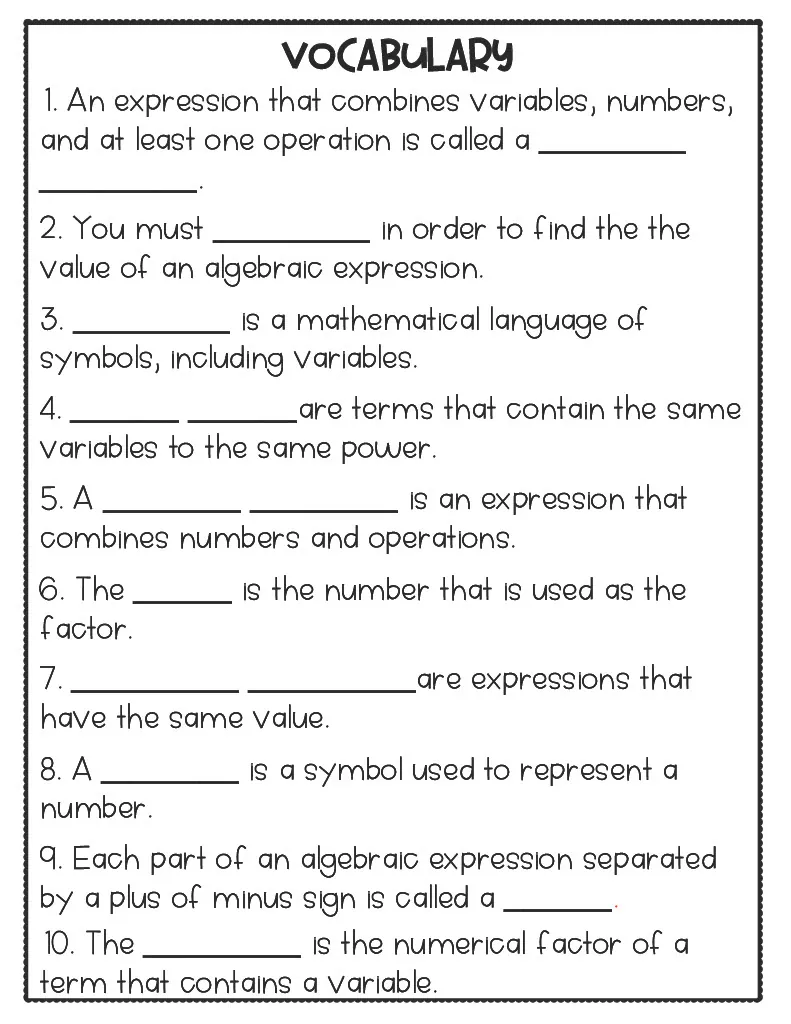
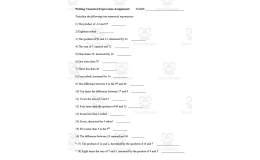
These notes are detailed with graphic organizers and fill in the blanks.
Answer keys are included.
Related resources
More resources teachers may find useful
24 related resources were found using this product's title, contributor, categories and tags.


In the classroom
Teaching tips & learning objectives

Learning objectives
Define and use algebraic-expression vocabulary terms such as coefficient, term, variable, and like terms.
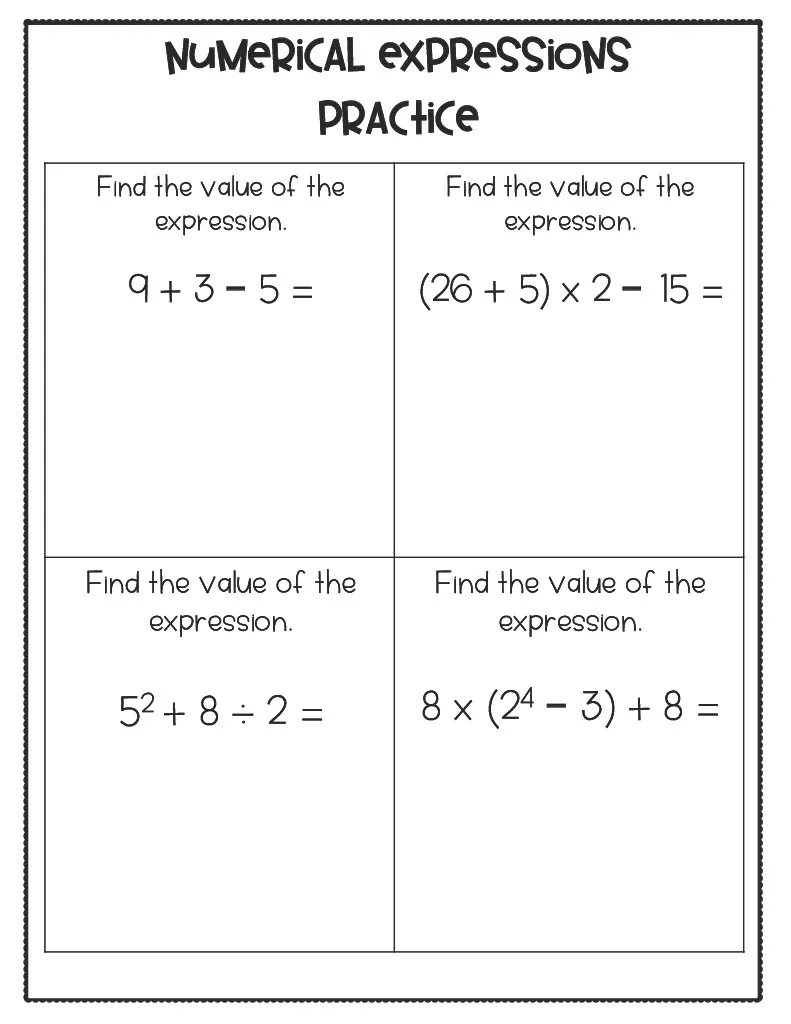
Write and evaluate numerical expressions that include whole-number exponents.
Translate verbal phrases, including two-step phrases, into algebraic expressions.

Teaching tips
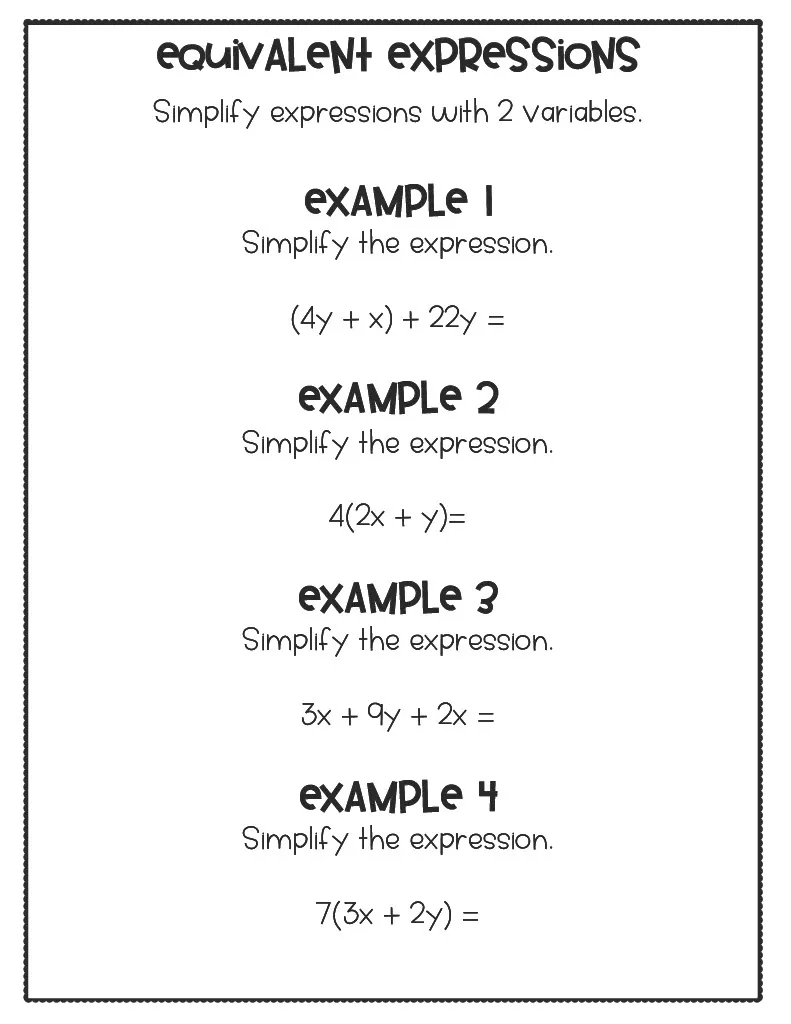
Introduce the vocabulary page first and keep it visible, since later pages (properties, distributive property, equivalent expressions) reuse terms like 'coefficient' and 'like terms' without redefining them.
Use the filled-in second half as a projection key while circulating, rather than handing it out, since every blank-notes page has a matching completed page in the same order.
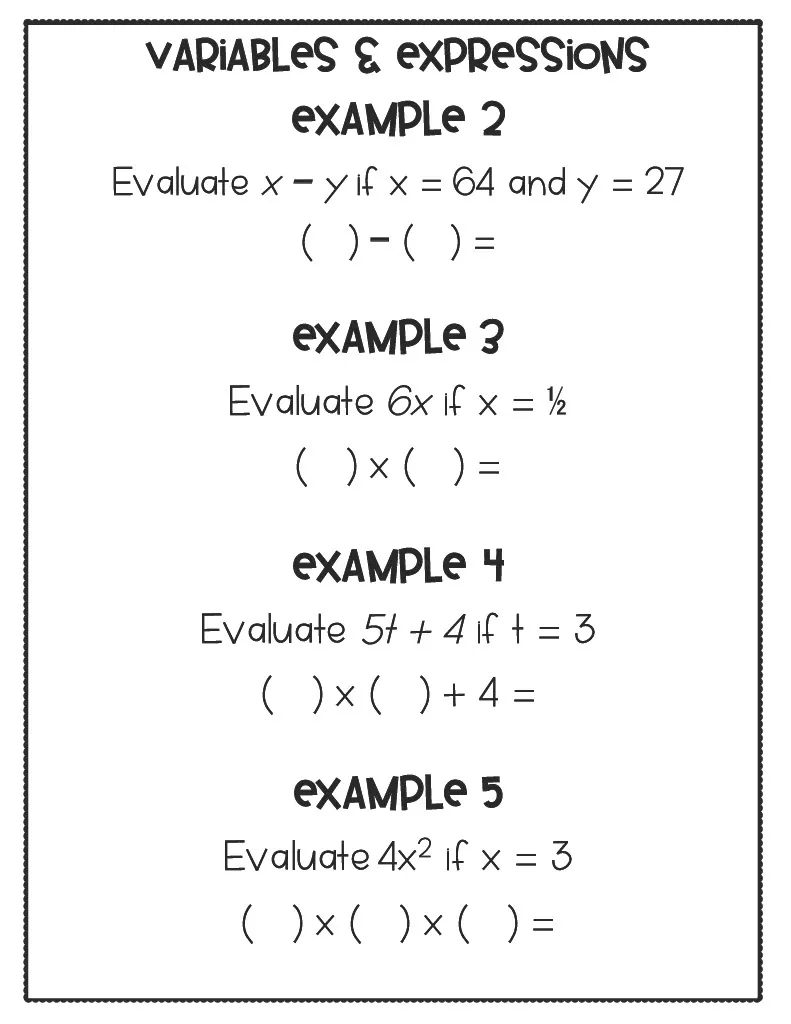
Pair the writing-expressions page with the variables-and-expressions page so students both build an expression from words and then evaluate one, reinforcing the same vocabulary from both directions.

Skills covered
Algebraic vocabulary -- students define and apply ten core terms (variable, coefficient, term, like terms, and more) used throughout every later section.
Order of operations -- students simplify multi-step numerical expressions using the parentheses/exponents/multiply-divide/add-subtract sequence.
Expression translation -- students convert verbal phrases, including two-step phrases, into algebraic expressions and back.

No reviews yet
Downloaded this resource? Tell other teachers how it went.
Curriculum
Standards, concepts & topics
Standards
 Standards
- 6.EE.A.2 — Write, read, and evaluate expressions in which letters stand for numbers. a. Write expressions that record operations with numbers and with letters standing for numbers. For example, express the calculation “Subtract y from 5” as 5 – y. COMMON CORE STATE STANDARDS for MATHEMATICS GRADE 6 | 44 b. Identify parts of an expression using mathematical terms (sum, term, product, factor, quotient, coefficient); view one or more parts of an expression as a single entity. For example, describe the expression 2 (8 + 7) as a product of two factors; view (8 + 7) as both a single entity and a sum of two terms. c. Evaluate expressions at specific values of their variables. Include expressions that arise from formulas used in real-world problems. Perform arithmetic operations, including those involving whole-number exponents, in the conventional order when there are no parentheses to specify a particular order (Order of Operations). For example, use the formulas V = s3 and A = 6 s2 to find the volume and surface area of a cube with sides of length s = 1/2.
Core concepts
 Core concepts
Algebraic expressions
Order of operations
Exponents
Distributive property
Like terms
 Topics
Explore more
Categories this resource belongs to
Explore related searches
More to explore
You may also like