Editable Jeopardy Template
Students (in teams) select a category and point value, then answer the teacher-authored question shown on the corresponding slide; no fixed academic content is provided by the template itself.
Classroom resources
Turn lesson review into team challenges, bingo, escape rooms and vocabulary games. Choose a ready-made subject game or an editable board for your own questions, with reading, math, science and history options.
Browse by lesson focus
Choose the topic or kind of practice you need.
Students (in teams) select a category and point value, then answer the teacher-authored question shown on the corresponding slide; no fixed academic content is provided by the template itself.
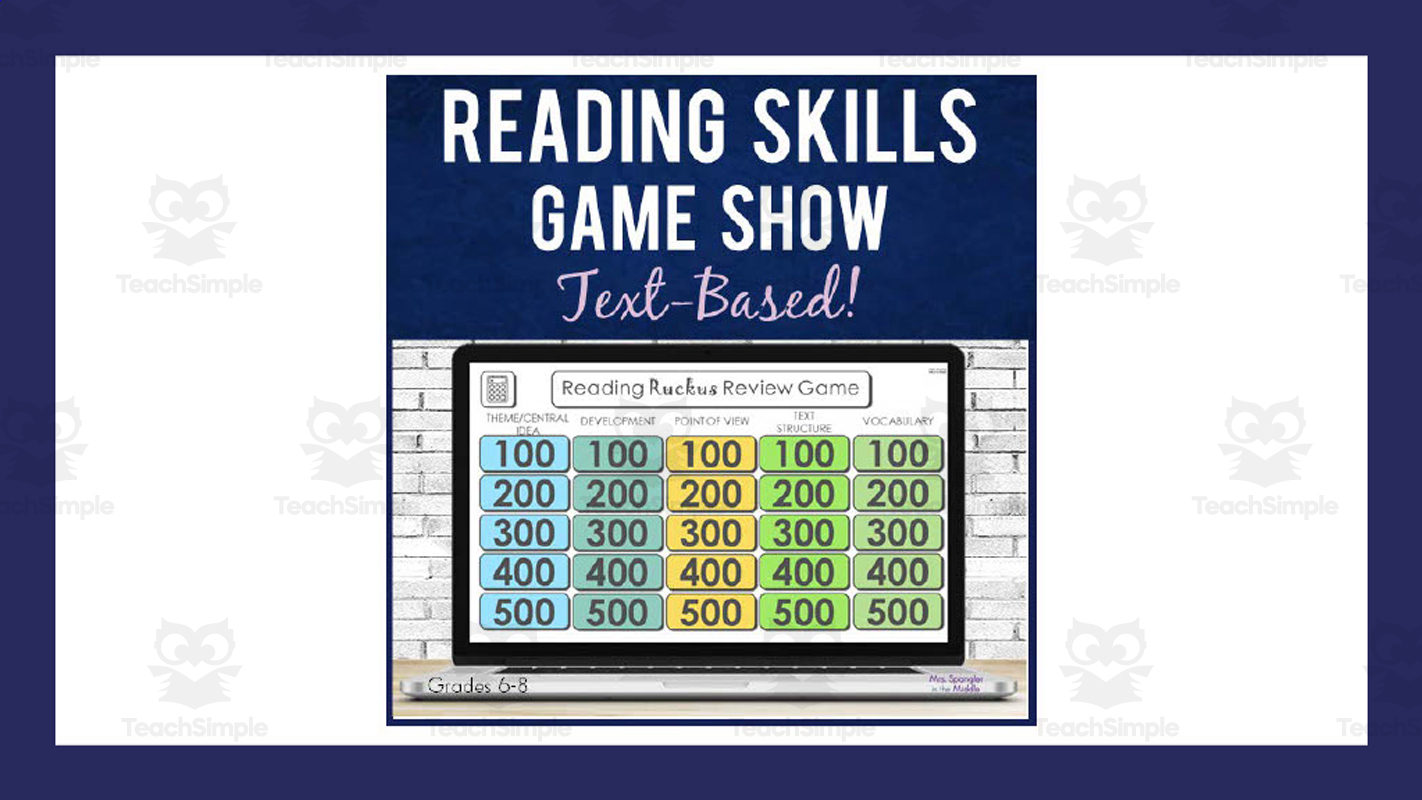
A Jeopardy-style review game (digital PowerPoint/Google Slides board plus a companion nonfiction reading passage) for reviewing reading skills: theme/central idea, development, point of view, text structure, and vocabulary.
Students fill a 4x4 bingo board with given answers in random order, solve math problems shown on slides while showing their work on paper, and mark/highlight matching answers on their board to try for a bingo.
Students select a category and point value, answer a question about animal classification/body systems/plants, then check the answer slide.
Students work in teams to answer displayed review questions; correct answers earn game-piece progress (e.g., drawing bear parts, placing marks) depending on which game mode the teacher selects.
Students split into two teams, answer teacher-supplied review questions, and place an X or O on a 9-square game board for correct answers.
This engaging and interactive review game is the perfect way to teach kids different self regulation activities and calming strategies, while reviewing their knowledge of different coping skills! This no-prep coping skill lesson is the perfect way to teach and review different calming strategies that kids can use when…
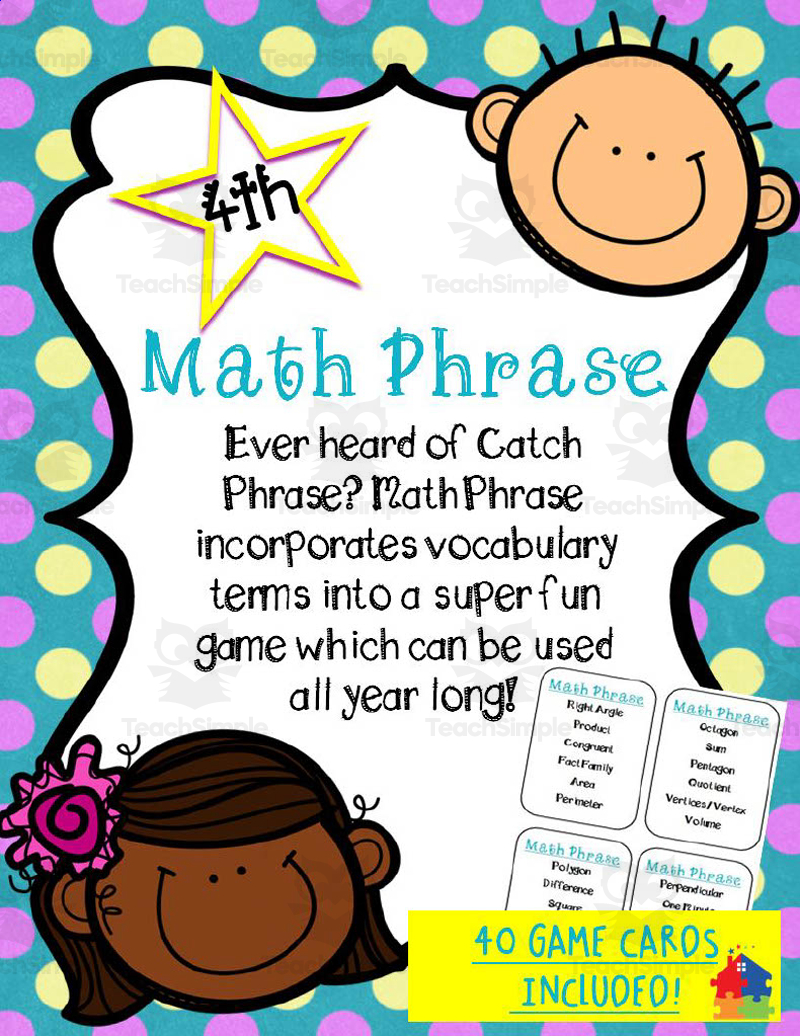
Students split into at least 2 teams; one player draws a card and describes math vocabulary words without saying the word itself, while teammates guess within a one-minute time limit; scores are tallied by team.
Play a 5-part self-checking digital game: review citing-evidence steps, use an embedded text to answer questions, and build a paragraph using citation skills.
Participate in physical movement games (e.g. Word Chase, Eraser Tag, Math Whizzer, Question Quest, Poetry in Motion, Definition Search, Making Time, Musical Circles) that combine movement with review of curriculum content.
Write a vocabulary word in each BINGO card square, listen to the teacher read a word's definition, determine which word was defined, and mark the matching square; call 'Bingo' after five in a row.
Work through a sequence of puzzles (a dominoes exercise, a crossword, a word search, and a worksheet) to derive four numbers, using a code-breaker sheet to combine them into the final combination-lock code.
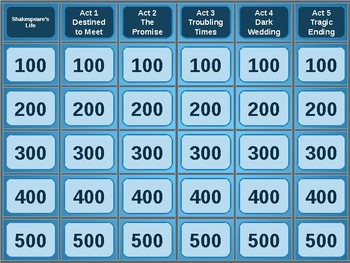
Play a Jeopardy-format review game (teams or individually), selecting categories and point values to answer questions about Shakespeare's life and each Act of the play.
A fully editable, blank Jeopardy-style review game template for teachers to customize with their own questions and answers for any subject.
As part of a team, select a dollar-value question from the game board and state what time is shown (e.g. '3 O'clock', '10 O'clock', '1 O'clock', '8 O'clock'), competing for points against other teams.
Select a clue from a category, read the vocabulary word, match it to its definition card, then check answers, tally correct matches, and record five definitions on a recording sheet.
A fully editable, blank Jeopardy-style game template teachers can populate with their own review questions and answers for any subject.
Study character relationships and genealogy, complete multiple-intelligences project options, engage with a Jeopardy-style review game, and map characters/plot on a love-and-hate schematic.
A Jeopardy-style digital review game (Google Slides/PowerPoint) for reviewing essay-writing skills and vocabulary, usable in whole group, small group, in-person, or distance learning.
Play a class game show: select point-value questions on a grid, answer place-value questions, and track scores on a scoreboard.
Students visit a Google Site, read text and a passage from the story, answer quiz and analysis questions, solve a jigsaw puzzle and a sliding letter-unscramble puzzle, watch a video about Poe and answer questions, and record lock codes on a worksheet to progress through 5 locks.
Solve math problems at each station, use the answers to determine code digits, record digits on a code sheet, and combine all digits to unlock the final code/complete the mission.
Each day, students solve 5 math problems on one page, take the first digit of each answer, and combine the five digits into a numeric code that completes that day's mission.
Answer 44 task-card questions about setting, characters, plot, and theme (using higher-order verbs such as infer, analyze, justify, evaluate); play a Jeopardy-style points game individually or in teams using the PowerPoint/Google Slides game board, or play the ZAP/SCOOT/SCATTER task-card variants.