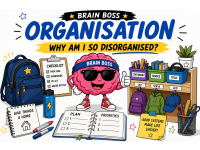
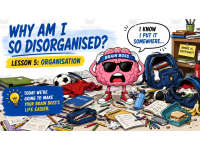
Brain Boss – Why Am I So Disorganised?

Life Skills, Special Resources, Social Emotional Learning (SEL), Social Skills, Special Education Needs (SEN)
Games, Activities, Lesson Plans, Teacher Tools, Presentations, Rubrics, Worksheets & Printables, Workbooks, Worksheets, Writing Prompts


About This Product
Brain Boss – Why Am I So Disorganised? | Executive Function, Organisation Skills & Life Skills Lesson
Introduction
Help students understand why they lose things, forget equipment, struggle with routines and sometimes find everyday organisation difficult.
Brain Boss – Why Am I So Disorganised? is an engaging, interactive lesson from MrSportandPE that helps students develop essential organisation and executive functioning skills.
Rather than simply telling students to be more organised, this resource helps them understand why organisation can be challenging and how practical systems can make everyday life easier.
Through relatable scenarios, visual activities, discussion, problem-solving and personal reflection, students explore the difference between being tidy and being organised.
The central message is simple:
Don't rely on your memory. Build a system.
Designed for upper elementary, primary and middle school students, this lesson is particularly useful for learners who experience difficulties with organisation, working memory, routines or independent learning.
Learning Objectives
By the end of the lesson, students will be able to:
Explain what organisation means and why it matters.
Understand how working memory affects everyday organisation.
Recognise the difference between tidying and organising.
Identify common situations where they lose or forget belongings.
Explain how checklists, routines and labels can support independence.
Develop practical strategies for managing school equipment and personal belongings.
Create an organisation system to solve a real-life problem.
Reflect on their organisational strengths and areas for improvement.
Lesson Overview and Activities
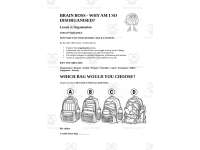
1. Which Bag Would You Choose?
Students compare different school bags and consider which would make finding equipment easier.
This introductory activity encourages discussion about organisation, time, stress and everyday challenges.
2. What Is Organisation?
Students explore the difference between a perfectly tidy workspace and a practical organisation system.
They discover that being organised is not necessarily about making everything look perfect.
Organisation is about making things work.
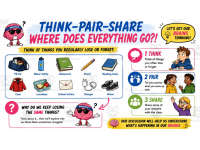
3. Where Does Everything Go?
Students identify items they regularly lose or forget, such as homework, books, school equipment and personal belongings.
They explore why the same items are often misplaced repeatedly.
4. Meet Your Brain Boss – Working Memory
Students learn why relying entirely on memory can be difficult.
They explore how external systems can reduce the amount of information they need to remember.
5. System vs Memory
Using relatable examples, students compare simply trying to remember something with creating a practical system.
They develop solutions for common problems such as forgetting PE equipment or losing homework.
6. Lost Property Detective
Students investigate items from a fictional lost-property collection.
They identify how the objects might have been lost and suggest organisation systems that could prevent similar problems.
7. School Bag Rescue
Students help organise a fictional student's school bag.
They explore how folders, compartments, labels, checklists and regular clear-outs can prevent future problems.
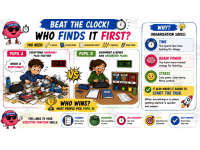
8. Beat the Clock
Students compare the experiences of two learners: one with equipment scattered randomly and another with an effective organisation system.
They consider how organisation can save time, reduce stress and make starting tasks easier.
9. Build a Morning Routine
Students organise everyday morning activities into a sequence that works for them.
They discover that effective routines do not have to be identical for everyone.
10. Chaos at Work
Students consider how professionals such as pilots, firefighters, teachers and paramedics rely on organisation systems.
This activity demonstrates why even experienced adults use checklists, routines and preparation.
11. The Brain Boss Organisation Toolkit
Students explore five practical strategies:
Give Things a Home: Keep important belongings in consistent locations.
Use Checklists: Reduce the need to remember everything.
Build Routines: Complete regular tasks in a predictable sequence.
Use Labels and Categories: Make items easier to locate.
Prepare Early: Get organised before something is needed.
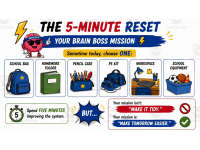
12. Fix the Problem – Build Your Own System
Students identify a genuine organisation difficulty in their own lives and design a practical solution.
The focus is on creating an achievable system rather than simply promising to try harder.
What's Included?
1. Interactive PowerPoint Presentation
A 21-slide PowerPoint presentation (PPTX) designed to guide the lesson through visual examples, discussion prompts, practical challenges and reflection activities.
The presentation encourages active participation and meaningful conversations about organisation.
2. Student Workbook
An accompanying editable Word workbook (DOCX) provides structured activities that follow the lesson.
Students can:
Record ideas and opinions.
Explore everyday organisation problems.
Compare different strategies.
Complete practical problem-solving activities.
Develop routines and checklists.
Design a personalised organisation system.
Reflect on their learning.
The workbook can be printed or adapted to suit individual learners.
3. Teacher Guidance and Assessment
An editable teacher guidance document (DOCX) provides support for delivering the lesson and assessing student progress.
It includes:
Programme overview.
Learning objectives.
Teaching approaches.
Discussion guidance.
Adaptations for different learners.
Extension activities.
Student reflection opportunities.
Brain Boss assessment and progress rubric.
Recommended Grades and Ages
Suitable for:
Upper elementary school.
Primary school.
Middle school.
Approximately ages 8–13, depending on student needs.
Executive functioning intervention groups.
Learning support and additional needs provision.
Social-emotional learning lessons.
Personal development and life skills programmes.
Small-group or individual support.
The resource can also be adapted for older students who need additional support with organisation and independence.
Supporting Different Learners
The lesson is designed to be accessible and discussion-based.
It may be particularly useful for students with executive functioning difficulties, ADHD-related organisational challenges or additional learning needs.
Teachers can adapt activities by:
Completing examples together.
Using paired or small-group discussions.
Allowing verbal rather than written responses.
Providing extra processing time.
Using drawing or visual explanations.
Supporting students in creating simple, achievable routines.
Breaking larger tasks into smaller steps.
The focus is on developing understanding and practical strategies, not judging students for their organisational difficulties.
Implementation and Teaching Format
This resource can be delivered as a whole-class lesson, small-group intervention or individual support session.
The PowerPoint provides the main teaching sequence, while the student workbook supports participation and reflection.
Teachers can select activities according to the available lesson time and students' needs.
For greater impact, students can revisit their organisation system after several days or weeks to evaluate what has worked and what needs adjusting.
Assessment Opportunities
Assessment focuses on students' understanding, reflection and ability to apply practical strategies.
Teachers can assess whether students can:
Identify an organisation difficulty.
Explain why a particular system might help.
Select an appropriate organisation strategy.
Develop a realistic personal plan.
Reflect on their progress.
The included Brain Boss assessment rubric supports ongoing monitoring of student development.
Curriculum and Educational Standards
This resource supports learning outcomes commonly associated with:
Executive functioning skills.
Social-emotional learning.
Personal development.
Independent learning.
Organisation and time management.
Self-awareness and self-management.
Problem-solving.
Goal setting.
Life skills and learning readiness.
It can be incorporated into different national, state and school curricula or used as part of targeted student support.
File Types and Contents
The downloadable ZIP package contains 3 editable teaching files:
Brain Boss – Why Am I So Disorganised? – 21-slide PowerPoint presentation (PPTX).
Brain Boss Student Notes – Accompanying student workbook (DOCX).
Brain Boss Teacher Guidance and Assessment – Teaching guidance and progress rubric (DOCX).
The Word documents can be edited to meet individual student needs and teaching requirements.
Why Choose This Resource?
Many students are told to be more organised without being shown how to develop effective organisational habits.
This lesson takes a different approach.
By combining practical examples, relatable challenges and achievable strategies, students learn that organisation is a skill that can be developed.
Instead of relying on memory or trying harder, they discover how simple systems can support independence, reduce stress and make everyday school life more manageable.
Understand your Brain Boss. Build better systems. Become more independent.
Created by MrSportandPE – practical teaching resources supporting Physical Education, personal development, social-emotional learning and executive functioning skills.
Resource Tags
0 Reviews
Check out these other great products