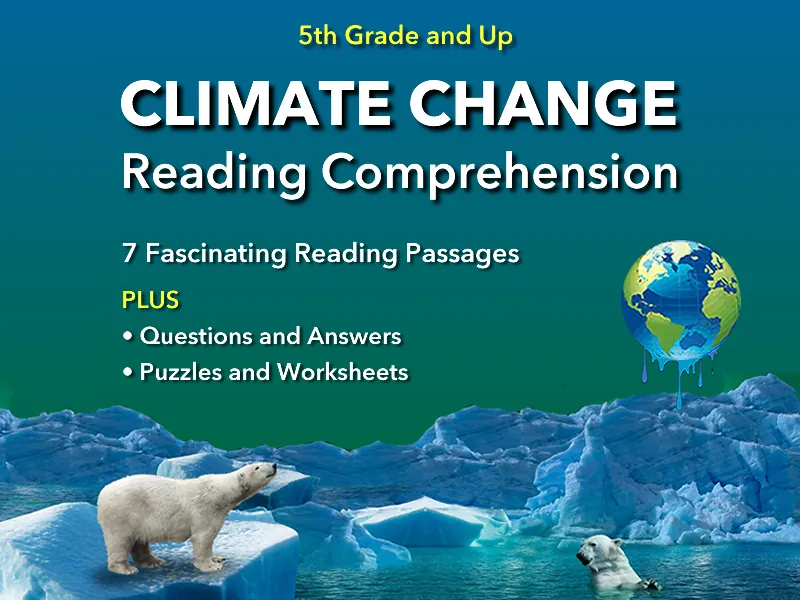
Climate Change Reading Comprehension for 5th Grade and Higher
- Grades
- Grades 5–7
- Pages
- 36
- File type
- Answer key
- Included


- Subject
- Science, Reading Comprehension
- Topic
- Climate change, Global warming
- Resource types
- Worksheets
- Answer key
- Included
- Standards
- RI.5.1 CCSS.RI.5.4
Product description
From the author
Do your students have a passion for protecting our planet?
Empower your students to understand climate change and how it impacts our world. Through these engaging Reading Comprehension passages, quizzes and worksheets, they'll explore a variety of climate change topics, while actively building literacy and comprehension skills.
Climate Change Reading Comprehension includes 7 reading passages, questions and answers, and 6 puzzle worksheets to support vocabulary development. The engaging content integrates well with the science curriculum while at the same time exercising and strengthening essential literacy and comprehension skills so critical for academic success.
Features
• 7 original text passages on key climate change topics
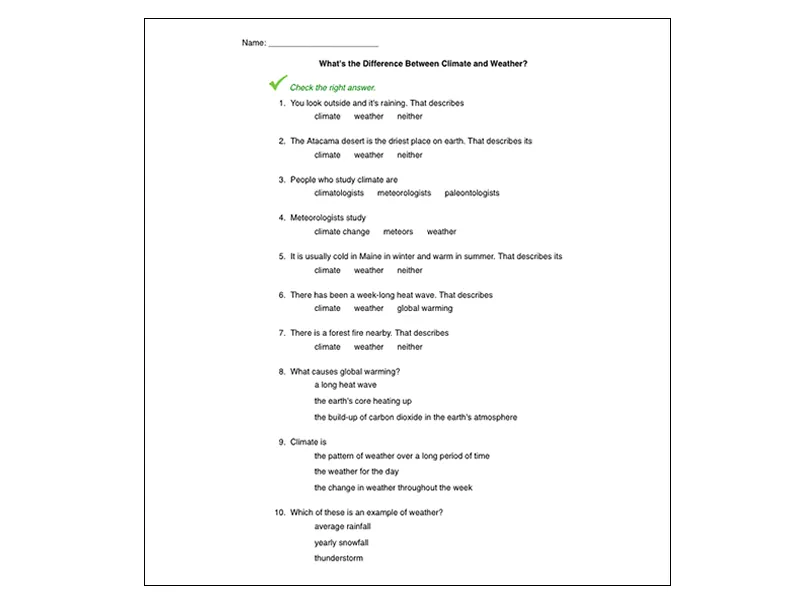
• Multiple choice questions tailored to each passage to reinforce comprehension and close reading skills
• Answer keys for easy assessment
• 6 puzzle worksheets to boost climate change vocabulary
• No-prep, 36 pages in easily printable PDF format
Although targeted to 5th - 7th graders, this resource can also benefit older students. The printable PDF format makes it easy to incorporate these passages and questions into classroom lesson plans, individualized reading programs or homework assignments.
Climate Change Reading Comprehension is a valuable tool for promoting active reading and critical thinking - ideal for developing strong reading comprehension skills and preparing students for standardized tests. In addition, this engaging collection of reading passages and worksheets will empower students to understand the complex issues surrounding climate change and turn their passion into purpose as they build the skills to drive change.
The Stories
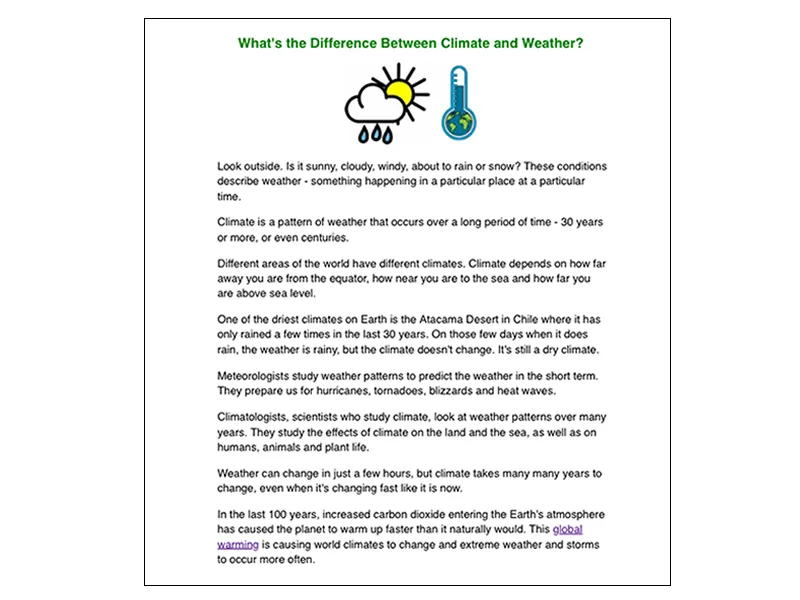
Climate or Weather?
Global Warming
How Is Climate Change Measured?
Animals and Climate Change
Oceans and Climate Change
Green Cities
You Can Help
Plus
• 3 Crossword Worksheets
• 3 Word Search Worksheets
Reading and vocabulary tasks support selected informational-reading skills. Match the passages and questions to the standards and curriculum used in your class.
Related resources
More resources teachers may find useful
24 related resources were found using this product's title, contributor, categories and tags.


In the classroom
Teaching tips & learning objectives

Learning objectives
Identify literal facts stated in an informational science passage, such as the primary greenhouse gas or the cause of rising sea levels.
Match climate-science vocabulary (e.g., 'trap,' 'greenhouse,' 'hydroelectric') to its definition through crossword clues.
Locate and identify domain-specific climate vocabulary within a word search grid.

Teaching tips
Assign one passage-and-quiz pair per day across a two-week unit, since all seven passages share the same one-page-reading-plus-quiz format.
Use the crosswords after the reading passages, since several clues (e.g., defining 'trap') reuse vocabulary introduced in the readings.
Save the three word searches for early-finisher time, since they reinforce the same vocabulary set without requiring a fresh reading passage.

Skills covered
Literal reading comprehension — students answer true/false and multiple-choice questions checking specific facts from each passage, such as the cause of melting Arctic ice.
Domain vocabulary — students match climate-science terms to definitions via crossword clues and locate them in word search grids.
Informational text structure — seven passages each introduce a single climate sub-topic (measurement, animals, oceans, cities, solutions) in a consistent one-page format.
Good to know
Questions teachers ask about this resource
What seven climate topics do the reading passages cover?
Climate or Weather?, Global Warming, How Is Climate Change Measured?, Animals and Climate Change, Oceans and Climate Change, Green Cities, and You Can Help — each a standalone one-page passage with its own quiz.
Do the crosswords and word searches use the same vocabulary as the reading passages?
Largely yes — the word search word banks include terms drawn from the readings, such as 'greenhouse,' 'glacier,' and 'hydroelectric,' giving students a second pass at the same vocabulary in a puzzle format.

No reviews yet
Downloaded this resource? Tell other teachers how it went.
Curriculum
Standards, concepts & topics
Standards
 Standards
- RI.5.1
- CCSS.RI.5.4 — Determine the meaning of general academic and domain-specific words and phrases in a text relevant to a grade 5 topic or subject area.
Core concepts
 Core concepts
Climate vs. weather
Greenhouse gases
Sea level rise
Climate vocabulary
 Topics
Explore more
Categories this resource belongs to
Explore related searches
More to explore
You may also like