24 related resources

Crash Course Psychology #8: Consciousness
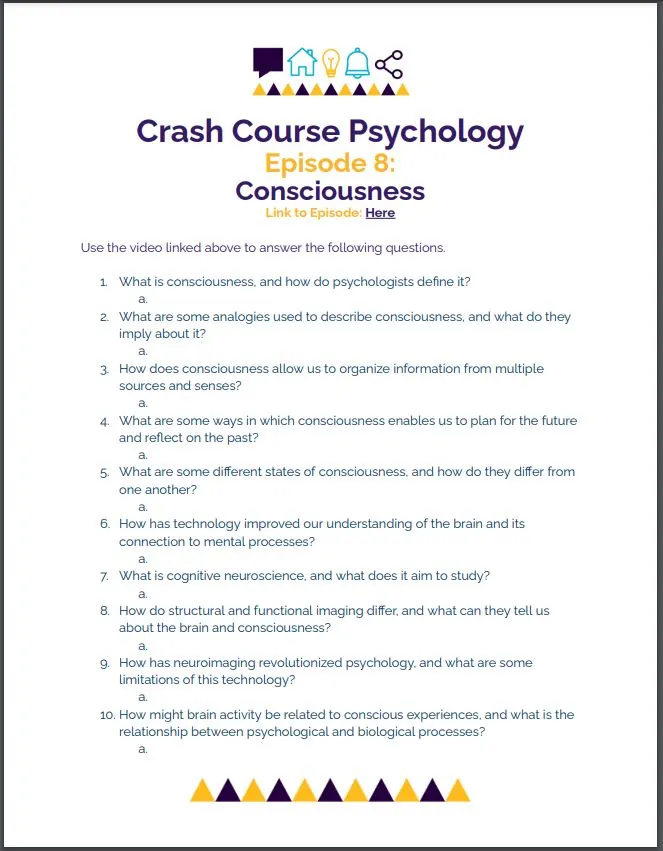
Fifteen open-ended questions tied to Crash Course Psychology's Episode 8 on Consciousness cover its definition, brain-imaging research, the dual-process model, and change blindness, with a matching teacher answer key.
Grades
Grades 9–12, High School
Pages
2
File type
Zip

Updated Feb 21, 2024

Subject
Social Studies, Psychology
Topic
crash course, psychology
Resource types
Worksheets & Printables, Worksheets

About this resource

What's inside this resource

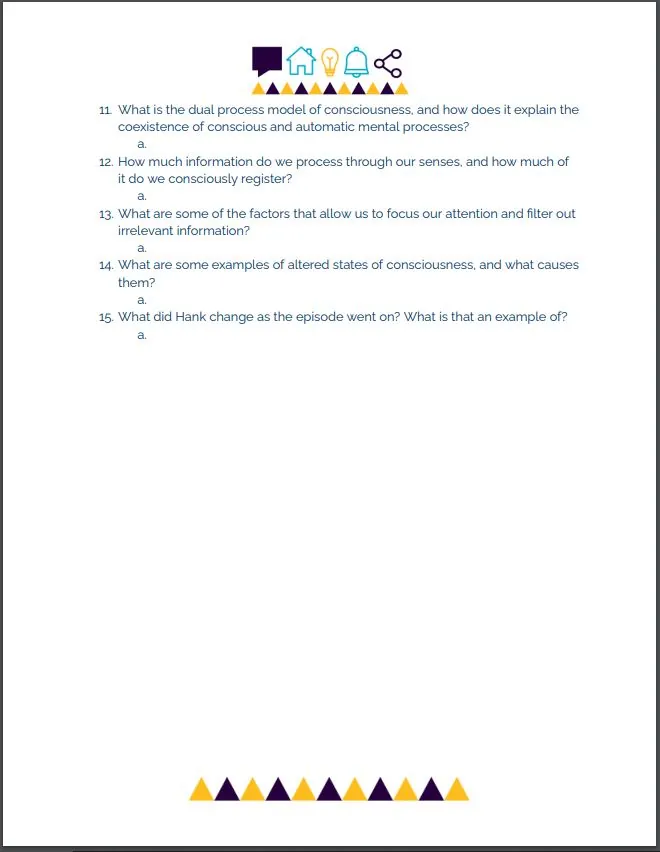
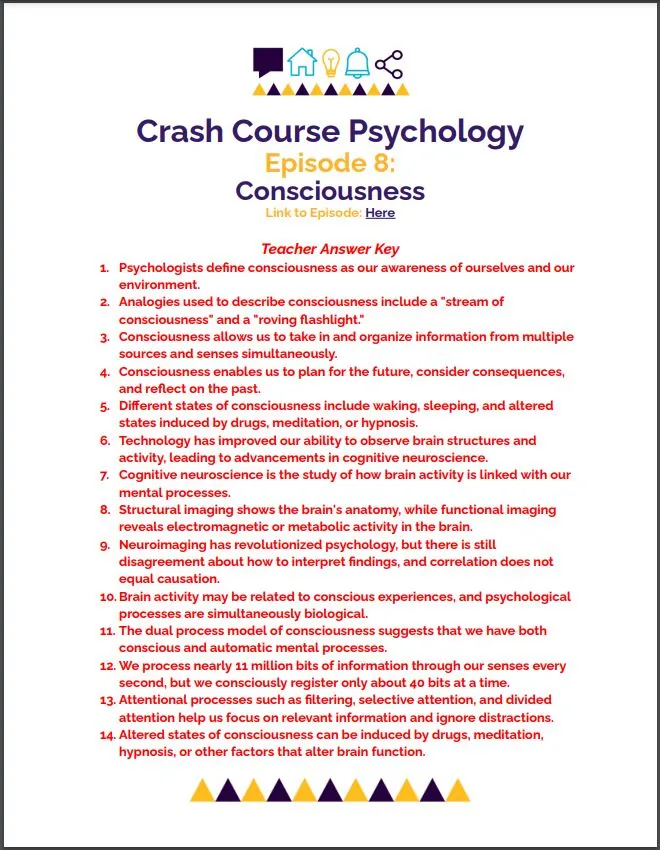
Fifteen open-ended questions guide students through Crash Course Psychology's Episode 8, Consciousness, covering how psychologists define consciousness, the roving-flashlight and stream-of-consciousness analogies, cognitive neuroscience and brain-imaging techniques, the dual-process model, and how much sensory information the brain processes versus what reaches conscious awareness. A closing question asks students to name what the host changed throughout the video and identify it as an example of change blindness. Each question is followed by a lettered answer line for students to write a short response while or after watching. A separate teacher answer key gives a full written answer for all 15 questions, matching each one to the worksheet by number.

Product description

From the author

Crash Course Psychology Resource for Consciousness\nThis educational resource helps students understand key concepts related to consciousness from Crash Course Psychology. Designed as a supplement to episode 8 on consciousness, it includes a digital worksheet and 15 critical thinking questions to deepen student comprehension. Useful for whole class instruction or independent practice, it covers states of consciousness, cognitive neuroscience, dual processing, selective attention, inattentional blindness, and how magicians utilize psychological principles. The questions and detailed answer key promote discussion and allow teachers to check for understanding. This versatile resource works well for in-class activities, homework, substitute plans, and distance learning. Students will enjoy the video component while gaining a well-rounded grasp of consciousness through the thoughtfully designed materials.

In the classroom

Teaching tips & learning objectives

Learning objectives

  • Define consciousness and explain the stream-of-consciousness and roving-flashlight analogies used to describe it

  • Distinguish between structural and functional brain imaging and describe what each reveals

  • Explain the dual-process model of consciousness (conscious versus automatic mental processes)

  • Identify change blindness using a specific example from the video

Teaching tips

  • Play the linked video and have students answer the 15 questions as they watch, since each question tracks the episode in order

  • Use the teacher answer key to lead a discussion or quickly check written responses after viewing

  • Assign whichever of the two provided file formats matches how students will complete the questions, typing or printing

Skills covered

  • Video-based note-taking — students answer 15 sequential open-response questions while watching an educational psychology video.

  • Concept explanation — students explain psychological concepts such as the dual-process model and cognitive neuroscience in their own words.

  • Applying a concept to an observation — students identify change blindness from a specific event in the video.

Good to know

Questions teachers ask about this resource

Do the questions follow the order of the video?

Yes — each of the 15 questions tracks a concept in the order it's presented in the episode, ending with the change-blindness example near the video's close.

No reviews yet

Downloaded this resource? Tell other teachers how it went.

Resource details

Concepts & topics

Core concepts

  • consciousness

  • cognitive neuroscience

  • dual-process model

  • selective attention

  • change blindness

Explore more

Categories this resource belongs to

Explore related searches

More to explore

You may also like