



Drama and Theater Terms word search, scramble and crossword puzzle
- Grades
- Grades 5–8
- Pages
- 6
- File type
- Answer key
- Included


- Subject
- ELA, Drama, Vocabulary
- Topic
- Drama terms, Theater vocabulary
- Resource types
- Crosswords Puzzles, Word Searches
- Answer key
- Included
- Standards
- L.6.6
Product description
From the author
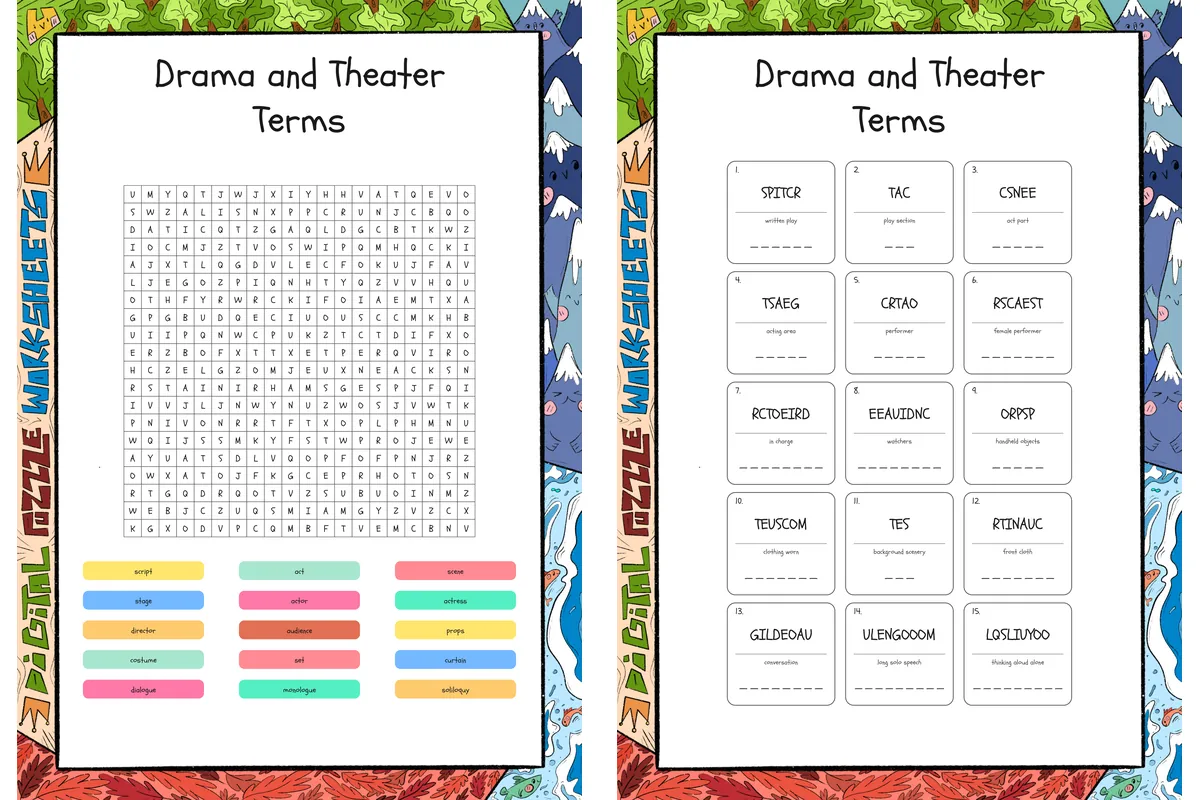
Review fifteen drama and theater terms with a word search, word scramble and crossword. Vocabulary includes script, act, scene, stage, actor, actress, director, audience, props, costume, set, curtain, dialogue, monologue and soliloquy.
Each puzzle comes in its own two-page PDF with a completed key, for six pages total. Short clues support the crossword and scramble. Use a puzzle for individual review, partner work or an early-finisher activity.
Related resources
More resources teachers may find useful
24 related resources were found using this product's title, contributor, categories and tags.


In the classroom
Teaching tips & learning objectives

Learning objectives
Attach a stage term to a short functional definition, from "handheld objects" for props to "background scenery" for set
Tell apart the three kinds of stage speech the list carries — dialogue as conversation, monologue as a long solo speech, soliloquy as thinking aloud alone
Spell each term correctly from scrambled letters using the supplied letters and clue

Teaching tips
Use the same fifteen terms across separate lessons, with the crossword and scramble for meaning work and the word search for recognition.
Compare actor and actress using their adjacent scramble clues, and discuss how those terms are used.
Keep the three completed keys for checking; the scramble’s blank lines do not indicate letter counts.

Skills covered
Stage vocabulary recall — students link fifteen theatre terms to compressed definitions such as "written play", "acting area" and "in charge", used in the crossword and scramble.
Distinguishing related terms — dialogue, monologue and soliloquy are separated only by their clues, as are act and scene, and actor and actress.
Locating words in a letter grid — the word search sets all fifteen terms into a twenty-by-twenty grid, using the printed word bank.
Good to know
Questions teachers ask about this resource
Which vocabulary is practiced?
The fifteen terms include script, act, scene, stage, actor, actress, director, audience, props, costume, set, curtain, dialogue, monologue, and soliloquy.

No reviews yet
Downloaded this resource? Tell other teachers how it went.
Curriculum
Standards, concepts & topics
Standards
 Standards
- L.6.6
Core concepts
 Core concepts
Drama vocabulary
Theatre terms
Word puzzles
Spelling
 Topics
Explore more
Categories this resource belongs to
Explore related searches
More to explore
You may also like


