Earthquakes word search, scramble and crossword
- Grades
- Grades 4–6
- Pages
- 6
- File type
- Answer key
- Included


- Subject
- Science, Earth Sciences, Vocabulary
- Topic
- Earthquakes, Focus and epicenter
- Resource types
- Crosswords Puzzles, Word Searches
- Answer key
- Included
- Standards
- L.5.6
Product description
From the author
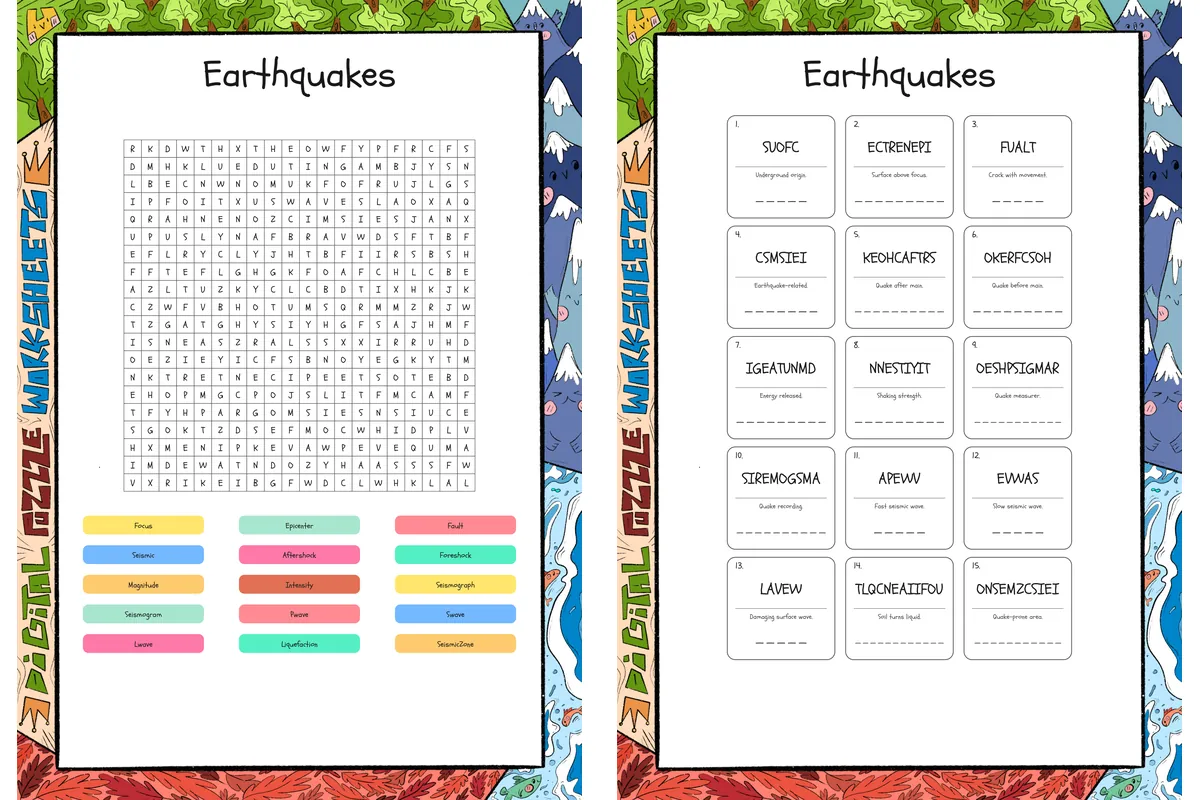
Review fifteen earthquake terms with a word search, word scramble and crossword. Vocabulary includes focus, epicenter, fault, aftershock, magnitude, intensity and liquefaction.
Three two-page PDFs each include a puzzle and completed key, for six pages total. The crossword and scramble provide short clues; the word search uses a word bank. Use the set for vocabulary review after introducing earthquake concepts.
Related resources
More resources teachers may find useful
24 related resources were found using this product's title, contributor, categories and tags.


In the classroom
Teaching tips & learning objectives

Learning objectives
Match a one-line definition to the earthquake term it names, across all fifteen terms
Separate terms that differ by a single element — foreshock from aftershock, seismograph from seismogram, and the P, S and L waves from one another
Find domain vocabulary inside a letter grid where the words are set both forwards and backwards

Teaching tips
Use the same fifteen terms across separate lessons, with the crossword and scramble for meanings and the search for word recognition.
Preview foreshock and aftershock, and seismograph and seismogram, if they are unfamiliar.
The scramble’s lines do not indicate letter counts. Compound terms appear without spaces in the puzzle grids.

Skills covered
Earthquake vocabulary recall — students connect fifteen terms to compressed definitions such as "Underground origin", "Surface above focus" and "Soil turns liquid", used in the crossword and scramble.
Precise spelling — the scramble supplies jumbled letters, a short clue and a blank line, so Seismograph and Seismogram have to be separated letter by letter.
Visual word recognition — the twenty-by-twenty word search sets the terms forwards and backwards, with a printed word bank to guide the search.

No reviews yet
Downloaded this resource? Tell other teachers how it went.
Curriculum
Standards, concepts & topics
Standards
 Standards
- L.5.6
Core concepts
 Core concepts
Earthquake vocabulary
Earth science
Word puzzles
Spelling
 Topics
Explore more
Categories this resource belongs to
Explore related searches
More to explore
You may also like