FREE: Nutcracker and Mouse King Novel Study Guide - Sample


- Grades
- Grades 4–6, Middle School, Homeschool Resources, Elementary
- Pages
- 16
- File type
- Answer key
- Included


- Subject
- ELA, Reading, Reading Comprehension, Literature, Language Development, Vocabulary, Christmas, Holidays, Holiday & Seasonal, Children’s Literature
- Topic
- resource, activities
- Resource types
- Worksheets & Printables, Novel Studies, Writing Prompts, Crosswords Puzzles, Worksheets, Word Searches, Graphic Organizers, Teacher Tools
- Answer key
- Included
- Standards
- CCSS.RL.4.1 CCSS.RL.4.2 +11
About this resource
What's inside this resource
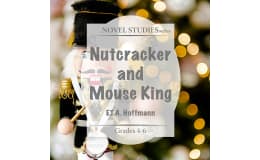
This is a FREE sample of our Nutcracker and Mouse King Novel Study Guide. In this sample, you can enjoy a selection of comprehension content, including hangman puzzle using vocabulary words, true or false, multiple choice, long answer questions, graphic organizer, answer keys, and the complete Nutcracker and Mouse King.
The full resource includes additional comprehension questions with vocabulary and definitions, word puzzles, writing and creativity prompts and graphic organizers.
The following description is for the full resource
About this Resource:
This resource is a study of the fairy tale Nutcracker and Mouse King, written by E.T.A. Hoffmann. The Novel Study Guide includes vocabulary with definitions and comprehension questions in the form of true or false, multiple choice and long answer. Students are meant to read the entire story, then answer the provided questions. Teachers can choose to hand the questions out all at once, or group them into sections. The resource is grouped into natural sections, such as vocabulary, comprehension, critical thinking, writing prompts, creativity activities, and graphic organizers.
About the Worksheets:
A series of comprehension-based worksheets make up this resource, along with Answer Keys.
Vocabulary: 60 words from the story are listed with their meanings in either the order they appear chronologically in the story, or in alphabetical order. The words were chosen by how difficult they were to understand based on context clues. Each word is then used in 1 of 5 vocabulary puzzle worksheets:
· Word Decoder: Use the legend to decode the word puzzle.
· Word Search: Find the vocabulary words hidden in the puzzle.
· Word Scramble: Unscramble the words to make the vocabulary words.
· Crossword: Solve each clue with the vocabulary word that matches. Write the vocabulary word in the matching spot in the crossword puzzle.
· Hangman: Guess letters to fill in the hidden vocabulary words. Guess a wrong letter and fill in the hangman. Finish the word before the hangman is done.
Short Answer: 20 True or False questions are provided. Students must answer each statement as True or False. 15 multiple choice questions are provided. Students must answer each question with the best answer option.
Long Answer: 15 comprehension and critical thinking questions are provided. Students answer each question with complete sentences on the lines provided.
Writing Prompts and Creativity Activities: 3 end-of-unit writing and creativity activities are provided. Complete one or more of these activities.
Graphic Organizers: 2 graphic organizers are provided.
· Design Your Own Nutcracker: Design your own version of a Nutcracker by drawing and coloring the provided blank version. Answer key provided.
· Travel through Toyland: Draw a map of Toyland using details from the story. Draw the route the characters take to reach the capital. Answer key provided.
Reading: A complete copy of the fairy tale is provided.
Related resources
More resources teachers may find useful
24 related resources were found using this product's title, contributor, categories and tags.

In the classroom
Teaching tips & learning objectives

Learning objectives
- Recall story details through true/false and multiple-choice questions
- Write extended answers to questions about the story
- Map the setting of Toyland using details from the story

Teaching tips
- One long-answer question asks students to look up a word's meaning online, so plan for internet access or supply the definition.

Skills covered
- Vocabulary — guessing letters to complete story words in a hangman puzzle

No reviews yet
Downloaded this resource? Tell other teachers how it went.
Curriculum
Standards, concepts & topics
Standards
 Standards
- CCSS.RL.4.1 — Refer to details and examples in a text when explaining what the text says explicitly and when drawing inferences from the text.
- CCSS.RL.4.2 — Determine a theme of a story, drama, or poem from details in the text; summarize the text.
- CCSS.RL.4.3 — Describe in depth a character, setting, or event in a story or drama, drawing on specific details in the text (e.g., a character’s thoughts, words, or actions).
- CCSS.RL.4.4 — Determine the meaning of words and phrases as they are used in a text, including those that allude to significant characters found in mythology (e.g., Herculean).
- CCSS.RL.4.5 — Explain major differences between poems, drama, and prose, and refer to the structural elements of poems (e.g., verse, rhythm, meter) and drama (e.g., casts of characters, settings, descriptions, dialogue, stage directions) when writing or speaking about a text.
- CCSS.RL.4.7 — Make connections between the text of a story or drama and a visual or oral presentation of the text, identifying where each version reflects specific descriptions and directions in the text.
- CCSS.RL.5.1 — Quote accurately from a text when explaining what the text says explicitly and when drawing inferences from the text.
- CCSS.RL.5.2 — Determine a theme of a story, drama, or poem from details in the text, including how characters in a story or drama respond to challenges or how the speaker in a poem reflects upon a topic; summarize the text.
- CCSS.RL.5.3 — Compare and contrast two or more characters, settings, or events in a story or drama, drawing on specific details in the text (e.g., how characters interact).
- CCSS.RL.5.4 — Determine the meaning of words and phrases as they are used in a text, including figurative language such as metaphors and similes.
- CCSS.RL.6.1 — Cite textual evidence to support analysis of what the text says explicitly as well as inferences drawn from the text.
- CCSS.RL.6.4 — Determine the meaning of words and phrases as they are used in a text, including figurative and connotative meanings; analyze the impact of a specific word choice on meaning and tone.
- CCSS.RL.6.7 — Compare and contrast the experience of reading a story, drama, or poem to listening to or viewing an audio, video, or live version of the text, including contrasting what they “see” and “hear” when reading the text to what they perceive when they listen or watch.
Core concepts
 Core concepts
- Fairy tale
- Vocabulary
- Setting
- Christmas Eve
 Topics
Explore more
Categories this resource belongs to
Explore related searches
More to explore
You may also like