



Goal-Setting Words word search, scramble and crossword puzzle
- Grades
- Grades 3–8, Elementary, Middle School
- Pages
- 6
- File type
- Answer key
- Included


- Subject
- Special Resources, Life Skills, ELA, Vocabulary
- Topic
- Goal Setting, Planning Vocabulary
- Resource types
- Worksheets & Printables, Worksheets, Word Searches, Crosswords Puzzles
- Answer key
- Included
- Standards
- L.5.6
Product description
From the author
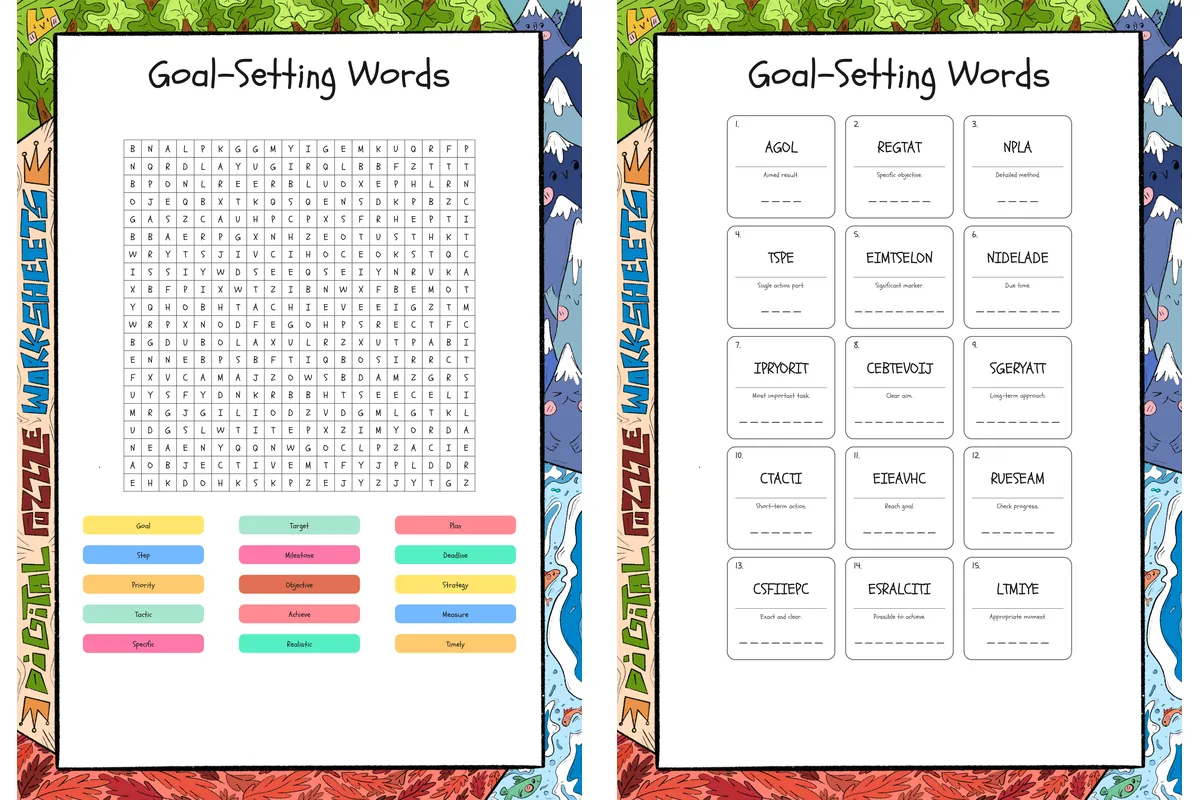
This goal-setting vocabulary set uses the same 15 words across a word search, scramble and crossword: goal, target, plan, step, milestone, deadline, priority, objective, strategy, tactic, achieve, measure, specific, realistic and timely.
Each puzzle comes in a two-page PDF with its solution, for six pages total. The scramble and crossword use short definition clues. Use a glossary or partner support according to students’ vocabulary readiness.
Related resources
More resources teachers may find useful
24 related resources were found using this product's title, contributor, categories and tags.


In the classroom
Teaching tips & learning objectives

Learning objectives
Match a plain-language definition to the goal-setting word it describes, such as "Short-term action" to tactic and "Due time" to deadline
Spell fifteen goal-setting terms correctly, with the crossword grid and the scramble dashes both fixing the letter count
Distinguish terms that sit close together in meaning - goal, target and objective; step, tactic and strategy - by the specific clue attached to each

Teaching tips
All three puzzles use the same fifteen words, so they can be run in sequence across a week with the difficulty falling as the words become familiar
The word search is the gentlest of the three because the words are printed underneath; the scramble is next, since the definition stays visible; the crossword is hardest, giving only the clue
Because each definition is a single short phrase, the crossword clue list doubles as a glossary to display while students work

Skills covered
Goal-setting vocabulary - students meet fifteen terms of planning language, from milestone and deadline to objective, strategy and tactic.
Spelling and letter counting - the crossword grid and the scramble's answer dashes both fix the length of each word before it is written.
Visual word recognition - the word search requires spotting all fifteen words inside a twenty-by-twenty grid of letters.
Good to know
Questions teachers ask about this resource
Which words do the three puzzles use?
The same fifteen in every puzzle: goal, target, plan, step, milestone, deadline, priority, objective, strategy, tactic, achieve, measure, specific, realistic and timely. Nothing appears in one puzzle that is missing from the others.
Are the clues the same across the puzzles?
Between the crossword and the scramble, yes - both use the same one-line definitions, so "Most important task" leads to priority in either. The word search takes a different route and simply lists the fifteen words below the grid.
Why does the crossword show clue 13 twice?
Because two answers start from the same numbered square. Thirteen across is step, from "Single action part", and thirteen down is strategy, from "Long-term approach"; the completed grid shows the two words sharing their opening S.

No reviews yet
Downloaded this resource? Tell other teachers how it went.
Curriculum
Standards, concepts & topics
Standards
 Standards
- L.5.6
Core concepts
 Core concepts
Vocabulary
Goal setting
Word puzzles
Spelling
 Topics
Explore more
Categories this resource belongs to
Explore related searches
More to explore
You may also like


