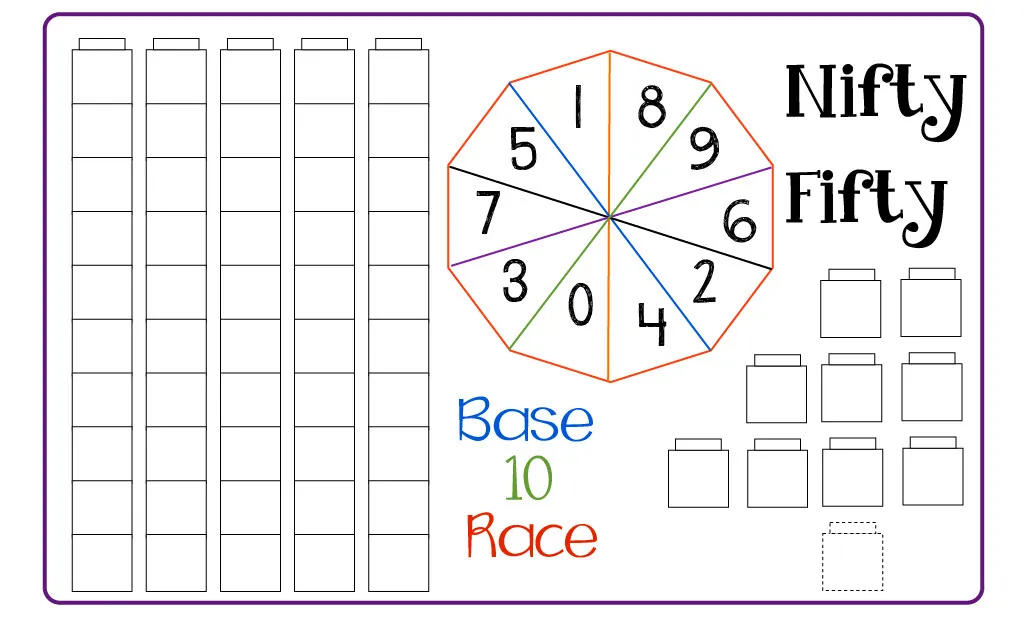
Nifty Fifty Base 10 Race Game
- Grades
- Grades 1–2
- Pages
- 3
- File type
- Preparation
- Print ready


- Subject
- Math, Place Value
- Topic
- Base ten, Exchange ten ones
- Resource types
- Games
- Preparation
- Print ready
- Standards
- 1.NBT.B.2
Product description
From the author
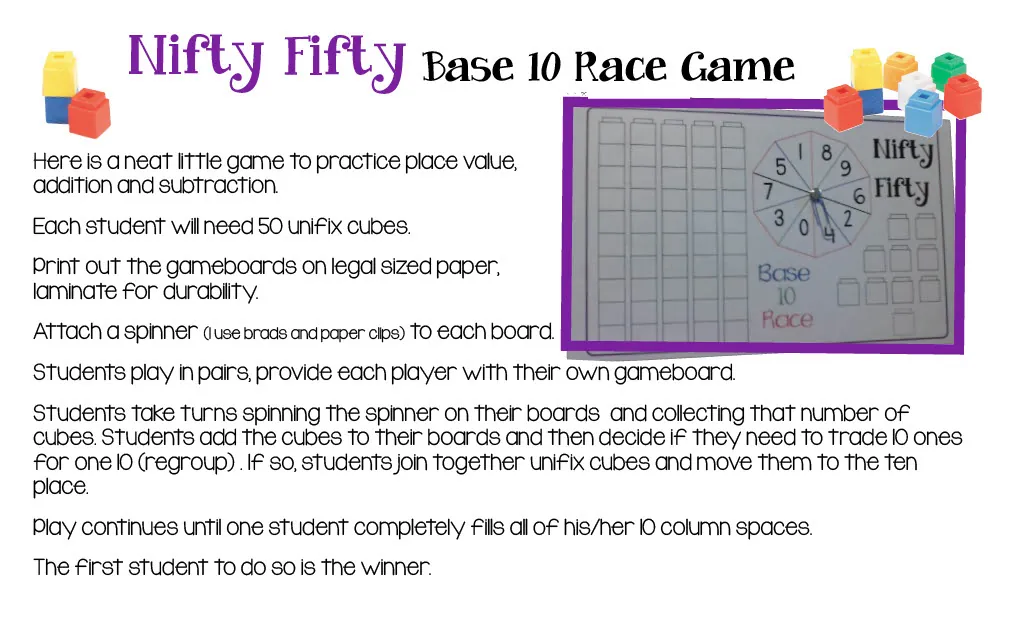
This resource is a Nifty Fifty Base 10 Race Game.
Here is a neat little game to practice place value, addition and subtraction. Each student will need 50 unifix cubes.
Students will play in pairs, so you will provide each player with their own game-board.
Directions are included for how to play the game.
Students will love this activity as they practice critical math skills.
Related resources
More resources teachers may find useful
24 related resources were found using this product's title, contributor, categories and tags.


In the classroom
Teaching tips & learning objectives

Learning objectives
Regroup ten ones into one ten while building a number toward 50 with unifix cubes
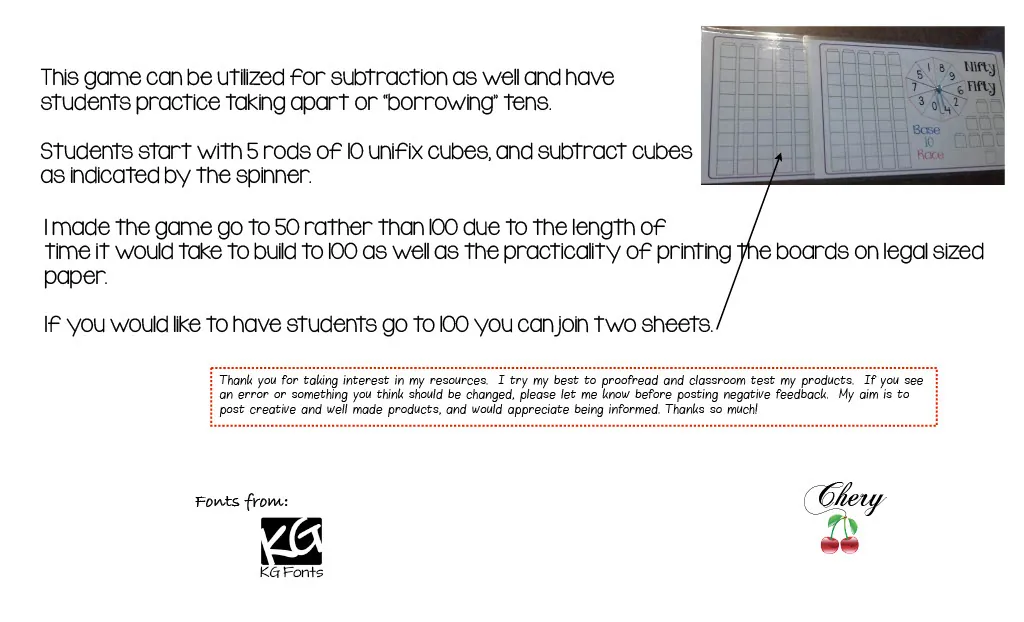
Decompose tens in the subtraction variant, starting from five rods of ten and removing cubes as the spinner directs
Add single-digit spinner amounts to a running cube total on a tens-and-ones board

Teaching tips
Print the gameboards on legal-sized paper and laminate them for durability, as the directions specify
Assemble each spinner with a brad and paper clip - the author's own method - before introducing the game
Once students are fluent racing to 50, join two sheets per player to extend the same rules to 100, per the author's note

Skills covered
Place-value regrouping - players decide each turn whether to trade ten ones for one ten and physically join the cubes and move them to the tens place.
Addition within 50 - every spin adds a single-digit number of cubes to the board's running total.
Partner game play - each player manages their own board and spinner, taking turns in a race to fill the tens column.
Good to know
Questions teachers ask about this resource
Why does the race stop at 50 rather than 100?
The author explains the choice directly: building to 100 takes too long for a classroom round, and 50 fits practically on a legal-sized printed board. Joining two sheets turns it into a race to 100 when you want the longer game.
How does the subtraction version of the game work?
Players begin with five rods of ten unifix cubes - a full board of 50 - and subtract the number of cubes the spinner shows each turn, breaking rods apart to practise taking apart or borrowing tens.

No reviews yet
Downloaded this resource? Tell other teachers how it went.
Curriculum
Standards, concepts & topics
Standards
 Standards
- 1.NBT.B.2
Core concepts
 Core concepts
Place value
Regrouping
Base ten
Addition and subtraction
 Topics
Explore more
Categories this resource belongs to
Explore related searches
More to explore
You may also like