



Othello Act 4, Scene 1 | Double Entry Journals
- Grades
- Grades 9–12
- Pages
- 2
- File type
- Multiple File Types
- Editable
- Yes


- Subject
- ELA, Literature
- Topic
- Othello, Double entry journal
- Resource types
- Worksheets
- Editable
- Yes
- Standards
- CCSS.RL.9.1
Product description
From the author
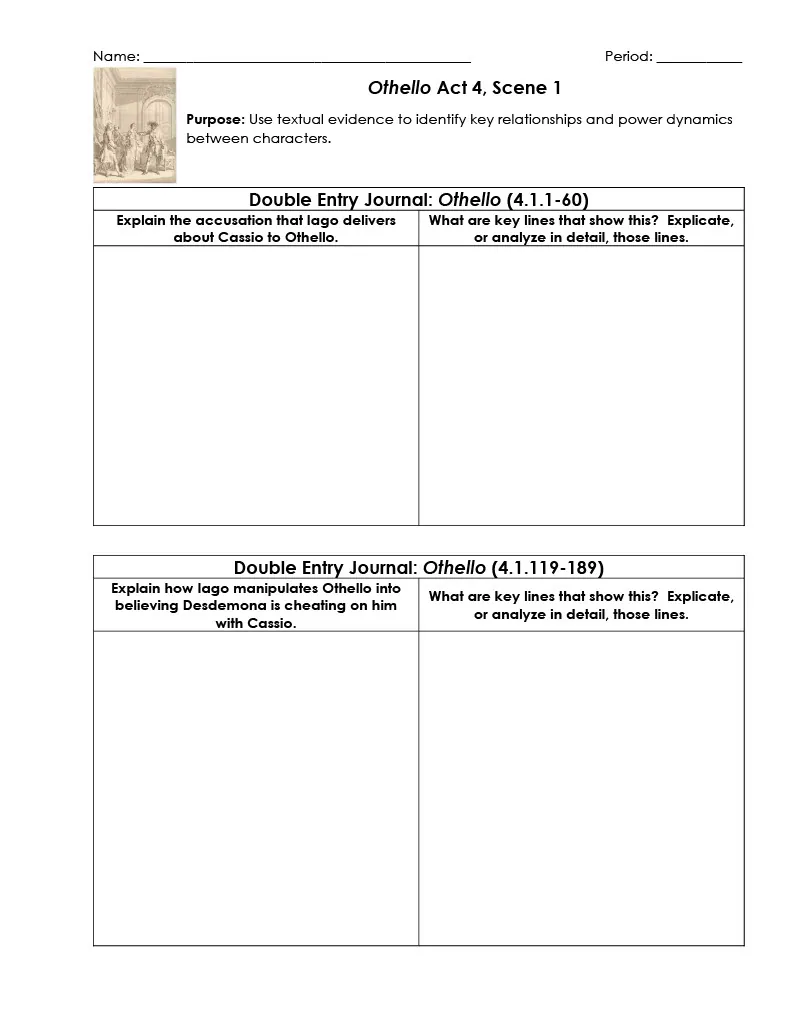
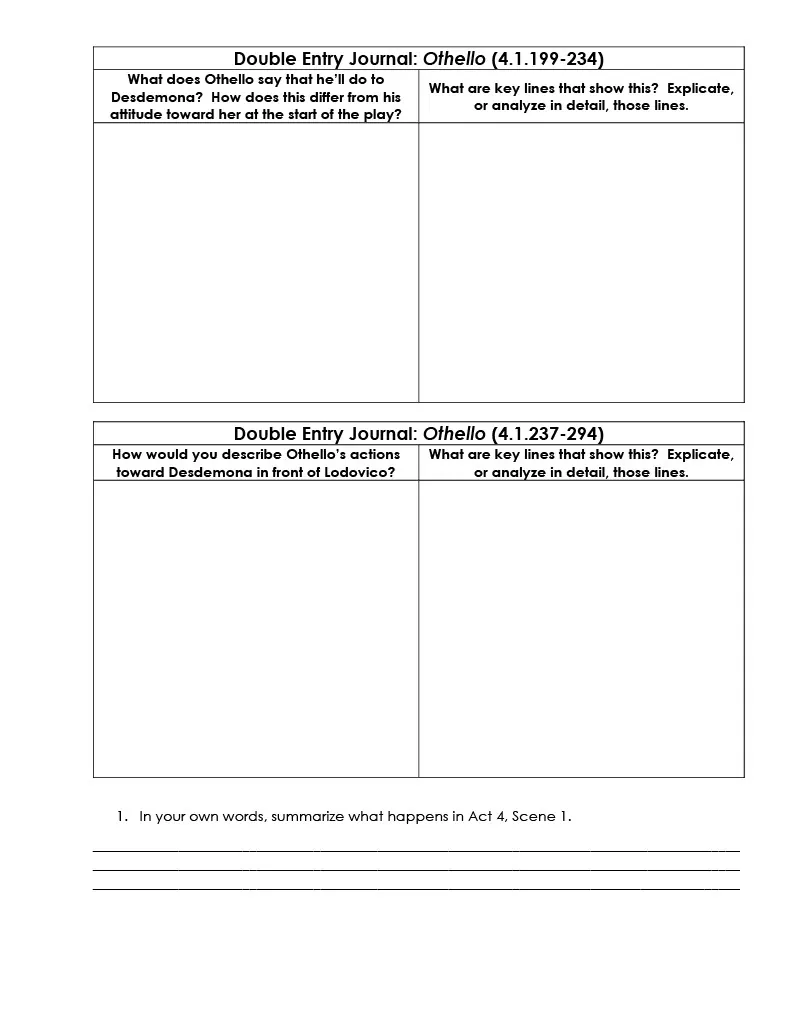
This two-page Othello Act 4, Scene 1 double-entry journal pairs four assigned line ranges with questions about character relationships and Iago’s manipulation. Students answer each prompt and quote and explain supporting lines, then summarize the scene.
The download includes a printable PDF and editable Word version. Supply the play separately and check line numbering against your edition. Use the entries at reading pauses or after the scene.
Related resources
More resources teachers may find useful
24 related resources were found using this product's title, contributor, categories and tags.



In the classroom
Teaching tips & learning objectives

Learning objectives
Students will use textual evidence to identify key relationships and power dynamics between characters in Othello Act 4, Scene 1.
Students will explicate specific lines of Shakespearean text to support an interpretive claim.
Students will summarize the events of Act 4, Scene 1 in their own words.

Teaching tips
Assign each double-entry box to correspond with a specific in-class reading stopping point, since the four boxes are already organized by consecutive line ranges (4.1.1-60, 4.1.119-189, 4.1.199-234, 4.1.237-294).
Model the 'explicate' expectation with the first box as a class, since the worksheet distinguishes between simply quoting a line and analyzing it in detail.
Use the final summary prompt as a quick formative check that students followed the scene's plot progression across all four journal entries.

Skills covered
Textual evidence analysis — students cite and explicate specific line ranges from Othello to support an interpretive claim about character relationships.
Close reading of Shakespearean dialogue — students trace how Iago's manipulation escalates Othello's suspicion of Desdemona across the scene.
Scene summarization — students condense the plot events of Act 4, Scene 1 into their own words.
Good to know
Questions teachers ask about this resource
Is the scene text included?
No. Use your own copy of Othello. The journal supplies line references, which should be checked against the edition your class uses.

No reviews yet
Downloaded this resource? Tell other teachers how it went.
Curriculum
Standards, concepts & topics
Standards
 Standards
- CCSS.RL.9.1 — Cite strong and thorough textual evidence to support analysis of what the text says explicitly as well as inferences drawn from the text.
Core concepts
 Core concepts
Close reading
Textual evidence
Othello
Shakespeare
 Topics
Explore more
Categories this resource belongs to
Explore related searches
More to explore
You may also like


