Personality Portfolio Project
- Grades
- High School, Adult Education
- Pages
- 3
- File type
- Microsoft Word
- Editable
- Yes


- Subject
- Social Studies, Psychology
- Topic
- Personality portfolio, Psychology project
- Resource types
- Projects
- Editable
- Yes
Product description
From the author
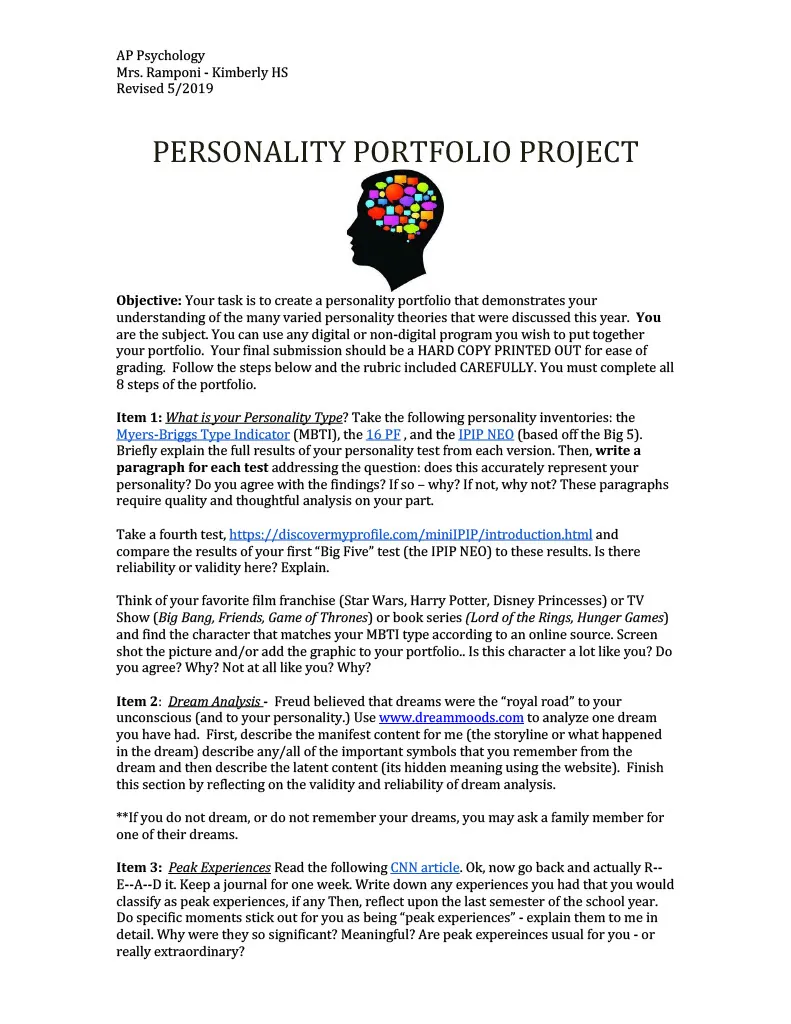
This resource is a Personality Portfolio Project.
Objective:
- Students will create a personality portfolio that demonstrates their understanding of the many varied personality theories that were discussed this year.
- The student is the subject.
- They can use any digital or non-digital program they wish to put together their portfolio.
- Their final submission should be a HARD COPY PRINTED OUT for ease of grading.
There are steps for students to follow and a rubric is included to assist students.
The brief numbers Items 1–7, divides Item 5 into two parts and adds a return to Item 1; clarify those requirements before assigning it.
Related resources
More resources teachers may find useful
24 related resources were found using this product's title, contributor, categories and tags.

In the classroom
Teaching tips & learning objectives

Learning objectives
Compare personality-theory approaches using the named inventories as classroom examples
Explain concepts such as manifest and latent dream content through fictional or teacher-provided examples when preferred
Critically discuss what interpretations and evidence can and cannot establish without treating the activities as diagnosis

Teaching tips
Assign the '30 Slips' item early, since it requires students to collect 30 peer/family descriptions before analyzing them, and needs lead time outside class.
Score the project with the included rubric, which weights Item 1 at 15 points, the remaining six content items at 5 points each, and mechanics plus format/creativity at 5 points each, for 55 points total.
Require the printed hard-copy submission specified in the assignment, since it is explicitly framed as easier to grade than a digital file.

Skills covered
Critical comparison of personality theories
Interpretation of example material, with fictional alternatives to personal disclosures
Supporting and questioning a theory-based interpretation using specific examples
Good to know
Questions teachers ask about this resource
How can the portfolio be adapted when a task asks for private information?
Offer a fictional or teacher-provided example in place of personal dreams, family details, or peer judgments. Present these as adaptations to the assignment, and assess students’ understanding of the theory rather than how much they disclose.

No reviews yet
Downloaded this resource? Tell other teachers how it went.
Resource details
Concepts & topics
Core concepts
 Core concepts
Personality theories
Projective testing
Trait reliability and validity
Self-assessment
 Topics
Explore more
Categories this resource belongs to
Explore related searches
More to explore
You may also like